AI CRM for Logistics. A freight broker CRM that fills itself
AI CRM is a freight broker CRM that fills itself: every shipper, carrier and consignee who calls, chats, e-mails or fills a form becomes a contact, with the whole story on one record. Deals open when a shipper asks for a quote and move as he acts, while your brokers keep the decisions a person should make.
TRY AI CRM FREENo credit card · Ready in 2 minutesReady to buy? See plans & pricing ›
7 days free · per company, never per seat · nothing to install
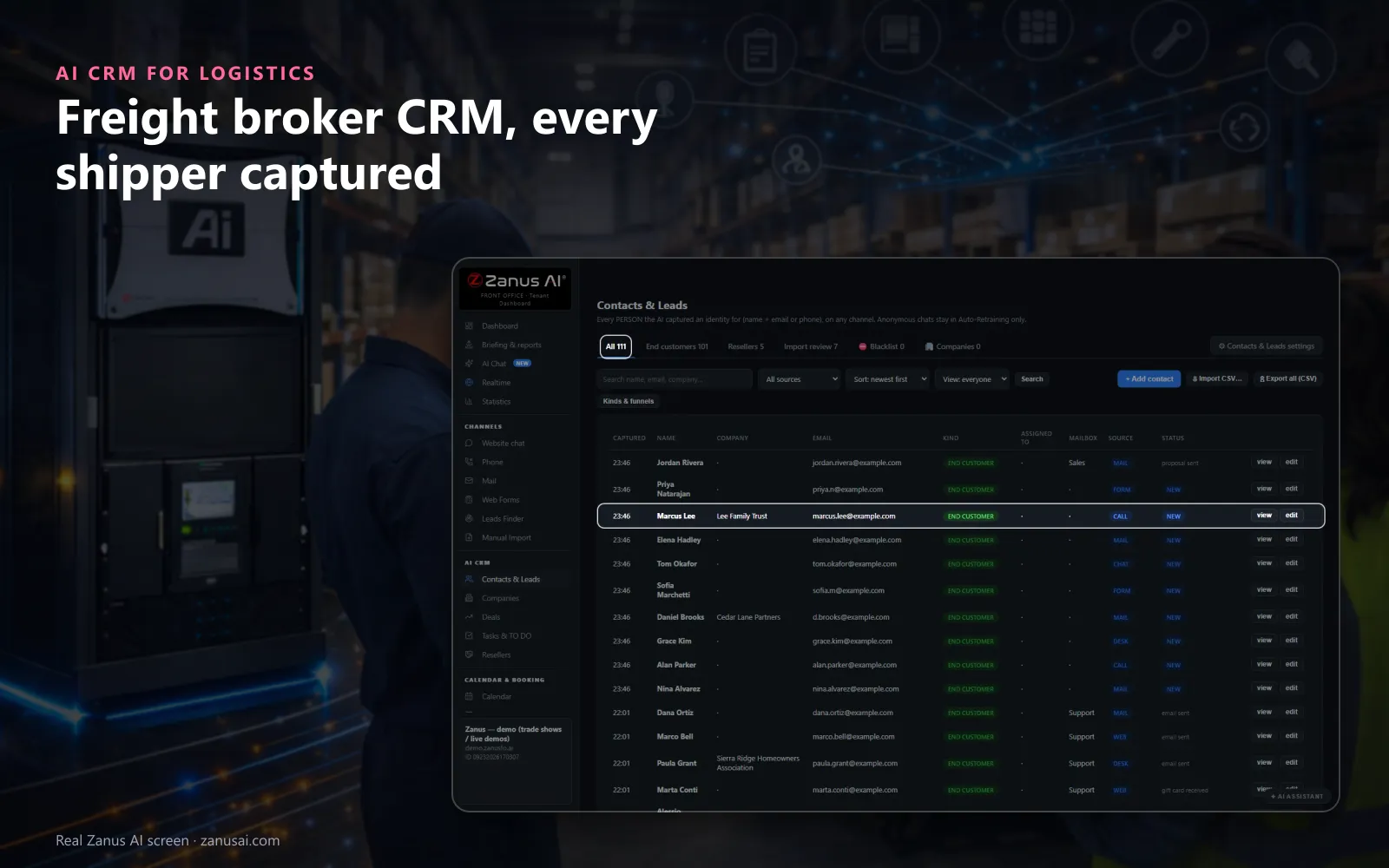
Contacts & Leads
Everyone who left a name with an e-mail or a phone on a call, a chat, a form or a mail, with where they came from and where they stand.
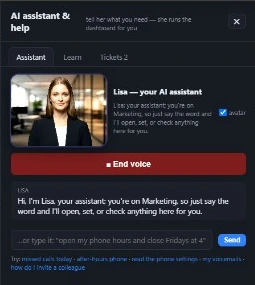 Easy setupSet up everything just by talking to Lisa AISee how ›
You“Add a lane field and an equipment field to every deal.”
Lisa“Every deal now carries two fields of your own: Lane as text and Equipment as a choice of dry van, reefer or flatbed. Apply?”
You talk. Lisa sets it up. Applied only on your yes.
How Logistics use it
A shipper who asked for rates on three lanes last week comes first under READY TO BUY, with the reason written under his name.
Before calling a plant's traffic manager, the broker presses Brief me and reads one page: what was asked, sent and promised.
A quoted deal silent for a week shows a falling health score, and the tooltip on it says why the score moved.
REAL AI - the whole Front Office is AI, not old software with an AI button.
What’s included
- Every person and company qualified from the conversations, health score with its WHY, gauges, photo, LinkedIn; nothing typed by your staff
- Deals with stages, probability and expected close, created and moved by the events themselves: lead qualified → demo → quote → won
- Tasks and to-dos assigned to your people, from the AI or by hand, with reminders; calls, meetings and notes logged on the record
- Your own fields on contacts, companies and deals; saved views; tags and segments; record ownership
- Pipeline forecast weighted by probability; win / loss review; "ask your pipeline" in plain language
- Basic contacts and companies stay in every Front Office, this item adds the qualification, the pipeline and the forecast
Add it to any contact channel — AI Phone, AI Webchat, AI E-mail or AI Web Forms — or get it inside a solution · See pricing › · Per company, never per seat.
Everything AI CRM does, for every business ›
Works withAI PhoneAI WebchatAI Web FormsAI DemoAI QuotingAI BookingAI Follow-upAI TicketsAI Returns & WarrantyAI Calls TranscriptsAI Marketing
What it does
What a freight broker CRM does without being asked
Most CRMs make brokerage sales teams type after every call. This one is fed by the front office itself, so your sales team finds the shipper record written while the conversation happens.
Shippers captured from every channel
A traffic manager who leaves a name with an e-mail or a phone on a call, a chat, a web form or a mail becomes a contact by himself, with the source kept on his row.
The whole story on one record
Quotes, files, deals, tasks and a timeline of every call, chat, e-mail and form, newest first, so a broker sees the account's history before he dials the shipper.
Lead scoring before you call
The AI verifies a new shipper's e-mail without sending, visits his company website and scores competitor risk, budget and buyer type; your broker can overrule each verdict.
Health with its reason
Each shipper carries a health score from 0 to 100, and its tooltip says why it moved: a quote opened, a reply received, or weeks without a word from the account.
Deals that keep themselves
A deal opens when a shipper asks for a quote or a demo and moves forward as he opens the quote, watches the demo or pays; only a person marks it lost.
Brief me before the call
One press and Lisa writes a one-page brief from the record: who the shipper is, which lanes he asked about, what your desk sent him and what to say next.
Contacts
Logistics CRM contacts: shippers, carriers and consignees on one record
Contacts & Leads lists every person the front office identified, with the information each one gave, split by the kinds of contact a brokerage meets across the supply chain.
Kinds of contact you name
Shipper, carrier, consignee, freight agent or customs broker: you name the kinds your freight brokerage needs, and each person can belong to several of the 39 types of business.
Companies formed from domains
People writing from verified addresses at the same shipper's domain become one company by themselves: the traffic manager, the receiving supervisor and the plant buyer side by side.
Roles read from questions
From what each person at a shipper asked, the AI infers the economic buyer, the technical evaluator or the champion, and shows that role beside health and engagement.
The empty chair
When nobody at a shipper has talked to the person who signs the freight budget, the company's health line says so, so your broker knows whom to reach before the quote.
Written in his own hours
The time zone comes from the country, so the AI's e-mails to a shipping manager in Monterrey wait for 7:00 to 19:00 his time, and lead notes tell it what to say.
The source on every row
Mail, form, call, chat, desk or web: every shipper shows where he came from and his status, from NEW to quote sent, quote opened and purchased.
Pipeline
A transportation CRM pipeline that moves by itself
Here pipeline management follows the shipper, not the reminder on a broker's desk: in the sales pipeline, a quote asked for opens the deal, and a quote opened or paid moves it on.
A board by stage
New, Qualified, Demo, Quoted, Negotiation, Won and Lost, as a board or a sortable list, filtered by broker and saved as a view of your own for the Monday sales meeting.
Stages in your words
Keep the deal stages as shipped or rename them to the way your brokerage sells, such as Lane review or Trial loads, and add fields of your own to every deal.
The weighted forecast
Open deals, the pipeline total and a forecast above the board, in which each amount is weighed by a probability that blends the stage with the shipper's health.
Every move written down
The stage history keeps when a shipper deal moved, the move itself, who made it and why, and the machine never moves a deal backwards.
Won, lost and why
Won closes the sale and Lost asks for the reason; the win/loss report then shows the lost reasons, the stage where freight deals stall and the days spent in each stage.
Quotes on the deal
With AI Quoting, a quote sent, opened or paid moves the shipper's status and the deal's stage by itself, and the quote sits one click away from the deal.
The week
A CRM for freight brokers through a working week
Monday, first coffee
Sort by READY TO BUY: the shippers who opened a quote, replied or asked for rates in the last fourteen days come first, with the buying signal written under each name.
Tuesday, a big account
Ask Lisa to brief you on a food manufacturer before the call and read one page: the lanes asked about, the quotes sent, the open deal and the next thing to say.
Thursday, the quiet ones
Ask which quoted deals have been silent for a week; the list comes back with each shipper's health and the follow-up plan already running for him.
Friday, a stop request
A shipper asks for no more e-mails. Ask Lisa to pause the marketing automation for him, and each step planned for that shipper waits until you resume it; a reply typed by your broker still goes out.
What it is not
Freight broker CRM software, not a TMS or a load board
A logistics and transportation business runs on several systems. This is the one that keeps the shipper relationship; the others keep the loads, and nothing here pretends otherwise.
No load board
It does not post loads, search for trucks or match capacity; the shippers and carriers on the record are the ones who already called, chatted, wrote or filled a form.
No carrier vetting
Operating authority, insurance and safety checks and carrier onboarding packets stay with the tools and people your brokerage uses for them today.
Not a TMS
Tenders, rate confirmations, dispatch and load tracking live in your transportation management system; the CRM keeps the conversations, the quotes and the deals around them.
One record for the front office
Every Front Office module you add, phone, chat, mail, forms, quoting and follow-up, writes onto the same shipper, so there is no second contact database to keep in step.
Compared
Freight CRM compared with a spreadsheet and a CRM you fill in
Six moments of shipper sales, and what each one looks like with the tools brokerages usually weigh against an AI CRM.
| What the freight sales desk needs | A spreadsheet | A CRM you fill in | Separate phone, chat and mail tools | AI CRM |
|---|---|---|---|---|
| A new shipper calls for rates | Typed in later, if at all | A broker types the contact | The call log knows, the CRM does not | A contact by itself:: with the source, the transcript and an open deal |
| Which shippers to call today | Sorted from memory | Filtered by the activity someone typed | Spread across three inboxes | READY TO BUY first:: the buying signal under each name |
| A shipper opens the quote | Nobody knows | Updated when someone notices | Seen in the quoting tool only | The deal moves itself:: from Quoted toward Negotiation as he acts |
| Four people at one shipper | One row per name | Linked by hand | Each thread on its own | One company record:: roles inferred and the empty chair shown |
| An account goes quiet | Noticed months later | A report someone has to run | No single view of it | Health with its reason:: silent quoted deals listed when you ask |
| Five minutes before the call | Scroll the sheet | Read the notes field | Search the inbox | Brief me:: one page written from the whole story |
Set-up
Set up your freight broker CRM in 2 minutes
Nothing to migrate
From the first call, chat, form or mail that gives a name and an e-mail, shippers land in Contacts & Leads; your old spreadsheet waits in Import review.
Your kinds and trades
Tell Lisa you sell to shippers, work with carriers and agents, and which industries you haul for; she fills the settings and shows the change before applying it.
Your stages and fields
Rename the deal stages to your sales process and add the fields freight needs, such as lane, equipment, commodity and weekly loads, as text, number, date or choice.
Seven days on your accounts
Run it free for 7 days with no credit card, then read every shipper it captured and every deal it opened during your trial week.
Questions & answers
Questions freight brokers ask about a CRM
What is a freight broker CRM?
A freight broker CRM is customer relationship management software built around shipper sales: the accounts, their contacts, the quotes asked for and the follow-ups. Zanus AI CRM is logistics CRM software that fills itself from your phone, chat, mail and forms, keeps every conversation on one record and opens a deal the first time a shipper asks for a quote.
What is the best CRM for a freight broker?
The one your brokers never have to feed. Look for these CRM features: shippers captured from every channel, the whole story on one record, a pipeline that moves as shippers act, follow-up written from the history and a price per company rather than per seat. AI CRM does those five, and the 7-day free trial runs on your own shippers.
Is AI CRM a TMS or a load board?
No. It keeps the customer relationships of your front office: shippers, carriers and their contacts, the calls, chats, e-mails and forms, the quotes and the deals. Loads, tenders, rate confirmations, carrier packets and load tracking stay in the transportation management system and the load boards your operations already use.
Can the CRM keep shippers and carriers apart?
Yes. You name the kinds of contact your brokerage needs, such as shipper, carrier, consignee or agent, and each person can carry several types of business. Tabs split end customers, resellers, the import review, the blacklist and the companies, and the toolbar finds anyone by name, e-mail, company or source.
Does it vet carriers or collect onboarding packets?
No. AI CRM does not check operating authority, insurance or safety records, and it does not collect carrier packets. A carrier who calls or writes becomes a contact with the conversation on his record, so your team sees who he is and what he asked before anyone calls him back.
Can it record and transcribe broker calls?
Yes, with AI Phone. Every call the AI answers lands on the contact's timeline with its transcript and summary, and with call recording switched on each call keeps its recording in the call register. Calls your brokers and customer service reps take themselves are written too once you add AI Calls Transcripts. Recording is off as shipped.
How are lanes, equipment and volumes tracked?
As fields of your own. Add text, number, date or choice fields to contacts, companies and deals, such as the lane, the equipment type or the weekly loads, and they sit beside the stage, the amount and the probability in the board and in the list views you save.
Can we import our shipper list from a spreadsheet?
Yes. A CSV import lands in Import review, where each lead is accepted one by one, and imported leads are never auto-called. Exports of customer data are reserved for Managers, and every export is logged with the name of the person who ran it.
Is AI going to replace freight brokers?
Not this AI. AI CRM does the typing: it captures contacts, writes the timeline, opens deals and scores each shipper's health. The relationship, the rate and the decision to call a deal lost stay with your brokers; the machine never moves a deal back and never marks one lost.
How does the CRM forecast shipper revenue?
Over the shipper deals board you read the open deals, the pipeline total and a weighted forecast, where each amount is multiplied by a probability mixing the stage and the shipper's health score. The win/loss report then reads the amounts, the lost reasons, the stage where deals stop and the days spent in each stage.
How much does a freight broker CRM cost?
AI CRM is priced per company, never per user per month or per seat, so your brokers, account managers and sales reps all work from one subscription. Pick the modules your brokerage needs and add others later; the plans are on the pricing page. A 7-day trial of the whole Front Office asks for no credit card.
Can freight forwarders and 3PLs use it too?
Yes. Forwarders, 3PLs and asset carriers sell the way brokers do, which is why logistics companies of every kind fit the same record: importers and shippers ask, quotes go out, accounts need follow-up. Name your own kinds of contact, add fields such as origin port or service type, and the record fills itself from the same phone, chat, mail and forms.
Keep exploring
Where next?
Start with the one thing you need. Add more anytime by asking Lisa.
AI Front Office for Logistics ›
Easy setup
Answers & books
Sells
Helps your team
Included
Award-winning AI
Winner at CES 2026, ISE 2026 and TMCnet Enterprise AI Product of the Year.
REAL AI - the whole Front Office is AI, not old software with an AI button.
Awards & trade shows ›


Give Lisa your website.
She sets up your business in 2 minutes.
Other software makes you learn it. Zanus AI learns your business.
Try it free on your own business — no credit card, per company, never per seat.
Ready to buy? See plans & pricing ›
Or call +1 (954) 736-3939 — the AI answers.