AI CRM for MedTech. The medical device CRM that fills itself.
AI CRM is a medical device CRM that fills itself from your Front Office: every hospital buyer, biomed engineer, lab manager and distributor who calls, writes, chats or fills a form becomes a contact, grouped under their hospital, clinic or lab with the whole story on one record. Deals open on the first quote or evaluation request and move as the account acts.
TRY AI CRM FREENo credit card · Ready in 2 minutesReady to buy? See plans & pricing ›
7 days free · per company, never per seat · nothing to install
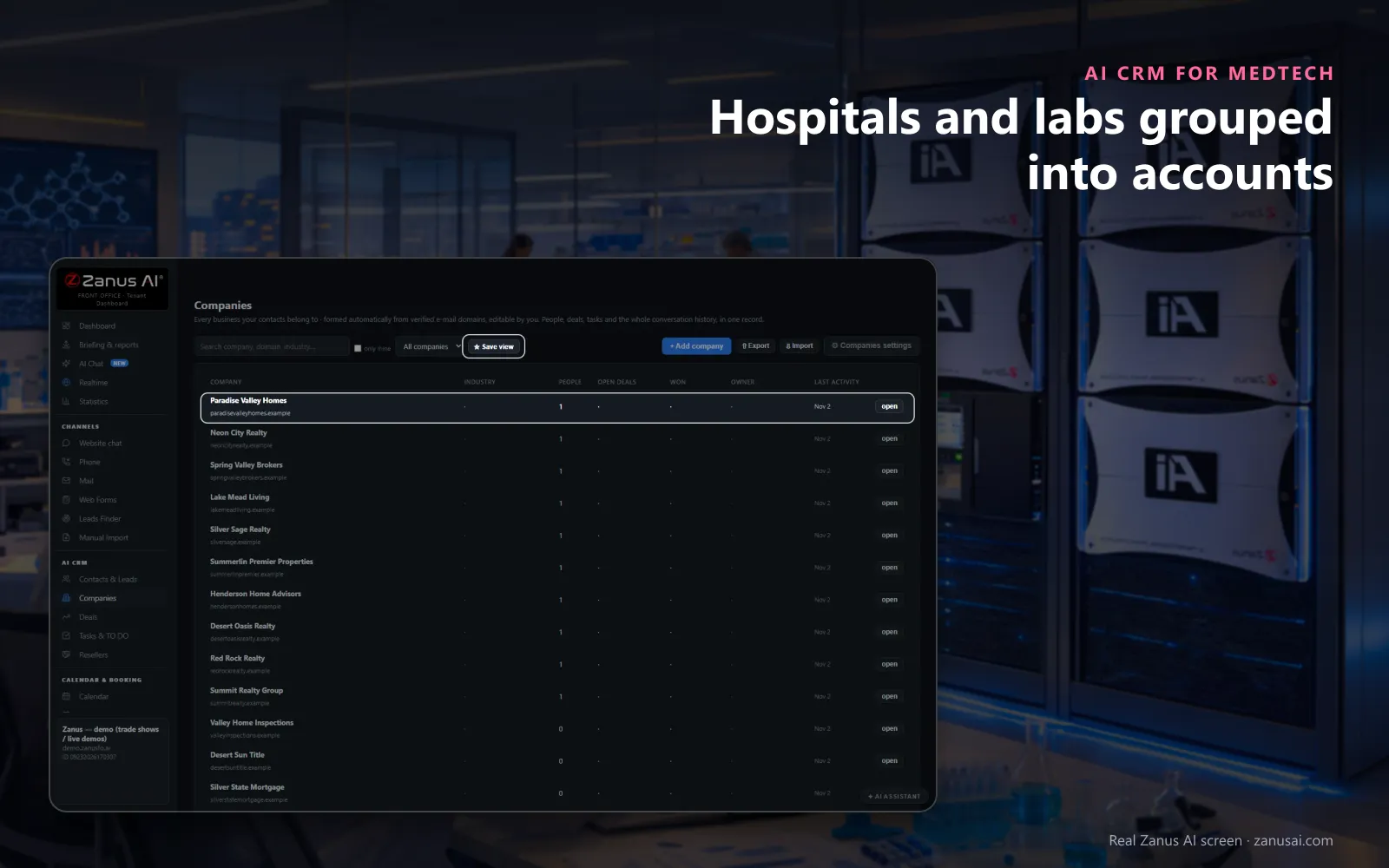
Hospital accounts
Accounts form from verified business e-mail domains, with each hospital's people, deals, tasks and conversations together on one record.
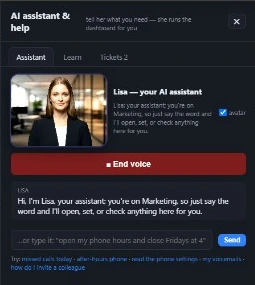 Easy setupSet up everything just by talking to Lisa AISee how ›
You“Add a territory field to companies and deals, with North, South, East and West.”
Lisa“I'm adding a Territory choice field to companies and deals, with North, South, East and West. Apply?”
You talk. Lisa sets it up. Applied only on your yes.
How MedTech use it
Purchasing, biomed and the cath lab director of one hospital write in over a month; their verified addresses group them under one account.
Before meeting a value analysis committee, the rep presses Brief me and reads one page on what each member asked and was sent.
A capital quote is opened twice but not accepted; the deal sits in Quoted with the buyer's health score and the reason it moved.
REAL AI - the whole Front Office is AI, not old software with an AI button.
What’s included
- Every person and company qualified from the conversations, health score with its WHY, gauges, photo, LinkedIn; nothing typed by your staff
- Deals with stages, probability and expected close, created and moved by the events themselves: lead qualified → demo → quote → won
- Tasks and to-dos assigned to your people, from the AI or by hand, with reminders; calls, meetings and notes logged on the record
- Your own fields on contacts, companies and deals; saved views; tags and segments; record ownership
- Pipeline forecast weighted by probability; win / loss review; "ask your pipeline" in plain language
- Basic contacts and companies stay in every Front Office, this item adds the qualification, the pipeline and the forecast
Add it to any contact channel — AI Phone, AI Webchat, AI E-mail or AI Web Forms — or get it inside a solution · See pricing › · Per company, never per seat.
Everything AI CRM does, for every business ›
Works withAI PhoneAI WebchatAI Web FormsAI DemoAI QuotingAI BookingAI Follow-upAI TicketsAI Returns & WarrantyAI Calls TranscriptsAI Marketing
One record per account
What a medical device CRM keeps without being asked
Medical device reps spend their days in hospitals, not at a keyboard, so a CRM medical devices teams keep current has to write itself: here the phone, the chat, the mail, the forms and the demos write the record as they work.
Every hospital contact, from every channel
A buyer who calls, a biomed engineer who writes, a lab manager who fills a form or a clinician who asks for a demo becomes a contact by itself, with the source kept on the row and the status beside it.
The account's whole story
Quotes, files, deals, tasks and a timeline of every event on every channel sit on one record, newest first, so nobody pieces together a hospital's history from inboxes and handwritten notes.
Lead scoring before the first call
The AI verifies the e-mail without sending, visits the website and scores competitor risk, budget and buyer type, so a rival filling your quote form stands out. You can overrule every verdict.
Health with its reason
Each contact carries a health score from 0 to 100, and the tooltip says why it moved, so a rep sees at a glance which surgery center has gone cold and why.
Deals that keep themselves
A deal opens on the first sales signal, a quote or an evaluation request, and moves as the hospital watches the demo, opens the quote or pays. Only one of your reps can mark a hospital deal lost; the system never does.
Brief me before every visit
One press on Brief me and Lisa writes a one-page brief from the story: who the contact is, what was asked, what was sent and what to say next, so reps walk into the account ready to close deals instead of rereading old mail.
Accounts and committees
A CRM for medical device companies that maps the buying committee
Hospitals rarely buy a device on one person's word: in complex sales like these, purchasing, clinical engineering, the department head and the value analysis committee all weigh in.
Accounts formed for you
People with a verified address at one hospital, clinic, lab or distributor domain become one company record, and two records are merged when a health system writes from two domains.
Roles read from questions
Economic buyer, technical evaluator or champion: each person's role is inferred from what they asked, so purchasing's questions about terms read differently from biomed's questions about service intervals.
The empty chair
When nobody has talked to the economic buyer yet, the company's health line says so, and the rep knows whom to reach before the capital quote goes to committee.
One timeline per account
The people, the deals, the tasks and the combined timeline of everyone at the hospital sit in one record, with a deal plan for the account beside them.
Pipeline
A CRM for medical device sales with a pipeline that moves itself
Capital systems, consumables agreements and service contracts share one sales pipeline in the CRM, each deal with its owner and its stage, moved forward by what the hospital does.
Board or list
New, Qualified, Demo, Quoted, Negotiation, Won and Lost as a board or a sortable list, filtered by owner and saved as each rep's own view.
Forecast at a glance
Open deals, the pipeline and a weighted forecast sit above the board: each amount times a probability that blends the stage with the contact's health score, ready before quarter-end.
Every move written down
Each deal's stage history records when it moved, the move, who made it and why; with every data export logged by its author, those are the audit trails your managers read. Automatic moves only go forward, and no automatic step closes a deal as lost.
Why deals stall
The win and loss report reads the amounts, the lost reasons, the stage where deals stop and the days spent in each, so you see where your sales process slows down on a long hospital decision.
A rep's week
Moments in a medical device rep's week that the CRM handles
For device sales teams on the road, these are the moments in a week when the record is already there and nobody has to type it.
Monday before the first visit
Sort by READY TO BUY and the hospitals that opened a quote, watched a demo or replied in the last two weeks come first, with the reason under each name.
In the surgery center car park
Ask Lisa for a brief on the account and read one page: what the OR manager asked, what was sent, the open deal and the next thing to say.
A quote gone quiet
Ask which quoted deals have been silent for a week, and the list comes back with each contact's health and the follow-up plan running for them.
After a value analysis meeting
The meeting lands on the account's timeline, and the next task sits in the operators' TO DO desk with the contact's local time on its line.
A clinic asks to stop mailings
Tell Lisa to pause all email marketing to that contact. Every scheduled step holds until you resume, and a reply your rep writes by hand still goes out.
A new rep takes over accounts
The accounts, deals and timelines are already on the record, so the new rep reads each hospital's story instead of asking the colleague who left.
Who works in it
One medical device CRM for both sales and service
The record serves both sales and service, so the people who sell a system and the people who keep it running read the same hospital story.
Field sales teams
Field sales teams ask Lisa for a one-page brief before each hospital visit, and the calls, mails and quotes that follow the visit land on the account by themselves.
Inside sales and the order desk
Inside sales and the order desk work from READY TO BUY, where accounts that opened a quote or watched a demo come first, and each quote sent moves its deal as the buyer acts.
Customer service and support
Customer service and customer support write onto the same contact as sales, so a biomed engineer calling about a ticket reaches someone who can see the open deal.
Field service engineers
Field service engineers find each hospital's calls, mails and tickets on its record, and a note they add there is read by your sales reps before the next visit.
Compared
Medical device CRM compared with a spreadsheet and a CRM you fill in
Most device companies run their accounts on tools like a spreadsheet, a CRM the reps fill in by hand, or separate phone, chat and mail tools; here is how they compare for the sales team.
| What the sales team needs | A spreadsheet | A CRM you fill in | Separate phone, chat and mail tools | AI CRM |
|---|---|---|---|---|
| New hospital contacts | Typed in when someone remembers | Typed in by the rep after the visit | Scattered across each tool's own list | Created by themselves: from every call, chat, mail, form and demo request |
| A hospital's buying committee | One row per person, no link between them | Linked by hand, if anyone does it | Not visible anywhere | Grouped under the account: with each person's role read from what they asked |
| Deal stages | A column changed by hand | Moved by the rep, often late | No pipeline at all | Moved as the hospital acts: while a person still decides what is lost |
| Before a visit | Read the rows and the inbox | Read the notes someone left | Search three tools | A one-page brief: written by Lisa from the account's story |
| Price | Free, but nothing fills it | Licensed seat by seat | One bill per tool | Per company: never per seat, with the Front Office beside it |
What it is not
Where a CRM in medical device industry sales stops
Not your order system
Orders, invoices and stock stay where you run them today. The CRM keeps who asked for what, the quotes sent from the Front Office and the next step on each account.
Not your complaint file
A reported fault or patient event is put through to quality on the channel it came in. The CRM shows the conversation took place; the investigation lives with your quality team.
No clinical judgement
The CRM records what clinicians asked and what was sent to them. It never recommends a device for a patient; those questions go to your clinical specialists.
People keep the decisions
The AI captures, scores and moves records; your reps decide lost deals, priorities and what to say, and every automatic step can be paused for one contact.
Set-up
Set up the medical device CRM in 2 minutes
Nothing to type on day one
Every call, chat, form or mail that gives a name with an e-mail or phone lands in Contacts & Leads from the first day, and a CSV import of your accounts waits in Import review.
Your kinds of contact
AI CRM is not a tool built specifically for one trade, so tell Lisa the kinds you use, such as hospital buyer, biomed, clinician and distributor, and the types of business you sell to. She shows the change before you apply it.
Your stages and fields
Keep the deal stages as shipped or rename them, and add fields to contacts, companies and deals, as text, number, date or choice, such as territory or product line.
Free for 7 days
Run it on your own accounts with no credit card and read every contact it captured and every deal it opened when the week ends.
Questions & answers
Medical device CRM questions from sales and service leaders
What is a medical device CRM?
A medical device CRM keeps the accounts a device maker, distributor or other life sciences supplier sells to, hospitals, clinics, surgery centers and labs, with the people who buy, use and approve, and every conversation, quote and deal. AI CRM fills that record by itself from the calls, chats, mails and forms your Front Office handles, so the data entry is not left to your reps.
What is the best CRM for medical device sales?
The one your sales reps never have to feed. Look for accounts built from every channel, buying committees mapped, deals that move as the hospital acts, a brief before each visit and a price per company. AI CRM does all of that with features like Brief me, READY TO BUY and the weighted forecast, and the 7-day free trial runs on your own accounts.
Can the CRM group a hospital's buyer, biomed and clinicians under one account?
Yes. People with a verified business address at the same domain become one company record by themselves, with their people, deals, tasks and one combined timeline. You can edit an account, merge two records and save the views your team uses.
How does it know who decides at a hospital?
From what each person asked. The AI infers the role each one plays, economic buyer, technical evaluator or champion, and shows it next to their health and engagement. When nobody has spoken with the economic buyer yet, the account's health line says so.
Does it track capital equipment and consumables deals?
Every deal sits on one board by stage, New, Qualified, Demo, Quoted, Negotiation, Won and Lost, filtered by owner. Add fields of your own to deals, such as product line or deal type, to tell a capital system from a consumables agreement.
Does a medical device CRM replace our ERP?
No. AI CRM is the record of conversations, quotes, deals and tasks with the people who reach your company. Orders, invoices, stock and inventory management stay in the business systems you run today; the CRM shows who asked what and what happens next.
Does it track product samples, lot numbers or device identifiers?
No. AI CRM keeps the people, accounts, conversations, quotes and deals of your Front Office. Product samples, lot numbers and device tracking by identifier stay in the systems your quality and operations teams already use, and those systems, not the CRM, are where regulatory requirements for such records are handled.
Can the CRM record calls with hospitals?
Yes, with AI Phone. Calls the AI answers land on the account contact's timeline with the transcript and a summary; once recording is switched on, the call register keeps each recording too. Recording starts switched off, and when you turn it on the AI can let hospital callers know the call may be recorded.
How do reps know which accounts to call first?
Sort by READY TO BUY: the people who opened a quote, watched a demo or replied in the last fourteen days come first, each with the reason under the name. A health score from 0 to 100 explains in its tooltip why it moved.
Who can export our account data?
Only Managers. Every export of customer data is logged with its author, and imported lists wait in Import review until someone accepts them one by one, so no hospital list is auto-called or leaves without a trace.
How is AI CRM priced for a device company?
Per company, never per seat, so inside sales, field reps, service teams and the order desk all work in it under one subscription. See the plans on the pricing page; the trial is free for 7 days and asks for no credit card.
How long does it take to set up a CRM for medical device companies?
2 minutes to start, with nothing to migrate first: the CRM fills from the first call, chat, form or mail. Tell Lisa your contact kinds and the types of business you sell to, keep or rename the deal stages, and add the fields your reps need.
Keep exploring
Where next?
Start with the one thing you need. Add more anytime by asking Lisa.
AI Front Office for MedTech ›
Easy setup
Answers & books
Sells
Helps your team
Included
Award-winning AI
Winner at CES 2026, ISE 2026 and TMCnet Enterprise AI Product of the Year.
REAL AI - the whole Front Office is AI, not old software with an AI button.
Awards & trade shows ›


Give Lisa your website.
She sets up your business in 2 minutes.
Other software makes you learn it. Zanus AI learns your business.
Try it free on your own business — no credit card, per company, never per seat.
Ready to buy? See plans & pricing ›
Or call +1 (954) 736-3939 — the AI answers.