AI CRM for Higher Education. The higher education CRM that fills itself
AI CRM is a higher education CRM that fills itself: every prospective student, parent, school counselor and alumnus who calls, chats, e-mails or fills a form becomes a contact, with the whole conversation on one record. The AI moves a record forward on a booked visit or a sent quote; your team moves students to applied, admitted or enrolled, and academic records stay in your own systems.
TRY AI CRM FREENo credit card · Ready in 2 minutesReady to buy? See plans & pricing ›
7 days free · per company, never per seat · nothing to install
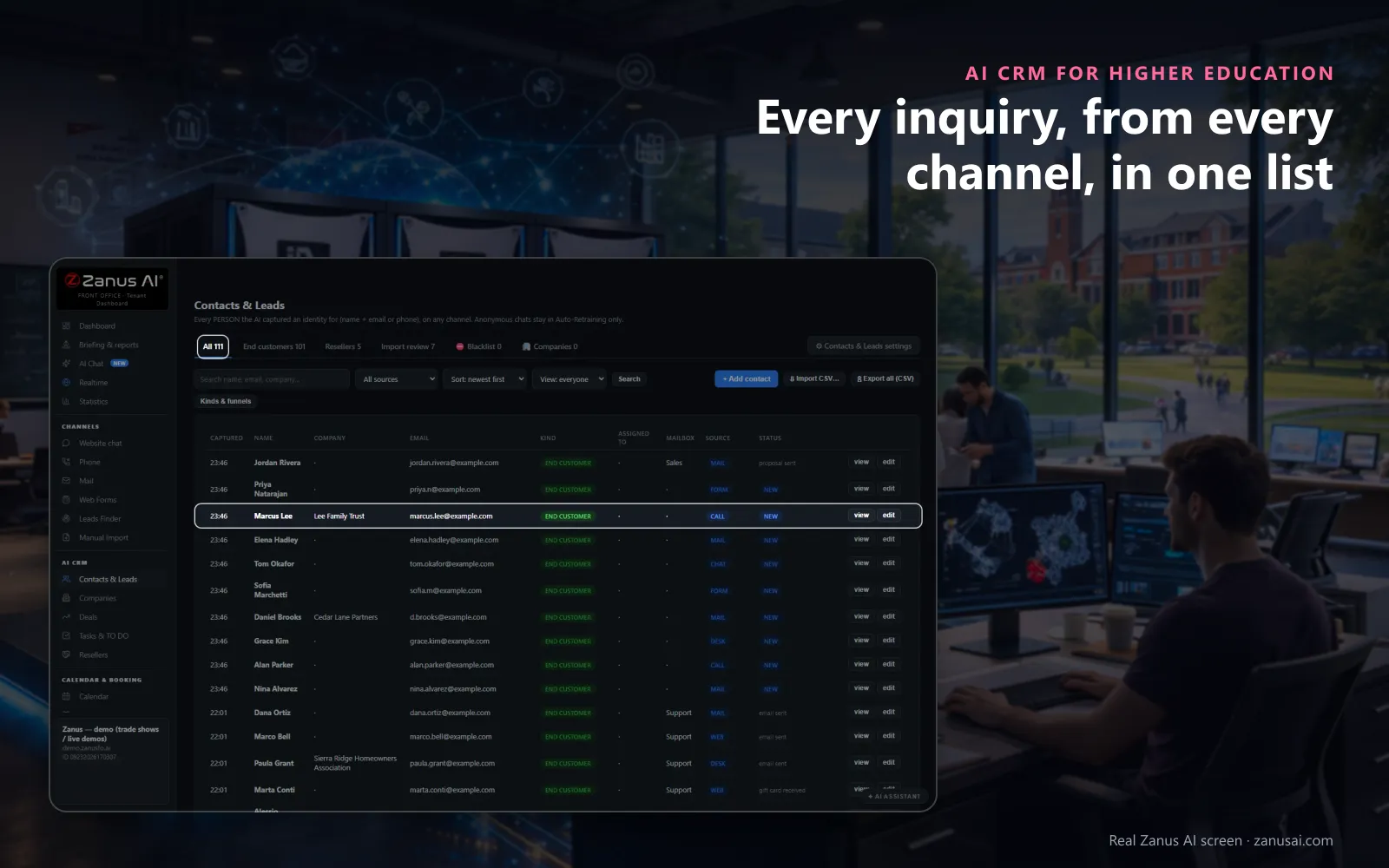
Contacts and leads
Everyone who leaves a name with an e-mail or a phone, on any channel, lands here with where they came from and their status; imported lists wait in their own tab.
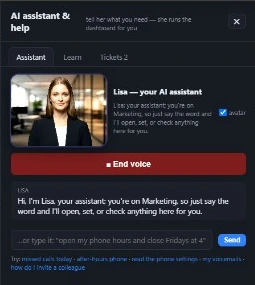 Easy setupSet up everything just by talking to Lisa AISee how ›
You“Rename the stages: inquiry, contacted, visited, applied, admitted, enrolled, lost.”
Lisa“The seven stages will read inquiry, contacted, visited, applied, admitted, enrolled and lost; your team still moves each student to applied, admitted or enrolled. Apply?”
You talk. Lisa sets it up. Applied only on your yes.
How Higher Education use it
A counselor asks Lisa for a brief before calling a family back and reads what they asked, what was sent and what to say next.
Every high school counselor writing from the same school domain is grouped into one company record, with their conversations and tasks beside it.
On Monday the admissions director sorts by READY TO BUY and sees first the families who watched a presentation or replied this week.
REAL AI - the whole Front Office is AI, not old software with an AI button.
What’s included
- Every person and company qualified from the conversations, health score with its WHY, gauges, photo, LinkedIn; nothing typed by your staff
- Deals with stages, probability and expected close, created and moved by the events themselves: lead qualified → demo → quote → won
- Tasks and to-dos assigned to your people, from the AI or by hand, with reminders; calls, meetings and notes logged on the record
- Your own fields on contacts, companies and deals; saved views; tags and segments; record ownership
- Pipeline forecast weighted by probability; win / loss review; "ask your pipeline" in plain language
- Basic contacts and companies stay in every Front Office, this item adds the qualification, the pipeline and the forecast
Add it to any contact channel — AI Phone, AI Webchat, AI E-mail or AI Web Forms — or get it inside a solution · See pricing › · Per company, never per seat.
Everything AI CRM does, for every business ›
Works withAI PhoneAI WebchatAI Web FormsAI DemoAI QuotingAI BookingAI Follow-upAI TicketsAI Returns & WarrantyAI Calls TranscriptsAI Marketing
What it does
What a higher education CRM does without data entry
Customer relationship management for colleges and universities, kept current by artificial intelligence instead of typed in by counselors.
Every inquiry becomes a contact
A name with an e-mail or a phone, given on the admissions line, the chat, an inquiry form, an e-mail or a presentation request, becomes a contact with its source on the row.
One timeline per student
Calls, chats, e-mails, forms, student support tickets, files and tasks sit on one record, newest first, so whoever picks up the conversation, across departments, starts where the last person left it.
Interest you can sort by
Each contact carries a health score from 0 to 100 with the reason it moved, and READY TO BUY puts the students who showed interest in the last fourteen days first.
A pipeline kept current
A booked visit or a sent quote advances a record without anyone typing; counselors take it on to applied, admitted or enrolled, and only a person marks it lost.
A brief before every call
Brief me turns the whole story into one page for the counselor: who the student is, what they asked, what was sent and the next thing to say.
Fields of your own
Add fields to contacts, companies and deals, such as intended major, start term or campus, as text, a number, a date or a choice.
The lifecycle
CRM in higher education across the student lifecycle
One record follows the entire student lifecycle, from the first question to the reunion invitation, so the student journey reads in one place.
The prospective student
A high school sophomore asks the chat about the marine biology program; the conversation is saved on a new contact with the page she was reading.
The applicant
Questions about the essay, the fee waiver and the portal land on the same record, so the counselor who calls back has read each one first.
The admitted student
Housing, orientation and deposit questions join the record, and a counselor sorting by stage sees which admitted students have gone quiet since decision day.
The alumnus
Alumni engagement starts from the same contact years later: reunion and mentoring invitations reach a person whose earlier story is still on the record.
Schools and agencies
Higher education CRM systems that map your feeder schools
Schools built from domains
Counselors writing from the same verified school domain become one company record, with their people, conversations and tasks kept together.
Agencies kept apart
Education agents can be their own kind of contact, so recruitment staff filter agencies, school counselors, parents and students separately.
One timeline per school
Open a school and read every counselor's messages, the open tasks and the combined timeline of everyone there, in a single record.
Compared
CRM software for higher education compared with the usual tools
What admissions gets from each way of keeping track of prospective students, from a spreadsheet to CRM solutions that counselors fill in by hand.
| What an admissions team needs | A spreadsheet | A CRM you fill in | Separate phone, chat and mail tools | AI CRM |
|---|---|---|---|---|
| A new inquiry on the record | Typed in when someone has time | Typed in by a counselor | Kept in each tool's own list | Created by itself: from every call, chat, e-mail and form |
| The story before a callback | A comment cell | The notes someone wrote | Searched across three inboxes | One timeline per student: with a one-page brief on request |
| Where inquiries stall | Counted by hand | A report if stages are kept current | Not visible | Stage history and days per stage: in the win/loss report |
| Mail at the student's hour | Whenever it is sent | A scheduled send if remembered | The sender's hours | Between 7:00 and 19:00: in the student's own time zone |
| Who exported the list | Anyone with the file | Depends on the settings | Each tool on its own | Managers only: with every export logged by author |
A counselor's day
A day with the admissions CRM
Small moments that shape the student experience, each one already on the record.
Before the first appointment
Sort by READY TO BUY to read student engagement at a glance: those who replied or watched a presentation in the last two weeks come first, each with the reason.
After a college fair
Contacts gathered at the fair arrive as a file, wait in Import review and are accepted one by one, never called automatically.
When an applicant goes quiet
Ask which applicants have been silent for a week; the list returns with each contact's health and the follow-up plan running for them.
When a family says stop
Tell Lisa to pause all marketing to a family; she shows the before and after, and every scheduled step holds until you resume it.
Boundaries
What this CRM for higher education does not hold
No academic records
Transcripts, grades, holds and enrollment status stay in your student information systems; the CRM keeps the conversations around them.
No coursework
Courses, gradebooks and assignments live in your learning management system; the CRM holds the conversations with students, families and partners.
No application review
Applications are read and decided in your application system and by your committee; the CRM records that a student asked about theirs.
No aid awards
Aid packages and scholarships are calculated and sent by the aid office; questions about them become tasks or tickets for that office.
No tuition billing
Tuition bills and payments stay with the bursar's own systems; the CRM records the questions families asked about them and who answered.
Student data under control
Only Managers export student data, each export logged with its author, and call recording stays off until someone switches it on.
Set-up
Set up your higher education CRM in 2 minutes
Nothing to migrate
From the first call, chat, form or e-mail that gives a name and an address, contacts fill the list; a file of past inquiries waits in Import review.
Your kinds of contact
Tell Lisa the kinds you use, such as student, parent, school counselor, agent and alumnus; she fills the settings and shows the change first.
Your stages and fields
Rename the seven stages in your enrollment words and add fields such as start term or intended major, each shown before it applies.
A week of real inquiries
Run it free for 7 days with no credit card and read every contact captured and every record opened when the week ends.
Questions & answers
Questions admissions teams ask about a higher education CRM
What is a CRM in higher education?
A CRM in higher education is the record of every relationship higher education institutions keep: prospective students, parents, school counselors, agents and alumni. AI CRM is a relationship management CRM that builds that record by itself from every call, chat, e-mail and form, so admissions reads one timeline per person instead of searching five inboxes.
Is AI CRM a student information system?
No. It keeps the relationship: who asked what, on which channel, and what was sent back. Grades, enrollment status, holds, applications and aid awards stay in the student information and application systems your registrar and aid office already run.
What is the best CRM for higher education?
The one your admissions team does not have to feed. Look for a CRM platform with contacts captured from every channel, a timeline per student, follow-up written from each conversation and a price per company rather than per counselor. All four come built in here, and admissions can test them free for 7 days on its own inquiries.
How does the higher education CRM capture prospective students?
Anyone who gives a name with an e-mail or a phone on any channel becomes a contact: the admissions line, the website chat, an inquiry form, an e-mail or a presentation request. The source stays on the row, anonymous chats stay out, and imported lists wait in Import review until accepted one by one.
Can the enrollment pipeline use our own stage names?
Yes. Keep the seven stages as shipped or rename them, for example inquiry, visited, applied, admitted and enrolled. Only a booked visit or a sent quote moves a record forward by itself; counselors move a student to applied, admitted or enrolled, and only a person marks a record lost, with the stage history keeping who moved it and why.
Can the CRM group contacts by high school or agency?
Yes. People who write from a verified address at the same school or agency domain become one company record by themselves, with their people, conversations and tasks together. You can edit or merge those records, so admissions sees every counselor at a feeder school in one place.
Are e-mails sent at sensible hours for international applicants?
Yes. Each contact's time zone comes from their country, so the e-mails the AI writes wait for 7:00 to 19:00 in the applicant's own time. Lead notes on the record tell the AI what to mention, or leave out, in every mail it writes.
Who can export student contact data?
Only people with the Manager role, and each export of contact data is logged with its author. Imported lists wait in Import review and are never auto-called, which helps admissions keep its contact data handling compatible with your institution's privacy policies.
Does the CRM record admissions phone calls?
With AI Phone added, every call the AI answers lands on the contact's timeline. Call recording is off as shipped; switch it on and each call keeps its recording and transcript in the call register, and the AI can tell callers the call may be recorded.
What are the benefits of CRM in higher education?
Counselors stop retyping what families already said, nobody calls a student twice about the same question, and directors see where inquiries stall between stages. Unlike CRM platforms that wait for someone to type, the Front Office writes every conversation onto the record as it happens, so those benefits come without data entry.
How is higher education CRM software priced?
Per company, never per seat or per counselor, so higher ed teams in admissions, the international office and alumni relations work in one subscription. The plans are on the pricing page, and the free trial runs on your own inquiries for 7 days with no credit card.
Can counselors ask the CRM questions in plain words?
Yes. Ask Lisa which admitted students have been silent for a week, and the list comes back with each contact's health and the plan running for them. Asking her to pause marketing to one family shows the change before it applies, and a reply written by hand still goes out.
Keep exploring
Where next?
Start with the one thing you need. Add more anytime by asking Lisa.
AI Front Office for Higher Education ›
Easy setup
Answers & books
Sells
Helps your team
Included
Award-winning AI
Winner at CES 2026, ISE 2026 and TMCnet Enterprise AI Product of the Year.
REAL AI - the whole Front Office is AI, not old software with an AI button.
Awards & trade shows ›


Give Lisa your website.
She sets up your business in 2 minutes.
Other software makes you learn it. Zanus AI learns your business.
Try it free on your own business — no credit card, per company, never per seat.
Ready to buy? See plans & pricing ›
Or call +1 (954) 736-3939 — the AI answers.