AI CRM for Defense Contractors. A CRM for government contractors, primes and subcontractors
AI CRM is a CRM for government contractors that fills itself: every call, chat, e-mail and form from an agency, a prime or a subcontractor becomes a contact under its organization, with the whole story on one record. Opportunities open as deals on the first sales signal and move through your stages, while bid, price and teaming decisions stay with your people.
TRY AI CRM FREENo credit card · Ready in 2 minutesReady to buy? See plans & pricing ›
7 days free · per company, never per seat · nothing to install
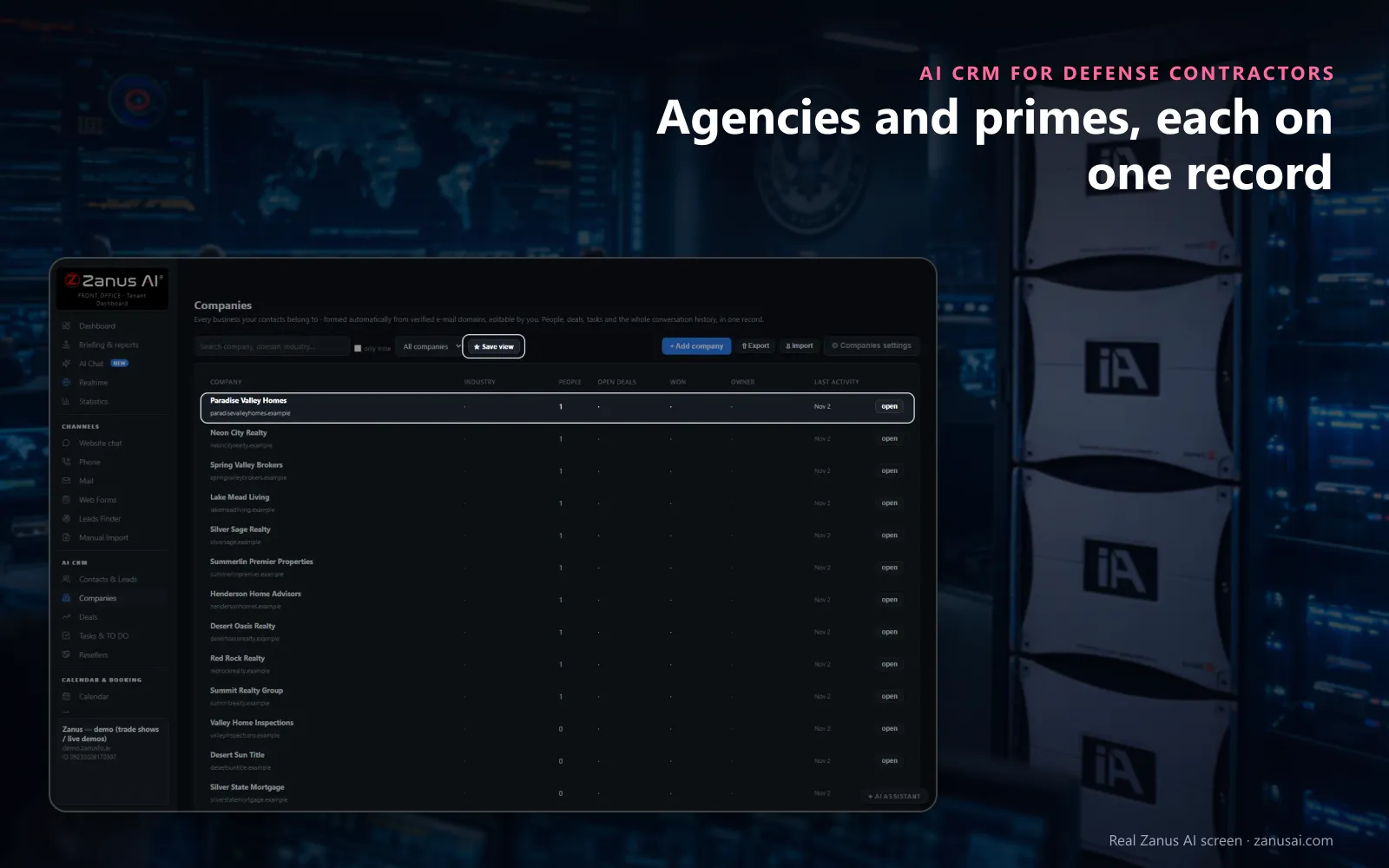
Organizations
One verified business domain, one company: its people, deals, tasks and conversations together, ready to edit or merge.
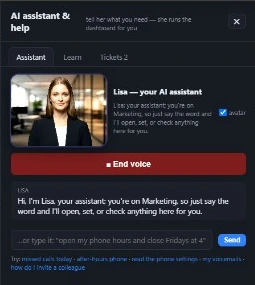 Easy setupSet up everything just by talking to Lisa AISee how ›
You“Add a solicitation number field and a due date field to every deal.”
Lisa“I'm adding a text field for the solicitation number and a date field for the due date to every deal. Apply?”
You talk. Lisa sets it up. Applied only on your yes.
How Defense Contractors use it
Contracts asks whether anyone promised a delivery date to a buyer; his record holds every call transcript and mail to check.
A program office that asked three questions in spring has gone quiet; its health score drops and the tooltip says why.
Before a capability briefing, your BD lead opens Brief me and reads one page on what the agency asked and was sent.
REAL AI - the whole Front Office is AI, not old software with an AI button.
What’s included
- Every person and company qualified from the conversations, health score with its WHY, gauges, photo, LinkedIn; nothing typed by your staff
- Deals with stages, probability and expected close, created and moved by the events themselves: lead qualified → demo → quote → won
- Tasks and to-dos assigned to your people, from the AI or by hand, with reminders; calls, meetings and notes logged on the record
- Your own fields on contacts, companies and deals; saved views; tags and segments; record ownership
- Pipeline forecast weighted by probability; win / loss review; "ask your pipeline" in plain language
- Basic contacts and companies stay in every Front Office, this item adds the qualification, the pipeline and the forecast
Add it to any contact channel — AI Phone, AI Webchat, AI E-mail or AI Web Forms — or get it inside a solution · See pricing › · Per company, never per seat.
Everything AI CRM does, for every business ›
Works withAI PhoneAI WebchatAI Web FormsAI DemoAI QuotingAI BookingAI Follow-upAI TicketsAI Returns & WarrantyAI Calls TranscriptsAI Marketing
What it keeps
What a govcon CRM keeps for a defense contractor
A CRM is only as good as what reaches it. Here the phone, the chat, the inboxes and the forms write into it as they work, so the BD team skips manual data entry and the record keeps up without adding a clerk to type it.
Every channel, one contact
A name with an e-mail or a phone, given on a call, a chat, a form, a mail or a demo request, becomes a contact by itself, with the channel it came from on the row.
Organizations from verified domains
People writing from the same verified business domain form one company record, with its people, deals, tasks and the combined timeline of every conversation.
Kinds of contact you name
Agency buyer, prime, subcontractor, teaming partner or depot: you name the kinds your business needs, and each contact shows its status, from new to quote opened and purchased.
Opportunities as deals
A deal opens on the first sales signal, a quote or a demo asked for, is named for what started it and moves forward as the buyer acts.
A health score with its reason
Each contact carries a score from 0 to 100, and the tooltip says why it moved; READY TO BUY sorts the people with buying signals in the last fourteen days.
Brief me before the call
One click on Brief me and Lisa writes a one-page brief from the story: who the contact is, what he asked, what was sent and what to say next.
The pipeline
Government contractor CRM pipeline, opportunity by opportunity
Board or list
New, Qualified, Demo, Quoted, Negotiation, Won and Lost, as a board or a sortable list, filtered by owner and saved as a view for each BD lead.
The weighted forecast
Open deals, the pipeline and the weighted forecast sit above the board, each amount counted by a probability that blends the stage with the contact's health.
Stage history
Each move is written down: when, which move, who made it and why. The machine never moves a deal back and never marks one lost.
Won, lost and why
WON closes the pursuit and LOST asks for the reason; the report then shows where deals stall and how many days they spend at each stage.
Who decides
Program offices, primes and the roles inside them
Roles read from questions
Economic buyer, technical evaluator or champion: each person's role is inferred from what he asked, and shown beside his health and engagement.
The empty chair
When nobody has spoken with the economic buyer yet, the company's health line says so, and your team knows whom to reach before the quote.
Lead scoring before you call
The AI verifies the e-mail without sending, visits the website and scores competitor risk, budget and buyer type; you can overrule each verdict.
Notes the AI reads
Lead notes tell the AI what to say in every mail it writes to that contact, read beside the company website and the type of business.
The BD year
Moments the CRM for defense contractors covers
After an industry day
Attendees who called, chatted or wrote all land as contacts under their organizations, each with the source, so the follow-up starts from what each one asked.
A sources-sought response
The program office contacts who asked for your capability details on a federal contract sit on one company record, with every reply sent and a deal opened once they ask for a quote.
Before a recompete
Before government contracts come up again, ask Lisa which organizations have been silent since their last review; the list comes back with each contact's health and the reason it fell.
The fiscal year-end rush
Sort by READY TO BUY on the first morning of September: the buyers who opened a quote, watched a demo or replied in the last two weeks come first.
When the solicitation lands
Between capture and proposal, the request moves into AI Proposal Studio: the compliance requirements it lists go into a register with their pages, and the proposal content is written from your Knowledge for a manager to approve.
Monday's pipeline review
Open the board filtered by owner, and the meeting does its pipeline management from facts on the screen: each pursuit with its stage, amount, probability and last move.
Compared
Government contracting CRM software or a spreadsheet?
Most BD teams start with a spreadsheet, then buy one of the CRM solutions someone has to feed by manual work. AI CRM is fed by the front office itself.
| What a business development team needs | A spreadsheet | A CRM your team types into | AI CRM |
|---|---|---|---|
| Every inquiry captured | When someone copies it in | When someone types it | Captured from every channel,: with the source on the row |
| Agencies and primes as organizations | One tab per customer, if kept | Built by hand | Formed from verified domains,: editable and mergeable |
| What was said to a buyer | Not recorded | A note, if someone wrote one | Every call, chat and mail,: on the contact's timeline |
| Opportunities by stage | A status column | Moved when a person remembers | Opened on the first signal,: moved as the buyer acts |
| Who decides a loss | Whoever edits the row | Any user | A person, with the reason,: read by the win/loss report |
| Exports of contact data | A copy anyone can take | Depends on the settings | Managers only,: each export logged with its author |
| The requirements a solicitation lists | Copied into a checklist by hand | Kept outside the CRM | Read by AI Proposal Studio,: where proposal workflows end with a person's approval |
Boundaries
What the CRM holds, and what stays in your own systems
Conversations from public channels
The record holds what buyers, partners and agencies said on your phone, chat, forms and inboxes, the same released world the front office speaks in.
No contract files or technical data
Contracts, drawings, specifications and controlled data stay in the document systems your security office approves; the CRM never needs them to keep a relationship.
No solicitation or award data
Solicitation searches, award records, contract vehicles and contract management live in the management tools built for them; a field for the solicitation number keeps the link on each deal.
Decisions with people
Bid or no-bid, teaming, pricing and a deal marked lost are your people's calls; the machine writes the record and keeps it moving, nothing more.
Set-up
Set up the CRM for government contractors in 2 minutes
Nothing to migrate first
Every call, chat, form or mail that gives a name and an e-mail lands in Contacts & Leads from the first day; a CSV import waits in Import review.
Your kinds of contact
Tell Lisa the kinds you use, such as agency buyer, prime, subcontractor and teaming partner, and the types of business you sell to.
Your stages and fields
Rename the stages in your BD team's words and add fields to contacts, companies and deals: text, number, date or choice.
A week on real inquiries
Run it for 7 days on your own inquiries, no card, and count the contacts and deals it made by itself.
Questions & answers
Government contractors' frequently asked questions about a CRM
What is a CRM for government contractors?
It is customer relationship management software that keeps a contractor's relationships with agencies, primes, subcontractors and teaming partners, and the opportunities pursued with them. AI CRM fills itself: every call, chat, form and mail lands on the right contact, people group into organizations and deals open on the first sales signal.
What is a govcon CRM?
GovCon is short for government contracting, and a govcon CRM is the record a contractor's business development team keeps of agencies, primes, partners and opportunities across the federal market. AI CRM covers the relationship and pipeline side from your own conversations, AI Proposal Studio covers proposal development, and solicitation searches and award data stay in the tools you already use for them.
What features should a CRM for government contractors have?
What government contractors need is contacts captured from every channel with their source, organizations with their people, kinds of contact you name, opportunity stages in your own words, a stage history, a weighted forecast, tasks, and every conversation on the record. Add exports of CRM data kept to Managers, with a log of who took each one.
What are the alternatives to a generic CRM for government contractors?
A spreadsheet, one of the general CRM platforms your team has to type into, or a contracting platform built around solicitation data. AI CRM is another road: the front office record that fills itself from the phone, the chat, the mail and the forms, so the relationship history is there before anyone types.
Does AI CRM search solicitations or government contract databases?
No. It is not a bid-search or market intelligence service: it does not search solicitations, read award data, score capture decisions or manage contract vehicles. It records what buyers, agencies and partners said to you, and you can add fields for solicitation numbers, task orders or due dates to each deal.
Can we track opportunities through our own pursuit stages?
Yes. Keep the shipped stages, New, Qualified, Demo, Quoted, Negotiation, Won and Lost, or rename them in your team's words, such as the stages of your capture management. Deals move forward on their own when a buyer asks for a quote or a demo; your people manage opportunities through the rest, and only a person marks a deal lost.
Can it show what our desk told a contracting officer?
Yes. Every call, chat and mail sits on the contact's timeline with its channel, and the calls the AI answers keep their transcript and summary. With call recording switched on, each call also keeps its recording in the call register.
How are agencies, primes and subcontractors grouped?
People with a verified business address at the same domain become one company record by themselves, which you can edit or merge. You name the kinds of contact you need, such as agency buyer, prime, subcontractor or teaming partner, and each organization's people, deals and tasks sit on one record.
Who decides that a pursuit is lost?
A person, always. LOST asks for the reason, and the win/loss report then reads the amounts, the lost reasons, the stage where deals stop and the days spent in each stage, so you see where long sales cycles slow your pursuits and what weighs on your win rate.
Can exports of contact data be controlled?
Yes. Exports follow role-based access: only Managers can export customer data, and the log records who took each export. Imported lists wait in Import review until someone accepts them one by one, and an imported contact is never called by the AI.
Does the CRM hold contract files or technical data?
No, and it should not. It holds the conversations of your public channels and the deals they open. Contract files, drawings and controlled technical data stay in the systems your security office approves, and contract lifecycle management stays in the tools you already run for it.
How much does a CRM for government contractors cost here?
AI CRM is priced per company, never per seat, so business development, contracts and program staff all work on the same records. The plans are on the pricing page, and the 7-day free trial runs on your own inquiries with no credit card.
Keep exploring
Where next?
Start with the one thing you need. Add more anytime by asking Lisa.
AI Front Office for Defense Contractors ›
Easy setup
Answers & books
Sells
Helps your team
Included
Award-winning AI
Winner at CES 2026, ISE 2026 and TMCnet Enterprise AI Product of the Year.
REAL AI - the whole Front Office is AI, not old software with an AI button.
Awards & trade shows ›


Give Lisa your website.
She sets up your business in 2 minutes.
Other software makes you learn it. Zanus AI learns your business.
Try it free on your own business — no credit card, per company, never per seat.
Ready to buy? See plans & pricing ›
Or call +1 (954) 736-3939 — the AI answers.