AI CRM for Manufacturing. The CRM for manufacturers that fills itself from every RFQ
AI CRM is a CRM for manufacturers that writes its own records: every buyer, dealer and plant engineer who calls, mails, chats or sends an RFQ form becomes a contact with the whole story on one page. Accounts group by company, deals open when a quote is asked for and move as the buyer acts, and your sales team keeps every decision.
TRY AI CRM FREENo credit card · Ready in 2 minutesReady to buy? See plans & pricing ›
7 days free · per company, never per seat · nothing to install
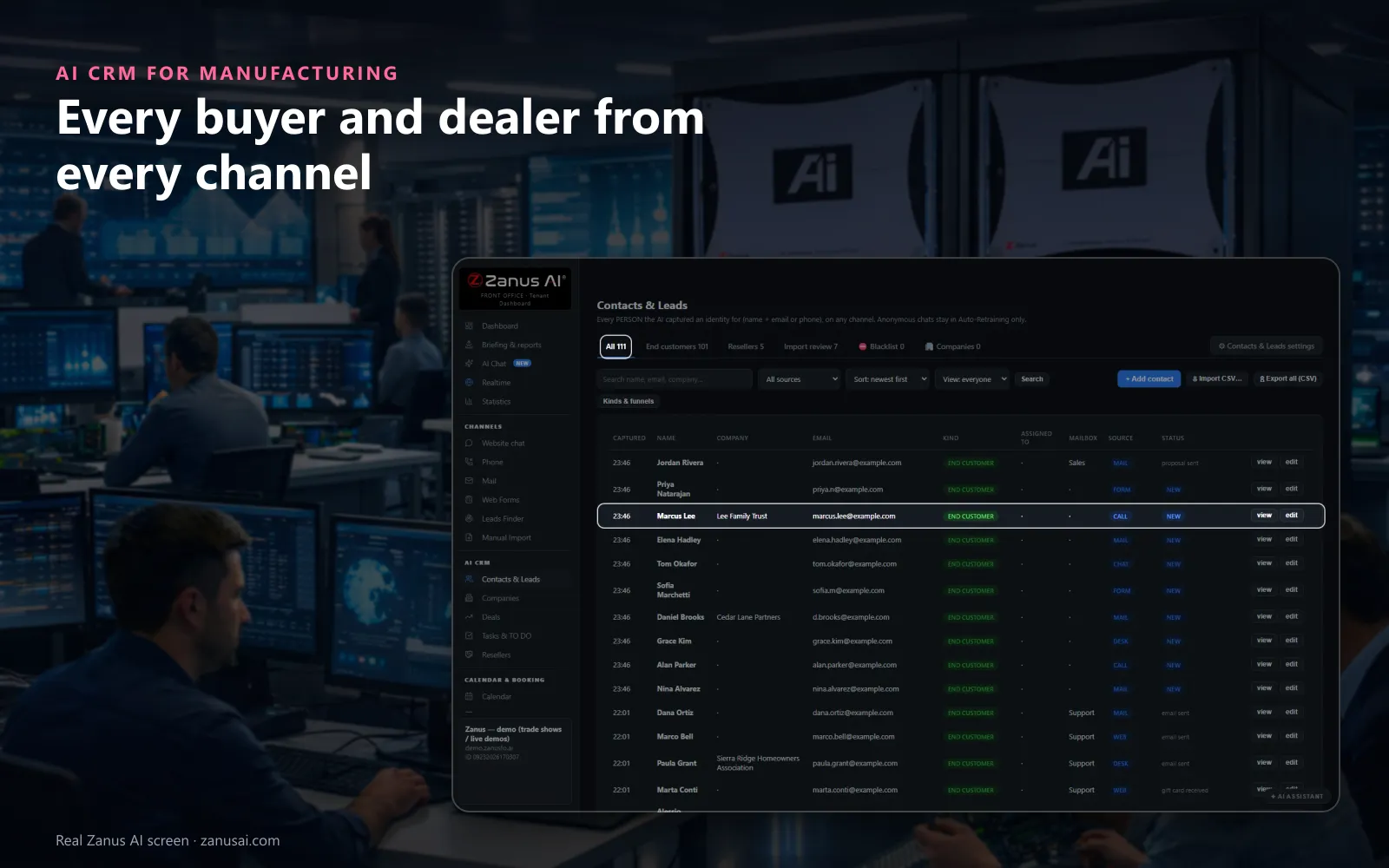
Contacts
Every buyer, dealer and engineer who left a name on a call, mail, chat or form, with the channel and the status on each row.
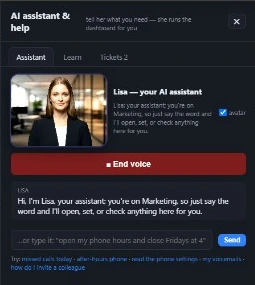 Easy setupSet up everything just by talking to Lisa AISee how ›
You“Add a contact kind Distributor and a deal field for annual volume.”
Lisa“Distributor joins your contact kinds, and every deal gets a number field called Annual volume. Apply?”
You talk. Lisa sets it up. Applied only on your yes.
How Manufacturing use it
A purchasing manager sends an RFQ for 2,000 brackets; a deal opens in Quoted with his company, the quote and his health score.
A distributor in Mexico City has gone quiet since March; Lisa lists his silent quotes and the follow-up plan running for him.
An OEM's design engineer and its buyer both write in; the company record shows one as technical evaluator, one as economic buyer.
REAL AI - the whole Front Office is AI, not old software with an AI button.
What’s included
- Every person and company qualified from the conversations, health score with its WHY, gauges, photo, LinkedIn; nothing typed by your staff
- Deals with stages, probability and expected close, created and moved by the events themselves: lead qualified → demo → quote → won
- Tasks and to-dos assigned to your people, from the AI or by hand, with reminders; calls, meetings and notes logged on the record
- Your own fields on contacts, companies and deals; saved views; tags and segments; record ownership
- Pipeline forecast weighted by probability; win / loss review; "ask your pipeline" in plain language
- Basic contacts and companies stay in every Front Office, this item adds the qualification, the pipeline and the forecast
Add it to any contact channel — AI Phone, AI Webchat, AI E-mail or AI Web Forms — or get it inside a solution · See pricing › · Per company, never per seat.
Everything AI CRM does, for every business ›
Works withAI PhoneAI WebchatAI Web FormsAI DemoAI QuotingAI BookingAI Follow-upAI TicketsAI Returns & WarrantyAI Calls TranscriptsAI Marketing
The records
Manufacturing CRM software that types its own records
Contact management and lead management with no data entry: the Front Office answers your customers, and as it works it writes every conversation into the CRM for you.
Contacts from every channel
A buyer who leaves a name with a phone or an e-mail on a call, a mail, a chat, an RFQ form or a demo request becomes a contact, with the channel he came from and the customer information he gave.
Status from the first mail to the order
Each row shows where the buyer stands, from new to quote sent, quote opened and purchased, so nobody asks the team where an account is.
Checked before the first call
The AI verifies the e-mail without sending anything, visits the company website and scores the budget, the buyer type and the competitor risk; your rep can overrule each verdict.
A health score with a reason
From 0 to 100, with a tooltip that says why it moved: a quote opened, a reply received, a demo watched or weeks of silence.
A brief before every call
Ask Lisa for a brief on an account and read one page: who the buyer is, what he asked for, what was sent and what to say next.
Notes the AI reads
Write in a lead note that a buyer orders by the pallet or needs certificates with every shipment, and every mail the AI writes him takes it into account.
Accounts
CRM for manufacturing companies that sell through dealers
An industrial sale has a buyer, an engineer and often a distributor in between, so the CRM keeps the account as well as the person.
Companies that form by themselves
People who write from the same verified business domain become one company record, which you can edit, merge with a duplicate and save in a view of your own.
Who decides, who checks
Each person's role is read from what he asked: economic buyer, technical evaluator or champion, shown beside his health and his engagement.
The missing decision maker
When the engineers love the sample but nobody has spoken to the person who signs, the company's health line says so before the quote goes out.
Dealers and end customers apart
Name the kinds of contact your channel uses, dealer, distributor, OEM, end user, and resellers sit on a tab of their own beside the end customers.
Your trades and segments
Start from 39 types of business already filled in and tag each contact with every one he belongs to. Those tags become segments for marketing automation in AI Marketing, whose campaigns go only where consent allows, never after an unsubscribe.
One account timeline
Every person at the company, every deal, every task and the combined timeline of their calls, mails and forms, with a deal plan for the whole account.
The pipeline
A sales pipeline that follows the RFQ, not the reminder
Deals open when a buyer asks for a price or a demo, and they move when he reads the quote, watches the demo or pays, so long sales cycles stay in view from the RFQ to the order.
A board by stage
New, Qualified, Demo, Quoted, Negotiation, Won and Lost, as a board or a sortable list, filtered by sales owner and saved as your own view.
Pipeline management at a glance
Open deals, the pipeline total and the weighted forecast sit above the board, each amount weighted by its stage and by the buyer's health.
Every move written down
The stage history keeps when a deal moved, who moved it and why. The AI never moves a deal back and never marks it lost.
Where deals stall
The win and loss report reads the amounts, the lost reasons, the stage where quotes stop and the days spent in each one, so you see where the sales process slows.
Compared
Choosing CRM software for the manufacturing industry
Choosing CRM software for manufacturing industry accounts comes down to who keeps the records current, since many CRM platforms wait for a rep to type. Four ways a plant tracks its buyers, and what each does with the moments inside sales lives through every week.
| The moment | A spreadsheet | A CRM you fill in | Separate phone, chat and mail tools | AI CRM |
|---|---|---|---|---|
| An RFQ arrives by mail | A row if someone adds it | A deal if a rep types it | Stays in the inbox | A deal opened by itself:: named for the request, with the company |
| A dealer calls about an order | Not recorded | A note if there was time | In the phone tool only | On his timeline:: every call the AI answered, beside his mail |
| A quote is opened twice | Unknown | Unknown unless tracked | Unknown | Health score up:: and the deal weighs more in the forecast |
| An account goes quiet | Noticed months later | A report someone runs | Nobody connects it | Listed by Lisa on request:: with the plan running for each buyer |
A day in sales
A day with a CRM for manufacturers
Before the first coffee
Sort by Ready to buy: the buyers who opened a quote, watched a demo or answered in the last two weeks come first, each with the reason under the name.
Before calling a distributor
Ask Lisa to brief you on the account and read what they ordered, what they asked last, the quote still open and the next thing worth saying.
When a quote goes silent
Ask which quoted deals have heard nothing for a week; the list comes back with each buyer's health and the follow-up plan running for him.
When a buyer asks for no mail
Tell Lisa to pause marketing to him. She shows the before and the after; every planned step waits until you resume, and a reply you write still goes out.
Its limits
What a manufacturing CRM does, and what stays in your ERP
No production planning
AI CRM schedules no machines, runs no material requirements and plans no shifts. The shop floor stays in the systems your plant already runs.
No job costing
It computes no machining time, scrap or routing cost. A price comes from your list in AI Quoting, or from the estimator who prices a custom part.
No accounting
Invoices, credit limits and the ledger stay in your accounting system; the CRM shows which quotes were sent, opened and paid.
The customer side, whole
What it does keep is every person, account, conversation, quote and deal, written by the Front Office as it answers, for sales and customer service alike.
Set-up
Set up a CRM for small manufacturing business in 2 minutes
Nothing to type
From the first day every call, chat, form or mail that gives a name and an e-mail lands in Contacts & Leads; an old list waits in Import review.
Your kinds and trades
Tell Lisa your contact kinds, dealer, distributor, OEM, and the trades you sell to; she fills the settings and shows the change first.
Your stages and fields
Keep the deal stages as they come or rename them to fit your sales processes, and add fields of your own, text, number, date or choice, to contacts, companies and deals.
A week on your accounts
Run the free trial for 7 days, no credit card required, then read every contact it captured and every deal it opened.
Questions & answers
AI CRM for Manufacturing: questions & answers
What is a CRM for manufacturers?
Customer relationship management software built around how a plant sells and keeps its customer relationships: accounts with several buyers, dealers and distributors in between, RFQs and repeat orders. AI CRM fills it by itself from your phone, chat, mail and forms, so the account history, the open quotes and the deals are there without inside sales typing them.
What is CRM used for in manufacturing?
To help manufacturers know who buys, who decides and what was promised. A manufacturing CRM keeps each account's people, quotes, orders and conversations in one record, shows the sales pipeline by stage and tells the team which accounts are ready to reorder. What the best manufacturing CRMs have in common is a record that stays current without retyping.
Is AI CRM an ERP or a production planning tool?
No. It plans no production, runs no MRP, costs no jobs and keeps no general ledger; your ERP stays where it is. AI CRM is the front of the business: the people, the companies, the conversations, the quotes and the deals your customer-facing team works every day.
Can it manage our dealers and distributors?
Yes. Name the kinds of contact you use, dealer, distributor, OEM, end user, and resellers get a tab of their own beside the end customers. Each dealer's people sit in one company record with its deals and timeline, and dealer applications can come through AI Partner Portal.
How does an RFQ become a deal?
When a buyer asks for a quote, on the phone, by mail, in the chat or on your RFQ form, the deal opens by itself, named for the request, with the company and the person. It moves to Quoted when your quote leaves and on again as the buyer opens it and pays.
How do we see which accounts are ready to buy?
Every contact carries a health score from 0 to 100 with the reason it moved. Sorting by Ready to buy puts first the people who opened a quote, watched a demo or replied in the last two weeks, so inside sales calls the warm accounts before the cold list.
Can a manufacturing CRM record calls with customers?
Yes, with AI Phone added: every call lands on the contact's timeline. Call recording is off as shipped; switch it on and each call keeps its recording and its transcript in the call register, and the AI can tell callers that the call may be recorded.
How is the weighted forecast worked out?
Above the deal board sit the open deals, the pipeline total and the weighted forecast. Each deal's amount is counted by a probability that blends its stage with the health of the contact, so a quote the buyer opened twice weighs more than one nobody read.
Can we import the customer list we already have?
Yes, as a CSV file. Imported contacts wait in Import review until someone accepts them one by one, and an imported lead is never auto-called. From then on the CRM fills itself from every channel. Exports of customer data are for Managers only, and each one is logged with its author.
Will the AI mark a deal lost or move it backwards?
Never. The machine only moves a deal forward as the buyer acts, and only a person marks one lost, giving the reason. The stage history keeps every move, when it happened, who made it and why, for the sales manager's review.
Does it handle export customers in other time zones?
Yes. Each contact's time zone comes from his country, so the mails the AI writes for him wait for 7:00 to 19:00 in his own hours. A buyer in Monterrey and a distributor in Rotterdam each hear from you during their working day.
How much does a CRM for a small manufacturing business cost?
AI CRM is priced per company, never per seat, so sales teams and the service desk all work in it at one price; the plans are on the pricing page. Run it first for 7 days on your own accounts, free and with no credit card.
Keep exploring
Where next?
Start with the one thing you need. Add more anytime by asking Lisa.
AI Front Office for Manufacturing ›
Easy setup
Answers & books
Sells
Helps your team
Included
Award-winning AI
Winner at CES 2026, ISE 2026 and TMCnet Enterprise AI Product of the Year.
REAL AI - the whole Front Office is AI, not old software with an AI button.
Awards & trade shows ›


Give Lisa your website.
She sets up your business in 2 minutes.
Other software makes you learn it. Zanus AI learns your business.
Try it free on your own business — no credit card, per company, never per seat.
Ready to buy? See plans & pricing ›
Or call +1 (954) 736-3939 — the AI answers.