AI Marketing for Small Business. Email marketing for small business, written from your knowledge.
AI Email Marketing is email marketing for small business that writes each campaign from your own website and price list and sends it to the customers it concerns, in their language. The heating check before the first frost, the holiday order deadline, the new Saturday hours: you say what to announce and to whom, Lisa writes it for your yes, and every reply is handled for you.
TRY AI MARKETING FREENo credit card · Ready in 2 minutesReady to buy? See plans & pricing ›
7 days free · per company, never per seat · nothing to install
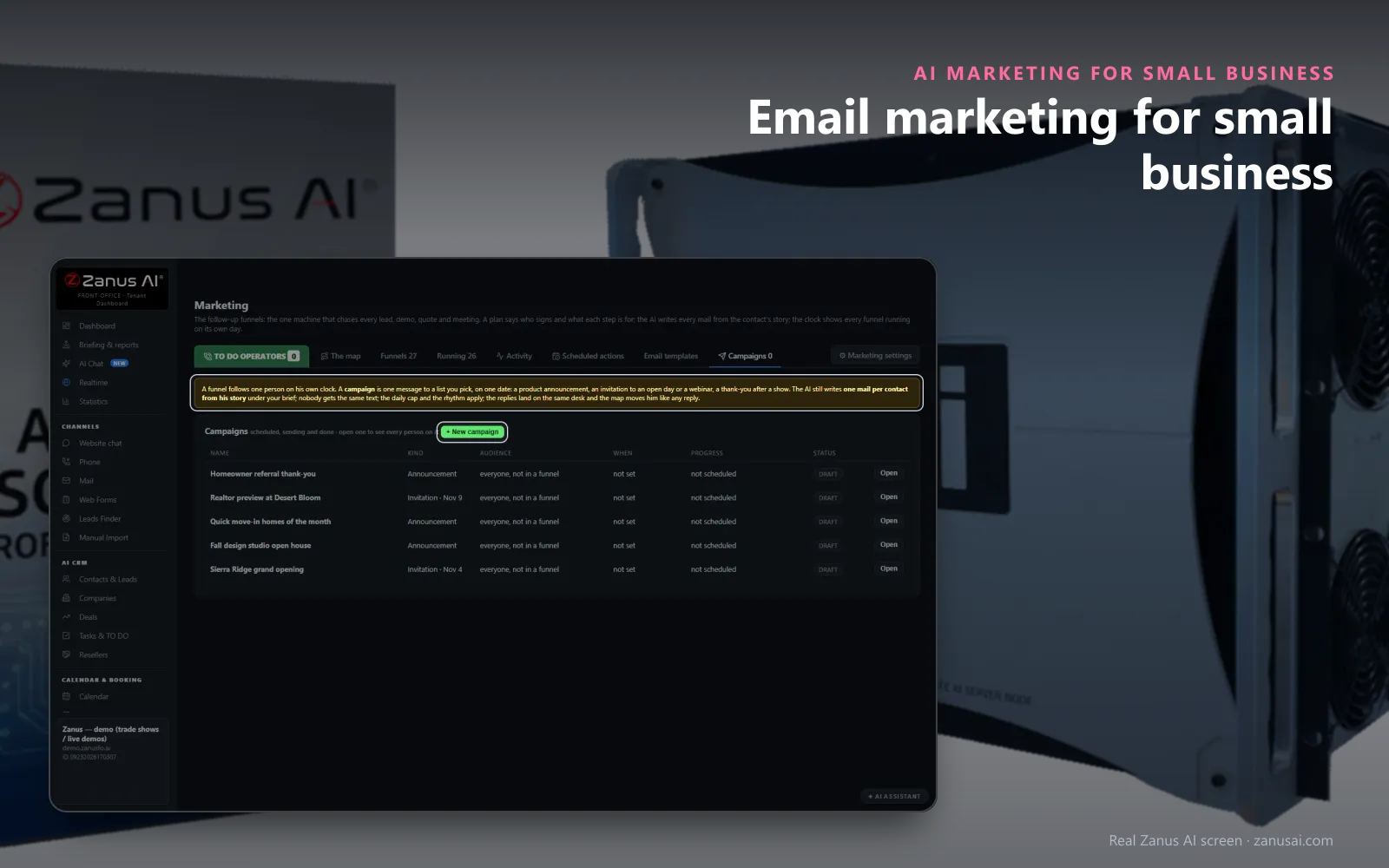
Campaigns
One announcement, one list and one date, yet the AI writes each customer a personal e-mail within your daily limit, in their language and signed by the person sending.
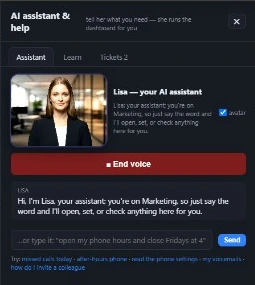 Easy setupSet up everything just by talking to Lisa AISee how ›
You“Mail last year's service customers in September, no more than once a month.”
Lisa“Ready: a September campaign to last year's service customers, capped at one marketing e-mail a month each, sent in their own hours. Apply?”
You talk. Lisa sets it up. Applied only on your yes.
How Small Business use it
A heating firm mails last winter's customers in early autumn to book a boiler service before the rush, and each reply asking for a date reaches the owner.
A bakery sends its pie order deadline to everyone who ordered for the holidays last year, each in their own language and during their own morning hours.
A reply to the studio's new timetable asks about beginner classes; the AI answers from the class page in the customer's language and the owner is alerted.
REAL AI - the whole Front Office is AI, not old software with an AI button.
What’s included
- Campaigns and events to segments of your contacts
- Templates written from your knowledge, in each customer's language; consent and frequency rules
- Replies handled by Front Office, a question gets an answer, an interest gets a follow-up
- Results on each customer's record; deliverability report
Add it to AI E-mail or get it inside a solution · See pricing › · Per company, never per seat.
Campaigns
What AI email marketing for small business does for you
You keep the ideas and the final word; the writing, the list, the pace and the replies are handled. These are the jobs small businesses usually leave undone, because nobody at the counter has a spare evening to write, segment and send a campaign by hand. What the best email marketing tools for small business do comes down to these six jobs.
Written from your offers
The AI drafts each campaign from your website, your services and your policies, so the e-mail says what your business really sells, in your own tone. A person of your team edits the draft before anything leaves, and every version is kept.
Sent to the right people
Pick the group by tag, kind of contact, source, country, language, deal stage or the date of the last contact. Only the customers whose consent allows it receive the campaign, so the news never lands on the whole list by accident.
Paced to protect your name
A daily limit, a pause between two sends and each customer's own sending hours keep your domain trusted by the inbox providers and your customers unbothered at night. A long list simply takes a few days instead of arriving everywhere in one burst.
Replies answered
A question in a reply gets an answer from your knowledge through AI E-mail, in the customer's own language. Real interest starts a follow-up and tells the person who sells who to call and why, while the customer still remembers your e-mail.
Your frame and signature
Every e-mail sits in your own template with your logo and your colours, and the merge fields fill in the customer's name, their company and the signature of the person sending, so a campaign reads like a note from your shop.
A sender they recognise
Choose the sender name and the reply-to mailbox your team reads. A real first name from your business, such as the owner's, reads better in a crowded inbox than the name of a department, and replies reach a person who knows the customer.
Strategy
Email marketing for small business: a strategy for a team of two
An email marketing strategy for a small team is less about volume than about timing: one clear reason to write, the customers it concerns, and every reply handled while the customer still cares. This is how small businesses run campaigns worth reading, without a marketing department behind them and without giving up their evenings.
One reason per mailing
A new service, a season, an event or a change of hours: each campaign carries one piece of news, so the customer knows from the first line why you wrote and what to do next, whether that is booking, ordering or simply replying.
The group it concerns
Instead of mailing the whole email list, filter the customers the news is for, such as last year's boiler services or every business client in one country. Your target audience for the campaign is set in one step, from records your team already keeps.
Written for each contact
Instead of A/B testing subject lines, every mail is written for its contact from your knowledge, in their language and with their name, so the message fits the person reading it rather than a guessed average of the whole list.
A rhythm you can keep
Decide how many marketing e-mails one person may receive, and the frequency rule holds that line for every campaign, however many announcements you plan. Customers hear from you often enough to remember you, and not so often that they tire of you.
Replies before results
Campaign performance is more than open rates. A reply asking a question, a price or a date is the result that matters to a small business, and it reaches a person of your team with the customer's whole story attached.
No workflows to draw
Many email marketing tools expect automation workflows drawn box by box. Here the automation features a small team needs, the follow-up after an interested reply and the stop when a customer answers, run by themselves in AI Follow-up.
Your calendar
Seasonal email campaigns for small business, sent on time
The year of a small business has its own rhythm, and each season has the customers it concerns. Write the campaign weeks ahead, schedule it for the right week, and it goes out paced under your daily limit, during each customer's own sending hours, while you get on with the work. Next year, the same filter finds the same customers again.
Before the busy season
The heating check before winter, the gutter clean before the autumn storms, swimwear alterations before summer: one campaign, written weeks ahead and scheduled for the right week, reaches the customers it concerns while there is still room in your calendar.
Holiday ordering dates
A bakery, a florist or a gift shop tells last year's holiday buyers the order deadline early enough to plan the kitchen and the stock. Each customer reads it in their own language, and a reply asking for one more tray reaches you.
A new service or new hours
Saturday openings, a second location or a new treatment, announced once to the customers who would care rather than the whole list. Replies asking about the new hours are answered from your updated pages, in the language each customer wrote in.
Events and open days
An open day, a workshop or a tasting gets its invitation, its reminder and its thank-you e-mail, with each registration kept on the customer's record beside their calls and quotes, so the team at the door knows who is coming.
Customers who went quiet
Filter by the date of the last contact to reach the customers you have not heard from in a year, with a short note about what is new since their last visit. Any reply is answered from your knowledge or passed to you.
Customers abroad
A guesthouse, a craft studio or a shop with buyers in other countries mails each of them in their own language, previewed before sending, with sending hours set for each time zone, so nobody receives your news at three in the morning.
Trust
Consent, unsubscribe and deliverability in small business email marketing
Email marketing automation should protect your customers' trust and your domain's reputation at the same time. These rules apply to every send, whoever starts the campaign, so a busy Friday never turns into a mailing you regret, and your domain keeps its good name with the inbox providers. None of it depends on someone remembering the rules on the day.
Consent first
Each contact carries an opt-in state, and only the people who may be mailed receive a campaign. The others are left out by themselves at sending time, so there is no list to clean before an announcement, however many contacts arrived this week.
Unsubscribe, for good
An unsubscribe is honoured at once and forever: that customer is never sent marketing again, and they leave every follow-up funnel too, so a person who asked you to stop never hears from a forgotten sequence months later.
A daily limit to start
A new sender starts at fifty marketing e-mails a day, with at least ninety seconds and a random pause between two sends. Anything over the day's limit waits for tomorrow, so a long list protects your sending reputation instead of spending it.
Each customer's own day
Sending hours are set per time zone, so a customer in another country receives your e-mail during their own working day, and a message that falls due at night waits quietly for their morning, then goes out within the hours you chose.
SPF, DKIM and DMARC
Campaigns leave from your own sending domain through AI E-mail. The three sender checks run live until SPF, DKIM and DMARC all read pass, which tells the inbox providers that the mail really comes from your business and not from an impostor.
The deliverability report
Bounces, complaints and engagement sit beside the health of your sender domain, so you notice a problem with your address early and fix it before your customers stop receiving your news. Nobody reads server logs to know where your domain stands.
Compare
Email marketing software for small business compared
Most email marketing platforms are built for marketing teams: someone to design templates, build automation workflows, write subject lines and watch open rates. Here is how mailing from your own inbox, classic email marketing services and AI Email Marketing compare on the eleven jobs a small business campaign needs, from the first draft to the result.
| What a small business needs | Mailing from your own inbox | A classic email marketing service | AI Email Marketing |
|---|---|---|---|
| Writing the campaign | You, late at night, from a blank page | You, in a drag-and-drop editor | Drafted from your knowledge: for your edit and your yes |
| The email list | Copied by hand from old messages | Exported from your records and imported | Already there: from every call, live chat, form and mail |
| Who receives it | Whoever you remember to add | Segments you build and keep up to date | A filter on your own records: tag, stage, source, country, language or last contact |
| Consent | Your memory of who agreed | A field you import and keep in step | Each contact's opt-in state: checked at every send |
| Other languages | Translated by hand, if at all | One version per list you build | Every customer's language: previewed before sending |
| Design | Plain text from your mailbox | An email builder with content blocks | Your template frame: logo, colours and signature filled in |
| Sending pace | Everything at once from your own address | A schedule you configure yourself | Paced under a daily limit: in each customer's own sending hours |
| Deliverability | Not checked | Records you set up on your own | SPF, DKIM and DMARC checked live: with a deliverability report |
| Follow-up after a reply | When you remember | Automation workflows you draw | Started by itself: and stopped when the customer answers |
| Replies | Lost among your other mail | Left to you in a separate inbox | Answered or followed up: and written on the customer's record |
| Results | None | Open rates per campaign | On each contact's record: delivered, opened, clicked and replied |
Results
Small business email marketing, measured on each customer
What counts is who answered and what happened next, written where your team will see it: on the customer's record, beside their calls, chats and quotes, rather than in a separate report nobody opens in a busy week. Small businesses judge a campaign by the replies, calls and quotes that follow it, and that is what the record keeps together.
Per customer
Delivered, opened, clicked and replied sit on each customer's record beside their calls, chats and quotes, so before you ring someone back you can see which mailing they reacted to and what they asked about it.
Per campaign
Each campaign's totals sit in one place, so you know how the spring mailing did against the autumn one without building a spreadsheet of your own or copying numbers into another tool at the end of the month.
What came next
The answer given, the follow-up started and the person alerted all stay with the customer, so the next call starts from where the e-mail left off rather than from a blank page and a guess.
Everything due, day by day
Scheduled actions lists what falls due each day: campaign sends, follow-up steps and the calls your team promised, so nothing planned for Tuesday is still waiting on Wednesday, and the week before a holiday can be read ahead.
A call list in their time zone
Customers to call after a campaign appear on your team's list in their own local time, with the reason to call and the whole story on one card, so the call is made at an hour they can answer.
Ladders by kind of contact
Buyers, partners, technical contacts and people whose potential is still unclear each get a follow-up ladder of their own after a campaign, so nobody receives an e-mail written for somebody else, and a reply stops the ladder at once.
Set-up
Set up your first campaign in 2 minutes
No list to import, no template to design and no separate automation tools: you talk, Lisa sets it up, and you read each e-mail before it goes. There is no learning curve to speak of, because the one thing to learn is what you want to tell your customers this season. Start with the one announcement you have been putting off for months.
Lisa reads your website
Your services, offers, policies and tone come from your pages, so every campaign is written from what you really do and how you usually say it, and a change on your site reaches the next campaign without retyping anything.
Connect your domain
Add your sending domain in AI E-mail. The sender checks run live until every one of them reads pass, and from then on each campaign leaves from your own address rather than a shared one, which is what inbox providers look for.
Pick sender and limits
Choose the sender name customers recognise, the reply-to mailbox your team reads, the daily limit and the sending hours for each time zone you mail into, then tell Lisa how often one person may hear from you.
Say what to announce
Tell Lisa what the campaign is about and who should get it, read the preview in each language, change a sentence if you like and give your yes; the campaign goes out now or on the day you schedule.
Questions & answers
Questions about email marketing for small business
How does AI help with email marketing for a small business?
Mostly by doing the writing and the sending you never have time for. AI Email Marketing drafts each campaign from your own website and offers, picks the customers it concerns, mails each in their language at a safe pace and handles the replies. A two-person business runs real email campaigns without a marketing hire, and the owner still decides what is said and when.
Which email marketing platform suits a small business?
The one your team will really use. Lists of email marketing platforms compare features like automation, segmentation and templates, but without a marketing department ease of use decides: nothing to design, nothing to import, no workflows to build. AI Email Marketing starts from the contacts your Front Office already holds and the pages Lisa read on your site, so there is nothing to migrate before the first campaign.
How do I start email marketing with the contacts I already have?
Start from the list you already have. Every caller, chat visitor, e-mail sender and form filler who left their name is a contact in your Front Office, with tags, source, language and deal stage, so your email list exists before your first campaign. Check who agreed to receive marketing, filter the group the news concerns, and ask Lisa to write the first announcement for your yes.
What does AI Email Marketing leave out on purpose?
The advanced features a marketing department uses: no landing pages to build, no social media posts, no advanced automation to draw and no advanced segmentation rules to write. Email marketing platforms and tools like these sell those features; for a small business, the filters on your own records and a follow-up that starts by itself after a reply do the job with far less to learn.
What is a good email marketing strategy for a small team?
Mail fewer people with more relevant news. Pick one reason to write each month, such as a season, a new service or an event, send it only to the customers it concerns, and let every reply become a conversation. Your email marketing strategy stays yours; the AI does the writing, the pacing and the first answer to each reply, so a small team keeps up.
How often should a small business send marketing emails?
There is no single right number: as often as you have something worth saying to that group, and not so often that customers tire of you. Pick a rhythm you can keep, such as one mailing per season. The frequency rule caps how many marketing e-mails one person receives, so a month with three announcements still mails each customer no more often than you allow.
Can I send a campaign to only some customers?
Yes. Filter by tag, kind of contact, source, country, language, deal stage or the date of the last contact, such as everyone who booked a spring clean last year, or every customer whose language is French. That group is the target audience of the campaign, and only those whose consent allows it are mailed, whatever the filter says, while the rest of the list hears nothing.
What happens when a customer replies to a campaign?
The reply goes through AI E-mail, not into a forgotten inbox. A question is answered from your knowledge in the customer's language; an interested reply starts the right follow-up in AI Follow-up and alerts the person who sells, with the reason and the customer's local time. Everything is written on that customer's record beside their calls and quotes, so whoever takes the next call knows the whole conversation.
How do SPF, DKIM and DMARC affect small business email marketing?
They tell inbox providers that your mail really comes from you, which weighs on whether a campaign lands in the inbox or in spam. Campaigns leave from your own sending domain through AI E-mail, and the three records are checked live until each reads pass. The deliverability report then keeps an eye on bounces, complaints and engagement, so a problem with your domain shows up before customers stop receiving you.
Can the AI write marketing emails in other languages?
Yes. Each campaign is written in every language your customers speak, from the same knowledge, and you can preview every version before a single e-mail leaves. A Spanish-speaking customer reads Spanish, a German one reads German, and a reply in either language is answered in it, without anyone on your team translating by hand or keeping a separate list per language.
How do I stop mailing someone who asked me to stop?
An unsubscribe is honoured at once and for good: that customer never receives marketing again from any campaign or follow-up funnel. You can also tell Lisa to pause marketing to one person while a complaint is sorted out, and every scheduled step for them waits until you resume, while a reply you write by hand still goes out. Resuming is one sentence to Lisa.
Is email marketing software for small business priced per user?
Not here, and that matters when the busy season brings extra hands. AI Email Marketing is priced per company, never per seat, so you, your partner and every seasonal helper use it with no licence of their own. The plans are on the pricing page, and the contacts, the knowledge and the mailbox are the same ones the rest of your Front Office already uses.
Keep exploring
Where next?
Start with the one thing you need. Add more anytime by asking Lisa.
AI Front Office for Small Business ›
Easy setup
Answers & books
Sells
Helps your team
Included
Award-winning AI
Winner at CES 2026, ISE 2026 and TMCnet Enterprise AI Product of the Year.
REAL AI - the whole Front Office is AI, not old software with an AI button.
Awards & trade shows ›


Give Lisa your website.
She sets up your business in 2 minutes.
Other software makes you learn it. Zanus AI learns your business.
Try it free on your own business — no credit card, per company, never per seat.
Ready to buy? See plans & pricing ›
Or call +1 (954) 736-3939 — the AI answers.