AI Proposal Studio for Marketing Agencies. Agency proposal software that reads the brief first
AI Proposal Studio is agency proposal software that starts from the client's brief, not a blank template. It reads the request and every document sent, page by page, asks three questions at most, and writes the proposal from your Knowledge, your rate card and your own blocks. Every figure is a sum made by code, and only a person sends.
TRY AI PROPOSAL STUDIO FREENo credit card · Ready in 2 minutesReady to buy? See plans & pricing ›
7 days free · per company, never per seat · nothing to install
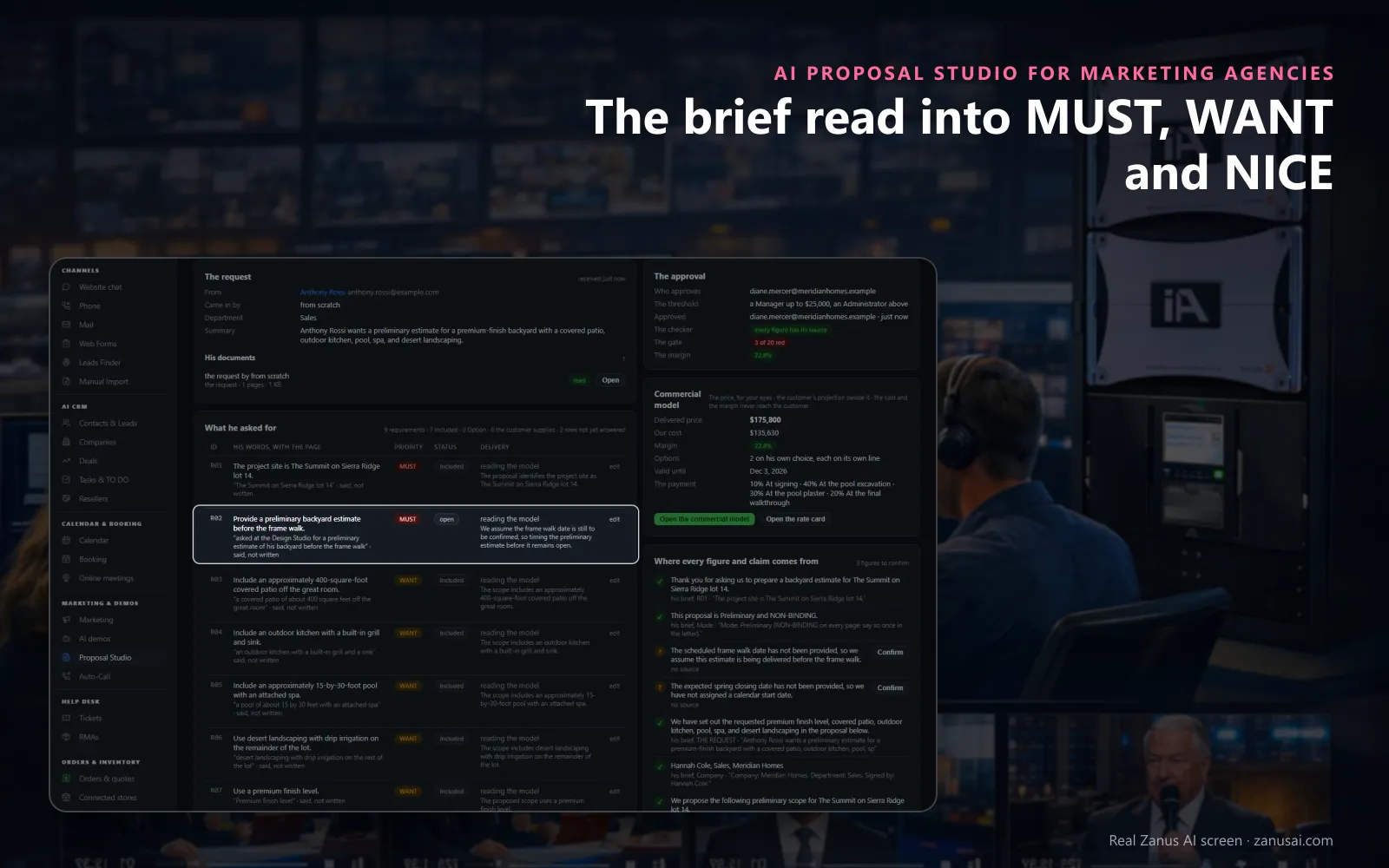
What they asked for
Each line of the client's brief gets its own row with a priority and how the proposal covers it, and an open MUST is yours to decide.
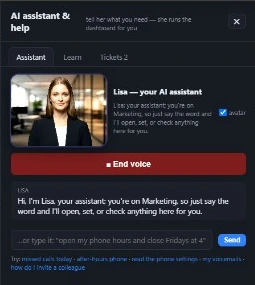 Easy setupSet up everything just by talking to Lisa AISee how ›
You“Make brand-team proposals eight pages at most.”
Lisa“Proposals from the brand department will be eight pages at most, in each mode. Apply?”
You talk. Lisa sets it up. Applied only on your yes.
How Marketing Agencies use it
A retailer mails a twelve-page brief for a spring campaign; every line becomes a MUST, WANT or NICE with the page it was read on.
A tender arrives with eighty requirements; RFP answer mode covers each one line by line, and a MUST left Open waits for your decision.
A prospect opened your proposal four times and went quiet; Call him orders a call from your own line, with the consent read first.
REAL AI - the whole Front Office is AI, not old software with an AI button.
What’s included
- Proposals: every request on its eight steps, with the one next thing to do
- New proposal: from your own words or a mail thread, in five steps on one page
- A proposal open: the request, the register, the questions, the blocks, the price and the approval
- Sent & tracking: opens, last activity, validity, state and the next step
- Blocks & pictures: the blocks a proposal is made of, and pictures from your Images library
- Reports: requested, sent, opened, won, lost, why we lose and what the checker caught
- The customer’s page: accept with his options, ask a question, decline, download the PDF
- Proposal Studio settings: who writes, who asks, who approves, the length, the prices and the doors
Available on its own or inside a solution · See pricing › · Per company, never per seat.
Everything AI Proposal Studio does, for every business ›
Works withAI E-mailAI PhoneAI Web FormsAI DemoAI QuotingAI Auto-CallAI Follow-up
Brief to proposal
Proposal software for marketing agencies, from the brief
From the first mail to the signature, the proposal process runs in one place, and proposal creation draws on a content library you already keep: your Knowledge and your blocks.
From any door
A mail with the brief attached, a web form, a phone call or one you file yourself; the same thread, form or call never opens a second proposal.
Read page by page
The brief and every attachment, scans included, become a register of what the client asked for, each line with its page and MUST, WANT or NICE.
Three questions at most
When something is missing, the AI writes three questions at most; they go by themselves or wait for a person, as each department is set.
Written from your Knowledge
The text comes from your Knowledge, your rate card and your blocks, to the length you set, printed as a PDF on your letterhead.
Priced by code
Every figure is a sum from your rate card and your inventory, so pricing tables are built by code; with no priced line there is no table, and the page says so.
Approved and sent by people
Approval workflows follow the amount: a manager approves, an administrator above your threshold, and only a person presses Send to the customer when the approval is in.
The pitch
AI proposal writing software for marketing agencies' pitches
Document creation starts wherever the brief arrives, so team members never copy a request from one tool into another.
A brief by mail
The mail desk files a proposal request with its thread and attachments, and the finished proposal later answers in that same thread.
A brief on the phone
Lisa takes the name, the company, the e-mail read back once and the project in the caller's words, promises nothing and files the request.
A brief on the website
A form whose Then step is a proposal request files it with the visitor's files, and the receipt goes out at once.
A brief you tell
New proposal is one page in five steps: who it is for, what they asked for, typed or dictated, the documents, how it is written, then Start.
The checks
Agency proposal software that never invents a fee
Better proposals start with numbers nobody has to check twice: every figure is made by code, and every claim carries its source.
Your rate card
Line, unit, price, cost and department on the rate card; Price it now builds the table by code from the lines as they stand.
The margin, for your eyes
Each line with its quantity, price, cost and source, the options, the total and the margin; the cost and the margin never reach the client.
A source for every claim
Every statement is listed with its source, and Confirm is pressed on the ones the checker could not place before anyone approves.
Twenty checks
Every requirement answered, every claim with its evidence, every total equal to its lines, the signer named; Approve lights only when none is red.
Tenders
Agency RFP response software, point by point
Every requirement registered
Each requirement with its code, its words, the page of the brief it was read on and its priority, and Add a requirement for one the reading missed.
Covered line by line
Kept, Option, Allowance, Not offered or Open; the short presets answer each requirement in one line, so eighty requirements fill a few pages.
Its own length
Pages at least and at most for an RFP answer, set per department and counted as Letter pages in the US and A4 elsewhere.
Long documents in full
A twenty-page statement of work is read in full, and several requests opened together are prepared six at a time and land on To review, so small sales teams keep up in a busy tender season.
After the send
Proposal software for creative agencies that follows to the yes
The client's own page
The same pages as the PDF with the version and the validity date; as on interactive pricing tables, ticked options change the total, and a full name signs the acceptance.
Questions in the thread
Ask a question lands on your proposal, and Answer in the thread writes back to the client where the proposal went.
Opened, negotiating, won
Analytics and tracking for each proposal: the opens, the last activity, the validity date and the state, with the one next step written beside it.
Won becomes a quote
Accepted or marked won, it becomes a quote with every line priced, so the sales process carries on, and the client is taken to the deposit when you set one.
Lost, with the reason
Mark lost asks why from your own list, the reason feeds Why we lose, and the win-back plan writes after the days you set.
Expired, then renewed
Past its validity it expires with one mail on how to ask again; Renew writes a fresh draft at today's prices, or Extend adds days.
Compared
Proposal software for design agencies, compared
What each way of writing a pitch, from proposal templates to proposal management software, does with the same client brief.
| What a pitch needs | Templates and copy-paste | Classic proposal software | A free AI proposal generator | AI Proposal Studio |
|---|---|---|---|---|
| Starts from | The last pitch's document | A template library | A prompt you type | The client's brief: read page by page |
| The requirements | Read by whoever writes | Checked by hand | Not tracked | A register: MUST, WANT or NICE with the page |
| The fees | Copied and edited | A pricing table you fill in | Whatever the AI writes | Summed by code: from your rate card |
| Facts and claims | From memory | From saved blocks | Unchecked | Each with its source: and twenty checks |
| Who sends | Whoever finishes | The writer | You paste it | A person, after approval: never the AI |
| After the send | A reminder to chase | Opens tracked | Nothing | Tracked to won or lost: with a call from your line |
Set-up
Agency proposal software, set up in 2 minutes
Not one more proposal tool to feed by hand, and ease of use comes from talking: tell Lisa who writes and who approves, and she shows each setting before and after.
Who writes and who asks
Per department, the AI writes and a person reviews, and the AI asks the client or a person asks; Lisa applies it on your yes.
Who approves
The amount a manager approves up to, the approvers and the reminders; above that amount, an administrator decides.
Your rate card and your look
Add the rate card lines and the payment stages, your letterhead and your footer line; your inventory is read as it is.
Seven days on real briefs
Run it free on your own incoming briefs for a week with no credit card; create, send and track real proposals, reading each one before it leaves.
Questions & answers
Questions about agency proposal software and proposal management
What is agency proposal software?
Software that turns a client's brief into a proposal the client can accept, so a small team can create professional proposals without a writer on every pitch. AI Proposal Studio reads the request and its documents page by page, asks what is missing, writes from your knowledge and blocks, prices by code from your rate card, and follows the proposal until it is won, lost or expired.
Can AI write a marketing agency proposal from a brief?
Yes. Forward the mail with the brief, or let a form or a call file it, and the brief is read into a register of requirements with the page each came from. The proposal is then written from your own Knowledge and blocks, as a PDF on your letterhead.
Does it invent case studies or results?
No. Every statement is listed with its source, the checker marks any it could not place for a person to confirm, and the approval waits while the checker is red. What it writes comes from your Knowledge, your rate card and your own blocks.
Where do the figures in a proposal come from?
From your rate card and your inventory, summed by code; the AI never writes a number. The cost and the margin stay on your side of the screen, and under your margin floor an administrator decides.
Can a proposal leave the fees for the conversation?
Yes. Proposals without prices are one preset away: a prices-on-request preset prints no figure on any page, lists what is included on the investment page and closes with the next step in your words; the client answers I am interested, let us talk.
How does it handle a formal RFP or a tender?
RFP answer mode reads every requirement into the register with its code, its words, its page and its priority, then covers each one as Kept, Option, Allowance, Not offered or Open. A MUST left Open or Not offered is yours to decide before approval.
Who approves a proposal before it goes?
A manager up to the threshold you set, an administrator above it. Only a person presses Send to the customer, after the approval, and a new version after an approval needs a new approval.
What does the client see?
The client's own page, with the same pages as the PDF, the version and the validity date. Options ticked change the total, a question goes into the thread, and a full name typed signs the acceptance.
Can we see if a prospect opened the proposal?
Yes. Sent & tracking shows how many times it was opened, the last activity, the validity date and the state. A proposal nobody opened is a reason to call, not to resend, and Call him orders a call from your own line.
What happens when a pitch is won or lost?
Won, it becomes a quote with every line priced and the client is taken to the deposit when you set one. Lost asks the reason from your list, which feeds Why we lose, and a win-back plan writes after the days you set.
Can a proposal request from a rival agency be held?
Yes. A request from a domain on your competitors list waits for a person: no receipt goes and nothing is read until someone presses Start the reading or declines it.
How long does agency proposal software take to set up?
Two minutes. Tell Lisa who writes and who approves in each department and the length a proposal should run, then add your rate card lines and letterhead; your Knowledge already holds the blocks, and the 7-day trial needs no credit card.
Keep exploring
Where next?
Start with the one thing you need. Add more anytime by asking Lisa.
AI Front Office for Marketing Agencies ›
Easy setup
Answers & books
Sells
Helps your team
Included
Award-winning AI
Winner at CES 2026, ISE 2026 and TMCnet Enterprise AI Product of the Year.
REAL AI - the whole Front Office is AI, not old software with an AI button.
Awards & trade shows ›


Give Lisa your website.
She sets up your business in 2 minutes.
Other software makes you learn it. Zanus AI learns your business.
Try it free on your own business — no credit card, per company, never per seat.
Ready to buy? See plans & pricing ›
Or call +1 (954) 736-3939 — the AI answers.