AI Marketing for Marketing Agencies. Email marketing for agencies' own leads and clients
AI Marketing is email marketing for agencies that runs the agency's own campaigns: announcements, case-study newsletters and event invitations to your own leads, past clients and partners, filtered from AI CRM's lists. Each mail is written from your knowledge in the contact's language, and every reply is answered or followed up. It never runs campaigns for your clients.
TRY AI MARKETING FREENo credit card · Ready in 2 minutesReady to buy? See plans & pricing ›
7 days free · per company, never per seat · nothing to install
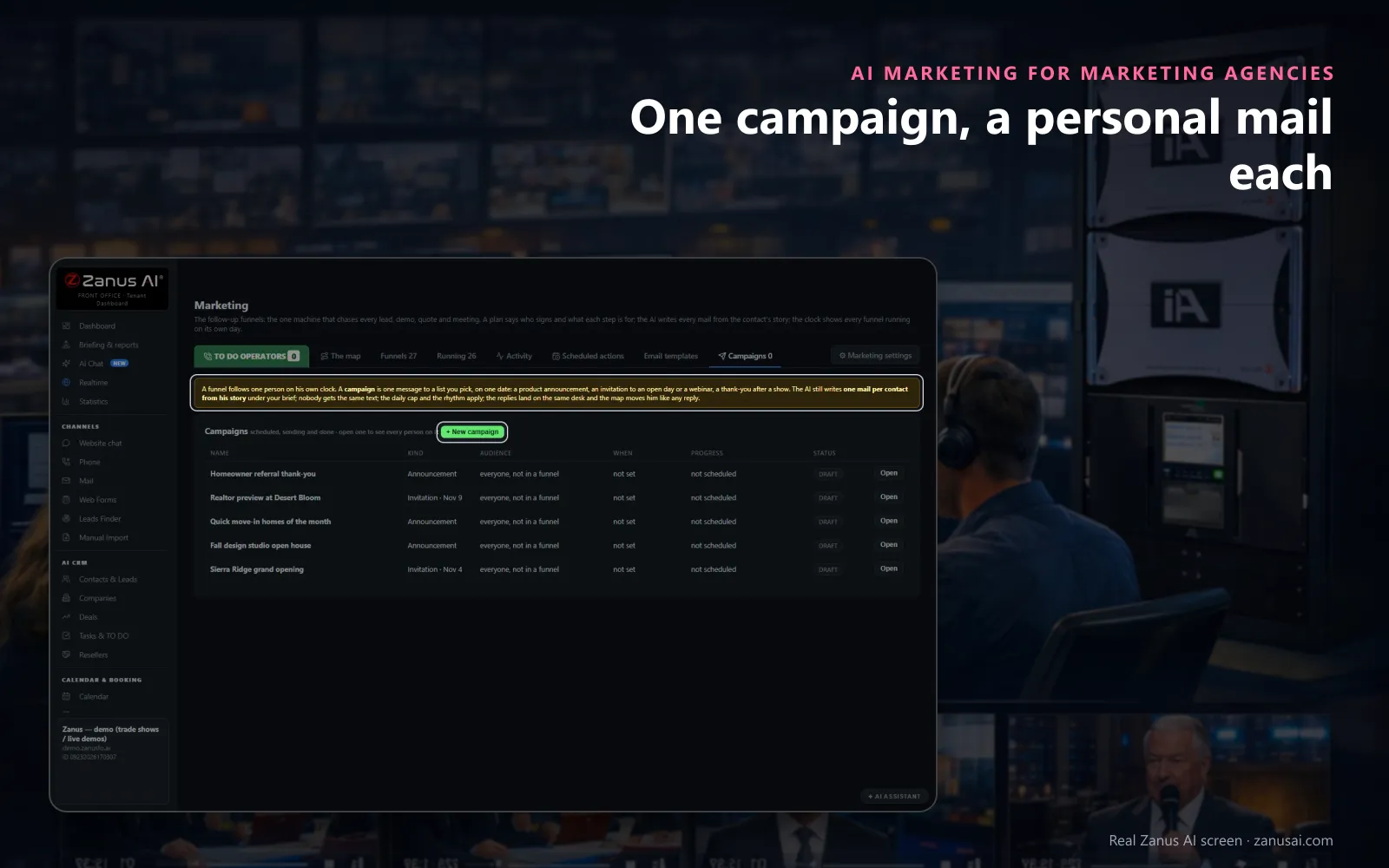
Campaigns
An announcement, an invitation or a thank-you goes to the list you pick on one date, and the AI still writes each contact a mail of their own.
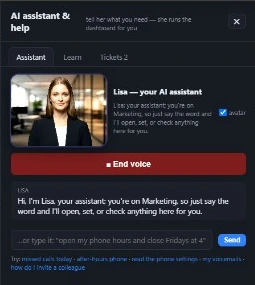 Easy setupSet up everything just by talking to Lisa AISee how ›
You“Mail our case-study newsletter only to contacts in Germany and Austria.”
Lisa“The case-study newsletter will go only to contacts whose country is Germany or Austria. Apply?”
You talk. Lisa sets it up. Applied only on your yes.
How Marketing Agencies use it
The founder tells Lisa to announce your new retail media service to past retail clients in AI CRM; she writes it and waits for the yes.
Your webinar on search trends gets its invitation, its reminder and its thank-you, and each registration lands on the contact's record.
A brand manager replies to the case-study newsletter asking whether you work with food brands; the answer comes from your knowledge and your lead is alerted.
REAL AI - the whole Front Office is AI, not old software with an AI button.
What’s included
- Campaigns and events to segments of your contacts
- Templates written from your knowledge, in each customer's language; consent and frequency rules
- Replies handled by Front Office, a question gets an answer, an interest gets a follow-up
- Results on each customer's record; deliverability report
Add it to AI E-mail or get it inside a solution · See pricing › · Per company, never per seat.
Your own campaigns
Email marketing for agencies, from AI CRM's lists
Whether you're a studio of six or a digital marketing agency of sixty, your own contacts are already in AI CRM, from every call, chat, brief form and mail. A campaign starts with a filter instead of an import, and the email list is made of people who already know the agency.
Filter who gets it
Tag, kind of contact, source, country, language, deal stage or the date of the last contact: past retail clients, this year's prospects or the referral partners in one country are each one filter away, read from the records your team already works with.
No list to export
Prospects, clients and partners captured by the phone, the chat, the brief forms and the inbox are already contacts, each with its consent state on the record, so nobody exports a spreadsheet, cleans it and uploads it to another tool before a send.
Now or scheduled
Send the email campaign at once or schedule it for the morning of a launch; it leaves paced under your daily limit, during each contact's own sending hours, and Scheduled actions shows the send beside the day's other work.
A preview per language
Read the campaign in every language it goes out in before a single mail leaves the agency's domain, so the partner who speaks Spanish checks the Spanish version while the founder reads the English one.
Ask Lisa for it
Say tell our past retail clients about the new content studio, and Lisa writes the marketing campaign from your knowledge for that group, then waits for your yes; any rule she changes is shown to you before and after.
From your own domain
Campaigns leave from the agency's own sending domain through AI E-mail, with SPF, DKIM and DMARC checked live on every send, so there is no separate email service to connect and replies come back to a mailbox your team reads.
The words
Agency email marketing written for each reader
In email marketing for marketing agencies, a campaign is one message to one list, yet no two contacts receive the same words. Your email templates give every mail the agency's frame, and the AI writes what goes inside for each reader, from your knowledge and from what that reader already told you.
Written from your knowledge
The draft comes from your website, your services and your policies, so the mail says what the agency really offers, draws its case studies from your own pages and sticks to the disciplines you practice.
Each contact's own language
The template is written in each language your contacts speak, so a brand manager in Munich reads German, one in Lyon reads French, and nobody on the team translates a newsletter by hand the night before it goes.
The AI drafts, you edit
The AI writes the first version; a copywriter of the agency edits it, subject line and all, every version stays on file for the next campaign, and nothing leaves before a person says yes.
Your frame and signature
Every mail sits in the agency's own template with your logo and colors, and merge fields fill in the contact's name, the company and the signature of the person who sends it.
A sender they recognize
Choose the sender name and the reply-to mailbox your team reads; a real first name from the studio, such as the new-business director's, reads better than a team name and brings the replies to the right person.
Notes the AI reads first
A note on the contact, such as asked about retail media at the awards dinner, is read by the AI before it writes, so the campaign mail picks up where the last conversation stopped.
The agency year
Agency newsletter campaigns: an email marketing strategy for the year
A small agency team does not need a weekly newsletter to have a marketing strategy of its own. It needs a handful of email marketing campaigns a year, each sent to the target audience it concerns, written well and followed up. These are the moments worth a mail.
A new service
One campaign to the contacts it concerns, such as past retail clients for a retail media offer, rather than the whole list, so the announcement reads as relevant news and not as one more promotion in a crowded inbox.
The case-study round-up
Two or three case studies worth showing, sent to the prospects who asked about that discipline and the clients who might want it next, each mail written from what its reader asked the agency before.
A webinar or a showcase
The invitation, the reminder and the thank-you mail each go out on their own date, and every registration is tracked on the contact's record, so the follow-up after the event knows who registered.
Award season
A shortlisting or a win, announced to the prospects and partners who know you, paced so the agency's domain stays healthy even when the whole list hears the news in the same week.
Past clients, a year on
Clients whose last contact was a year ago, filtered by that date, hear what the agency does now and who to call about it, often the easiest lead generation a marketing agency has.
Referral partners
Partners filtered by their kind of contact get a mail of their own about the services they can send your way, written for a partner rather than a buyer and signed by the person who looks after them.
The replies
Email campaigns for marketing agencies that answer back
A social media post reaches whoever the feed shows it to; a campaign reaches the contacts you chose, and they can answer it. Every reply goes through AI E-mail, so a campaign starts conversations instead of filling an inbox nobody has time to sort.
Questions answered
A contact who replies with a question, such as whether the agency runs retail media in Spain, gets the answer from your knowledge through AI E-mail, in their own language, while the question is still fresh.
Interest followed up
An interested reply starts the right follow-up funnel, written by the AI from the contact's story and signed by a person of your team, and alerts your new-business lead while the prospect is still warm.
A call when it matters
The contacts to call appear on your team's list in their own time zone, with why to call and the whole story on one card, so a partner rings the brand that replied rather than the one that only opened.
A reply stops the sequence
The follow-up stops the moment the contact answers, and the contact reaches your team with the reason, so nobody receives the next mail after saying yes or asking for a call.
A ladder for each kind of contact
Buyers, technical influencers, partners and contacts whose potential is still unclear each get a follow-up ladder of their own after the campaign, so a procurement lead and a referral partner are not chased the same way.
On the contact's record
The reply, the answer and what happened next sit in the contact's story, beside the calls, chats and quotes, so the account lead who picks up the thread next week reads it all in one place.
Consent and pace
Email marketing software for agencies that keeps trust
Email marketing automation should protect a contact's trust and the agency's domain at once. Every rule below holds for each send, whoever started the campaign, so nobody has to make sure by hand that a contact may be mailed today.
Consent first
Each contact carries an opt-in state on the record, and only those who may be mailed receive a campaign from the agency, whichever channel first brought them in and whoever on the team builds the list.
A frequency cap
A frequency rule caps how many marketing mails one person receives, so a prospect on the newsletter, the webinar list and the award announcement is not flooded in a single week.
Unsubscribe, forever
An unsubscribe is honored at once and forever: that contact never receives the agency's marketing mail again, from any campaign or sender, and the sequence view shows them as unsubscribed.
A pace for your domain
Fifty marketing emails a day to start, a gap of at least 90 seconds between sends plus a random pause, and the rest held for tomorrow, so a long list never reaches the receiving servers all at once.
Sending hours per time zone
Each contact receives the mail during their own day, by the sending hours you set for each time zone, so a brand manager in Singapore and one in Chicago both find it inside their working hours.
Deliverability report
Bounces, complaints and engagement, plus the sender domain's health: SPF, DKIM and DMARC must all read PASS. It is where the agency watches its email deliverability, campaign after campaign.
Compared
Agency email marketing compared: inbox, tool, outside agency or AI
Of all an agency's marketing channels, email is the one it owns outright, and there are four ways to run it. Most top email marketing tools assume a marketing department: someone to design templates, build automation workflows, write subject lines and watch open rates. Outside email marketing agencies take the job on from a brief you write. Here is what each does with one marketing campaign.
| What the campaign needs | From your inbox | A classic email marketing tool | An outside email marketing agency | AI Marketing |
|---|---|---|---|---|
| The list | Copied from a spreadsheet | Exported and imported | Sent to them as a file | Filtered from AI CRM: every call, chat and form |
| The words | One mail for everyone | A template someone designs | Their copywriters, from your brief | Written per contact: from your knowledge |
| The languages | Yours only | One version per language you translate | The languages they cover | Each contact's own language: with a preview for each |
| Finding words that work | Gut feeling | A/B testing subject lines on a sample | Tests they run for you | No test needed: each mail written for its reader |
| Consent | Remembered by someone | A list field to keep current | Your list, their process | An opt-in state per contact: and a frequency cap on every send |
| The pace | Whatever the inbox allows | Set by your settings | Set on their platform | Paced under a daily limit: in each contact's hours |
| The replies | Mixed into your inbox | Left for someone to read | Forwarded back to you | Answered or followed up: and the lead alerted |
| The results | Guesswork | Open rates in a report | A report they send | On each contact's record: beside calls and quotes |
Set-up
Email marketing for agencies, set up in 2 minutes
The agency's contacts are already in AI CRM and Lisa has read your site, so the first campaign needs a domain, a sender and your yes. The strategy stays the agency's; the writing, the pacing and the replies are handled for you.
Trained on your website
Lisa reads your services, work and about pages, so every campaign is written from what the agency really offers and the way it says it, with the case studies you already publish.
Your sending domain
Connect the agency's domain in AI E-mail; SPF, DKIM and DMARC are checked live until all three read PASS, and the deliverability report keeps watching them from the first campaign on.
Your sender and rules
Pick who the mails come from, the reply-to inbox the agency watches, how many go out a day and at which hours; Lisa shows each setting before and after and applies it on your yes.
Seven days, your own contacts
Try it free for a week on the agency's own contacts with no credit card, send a first campaign to a small group, and read every mail before it leaves.
Questions & answers
Questions about email marketing for agencies
What is email marketing for agencies?
It is the email a marketing agency sends for itself: a new service announced, a case-study newsletter, an event invitation or a seasonal offer to its own leads, past clients and partners. AI Marketing writes each mail from your knowledge in the contact's language, sends it at a pace that protects your domain, answers the questions that come back and follows up the interest.
Does AI Marketing run email campaigns for our clients?
No. It mails the agency's own contacts from the agency's own domain, chosen from AI CRM's lists. There is no account per client and no campaign managed on a client's behalf, so it never replaces the email marketing services you sell to clients. It is the agency's own channel for new business, newsletters and events, run from the same Front Office that answers your phone and inbox.
How does a small agency team run its own email marketing strategy?
Decide who should hear what, then let the software carry the rest. A small team picks four or five moments a year, such as a new service, a case-study round-up, a webinar and an award, and a target audience for each from AI CRM. Lisa writes every campaign from your knowledge, the pace and consent rules run by themselves, and replies come back as conversations.
Where does the email list come from?
From AI CRM. Every prospect, client and partner who called, chatted, filled in a brief form or wrote is already a contact, with its consent state. A campaign starts from a filter: tag, kind of contact, source, country, language, deal stage or the date of the last contact. There is no email list to export, clean and import before each campaign, and only contacts who agreed are mailed.
Can we schedule a campaign and send it in several languages?
Yes, both. Send at once or schedule it for the launch date you choose; it leaves paced under your daily limit and inside each contact's own sending hours, so a mail due at night waits for their morning. The template is written in each language your contacts speak, from the same knowledge, and a preview per language shows every version before one mail leaves.
Who writes the campaign, the AI or our copywriters?
Both. The AI writes the first draft from your website and knowledge, a copywriter of your team edits it inside your own template, every version is kept, and nothing goes before your yes. Instead of A/B testing subject lines on a sample, each mail is written for the contact who reads it, from that contact's story with the agency.
What happens when a contact answers a campaign?
Every reply goes through AI E-mail. A question is answered from your knowledge in the contact's language; an interested reply starts the right follow-up, written from the contact's story and signed by a person of your team, and alerts your new-business lead. The follow-up stops the moment the contact answers again, and the contacts to call appear on your team's list in their own time zone.
How do SPF, DKIM and DMARC protect our email deliverability?
They prove to the receiving inboxes that a mail really comes from your domain. Connect the sending domain in AI E-mail and all three are checked live until they read PASS; the deliverability report then keeps watching them beside bounces, complaints and engagement. The pace helps too: fifty marketing emails a day to start, at least 90 seconds plus a random pause between two sends.
How are consent, frequency and unsubscribes handled?
Each contact carries an opt-in state, and only those whose consent allows it receive a campaign. A frequency rule caps how many marketing mails one person gets, however many campaigns run that month, and an unsubscribe is honored at once and forever. Nobody has to remember these rules: they hold for every campaign, so a busy launch month never floods a client's inbox.
How do we see how a campaign did?
An open rate is only the start. Delivered, opened, clicked and replied are written on each contact's record, each campaign's totals sit in one place, and beside them is what came next: the answer sent, the follow-up started, the new-business lead alerted. Scheduled actions lists what is due day by day, from campaign sends to follow-up steps and the calls your team promised.
What should an agency look for in email marketing software?
Start from what the best email marketing tools for agencies do: a clean list, consent, a sending pace that protects the domain, and results you can act on. Then make sure the tool fits a small team: AI Marketing reads its list from AI CRM, writes each mail from your knowledge, answers the replies and needs no email design or automation workflows built first.
How much does AI Marketing cost an agency?
It is priced per company, never per seat, so the whole agency works in it under one subscription, and a new hire adds nothing. There is no separate email service to connect either: campaigns leave through AI E-mail from your own domain. The modules and plans are listed on the pricing page, and the 7-day trial needs no credit card.
Keep exploring
Where next?
Start with the one thing you need. Add more anytime by asking Lisa.
AI Front Office for Marketing Agencies ›
Easy setup
Answers & books
Sells
Helps your team
Included
Award-winning AI
Winner at CES 2026, ISE 2026 and TMCnet Enterprise AI Product of the Year.
REAL AI - the whole Front Office is AI, not old software with an AI button.
Awards & trade shows ›


Give Lisa your website.
She sets up your business in 2 minutes.
Other software makes you learn it. Zanus AI learns your business.
Try it free on your own business — no credit card, per company, never per seat.
Ready to buy? See plans & pricing ›
Or call +1 (954) 736-3939 — the AI answers.