AI Front Office for Government Agencies. An AI receptionist for government agencies and program offices
Zanus AI is an AI receptionist for government agencies that answers the public line, the website chat, program inboxes and online forms day and night, in each caller's language. It explains benefits, licensing and filing steps from your approved pages, books visits and files requests, while eligibility and every decision stay with your staff.
TRY IT FREE NOWNo credit card · Ready in 2 minutesReady to buy? See plans & pricing ›
7 days free · per company, never per seat · nothing to install
Easy setup
Answers & books
You talk. Lisa sets it up.
You“Send eligibility questions to the program desk; after 5 PM, the AI answers first.”
Lisa“Here is the change: eligibility questions route to the program desk, and after 5 PM the AI answers first. Apply?”
Any setting, in any module · applied only on your yes
Start with the one thing you need. Add more anytime by asking Lisa.
The whole Front Office › · All industries ›

Who reaches you
Who the AI answers for Government Agencies
- Applicants asking which documents a benefit or license needs
- License holders facing a renewal date or a lapsed credential
- Business owners registering, filing or answering a notice
- Vendors and grantees asking where a payment or report stands
- Constituents writing to a program office about their case
- Family members and accountants calling on someone's behalf
What it does
What an AI receptionist for government agencies does
One front office behind the numbers, pages and addresses constituents already use, answering from what your agency publishes.
The public line
Callers ask in natural language about benefits, licensing and filing, hear an answer on the first ring, and are routed by reason and language to a program desk or a named colleague.
The agency website
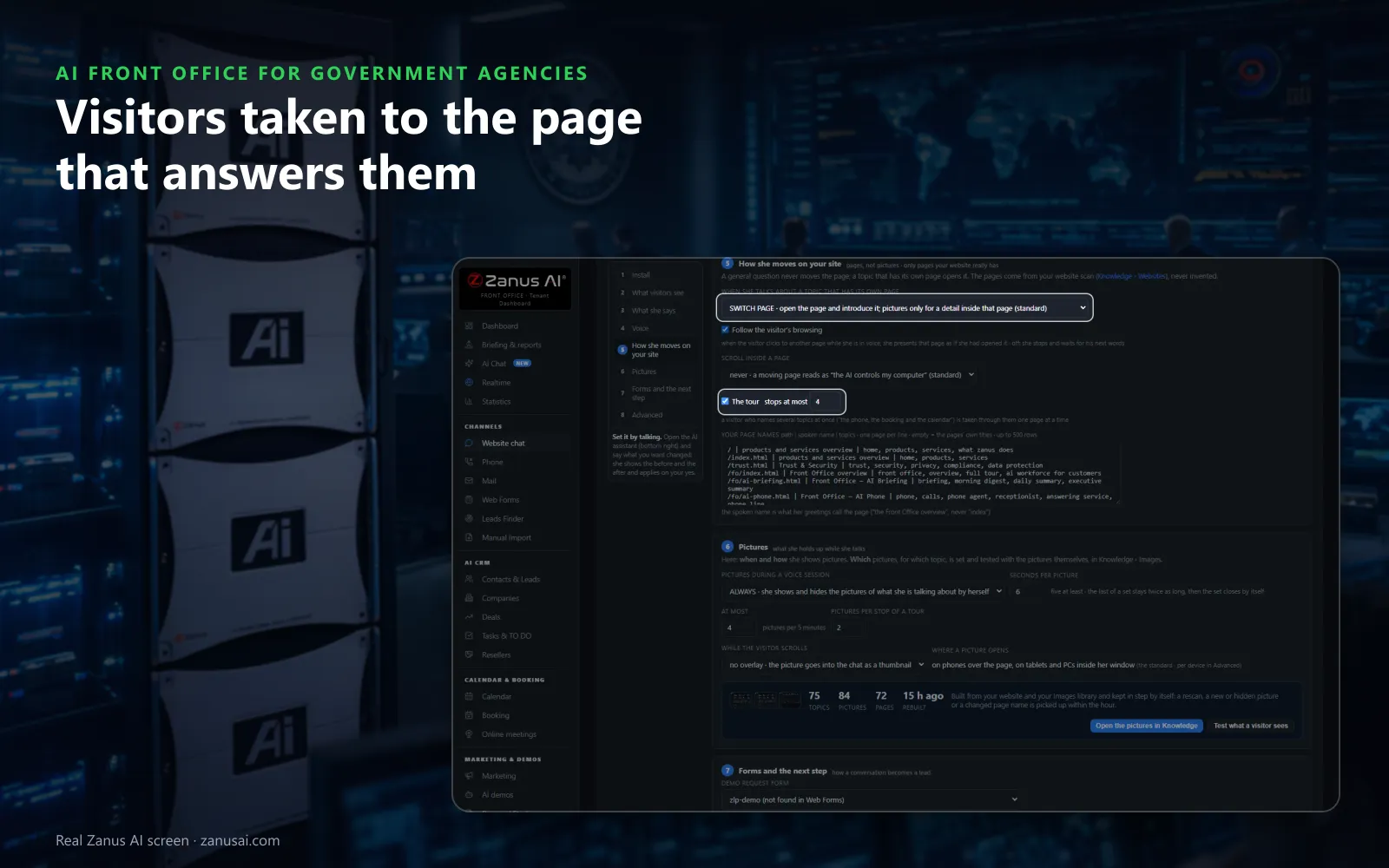
Visitors ask by text or voice on any page; the chat answers from your pages in their language and opens the page that explains the procedure.
Program inboxes
Mail to each program address lands on its own desk with a reply drafted from your approved information, sent alone or after a staff member's click.
Online forms
Applications, registrations and questions sent through your forms are acknowledged on the spot, the e-mail verified and the owning desk told.
Counter visits and interviews
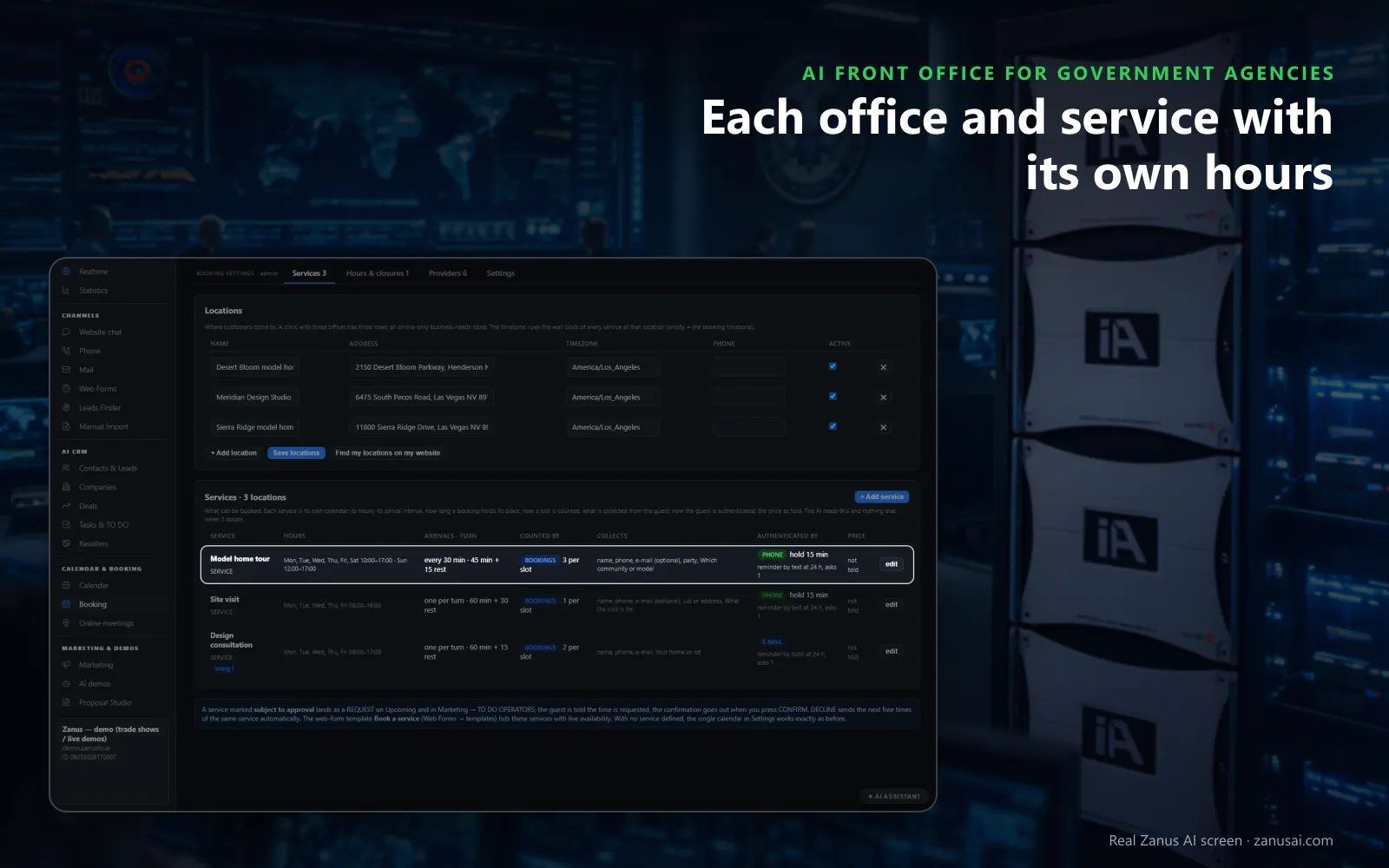
Through appointment scheduling on the phone and in the chat, document checks, counter visits and phone interviews go into free slots only, each applicant verified and the confirmation sent at once.
Numbered requests
Status questions, address changes and complaints become tickets with the whole conversation attached, so no request waits in a voicemail box.
The agency year
Citizen services AI for the busiest weeks of the agency year
The agency calendar decides the call volume of each month; these are the weeks when call volumes peak and AI-enabled citizen services still answer every caller on the first ring.
Renewal season
Licensees all ask the same questions in the same month; each hears your approved answer on the first ring, and the chat opens the renewal page.
The morning after a mailing
When notices land in mailboxes the calls start at opening time; nobody waits in a hold queue, and every caller hears the same reading of the letter.
A filing deadline
Businesses call and write in the last days of a filing period; their forms are acknowledged at once, and extension questions reach the desk that decides.
A program opens
A new benefit or grant program brings a wave of who-can-apply questions; the AI explains the published criteria, and eligibility stays with your caseworkers.
A rule changes
Staff update the guidance page once; the daily scan reads it, the approved questions are replayed, and every channel answers from the new version.
Vendor payment days
Vendors and grantees ask where a payment stands; the AI gives your published payment terms and files a ticket for finance when someone must check.
Real screens
Constituent services software on real Zanus AI screens
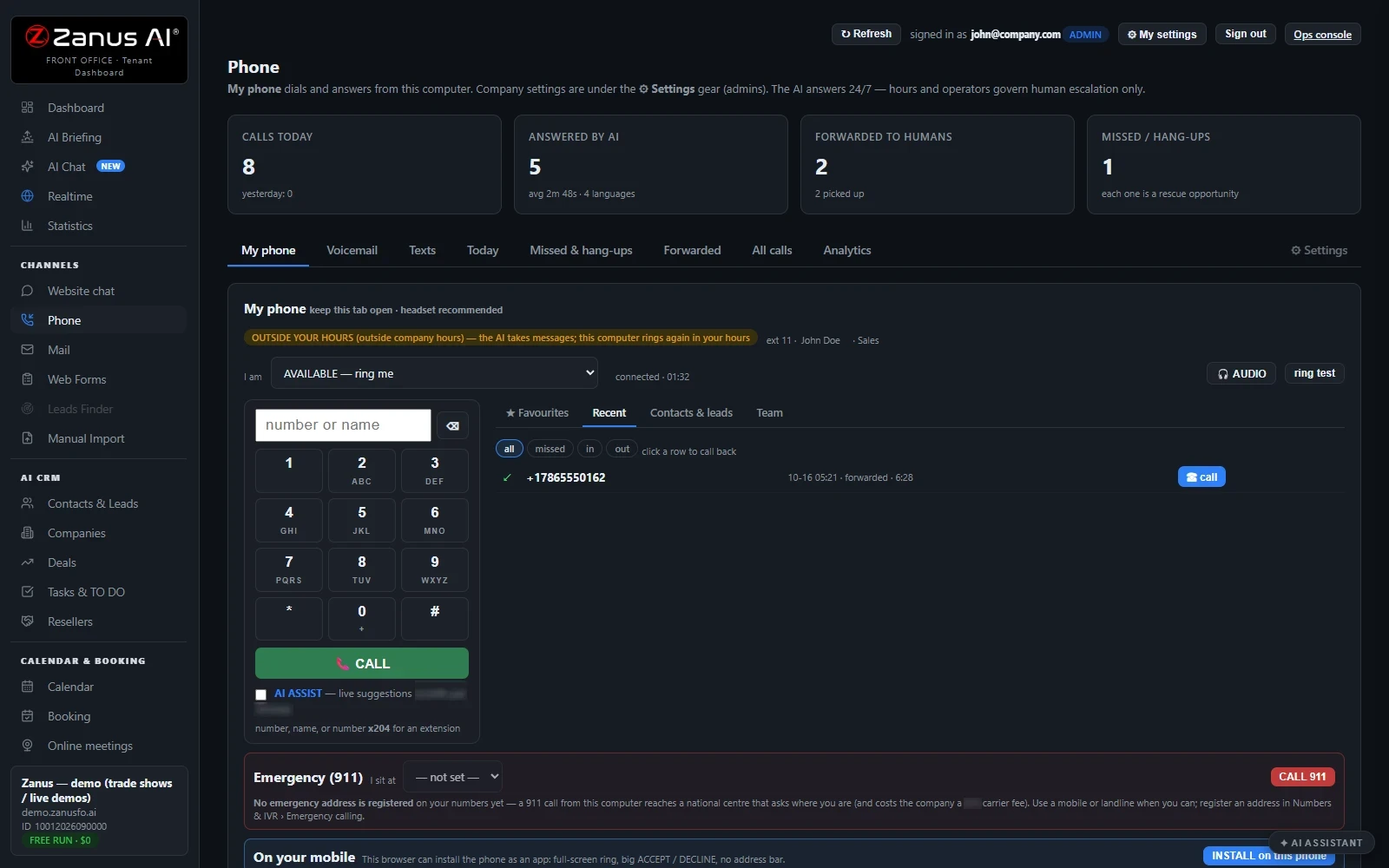
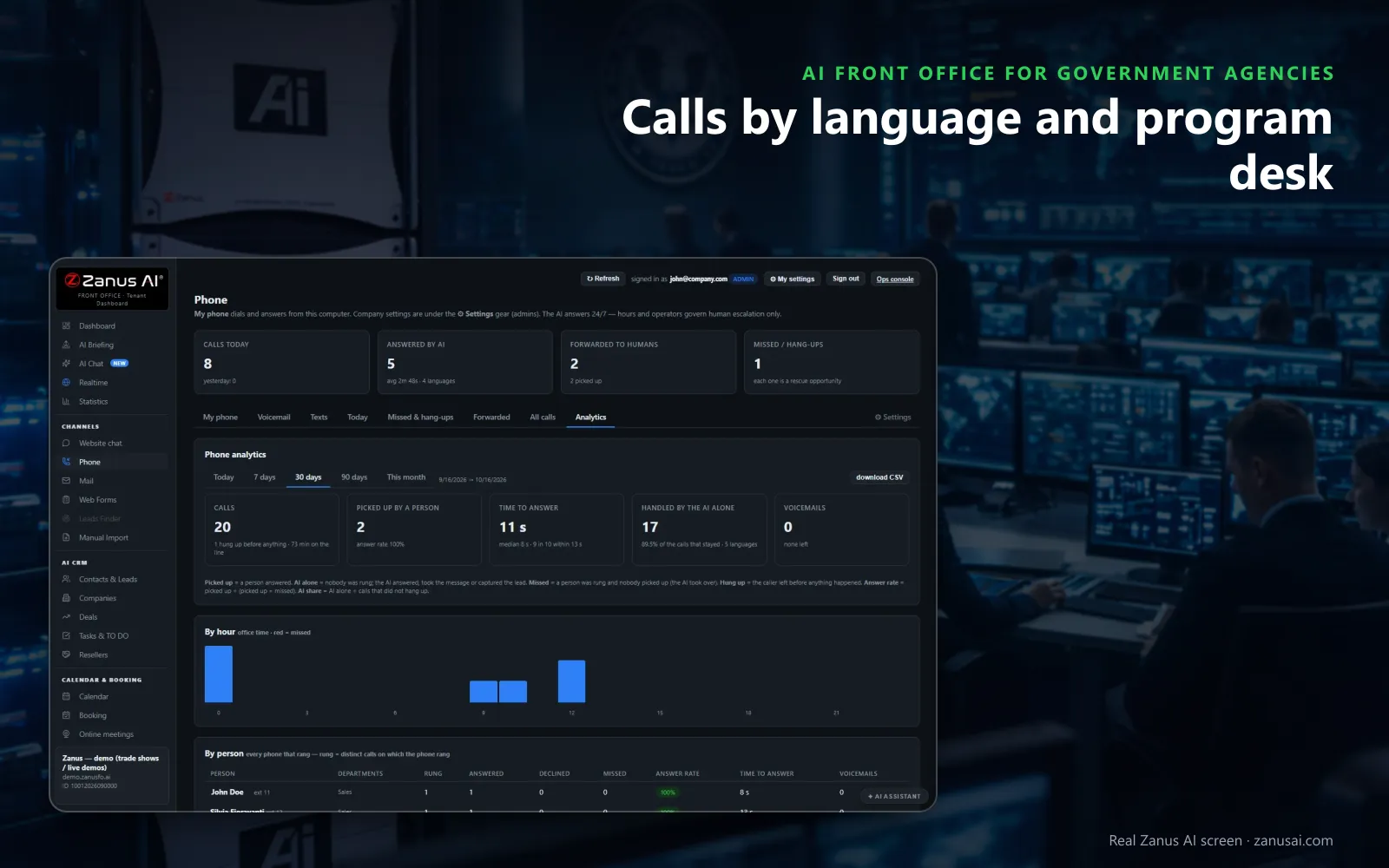
Each picture is a real screen with demo data; the caption says what it does for a program office.
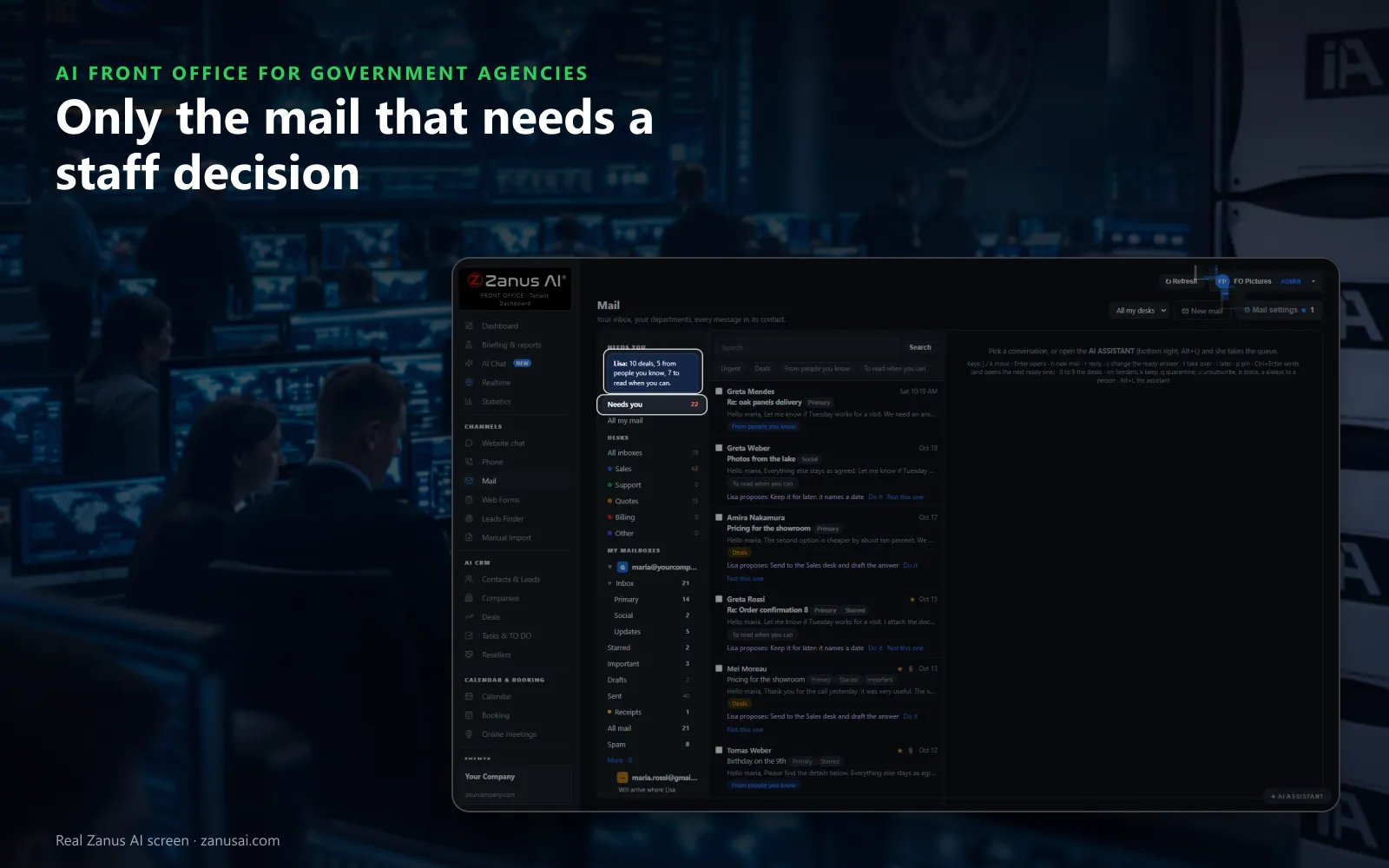
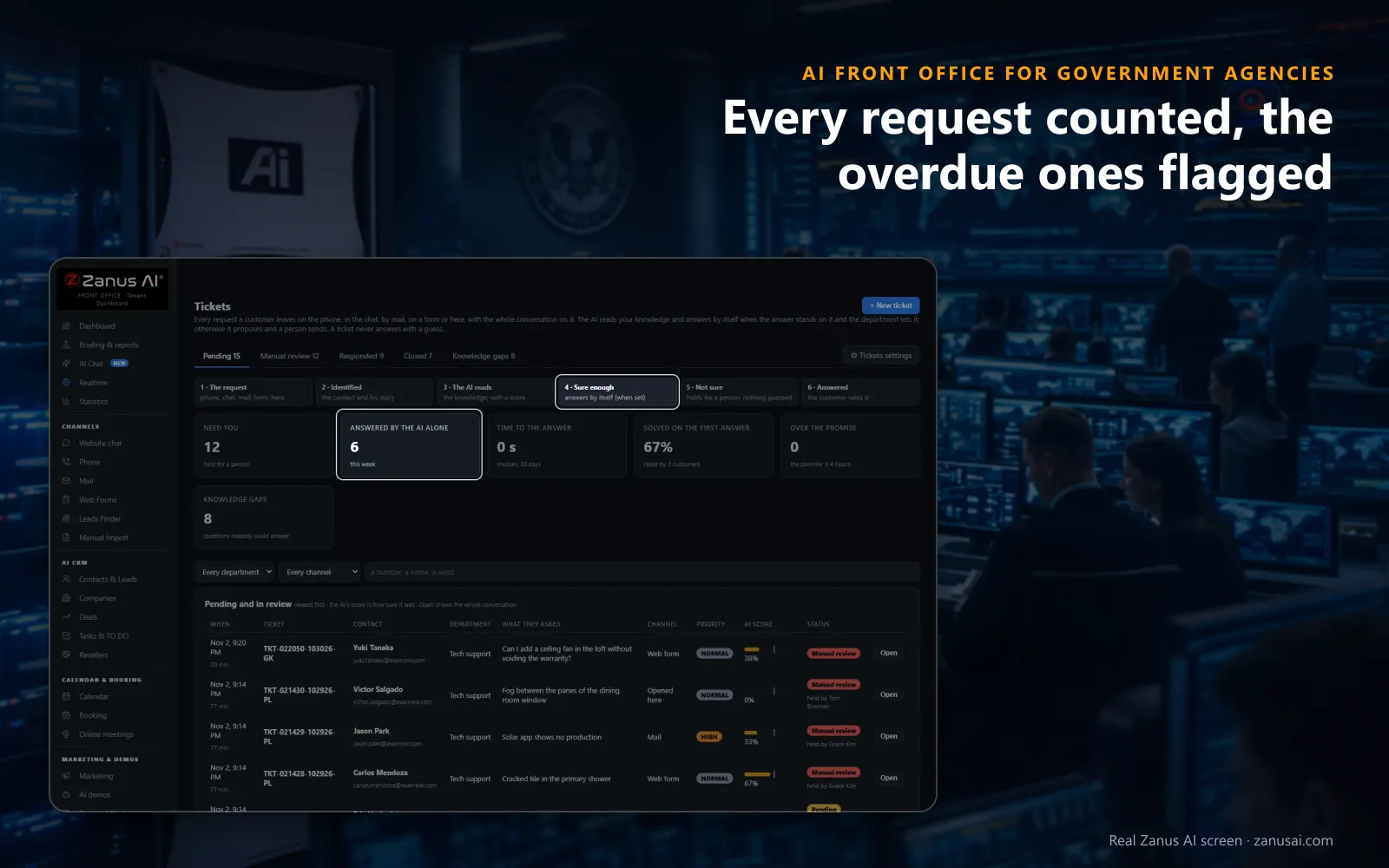
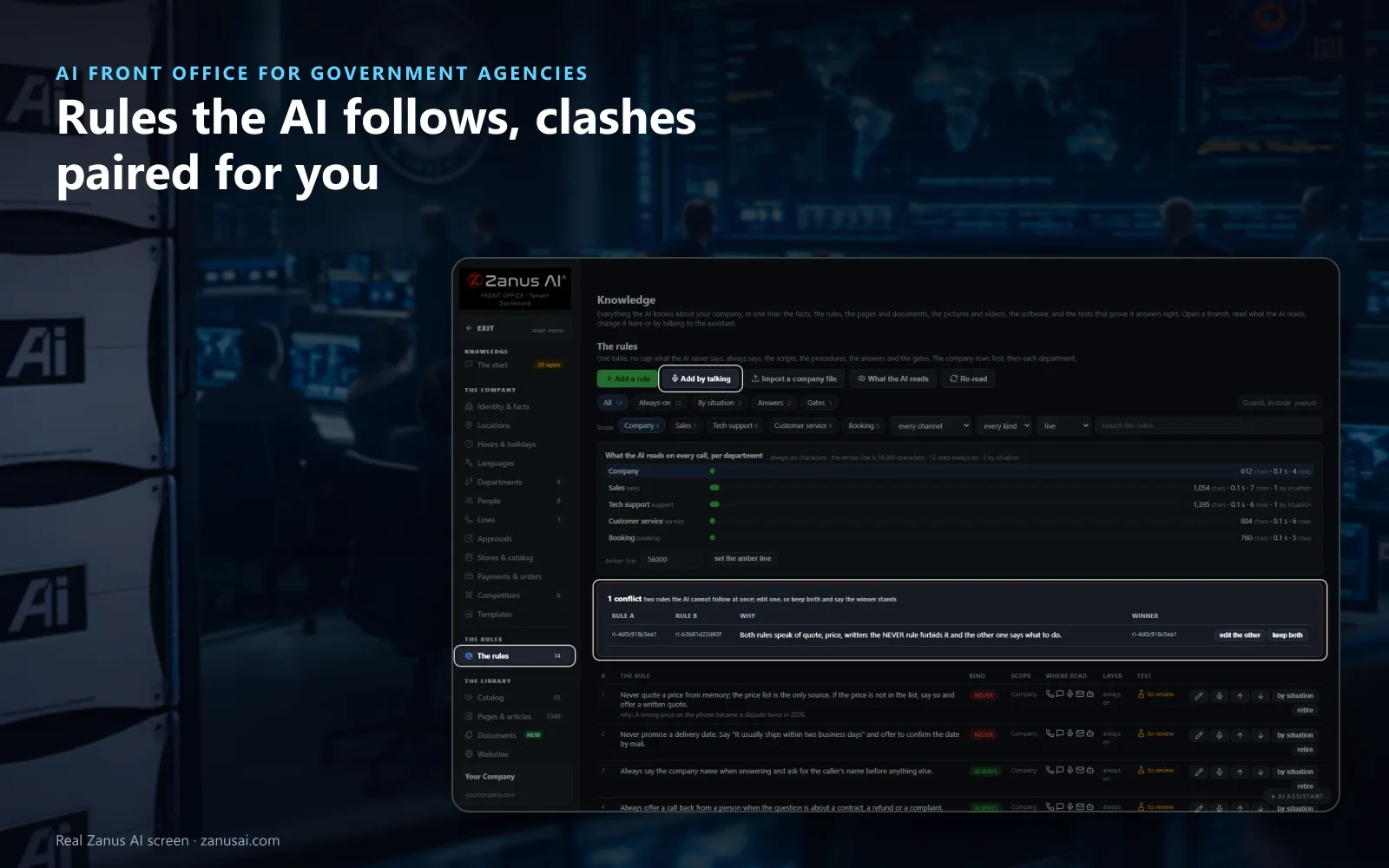
Compared
A virtual receptionist for government agencies, compared with today's options
What a constituent meets on the public line today, from staff between cases to an outsourced call center, and how call handling changes when the AI answers it.
| What constituents need | Staff between cases | A recorded menu and voicemail | An outsourced call center | Zanus AI |
|---|---|---|---|---|
| The morning after a mailing | Lines busy and callers on hold | A queue, then a message box | Agents reading a script they were sent | Every call answered on the first ring,: each caller hearing your approved explanation |
| Questions about eligibility | Answered by whoever is free | Not answered at all | Agents with no authority to decide | The published criteria explained,: and the decision transferred to your program staff |
| Callers in other languages | Depends on who is on shift | A menu in one or two languages | Depends on the agents scheduled | Answered in the caller's language,: with a route to bilingual staff where you set one |
| Nights, weekends and holidays | Closed until the next business day | A recording with office hours | Covered for the hours in the contract | Answered all night,: with messages filed by desk and callback numbers read back |
| The record of each call | Notes typed if time allows | A voicemail to listen to | A report from another company's system | A transcript and summary on the constituent's record,: beside their mail, chats and requests |
Guardrails
What a government agency keeps for its own staff
Eligibility and benefits
Whether a person qualifies, how much a benefit is and when it is paid are decided by your caseworkers; the AI explains the published rules and passes the question on.
Licenses and enforcement
Issuing, renewing, suspending or reinstating a license, and any penalty, stay with your staff; the AI explains the process and files the request.
Legal and tax advice
Questions about what someone should do legally or financially go to a person; the AI answers only from information your agency approved.
Appeals, complaints and the press
An appeal, a complaint about staff or a reporter's question goes to the desk you named for it, where a person writes the answer.
A person when asked
A caller who asks for a person is transferred with the reason announced, or leaves a message filed for the right desk.
Your systems of record
Case files, benefit records and license databases stay in your own systems; the Front Office keeps the conversations, bookings and requests.
Set-up
Set up your AI receptionist for government agencies in 2 minutes
Give Lisa your website
Lisa reads your agency's pages on programs, licenses, forms and offices, the frequently asked questions included, then asks which program desks take which kinds of calls.
Name desks and hours
Tell Lisa each program desk, the staff who answer it, office hours, state holidays and the languages your constituents use.
Forward the public line
Forward the numbers printed on your letters and website; calls are answered from that moment, with no porting and nothing to install.
Read a week of calls
The trial lasts 7 days, without a credit card; at the end, read the record of every call, chat and request the agency received.
Questions & answers
Questions about an AI receptionist for government agencies
Can an AI receptionist answer calls for a government agency?
Yes. It works like a trained front desk on the public line and each program desk, picking up on the first ring, day and night, in the caller's language, and answering only from information your agency approved. Call routing goes by reason and language to the right department, and before a transfer connects your colleague hears who is calling and why.
Does the AI decide eligibility, a benefit, a license or a case?
No. It explains the criteria and steps your agency publishes, then hands every question about a person's own eligibility, a benefit amount, a license decision, an appeal or a penalty to your staff, as a transfer, a message or a ticket with the whole conversation attached.
Is Zanus AI a good fit for a state or federal agency?
It fits agencies whose phones, chat and inboxes carry the same questions every day: which documents, which form, which office, which deadline. That repeated question is the clearest use case, and the AI answers it from your approved pages in each caller's language while every decision stays with staff. Try it for 7 days on your own line before deciding.
Is generative AI safe on a government agency's public channels?
Here it answers only from your knowledge. A sentence your sources do not support is held back, and when nothing is written down the AI says it will verify and come back. Nothing it learns goes live before a staff member approves it, and every rule is tested each night.
Can a caller find out where an application stands?
The AI walks the caller through the processing stages your agency publishes, and with AI Tickets it files a status question for the program desk before the call ends. The confirmation e-mail carries the ticket number, while benefit records and case files stay in your own systems.
Which languages can constituents use?
The phone answers in the caller's language and can route by language to a bilingual staff member. The website chat speaks 40 languages by text or voice, forms are translated into the languages you add, and an e-mail is answered in the language it was written in.
Do we keep the phone numbers our agency already publishes?
Yes. Forward the numbers on your letters and website to the Front Office and the AI answers from that moment, with no porting and no new phone system. If a program office wants a line of its own, a new local number is available.
What do callers hear after hours and on state holidays?
With full AI service after hours, your government agency answering service picks up the calls that used to become missed calls early, late, at lunch or on holidays, and your business hours only decide when a staff member can be reached. A desk may choose take-a-message only or voicemail instead, and on a closure callers hear the message you wrote for that day.
Is it compatible with our agency's privacy rules?
It is built to be compatible with them: call recording is off as shipped, staff-only pages never reach the public channels, each person reads only the mail of the desks their scope covers, and every export of contact data is logged with its author.
What happens when a caller is in crisis or reports an emergency?
Your rules decide what the AI always says on each channel, such as the emergency number to dial, and which desk or colleague takes such a call. The AI does not handle emergencies: it gives your approved words and routes the caller to the person you name.
How much does an AI receptionist for a government agency cost?
It is priced per company, never per seat, so every program desk shares one subscription. You choose the modules your agency needs, the current plans are on the pricing page, and the free trial runs 7 days on your own lines with no credit card.
How long does set-up take, and what does Lisa ask?
The first line answers in 2 minutes. Lisa reads your agency website, asks which program desks take which calls, your office hours and the languages you serve, and shows each change before and after, so nothing goes live without your yes.
Does it replace our case-management or benefits system?
No. It does the front-office work in front of those systems: answering, booking, filing and reminding. Applications, benefit records, licenses and case files stay where they are, and the Front Office keeps the conversation record of each constituent beside them.
Award-winning AI
Winner at CES 2026, ISE 2026 and TMCnet Enterprise AI Product of the Year.
REAL AI - the whole Front Office is AI, not old software with an AI button.
Awards & trade shows ›


Give Lisa your website.
She sets up your business in 2 minutes.
Other software makes you learn it. Zanus AI learns your business.
Try it free on your own business — no credit card, per company, never per seat.
Ready to buy? See plans & pricing ›
Or call +1 (954) 736-3939 — the AI answers.