ZANUS AI FOR HOA & PROPERTY MANAGEMENT — OVERVIEW
Every community. One calm office.
Resident calls answered at 7 AM and on Sunday — gate codes, assessments, the pool schedule. Violation letters drafted with the CC&R section cited. Board packets assembled before the manager asks. One AI system for the resident side and the management side, across every community, in your isolated private tenant or on hardware you own.
Private tenant or your own server · your whole team · resident-privacy-conscious architecture
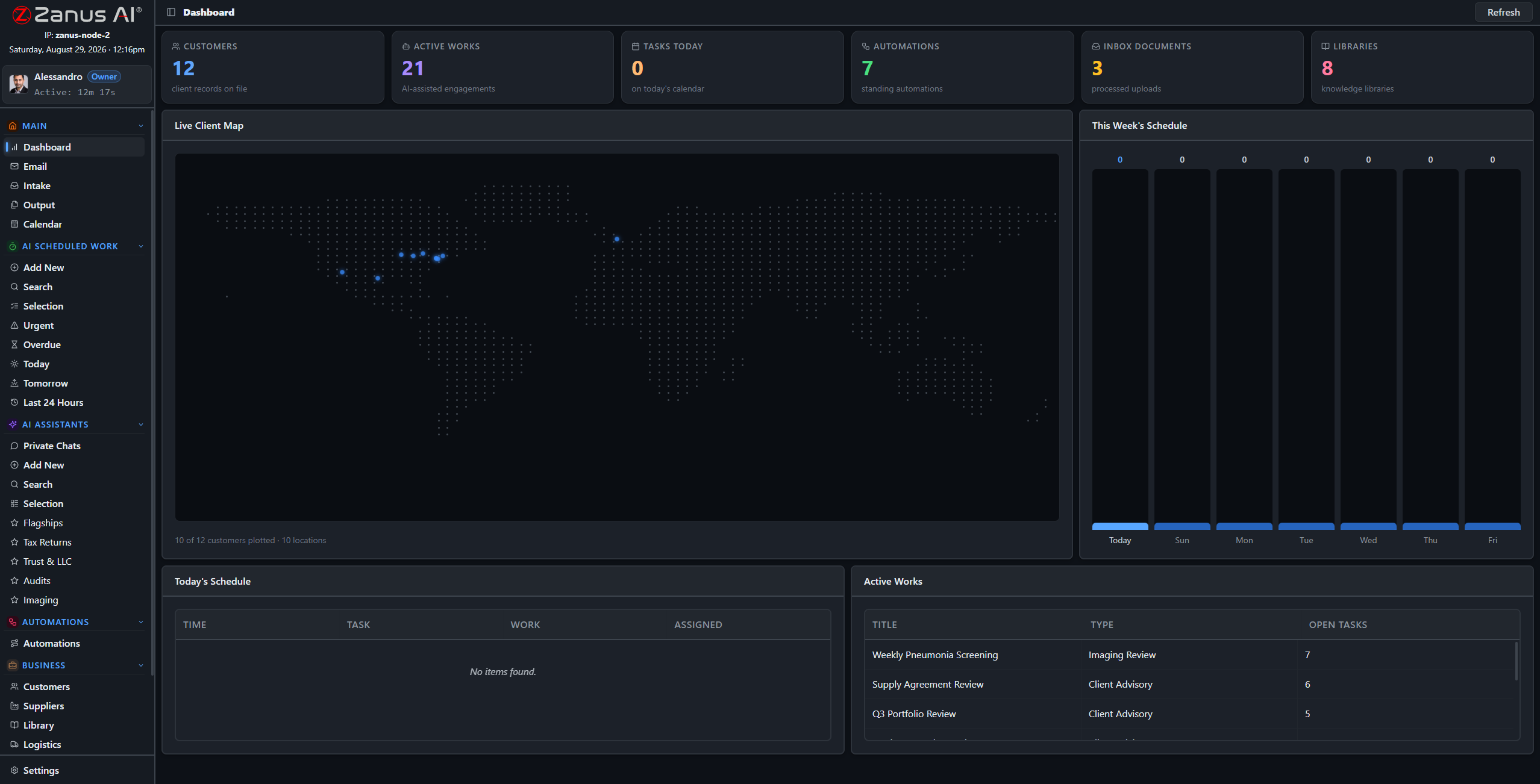
A real deployment view: communities, open work orders, board-packet works scheduled on the calendar.
What it does
The AI answers your lines 24/7 — amenity reservations, assessment questions, work-order intake — and routes the burst pipe at midnight to the emergency vendor, by your rules.
Violation letters citing the exact CC&R section, board packets, meeting-minute summaries and vendor solicitations drafted from your own records — reviewed and released by your managers.
Your tenant is isolated; resident records and board matters train no one else’s model. Large management companies run the same OS on servers they own — one price, all communities.
Front office: the resident side, handled
Saturday, 7:20 AM: a resident calls about the clubhouse reservation, another about a gate code, a third about a sprinkler geyser. The Zanus front office answers all three at once — books the clubhouse, gives the code to the verified resident, opens the emergency work order — in up to 40 languages.
- AI phone on your menu and voices, 24/7
- Work orders intaken with photos and details
- Amenity bookings into real community calendars
- See the Front Office for property management →

Back office: the governance side, working
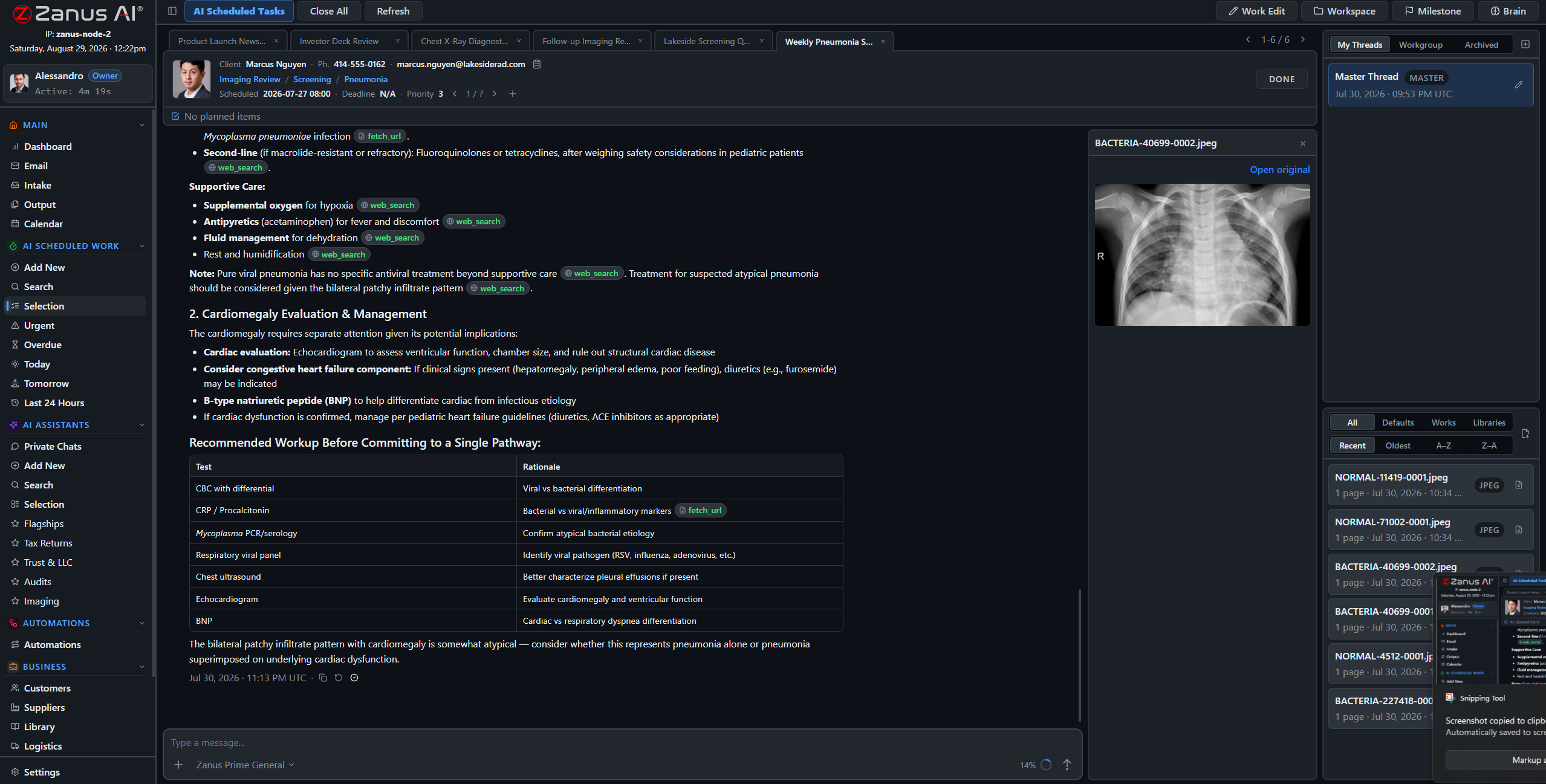
A monthly board-packet draft, executed by the AI on schedule: financial summary, open violations, work-order status, vendor bids compared — every item cited to its source, filed for the community manager days before the meeting instead of the night before.
- Scheduled AI work: board packets, violation queues, delinquency summaries
- Verified answers from YOUR governing documents
- Every draft awaits manager sign-off
- See the Back Office for property management →
When the portfolio outgrows renting software
Management companies running dozens of communities consolidate on Zanus hardware inside their own walls: air-gap capable, USB updates, your whole team — no per-door fees, no per-community licenses, ever.
- Private On-Premises AI: owned, no recurring fees
- On-Prem Tokens Server for high-volume document processing
- Explore the AI Servers →

Questions, answered
Does the AI make board decisions?
No. Boards decide; the AI drafts, organizes and cites. Violation letters, budgets and policies are prepared from your records and governing documents for YOUR managers and boards to review and approve.
How is resident privacy handled?
Resident-privacy-conscious by architecture: isolated tenants, role-based access to the field level, server-side redaction, searchable audit trail — a board member sees their community, not their neighbor’s ledger. Specifics are reviewed during onboarding.
We manage 30 communities — is that 30 licenses?
No. One tenant, your whole team, flat price: communities map to workgroups, each with its own documents, calendars and permissions. Community 31 costs nothing extra.
See it working on YOUR portfolio — the demo IS the product.
ZANUS AI FOR HOA & PROPERTY MANAGEMENT — FRONT OFFICE
The gate-code call, answered for the thirtieth time.
A community manager’s phone is the same twenty questions on a loop, punctuated by real emergencies. The Zanus front office answers on your menu, in your voices — verified residents get answers, emergencies get routed — 24/7, in up to 40 languages.
Private tenant or your own server · your whole team · resident-privacy-conscious architecture

Calls, chats, work orders and amenity bookings — one dashboard the portfolio manager can read.
What it does
A pipe bursts at 12:40 AM. The AI answers, recognizes the emergency by your rules, dispatches the on-call plumber, notifies the manager and logs everything — no answering-service relay, no soaked ceiling at 8 AM surprise.
Location, description, photos, access instructions and urgency captured on the first call — the vendor gets a workable ticket, not a callback chain.
Pool hours, gate codes for verified residents, assessment due dates, architectural application status, trash day: answered instantly from YOUR community documents, identically every time.
From resident call to closed loop, hands-free
A resident reports a broken irrigation head; the AI opens the work order, checks the landscaping contract for coverage, queues the vendor dispatch for approval and tells the resident what happens next — then follows up when the work closes. The manager touched it once, to approve.
- Work orders intaken with photos and access notes
- Vendor coverage checked against the contract
- Resident notified at every status change
- Emergencies routed by YOUR escalation rules


The portal that residents actually use
Website chat answers CC&R and amenity questions from the community’s own documents, web forms take architectural applications and clubhouse requests — and every submission is filed, acknowledged and tracked in minutes.
- Chat grounded in each community’s own documents
- ARC applications and reservations intaken by form
- Every conversation logged with full transcript
- See the full Front Office tour →
Questions, answered
How does it verify a resident before giving a gate code?
By your rules — the verification questions you set, checked against the resident record. Unverified callers get the public answer and a path to a human.
Do we keep our phone numbers?
Yes. Your numbers stay; calls route AI-first, staff-first, or any mix per line and per hour — office hours one way, the emergency line another.
Can each community sound different?
Yes — menus, voices, greetings and approved answers are configured per community, while your staff manages everything from one system.
See it working on YOUR portfolio — the demo IS the product.
ZANUS AI FOR HOA & PROPERTY MANAGEMENT — BACK OFFICE
Governance runs on paper.
Now the paper keeps up.
CC&Rs, meeting minutes, budgets, reserve studies, vendor contracts, violation logs: managing communities is governance paperwork at portfolio scale. The Zanus back office turns that archive into a working AI staff — drafting, comparing and citing, under your managers’ sign-off.
Private tenant or your own server · your whole team · resident-privacy-conscious architecture
A real session: board packet assembled — financials, violations, bids — every item cited, manager decides.
What it does
The letter quotes the exact section, references the photos on file, states the cure period from your policy — drafted in the community’s tone, queued for the manager to release.
Financial summary, delinquency report, open work orders, vendor bids side by side: the monthly packet drafted from the records days early, every figure cited.
Every AI-drafted letter, packet and summary lands in Output awaiting review. Nothing reaches a resident, board or vendor without your team’s decision.
Vendor bids, compared like a quantity surveyor
Three roofing bids arrive as PDFs in three formats. The AI tabulates scope, price, exclusions and timeline side by side, flags the bid that omits the flashing, and files the comparison for the board — with every line cited to the bid it came from.
- Bids ingested in any format
- Scope and exclusion differences flagged
- Comparison filed for board review, cited


Minutes and correspondence, drafted
The documents that eat a manager’s evenings: meeting-minute drafts from the recording, delinquency letters per your collection policy, the annual-meeting notice with the proxy attached. Drafted in minutes, in each community’s templates.
- Each community’s templates and letterhead
- Policy language cited in every letter
- Approval workflow before anything sends
Questions, answered
Do violation letters go out automatically?
Only if you designate the category as auto-send. By default every letter waits in the approval queue — the manager reviews the citation, the photos and the tone before release.
Can it handle 30 communities’ worth of paper?
Yes — each community is a workgroup with its own documents and templates, and the AI works them in parallel. The constraint is your review capacity, not the AI’s.
YOU MIGHT ALSO LIKE
The Back Office executes. Who answers the phone?
Front Office AI picks up every call and chat — books, quotes, follows up, 24/7 in 40 languages. Watch it run a business like yours, live.
See it working on YOUR portfolio — the demo IS the product.
ZANUS AI FOR HOA & PROPERTY MANAGEMENT — DOCUMENTS
Ask the CC&Rs. They answer.
CC&Rs, bylaws, meeting minutes, reserve studies, vendor contracts, architectural guidelines — loaded into curated libraries per community. Ask in plain language; get the answer with the section cited, scoped to whoever asks.
Private tenant or your own server · your whole team · resident-privacy-conscious architecture
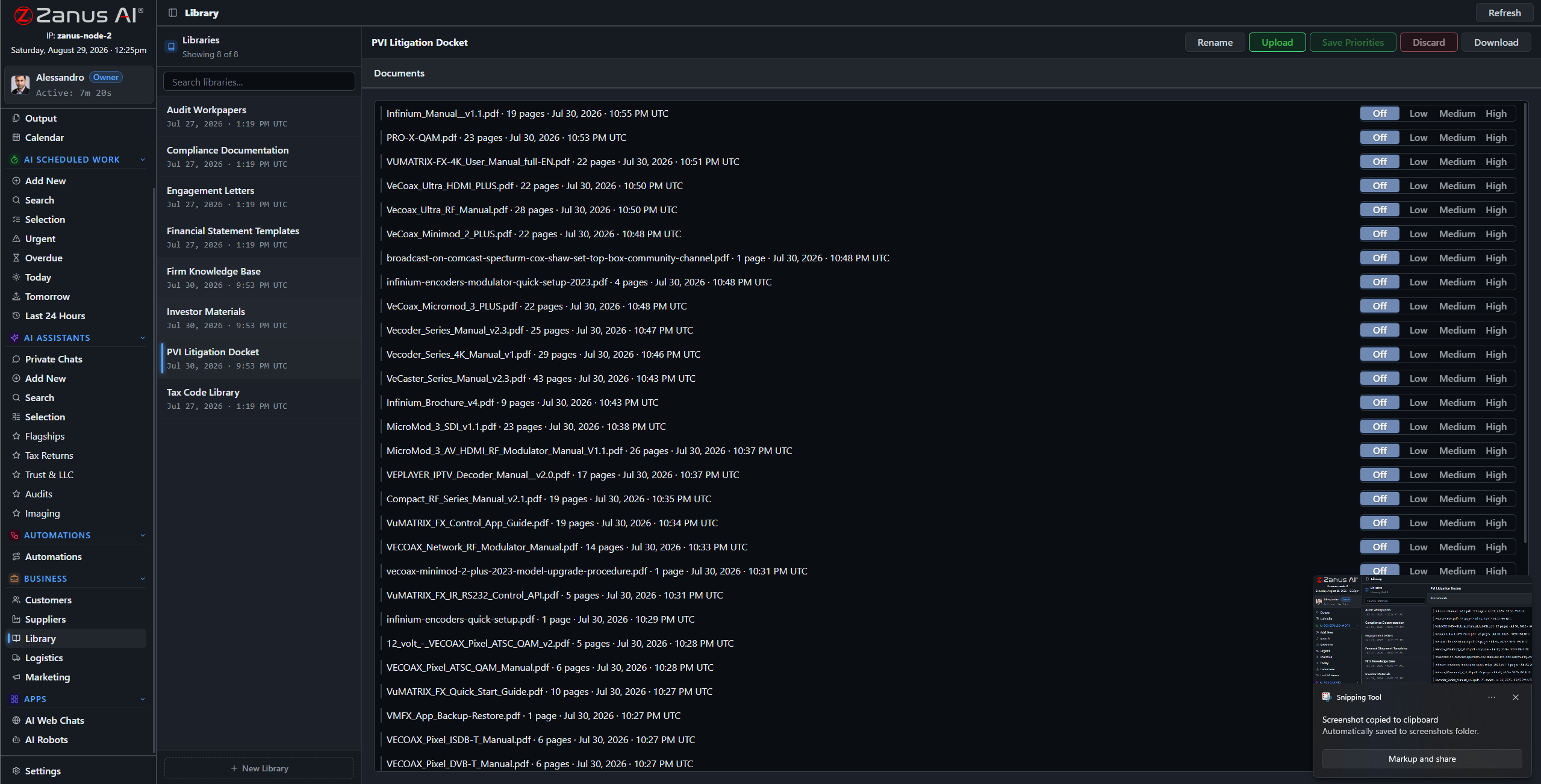
Libraries per community: recorded amendments outrank the original CC&Rs — you set the order.
What it does
Recorded CC&Rs as scans, minutes as Word files, reserve studies as 90-page PDFs, contracts as email attachments — the ingestion pipeline turns it all into queryable knowledge.
No source in the documents, no claim: the AI cites the CC&R section, the minute, the contract clause — or says it cannot answer. In a dispute-prone business, that discipline is the shield.
A board member queries their own community’s reserves; a manager queries the portfolio; a resident-facing answer stays public-safe: each scoped to the role, enforced server-side.
Twenty years of minutes, one question away
“When did the board approve the fence-height variance on Lot 41?” “What does the landscaping contract say about storm cleanup?” “Which communities still ban rentals under 30 days?” The archive answers in seconds, with the documents attached — instead of a week of asking the previous manager.
- Plain-language questions across every community
- The exact section or minute attached to every answer
- Priority order: recorded amendments always win

Questions, answered
Who can see which community’s documents?
Only roles you authorize. Communities map to workgroups; permissions reach the field level and the server redacts what a user cannot see — board members never see a neighboring association’s files.
Do our documents train outside models?
Never. Your tenant is isolated; your communities’ records are yours alone — and the on-premises option keeps them physically inside your building.
See it working on YOUR portfolio — the demo IS the product.
ZANUS AI FOR HOA & PROPERTY MANAGEMENT — AI WORKFORCE
The assistant manager who covers every community.
Assign work to the AI the way you assign it to staff: type, community, deadline, priority. The monthly board packet, the weekly violation queue, the quarterly delinquency summary — executed on schedule, with citations, under review.
Private tenant or your own server · your whole team · resident-privacy-conscious architecture
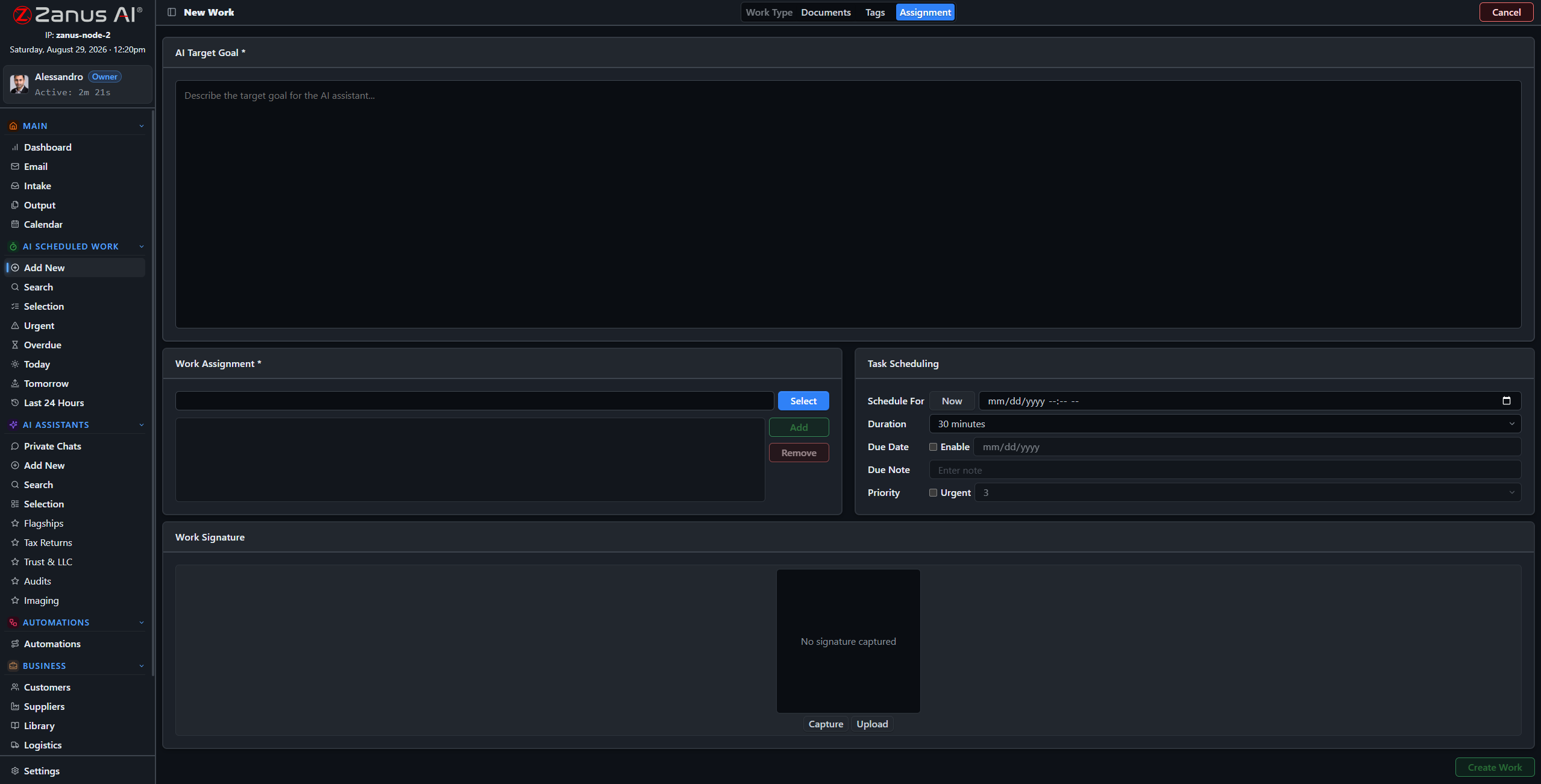
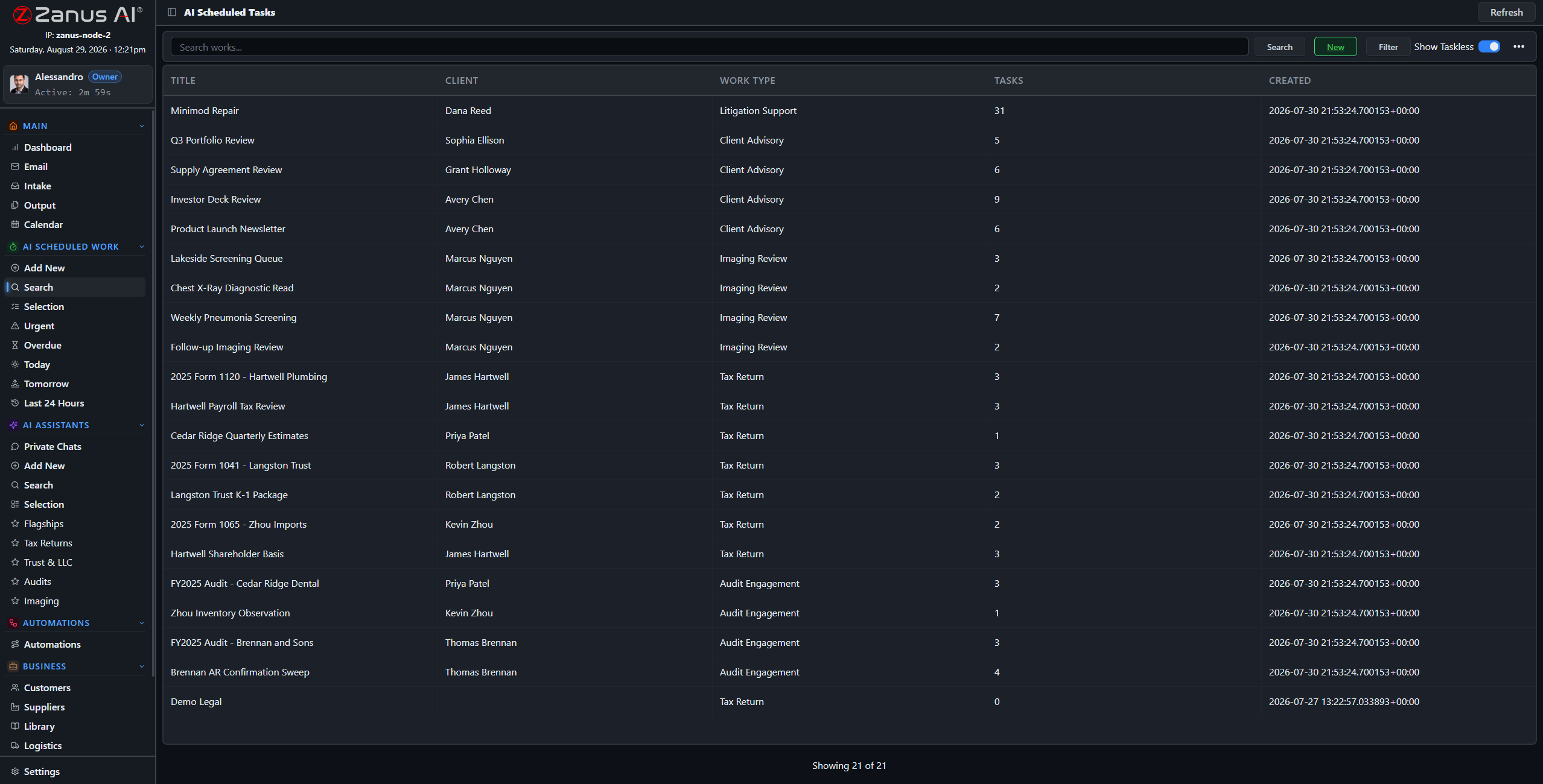
Four steps: work type, community and libraries, tags, schedule — the AI takes it from there.
What it does
Board packet, violation letter batch, vendor bid comparison, delinquency summary, reserve-study digest: work types molded to your operation, each with default libraries and examples.
The AI’s workload is managed like the team’s: one-click views show what is urgent, late, today and tomorrow — no board meeting arrives with an unfinished packet.
Every work is a full session: reasoning streamed, sections cited, milestones tracked, linked to the community and the meeting calendar.
Ten days before every board meeting: the packet is drafted
Set “Monthly Board Packet — Willow Creek” once: ten days before each meeting the AI assembles financial summary, delinquencies, open violations, work-order status and pending bids — every figure cited — and files it for the manager’s review. Multiply by every community you manage.
- Recurring schedules aligned to each board calendar
- Every figure cited to ledgers and logs
- Packet in Output, awaiting manager sign-off
Questions, answered
Can we supervise mid-work?
Yes — open any session, read the reasoning, redirect it, or stop it. The AI works like staff: visible, accountable, interruptible.
Does annual-meeting season overwhelm it?
No — thirty annual-meeting notice packages queue the same as three. The constraint is your review capacity, not the AI’s.
See it working on YOUR portfolio — the demo IS the product.
ZANUS AI FOR HOA & PROPERTY MANAGEMENT — PROCEDURES
The policy binder, alive.
Associations get sued over uneven enforcement — and uneven enforcement starts with staff guessing at the policy. In Zanus, collection policies, violation procedures and ARC guidelines are living documents: answerable in chat, attached to work, priority-ordered so the current version always wins.
Private tenant or your own server · your whole team · resident-privacy-conscious architecture
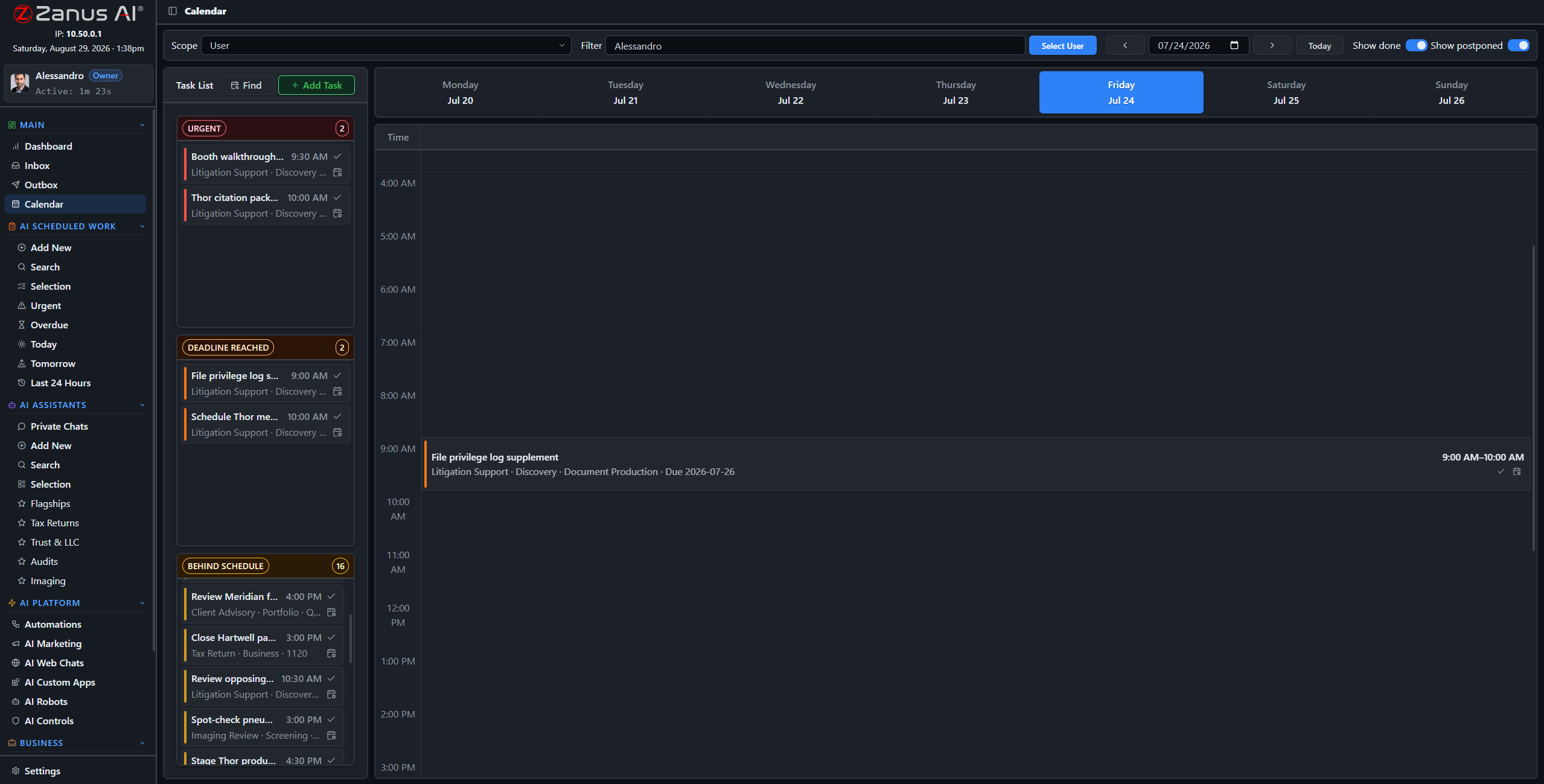
Policy upkeep, scheduled like community work: annual policy reviews and contract-renewal checks on the calendar.
What it does
Collection policy, violation escalation steps, ARC review criteria, amenity rules, emergency procedures: one library per community, current versions on top, superseded ones outranked.
“What is the cure period before a second violation notice at Willow Creek?” — answered in seconds with the policy attached, before the wrong letter goes out.
Work types carry their default policies: the AI drafting a violation letter reads that community’s escalation procedure — by construction, not by memory.
Even enforcement, provable
Because every letter and every fine follows the written policy the AI cites, enforcement is consistent across residents and across years — and when a homeowner’s attorney asks, the paper trail shows the same procedure applied every time.
- Recurring policy review works with deadlines
- Update summaries drafted for board approval
- Every revision on the audit record
Questions, answered
How do policy updates roll out?
Upload the board-approved version, set it on top: from that moment every answer and every AI work cites the new policy. Old versions remain archived for audit.
See it working on YOUR portfolio — the demo IS the product.
ZANUS AI FOR HOA & PROPERTY MANAGEMENT — TEAM TRAINING
Manager turnover without portfolio amnesia.
When a community manager leaves, the institutional memory of five associations leaves too — unless it lives in the system. New managers learn your procedures and their communities from the AI, and everyone has an assistant that answers “how does this community do it?” instantly, with the source attached.
Private tenant or your own server · your whole team · resident-privacy-conscious architecture

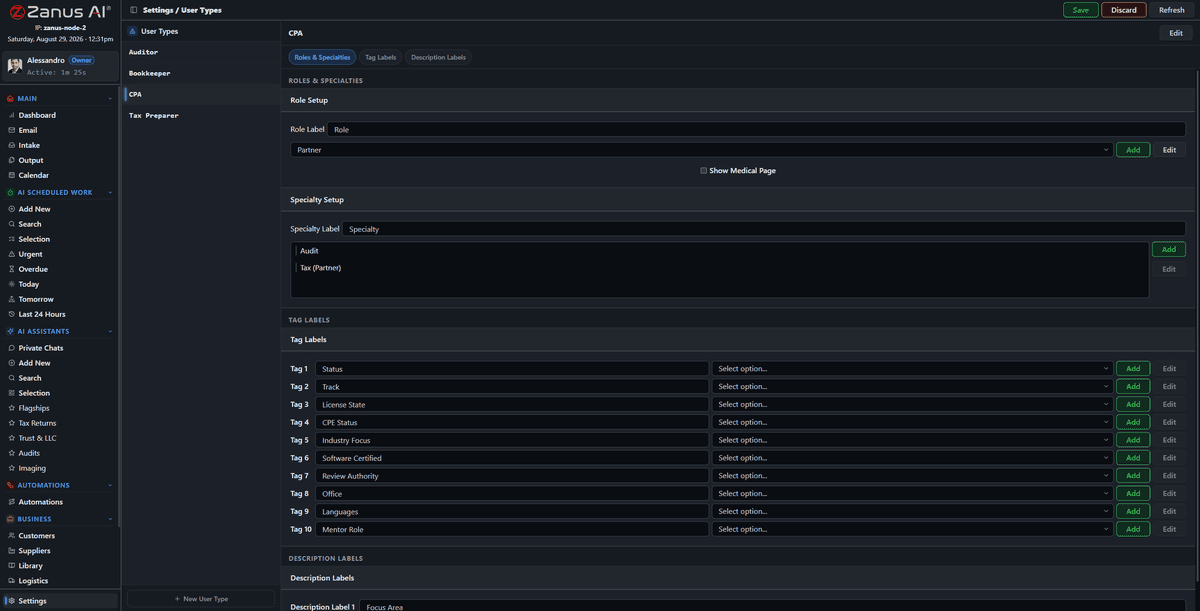
Training lives inside the software: the AI walks each new manager through the portfolio’s own procedures.
What it does
A new manager inherits five communities and learns each one from the AI — governing documents, open issues, vendor history, board personalities on paper — productive in days, not a season.
“Who services the gates at Stonebridge, and what does the contract cover?” — asked to the assistant, answered from the vendor file, without calling the manager who left.
Private chats work on any device with a login — the knowledge follows the manager to the site visit, the board meeting and the after-hours emergency.
The trainer that never tires of the question
The tenth “how do I process an architectural application?” gets the same patient, sourced answer as the first. Training stays current automatically, because the assistant reads from the same living policies as everything else.
- Answers cite the current procedure
- Personal preset assistants per role
- Training progress visible to the portfolio director
Questions, answered
Does training content go stale?
No — the assistant answers from the live libraries. Update the policy once and every future answer updates with it.
See it working on YOUR portfolio — the demo IS the product.
ZANUS AI FOR HOA & PROPERTY MANAGEMENT — AUTOMATIONS
The portfolio’s repetitive work, set once.
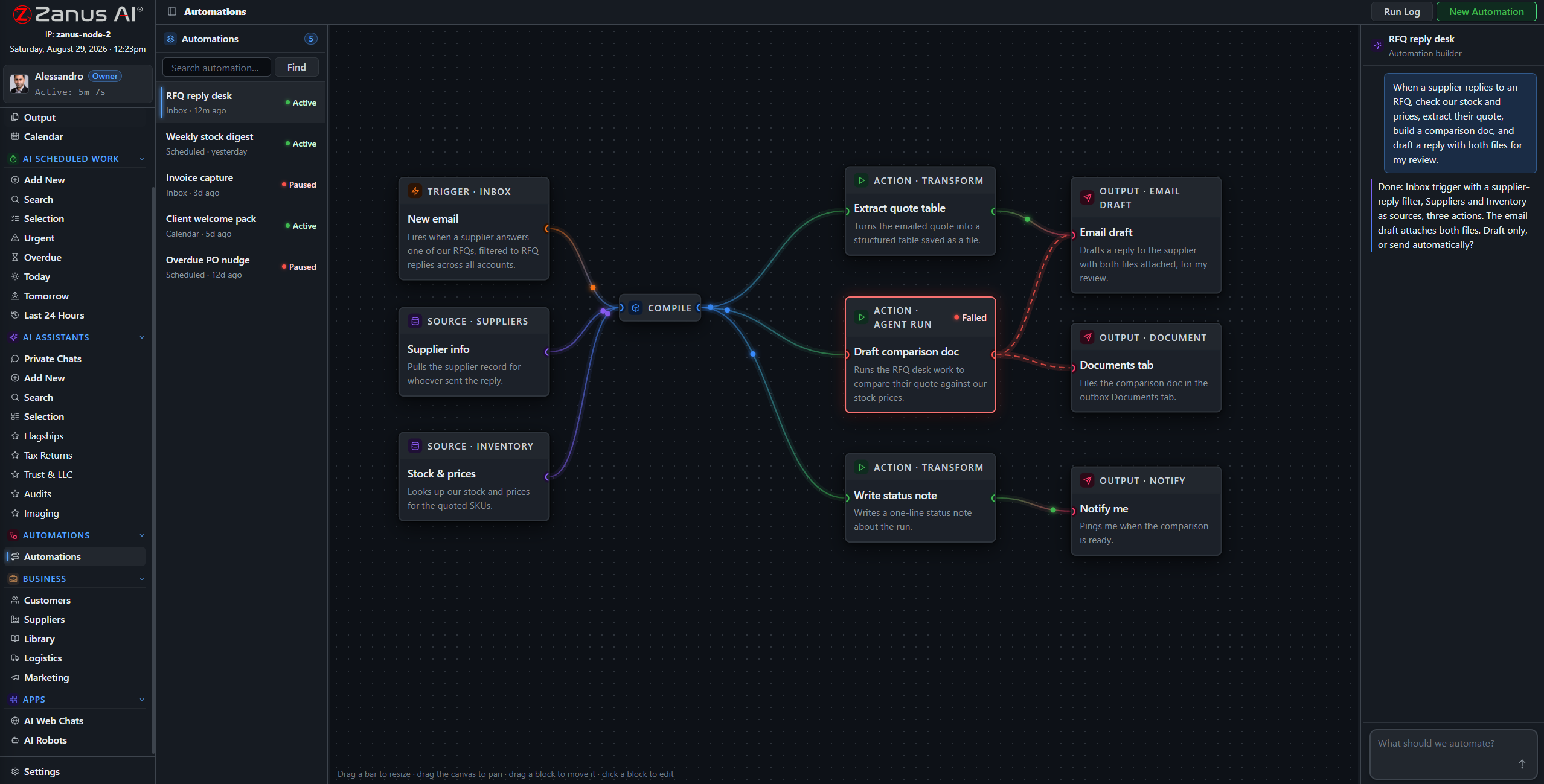
Describe the job in plain words — “when a violation is logged, draft the letter citing the CC&R section and start the cure-period clock” — and it becomes connected blocks on a canvas, running on its own, with every run visible.
Private tenant or your own server · your whole team · resident-privacy-conscious architecture
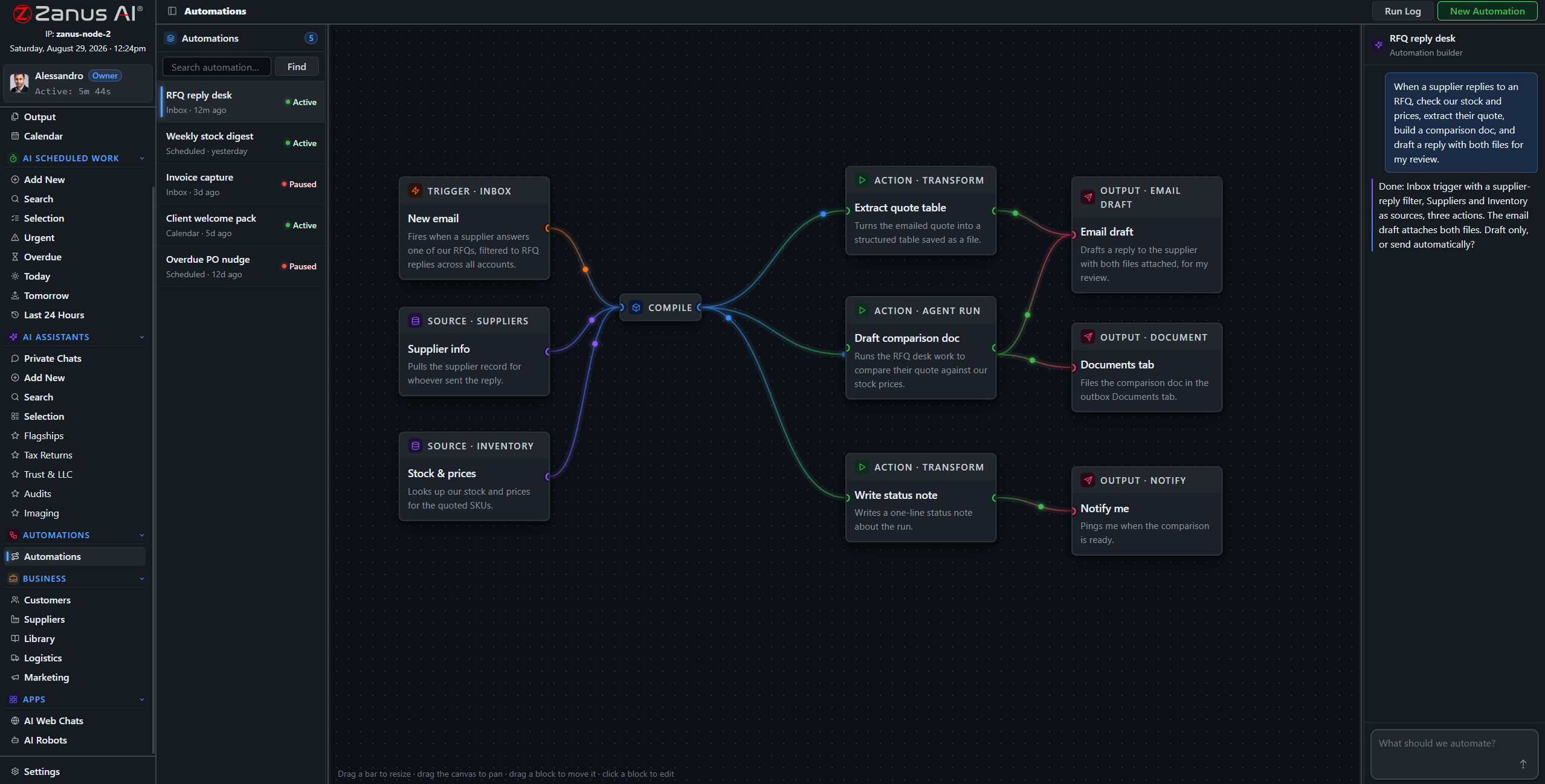
A real flow: violation trigger, document sources, AI compile, three outputs — drawn from a description.
What it does
The logged violation drafts its letter, starts the cure period, schedules the re-inspection and escalates per the written policy — each step queued for approval, nothing skipped, nothing doubled.
Vendor dispatched, resident notified, completion photo requested, invoice matched to the work order — the loop closes itself and the ledger knows.
Meeting date set: notice drafted per the bylaws’ timeline, proxy attached, packet work scheduled, minutes work queued for after — every community, every month.
When something fails, you SEE it
Run states live on the flow: green success, red failure on the exact block. A silently failed annual-meeting notice is a voided election — here, nothing fails silently.
- Run log per automation
- One-click retry on failures
- Finished documents in Output, statused
Questions, answered
Who approves what reaches residents?
Your rules: queue everything for human approval, or auto-send only the categories you designate as safe — the pool-closure notice one way, a violation letter another.
See it working on YOUR portfolio — the demo IS the product.
ZANUS AI FOR HOA & PROPERTY MANAGEMENT — RESIDENT NOTICES
Notices that reach every door.
Assessment reminders, annual-meeting notices with proxies, community newsletters, the pool-resurfacing update — drafted by the AI from your own records, in each community’s voice, queued for approval. Communication that used to slip now ships on schedule.
Private tenant or your own server · your whole team · resident-privacy-conscious architecture
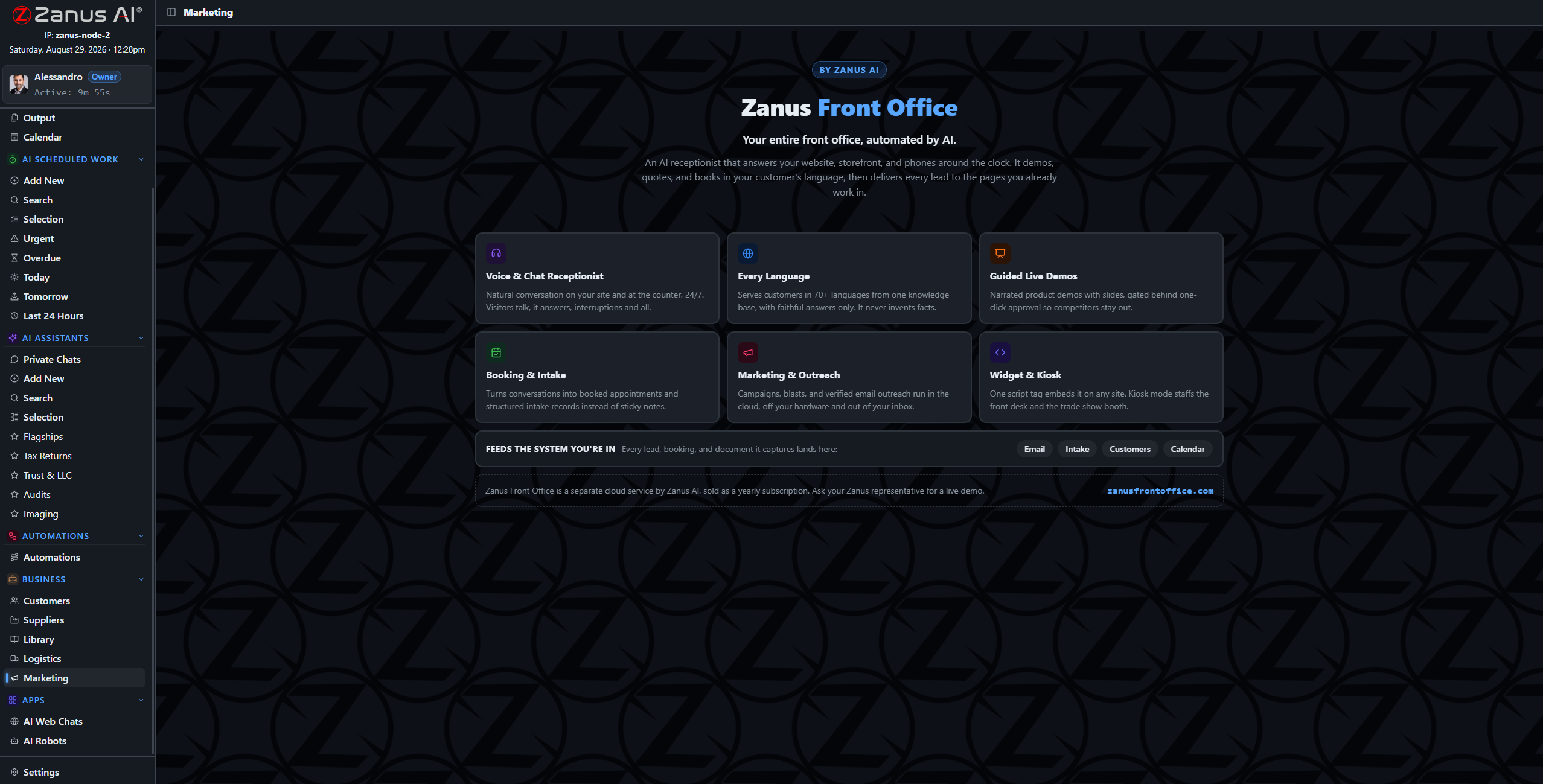
Campaigns and sequences drafted from the records — assessments, meetings, newsletters — awaiting approval.
What it does
Owners with open balances, residents affected by the clubhouse closure, off-site owners for the annual meeting: audiences built from your own resident records — no list exports to a mailing tool.
Notice drafted per the bylaws’ timeline, proxy form attached, reminders paced until quorum — per community, in the residents’ languages, on the record.
Email, mail-merge-ready letters or portal notices per each resident’s preference; opt-outs enforced by the system, not by memory. Every send is on the record.
From the rolls to the notice, without export
The audience, the content and the sending all live in the same system as the resident records — nothing leaves your tenant to reach a mailing platform. “Remind every owner with a balance over $200, thirty days before late fees” becomes a drafted, scheduled sequence in minutes.
- Audiences from your own resident data — private by architecture
- Notices drafted per community, per language
- Replies routed to the right manager automatically

Approval first, always
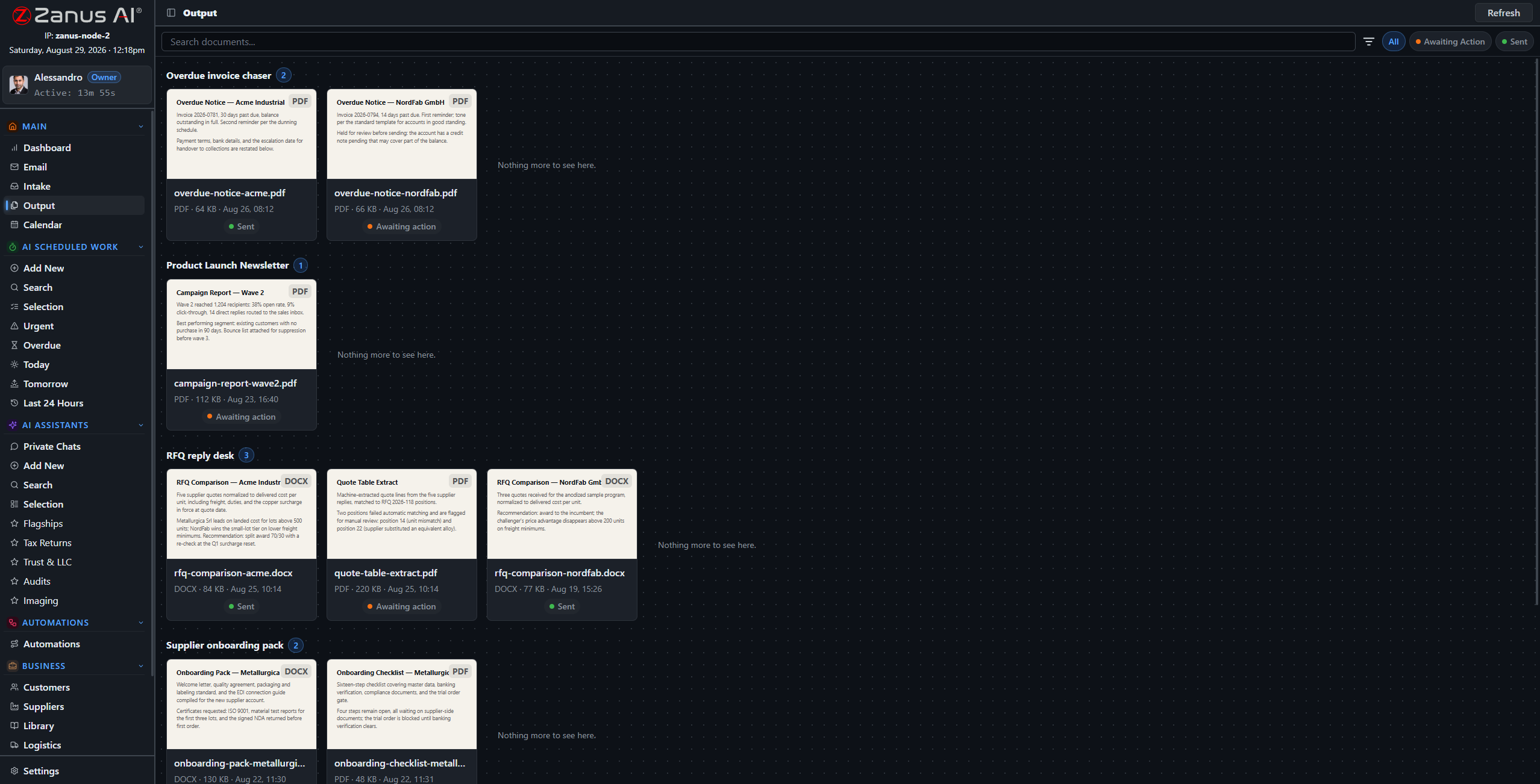
Every outbound notice lands in the approval queue unless you designate the category as auto-send. The manager controls every word that reaches a resident — and when a homeowner claims they were never notified, the send history is a search away.
- Approval workflow per notice type
- Full history of what was sent to whom
- Results tracked: quorum reached, balances paid, replies
Questions, answered
Can notices meet legal timing requirements?
Timelines come from each community’s bylaws and your policies: the sequence is scheduled against them and the audit record proves when each notice went out. Have your association counsel review the setup at onboarding.
Do delinquency notices follow our collection policy?
Yes — drafted per the written policy the AI cites, escalated on the policy’s schedule, always through the approval queue.
See it working on YOUR portfolio — the demo IS the product.
ZANUS AI FOR HOA & PROPERTY MANAGEMENT — PM SOFTWARE & INTEGRATIONS
Keep your PM accounting. Add the intelligence.
Your property-management accounting system stays the ledger of record. Zanus becomes the system of work: connectors sync residents, balances and documents both ways, the intake pipeline files what arrives, and AI-drafted letters flow back where they belong. No rip and replace.
Private tenant or your own server · your whole team · resident-privacy-conscious architecture

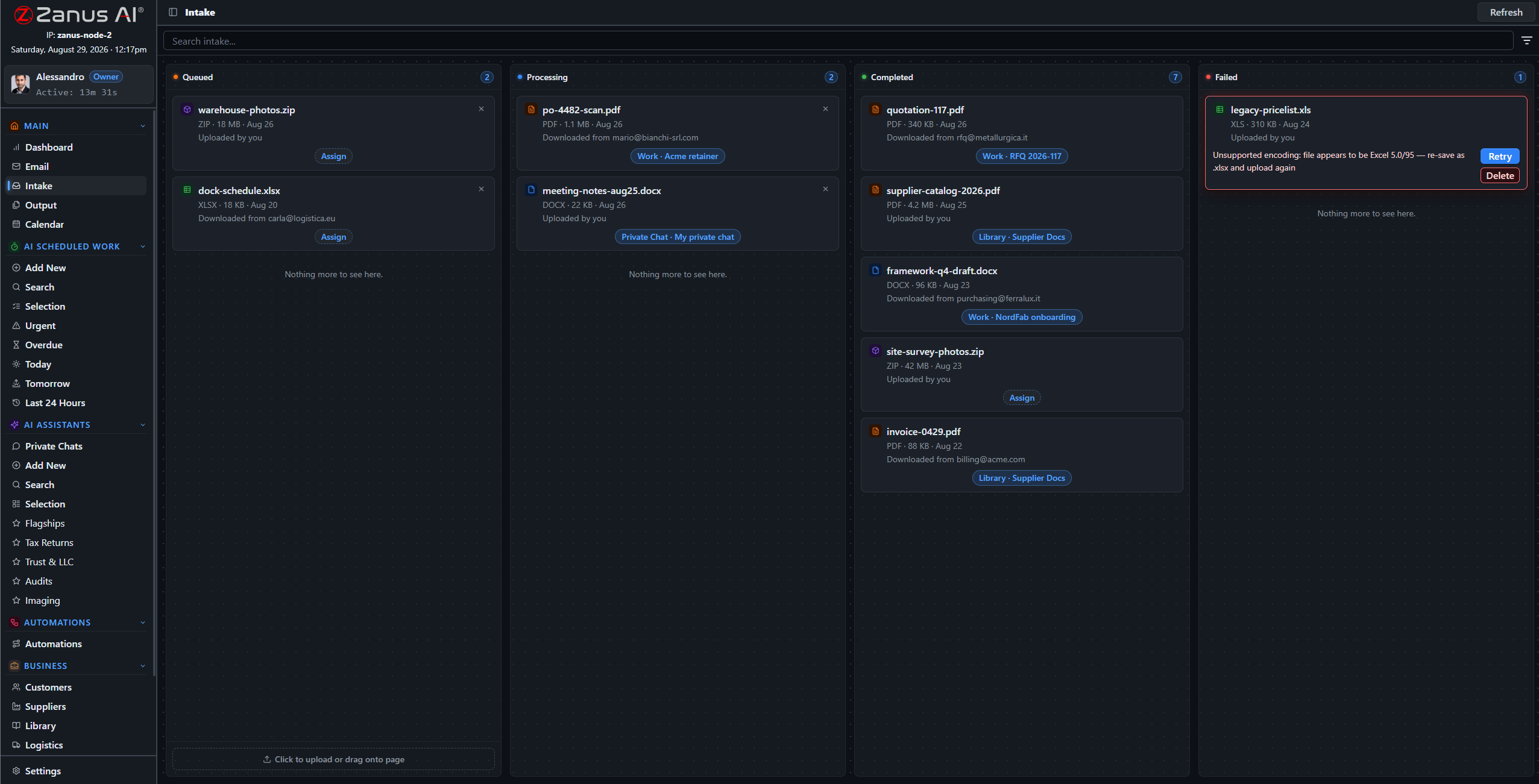
No rip and replace: the accounting system, portal and calendars stay — the AI layer connects to all of them.
What it does
Residents, units, balances and work orders mapped field by field, with a dry-run preview before anything writes — push, pull or two-way, your choice.
Vendor invoices, insurance certificates, recorded amendments and inspection reports route through the intake pipeline to the right community — and the AI can draft the follow-ups.
A full API for whatever else the operation runs: payment portals, access-control systems, inspection apps — data in, results out, under scoped keys.
One question across all your systems
The balance lives in the accounting system, the work order in the portal, the CC&R in the library — and the AI reads across all of it. “What is open on this unit before the board meeting?” becomes one question with one grounded answer.
- Field mapping with dry-run preview
- Each system stays master of its own records
- Every sync event on the audit record
- External systems appear as blocks on the automation canvas
Documents flow back where they belong
The violation letter the AI drafted, the board packet, the bid comparison: finished documents return to the unit or community record in your PM system through the same connectors — reviewed and released by your managers first.
- AI output filed back to the system of record
- Approval workflow before anything writes back
- Webhooks notify your systems in real time
Questions, answered
Which PM platforms do you support?
Connectors are mapped per deployment — bring your accounting system and portal to the demo and we walk through the exact integration path for your stack.
Does resident data pass through third parties?
No. The connectors run inside your tenant — or inside your building on the on-premises option. Data moves directly between your systems.
See it working on YOUR portfolio — the demo IS the product.
ZANUS AI FOR HOA & PROPERTY MANAGEMENT — COMPLIANCE
Built like a records request is coming.
Associations hold ledgers, disputes and personal details for every household — and homeowners have inspection rights over some records and privacy rights over others. Permissions to the field level, server-side redaction, a searchable audit trail — and an on-premises option under your full custody.
Private tenant or your own server · your whole team · resident-privacy-conscious architecture
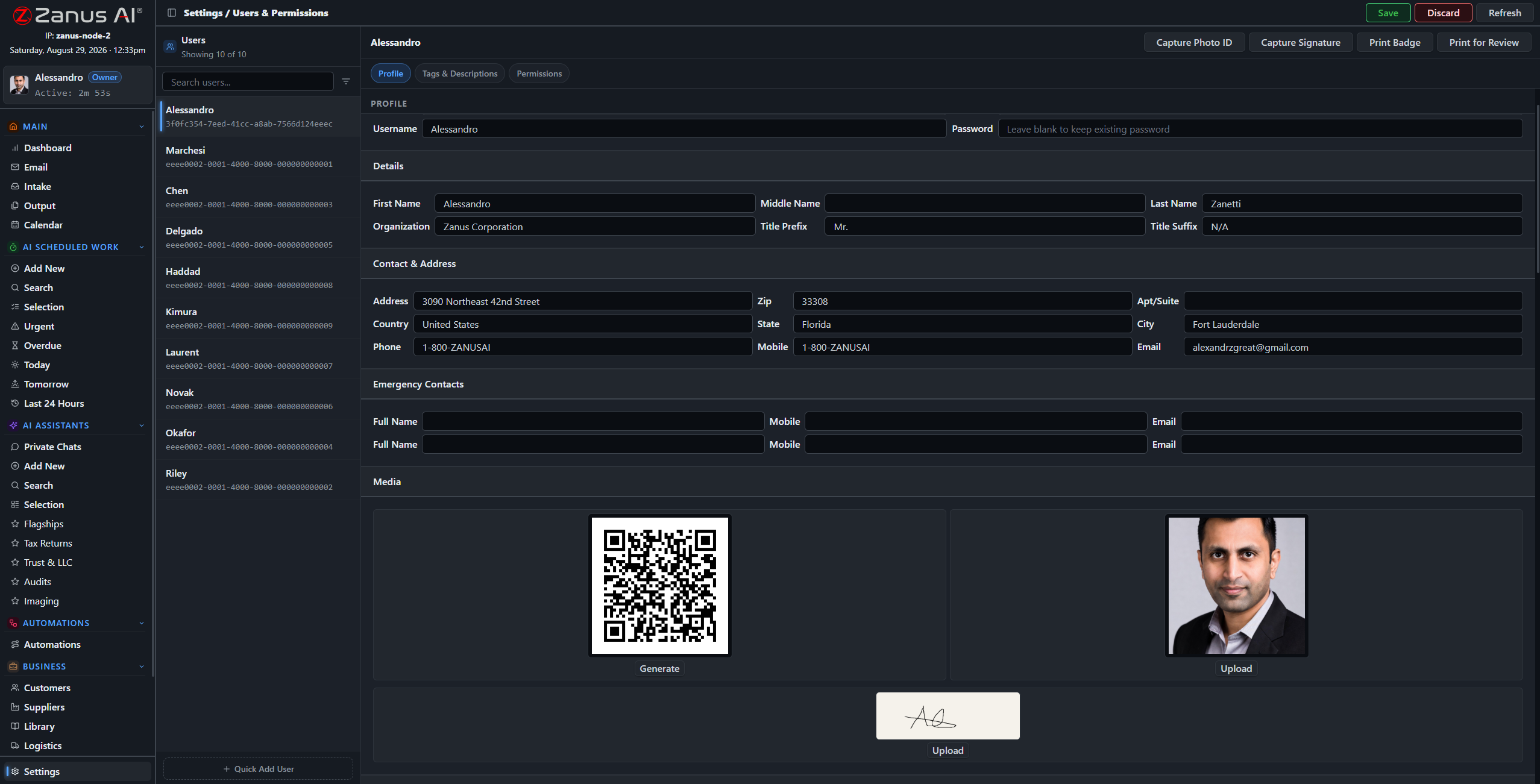
One record per user: role, tags, and granular permissions over every domain of the system.
What it does
Workgroups map communities; the server redacts what a role cannot see — a board member reads their association’s ledger, never the management company’s other books.
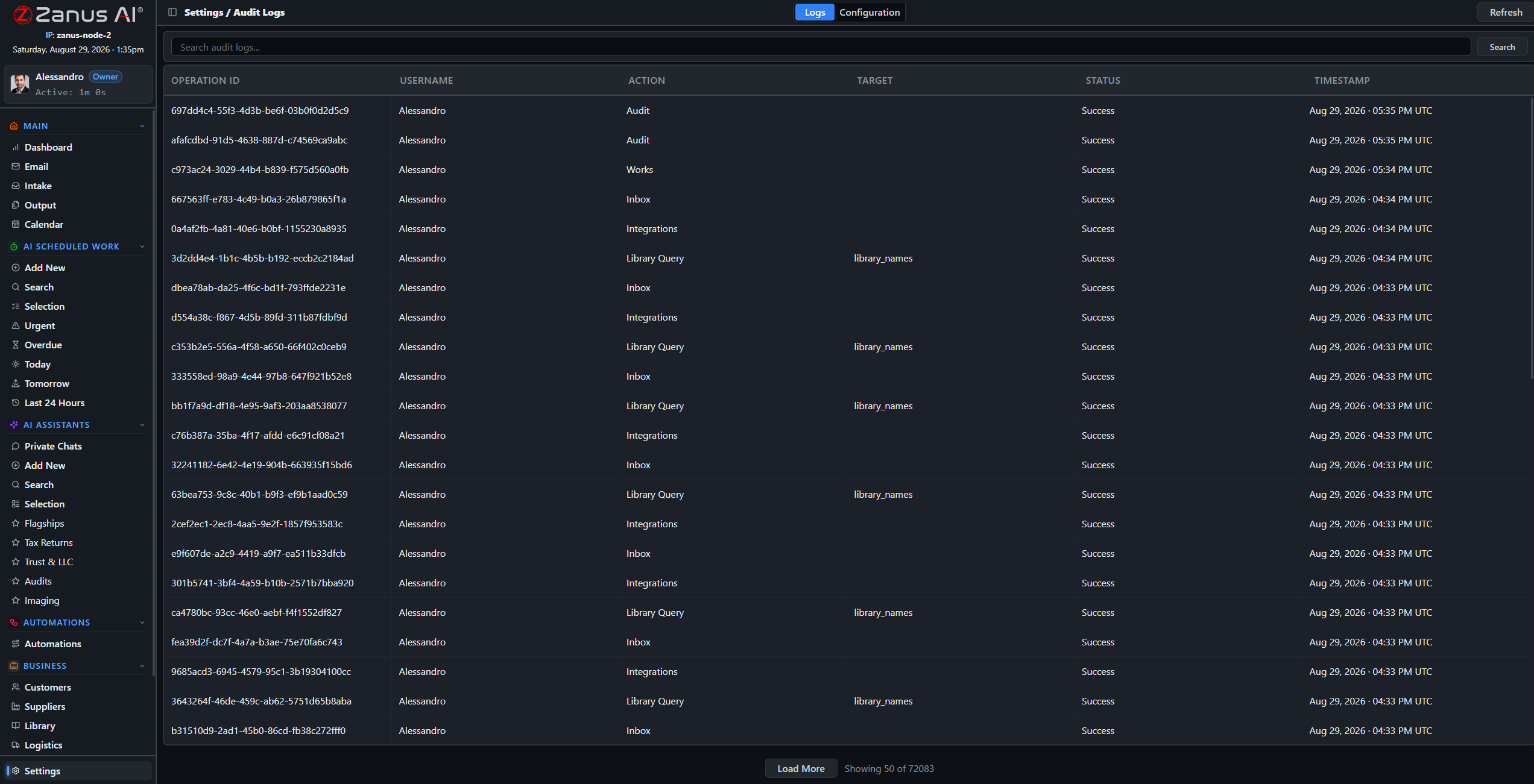
A searchable log of every audited action, with configurable categories: who viewed the delinquency list, who edited the letter, who released the notice, when.
Five-level workgroups map regions, communities and boards; the on-premises option puts the whole system inside your building, air-gap capable.
The records request, answered in minutes
When the request comes — a homeowner’s inspection demand, an attorney’s letter, a board transition audit — the answer is a search away: the record, its access history, its update trail with pre-update snapshots preserved, and the redactions your rules require applied server-side.
- Searchable audit trail
- Automatic pre-update snapshots with rollback
- USB updates for air-gapped deployments
Questions, answered
Where do resident records live?
In your isolated tenant — never training outside models — or fully on-premises on hardware your company owns, physically incapable of internet exposure.
Can our association counsel review the setup?
Please bring them: deployment specifics, retention behavior and records-request handling are walked through with your team during onboarding.
See it working on YOUR portfolio — the demo IS the product.
ZANUS AI FOR HOA & PROPERTY MANAGEMENT — LIVE DEMO
Do not watch a video.
Talk to your AI.
Big vendors show property-management demos as videos behind a form. Ours is the product itself, configured for community management: open the chat below-right and try it — report a broken gate, ask a pool-rules question, request a demo of the board-packet workflow.
The conversation you have with us IS the demo
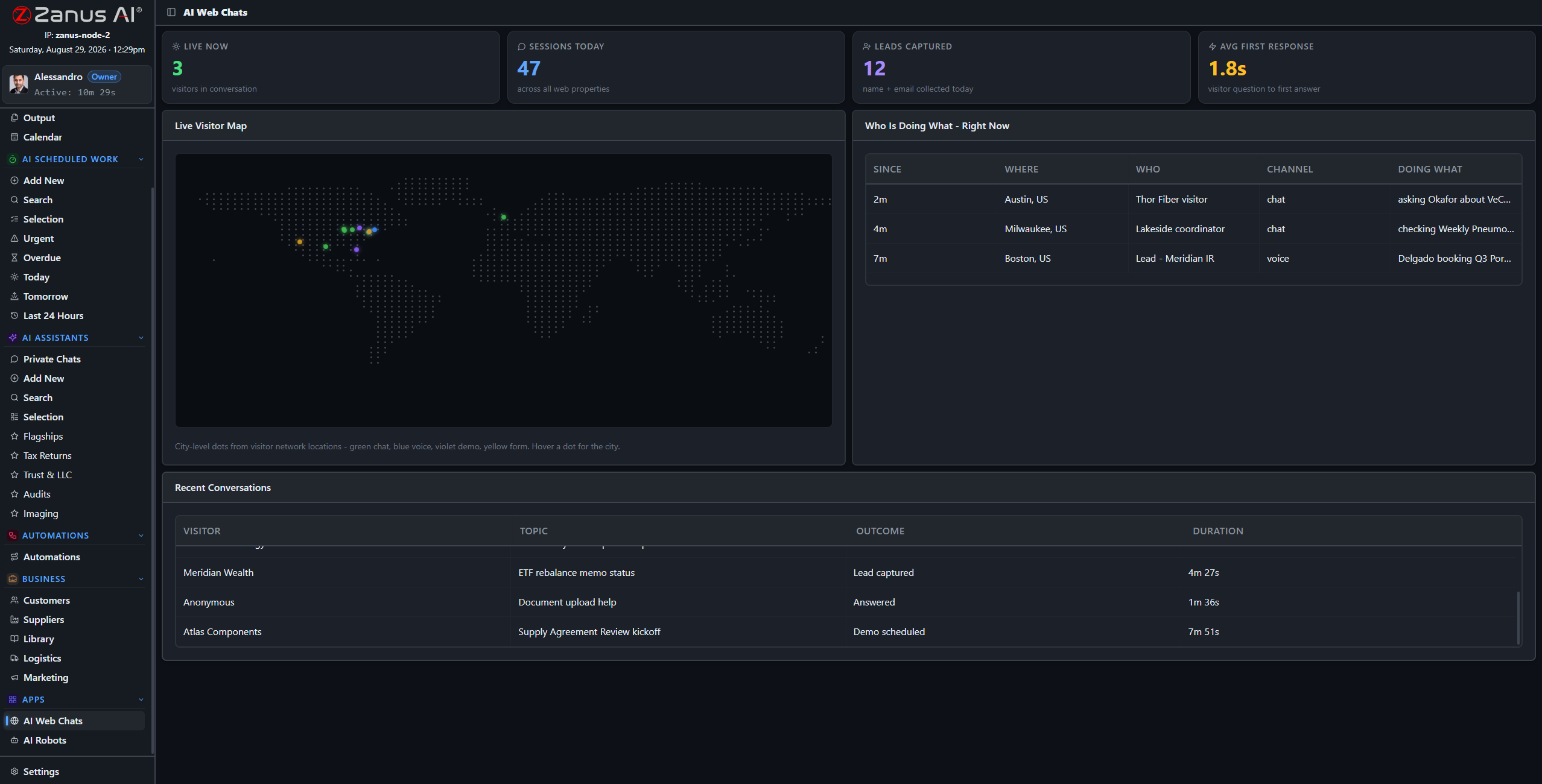
This screen is watching demos like yours happen: live conversations, outcomes, first response in seconds.
What it does
Ask the chat: “the gate at the north entrance is stuck open” — watch it intake the work order, ask for the details a vendor needs, and confirm like your best manager on their best day.
Ask: “how would you assemble our board packet?” — it walks the workflow it would run in your tenant, grounded, cited, sign-off included.
The full demo loads a property-management tenant with sample communities: a violation letter draft, a bid comparison, CC&R answers with the section cited — your world, working.
Or pick your exact business
Every link below is a full live-demo page for that specific business — its vocabulary, its calls, its booking rules.
Two minutes to your inbox
Request the demo and the interactive property-management demo arrives in about two minutes — no sales call, no calendar dance. Watch it, interrupt it with questions, and book the human conversation when YOU are ready.
- Interactive demo, property-management-configured
- Ask questions mid-demo — it answers and resumes
- In your inbox in ~2 minutes, free

Questions, answered
Is the demo really the product?
Yes — the same AI, configured with a sample property-management tenant. What you see is what your managers get, with your communities instead of the samples.
See it working on YOUR portfolio — the demo IS the product.
Sharing with a colleague? 📄 Get the PDF · ✉️ Email this page ·