ZANUS AI FOR FIELD SERVICE & REPAIR — OVERVIEW
The answer on the roof, not back at the shop.
Service calls answered and booked around the clock. Techs querying your repair manuals and service bulletins from their phones, answers cited to the page. One AI system for the customer side and the field side — isolated in YOUR private tenant, where your manuals train nobody else’s model.
Private tenant or your own server · unlimited technicians · your manuals never train a public model
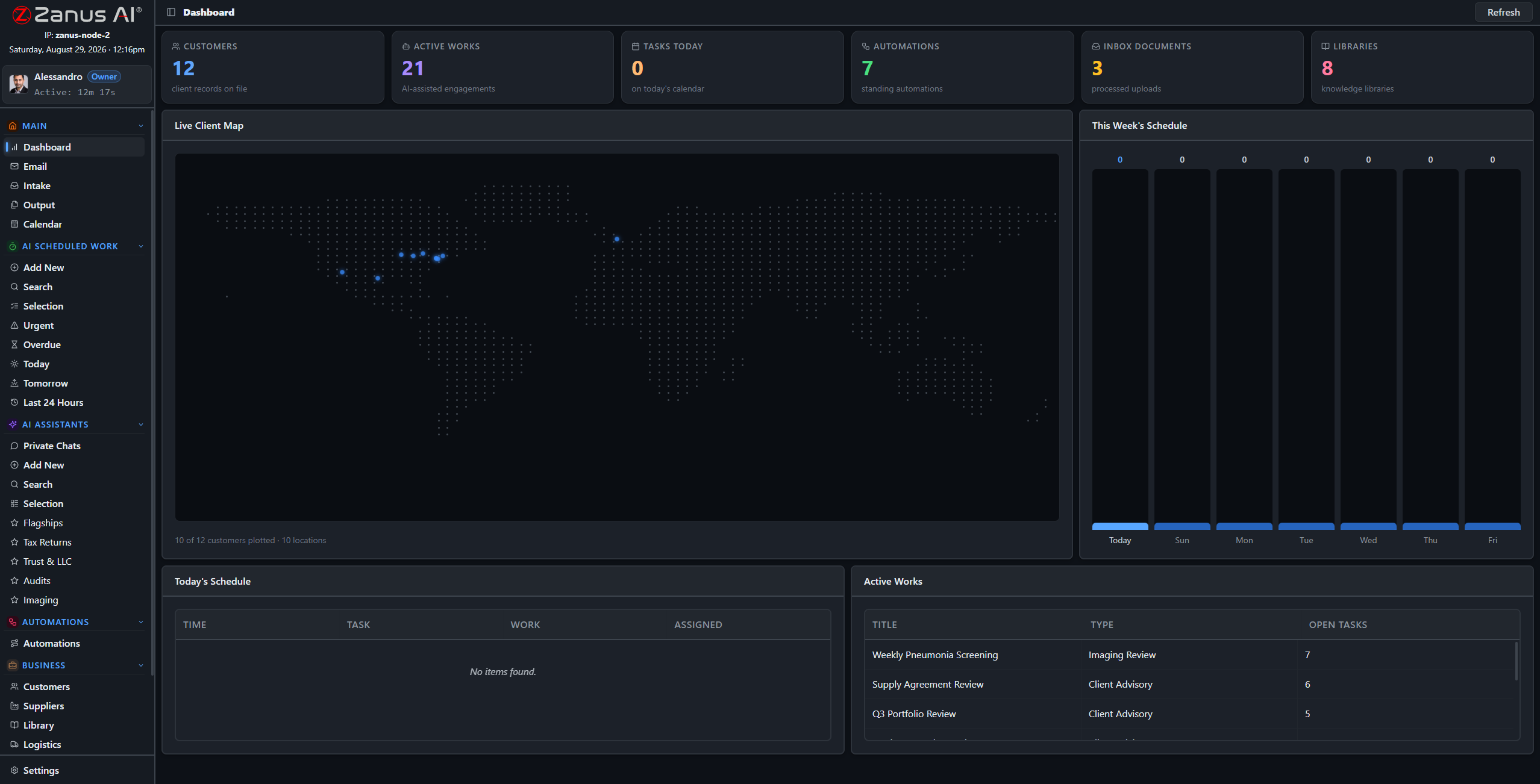
A real deployment view: customer records, work orders in flight, scheduled AI works for the fleet.
What it does
The AI answers your service line 24/7 in your chosen voices, qualifies the emergency, books the service window into a real calendar and texts the confirmation — the dispatcher finds it scheduled, not on voicemail.
The tech at the rooftop unit asks “torque spec for the compressor mounting bolts on this model” and gets the number with the manual page cited — in seconds, one-handed, without calling the shop.
OEM repair manuals and confidential bulletins live in your isolated tenant: nothing trains outside models, permissions decide who reads what, and the on-premises option keeps them physically in your building.
Front office: the customer side, handled
Every missed service call is a job your competitor books. The Zanus front office answers on your menu, qualifies the problem, offers real service windows, quotes from your real price book with payable links, and sends the reminders that kill no-show visits.
- AI phone on your menu and voices, 24/7
- Service windows booked into real calendars
- Appointment reminders that reach customers in their language
- See the Front Office for field service →

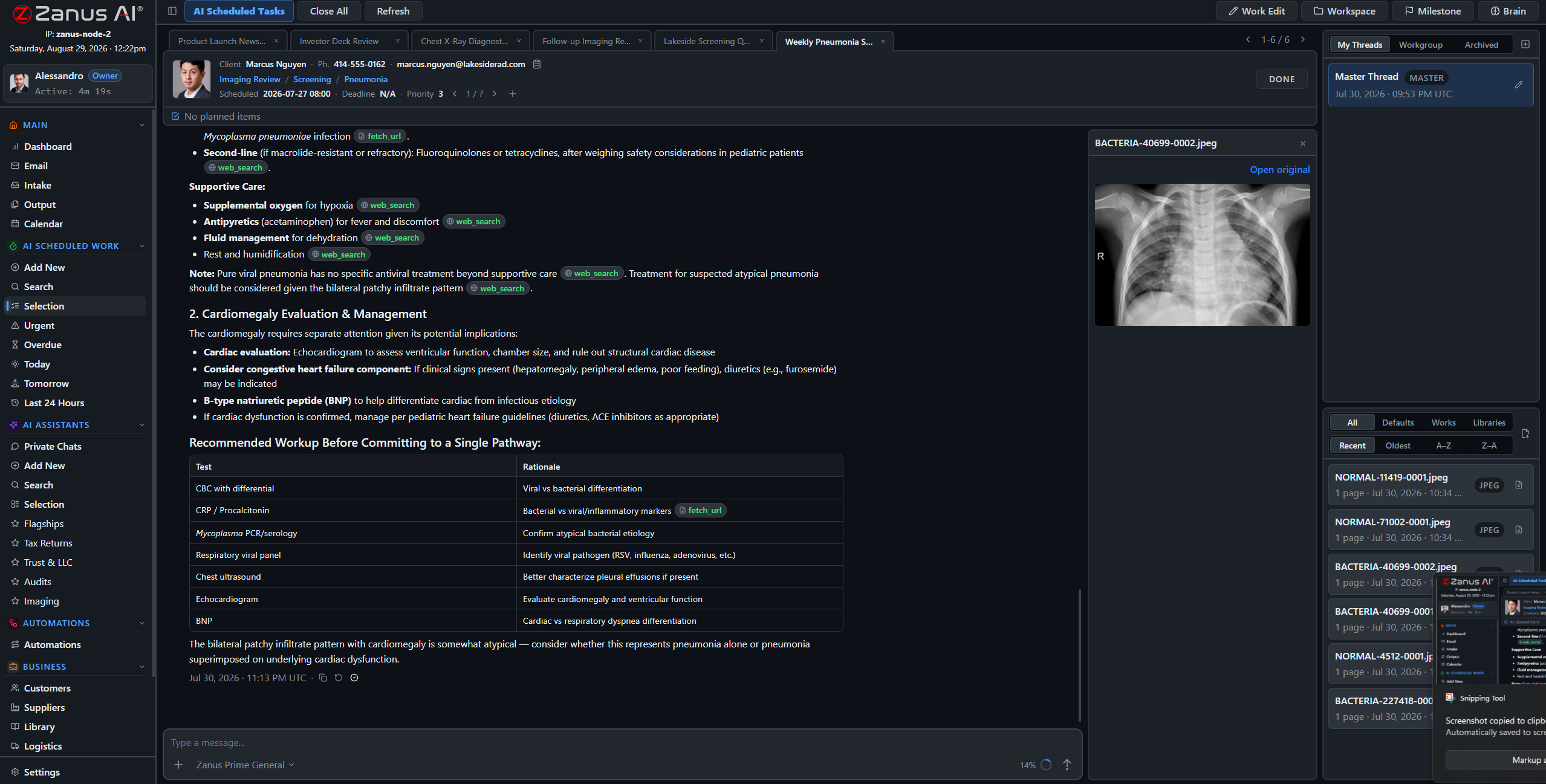
Back office: the field side, armed
Repair manuals, service bulletins, wiring diagrams, warranty terms, the callback history: the knowledge exists — on the truck it does not. The Zanus back office puts it one question away with the source cited, and drafts the service reports and warranty claims that eat your evenings.
- Verified answers cited to manual and bulletin pages
- Service reports and warranty claims drafted for review
- Scheduled AI work: callback reviews, bulletin digests
- See the Back Office for field service →
When the manuals cannot leave the building
Shops holding OEM documentation under strict NDA — or servicing equipment whose manuals are trade secrets — run the identical OS on Zanus hardware they own: air-gap capable, USB updates, your whole team, no recurring fees.
- Private On-Premises AI: owned, no recurring fees
- On-Prem Tokens Server for high-volume operations
- Explore the AI Servers →

Questions, answered
Can techs really use this from the field?
Yes — private chats work on any device with a login. The tech on the roof, in the crawlspace or at the panel asks in plain language and gets the cited answer on the phone in hand.
Do our manuals train someone else’s AI?
Never. Your tenant is isolated; manuals, bulletins and job history are yours alone. For full custody, the on-premises option keeps everything physically inside your building.
How fast can a shop be live?
Days to weeks: load the manuals and price book, connect the calendars, set escalation rules. The interactive demo of your own version arrives in about two minutes.
See it working on YOUR fleet — the demo IS the product.
ZANUS AI FOR FIELD SERVICE & REPAIR — FRONT OFFICE
Every service call answered and booked. Even at 9 PM.
Service calls arrive when things break, not when the office is staffed — and every voicemail is a job that calls your competitor next. The Zanus front office answers on your menu, in your voices, qualifies, books and reminds — 24/7, in up to 40 languages.
Private tenant or your own server · unlimited technicians · your manuals never train a public model

Calls, bookings, quotes and reminders — one dashboard your dispatcher reads at 7 AM.
What it does
Call your own service line Saturday evening. Voicemail? The AI answers in one ring, asks the questions your dispatcher would — no heat, or no cool? — books the window and texts the confirmation.
Model number, symptom, access notes, gate codes: collected in the first conversation, attached to the work order — the tech arrives knowing what he’s walking into.
Day-before confirmations and on-the-way notices in the customer’s language: fewer locked doors, fewer wasted truck rolls, a route that holds together.
From breakdown call to booked window, hands-free
A property manager calls about a walk-in cooler at 6:40 AM; the AI answers, captures the model and symptom, checks real availability, books the morning’s first window and quotes the diagnostic fee from your price book with a payable link — before your dispatcher pours the coffee.
- Real calendar sync — windows that actually exist
- Quotes from your real price book with payable links
- Emergency language escalated to the on-call by your rules
- Every conversation logged with a transcript


The web channel books too
Website chat grounded in your services and coverage area, web forms for service requests worked in minutes, and instant answers on pricing, warranty terms and what to check before the visit.
- Grounded chat on your site, 40 languages
- Service request forms worked in minutes, not days
- Warranty and coverage questions answered from YOUR terms
- See the full Front Office tour →
Questions, answered
What about real emergencies?
Emergency language routes by YOUR rules — straight to the on-call tech, with the transcript and the captured details attached. The AI never leaves a gas leak on hold.
Do we keep our phone numbers?
Yes. Your numbers stay; calls route AI-first, dispatcher-first or any mix per line and per hour — the AI takes nights and weekends, your team takes the day, for example.
Can it quote a repair?
It quotes what you put in the price book — diagnostic fees, standard services, maintenance plans — with payable links. Complex repair quotes route to your service manager.
See it working on YOUR fleet — the demo IS the product.
ZANUS AI FOR FIELD SERVICE & REPAIR — BACK OFFICE
Techs fix machines.
The paperwork fixes itself.
Service reports, warranty claims, parts requests, the callback log: a repair shop runs on paperwork nobody became a technician to write. The Zanus back office drafts it from the job records — cited, in your templates, waiting for a human signature.
Private tenant or your own server · unlimited technicians · your manuals never train a public model
A real session: the warranty claim drafted from the job record — bulletin cited, manager decides.
What it does
The tech’s voice notes and photos from the job become a clean service report in your template: work performed, parts used, recommendations — drafted before the truck leaves the lot.
The AI drafts the claim from the job record, cites the service bulletin that covers the failure, attaches the photos — fewer rejected claims, fewer Friday afternoons lost to resubmission.
Every AI-drafted document — the report, the claim, the callback analysis — lands in Output awaiting review. Your service manager signs; the system remembers.
The callback pattern, finally visible
A monthly AI review reads the callback log against the job records: the compressor model failing early, the install step that keeps getting skipped, the tech who needs a refresher on the new refrigerant — drafted with the jobs cited, on the service manager’s desk the first of the month.
- Recurring reviews across the whole job history
- Findings cited to actual work orders
- Report in Output, awaiting sign-off

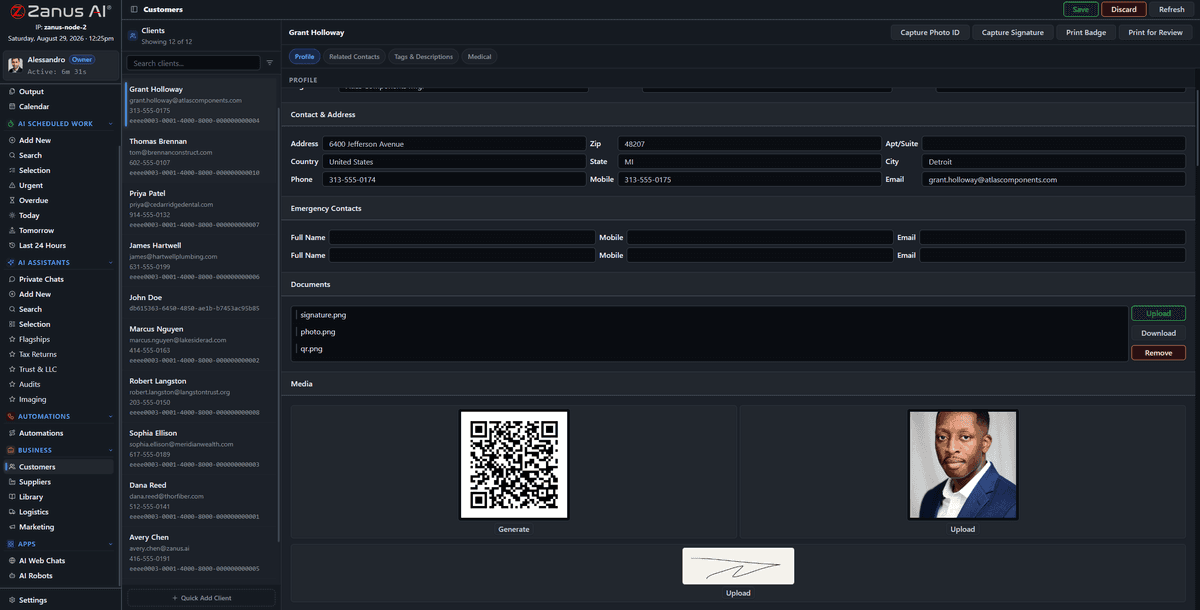
Suppliers and fleet in your vocabulary
The CRM molds to how a shop actually talks: equipment, serial numbers, maintenance contracts, parts vendors, lead times. Ask “which customers have units past their service interval?” and get the answer with the records attached.
- Customers, equipment and contracts in one system
- Parts vendors with lead times and terms
- Calendar, tasks and routes shared human + AI
Questions, answered
Does this replace our FSM or dispatch software?
No — your FSM stays the system of record for work orders. Zanus is the system of work on top: it reads, drafts, analyzes and answers. Bring your FSM to the demo and we map it.
Who reviews the warranty claims?
Whoever you assign — usually the service manager or warranty administrator. Drafts land in Output with the bulletin and job record cited; nothing files without a human yes.
YOU MIGHT ALSO LIKE
The Back Office executes. Who answers the phone?
Front Office AI picks up every call and chat — books, quotes, follows up, 24/7 in 40 languages. Watch it run a business like yours, live.
See it working on YOUR fleet — the demo IS the product.
ZANUS AI FOR FIELD SERVICE & REPAIR — MANUALS & BULLETINS
Ask the manual. From the roof.
Repair manuals, service bulletins, wiring diagrams, parts lists, warranty terms — loaded into curated libraries the AI reads from. The tech asks in plain language from the phone in hand; the answer comes back with the page cited, in seconds.
Private tenant or your own server · unlimited technicians · your manuals never train a public model
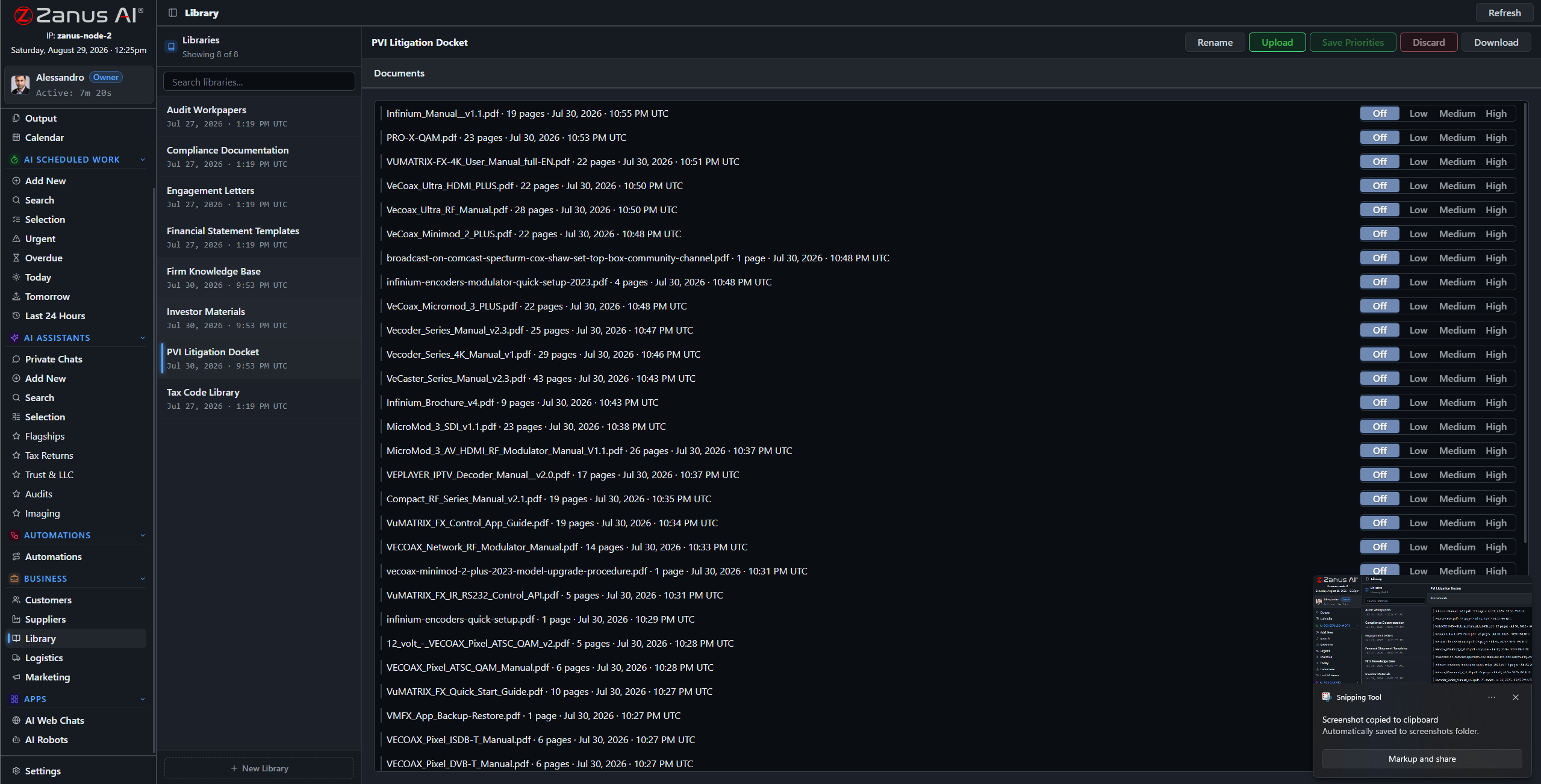
Libraries: the current bulletin outranks the old manual page — the AI answers from the right one.
What it does
Scanned manuals from 1998, PDF bulletins, photos of wiring diagrams, the OEM’s spec sheets — the ingestion pipeline turns the filing cabinet into queryable knowledge.
When bulletin SB-2024-11 supersedes the manual’s procedure, priority order makes sure the answer cites the bulletin — not the page it replaced.
The apprentice sees the procedures; the service manager sees the warranty terms and margins: answers scoped to role, enforced server-side — and OEM NDA boundaries hold.
The torque spec, one-handed, in the wind
The tech at the rooftop unit types “torque spec compressor mounting bolts” with the model number: the answer arrives with the manual page cited — no call to the shop, no scrolling a 400-page PDF on a phone screen, no guessing from memory.
- Plain-language questions from any device
- Answers cited to the manual page and bulletin
- No source in the library, no claim — ever

Questions, answered
Our manuals are confidential — where do they go?
Into your isolated tenant and nowhere else: they never train outside models, permissions control who reads them, and the on-premises option keeps them physically inside your building.
What if the answer is not in the manuals?
The AI says so — claim guard means no source, no claim. A wrong torque spec is worse than no answer, and the system is built on that principle.
See it working on YOUR fleet — the demo IS the product.
ZANUS AI FOR FIELD SERVICE & REPAIR — AI WORKFORCE
The back-office hire the shop never budgeted.
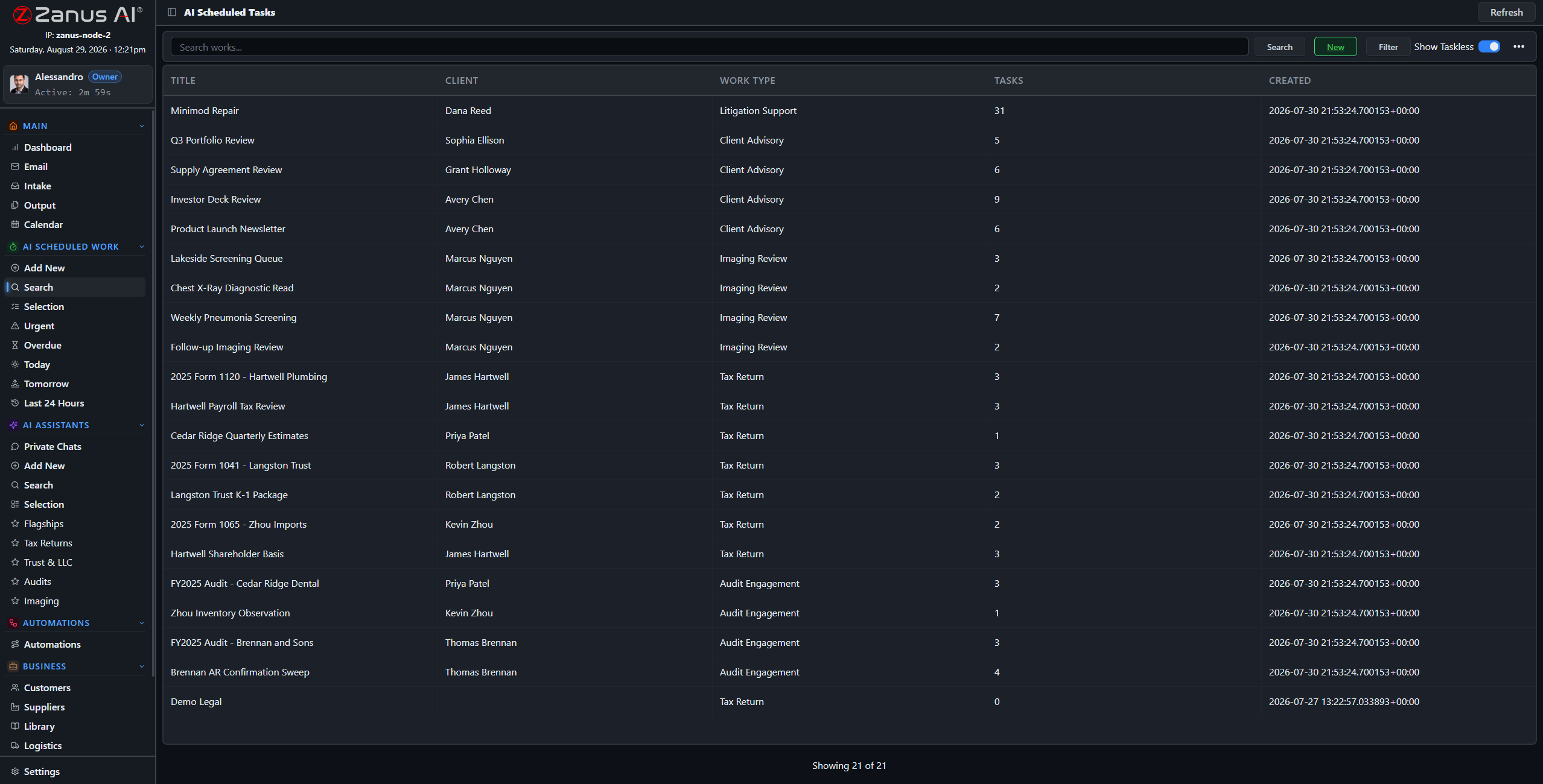
Assign work to the AI the way you assign it to staff: type, sources, deadline, recurrence. The Friday warranty-claims batch, the monthly callback review, the weekly bulletin digest — executed on schedule, with citations, under review.
Private tenant or your own server · unlimited technicians · your manuals never train a public model
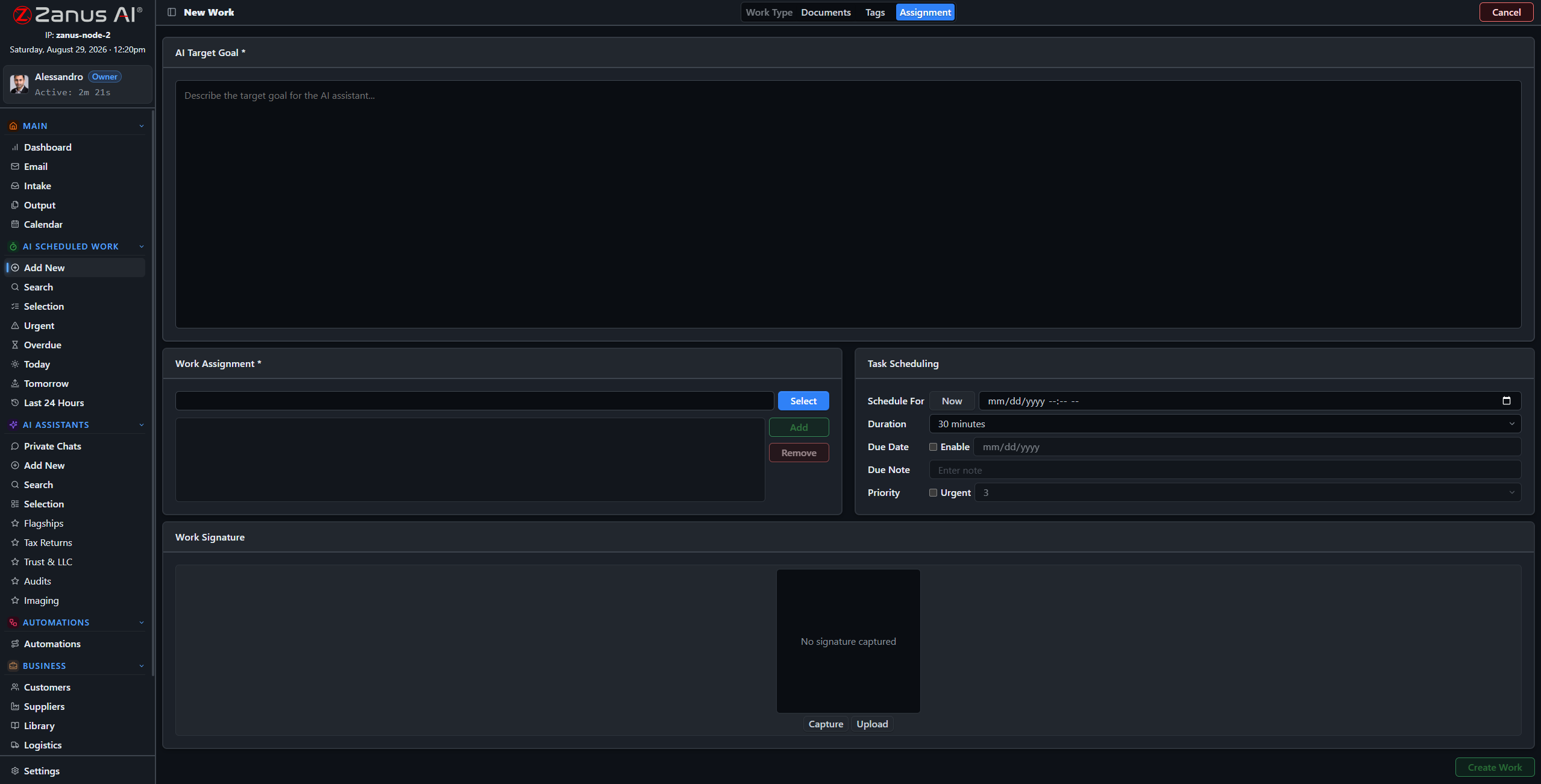
Four steps: work type, records and libraries, tags, schedule — the AI takes it from there.
What it does
Warranty claim, callback review, bulletin digest, maintenance-due report: work types molded to your operation, with default libraries and examples per type.
The AI’s workload is managed like the crew’s: one-click views show what is urgent, late, today and tomorrow — nothing slips while the trucks are out.
Every work is a full session: reasoning streamed, job records cited, milestones tracked, linked to the customer and the unit it belongs to.
Friday, 4 PM: the warranty batch is drafted
Set “Weekly Warranty Claims” once: every Friday the AI reads the week’s eligible jobs, drafts each claim with the covering bulletin cited and the photos attached, and files the batch for the warranty administrator — the Friday that used to end at 7 now ends at 5.
- Recurring schedules for periodic shop work
- Claims cited to bulletins and job records
- Batch in Output, awaiting sign-off
Questions, answered
Can we supervise mid-work?
Yes — open any session, read the reasoning, redirect it, or stop it. The AI works like staff: visible, accountable, interruptible.
Can it handle peak season volume?
It does not get tired in July: the constraint is your review capacity, not the AI’s. Configurations size from a three-truck shop to a multi-branch fleet.
See it working on YOUR fleet — the demo IS the product.
ZANUS AI FOR FIELD SERVICE & REPAIR — JOB CHECKLISTS
The checklist binder, alive.
Checklists only work when the tech at the unit can find them — the current revision at that. In Zanus, your commissioning checklists, safety procedures and startup sequences are living documents: answerable from the jobsite, attached to work, priority-ordered so the latest revision always wins.
Private tenant or your own server · unlimited technicians · your manuals never train a public model
One library: commissioning checklists, lockout-tagout, startup sequences — current revisions on top.
What it does
Lockout-tagout, refrigerant handling, commissioning steps, the ladder-safety policy, the callback-prevention checklist: one library, current revisions on top, superseded versions outranked.
“What is the startup sequence after a compressor swap on this model?” — answered in seconds with the checklist attached, at the unit, on a phone, gloves half off.
Work types carry their default procedures: the AI drafting a commissioning report reads from the current commissioning checklist — by construction, not by memory.
Season change, rehearsed on the calendar
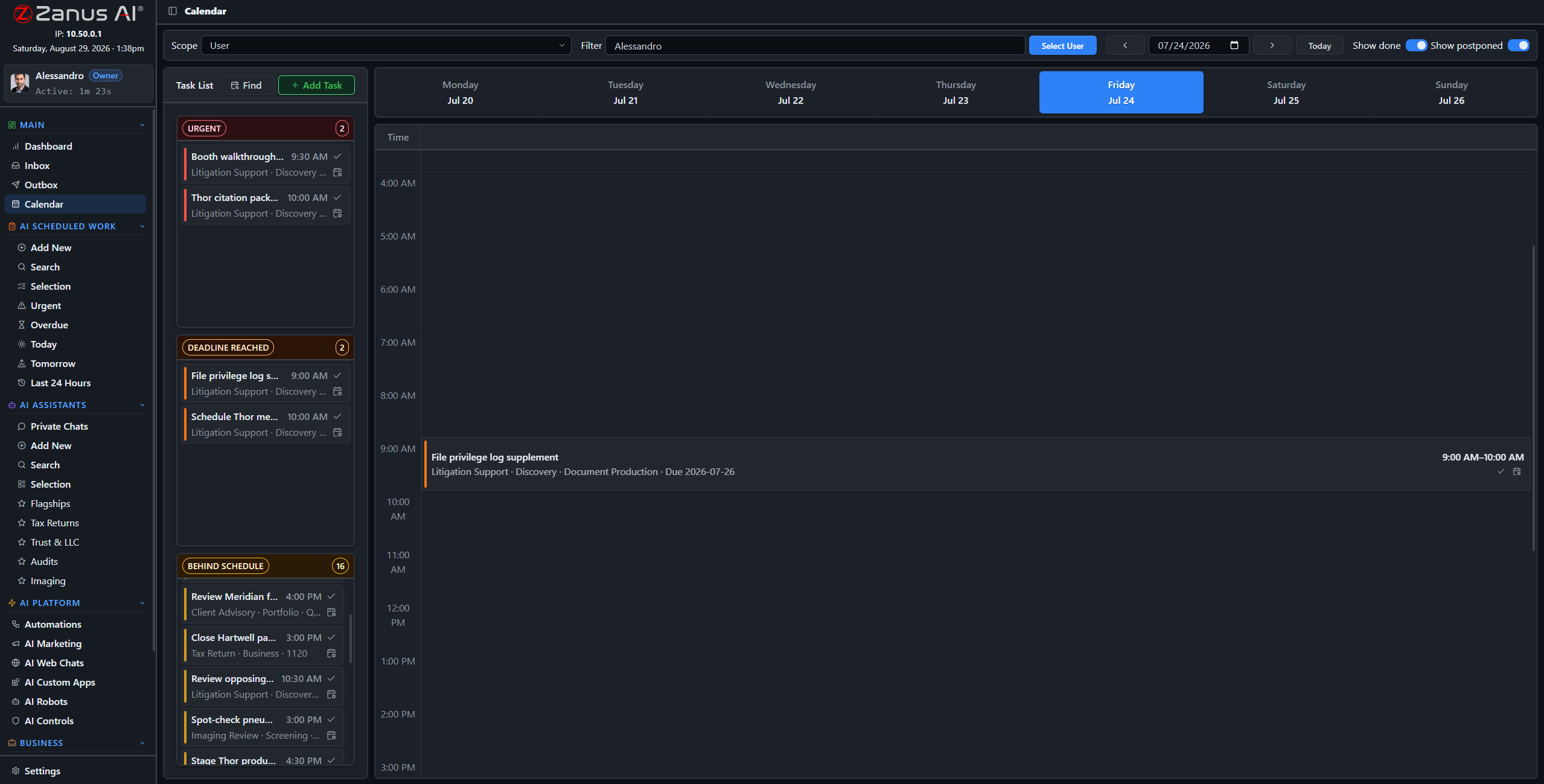
Pre-summer checklist reviews, refrigerant-regulation updates, the winterization procedure refresh: assigned once as recurring AI works, executed on schedule — gaps flagged, revisions summarized for the Monday toolbox talk. The binder never goes stale again.
- Recurring review works with deadlines
- Update summaries drafted for toolbox talks
- Every review on the audit record
Questions, answered
How do revised procedures reach the trucks?
Upload the new revision, set it on top: from that moment every answer on every phone cites the new procedure. Old revisions stay archived for audit.
See it working on YOUR fleet — the demo IS the product.
ZANUS AI FOR FIELD SERVICE & REPAIR — TEAM TRAINING
Your best tech retires.
His knowledge doesn’t.
The 30-year veteran who knows every quirk of every unit in town retires next spring — the apprentice starts Monday. In Zanus, the knowledge lives in the system: new techs learn your procedures from the AI, and every tech has an assistant that answers “how do I…?” from the jobsite.
Private tenant or your own server · unlimited technicians · your manuals never train a public model

Training lives inside the software: the AI walks each new tech through the shop’s own procedures.
What it does
New techs learn your job workflow, documentation standards, safety procedures and the systems on the truck through guided training — productive in days, not a season.
“How do I document a refrigerant recovery?” — asked to the assistant from the jobsite, answered from the procedure, without a radio call to a busy senior tech.
Private chats work on any phone with a login — the how-to knowledge rides along to the rooftop, the basement and the highway rest stop in between.

The mentor that never gets impatient
The tenth “which fitting for this line set?” of the week gets the same patient, sourced answer as the first. Training material stays current automatically, because the assistant reads from the same living manuals and checklists as everything else.
- Answers cite the current manual and checklist
- Personal preset assistants per role
- Training progress visible to the service manager
Questions, answered
Does training content go stale?
No — the assistant answers from the live libraries. Update the procedure once and every future answer updates with it, for this apprentice and the next.
See it working on YOUR fleet — the demo IS the product.
ZANUS AI FOR FIELD SERVICE & REPAIR — AUTOMATIONS
The shop’s repetitive work, set once.
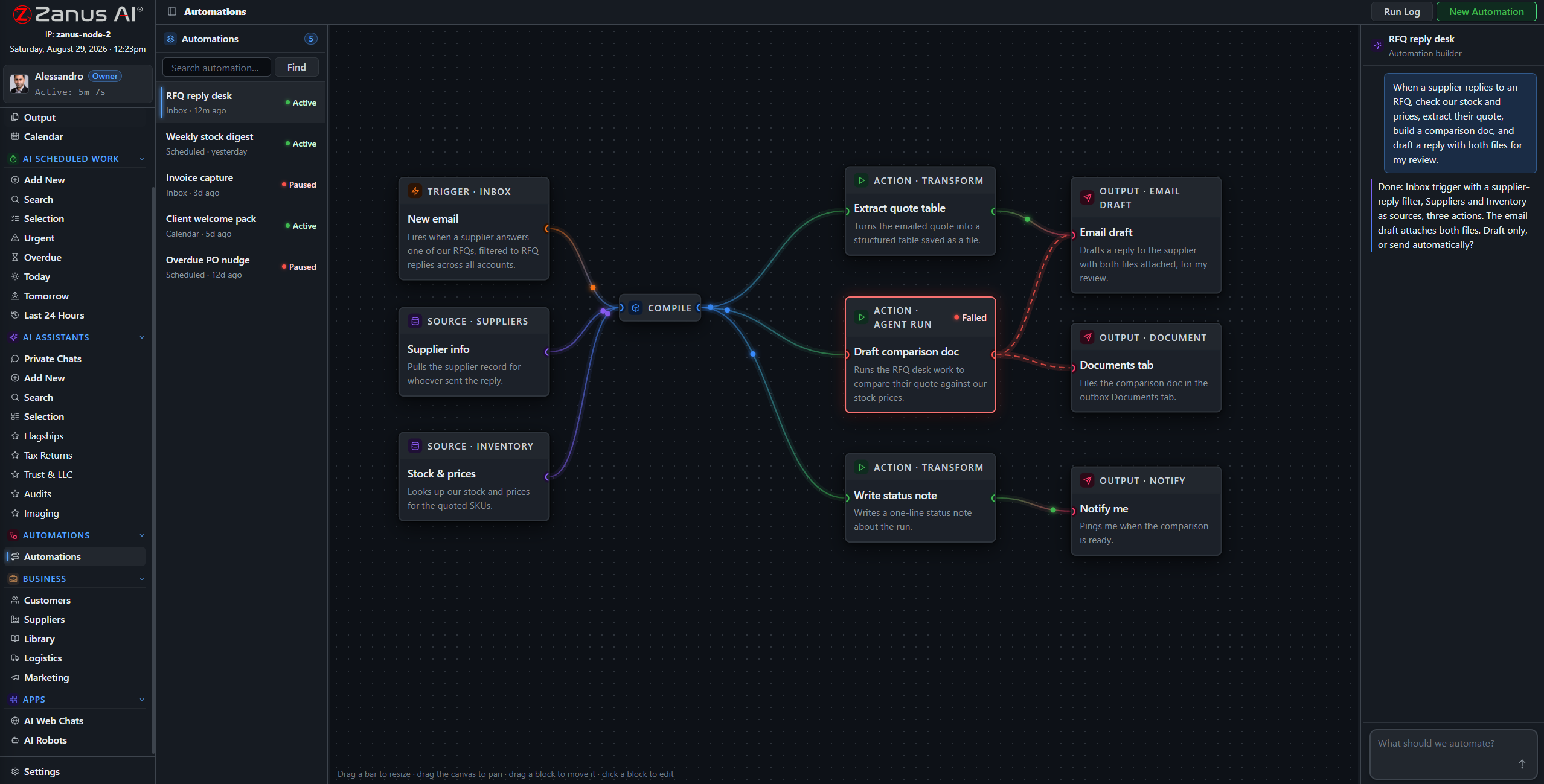
Describe the job in plain words — “when a job closes, draft the service report from the tech’s notes and queue the customer summary” — and it becomes connected blocks on a canvas, running on its own, with every run visible.
Private tenant or your own server · unlimited technicians · your manuals never train a public model
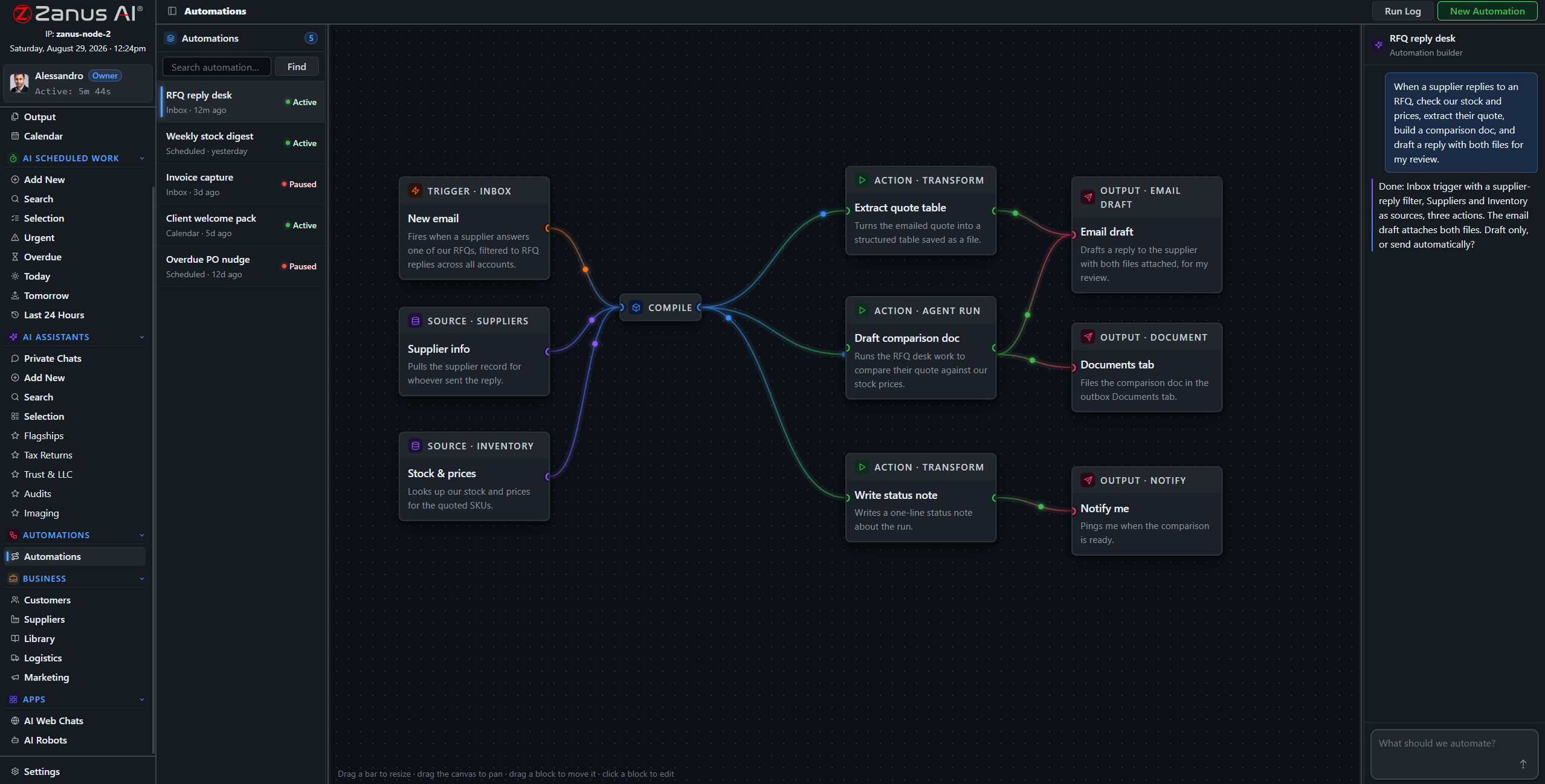
A real flow: job-closed trigger, notes and manual sources, AI compile, outputs queued — drawn from a description.
What it does
Job closed → the AI reads the tech’s notes and photos, drafts the service report in your template and the plain-language customer summary, and queues both for review.
New OEM bulletin arrives by email → filed to the right library, affected models identified against your install base, a digest drafted for Monday’s toolbox talk.
Day-before → confirmation in the customer’s language; morning-of → the on-the-way notice. Rescheduling requests flow back to the calendar, not to a sticky note.
When something fails, you SEE it
Run states live on the flow: green success, red failure on the exact block. A silently broken reminder flow means a tech at a locked gate at 8 AM — here, nothing fails silently.
- Run log per automation
- One-click retry on failures
- Finished documents in Output, statused
Questions, answered
Who approves what customers receive?
Your rules: queue everything for human approval, or auto-send only the categories you designate as safe — reminders yes, repair recommendations never.
See it working on YOUR fleet — the demo IS the product.
ZANUS AI FOR FIELD SERVICE & REPAIR — SERVICE REMINDERS
The maintenance book that fills itself.
Maintenance-due reminders, seasonal tune-up campaigns, warranty-expiration notices, contract renewals — drafted by the AI from your own service history, in the customer’s language, queued for approval. The slow-season pipeline, built from records you already own.
Private tenant or your own server · unlimited technicians · your manuals never train a public model
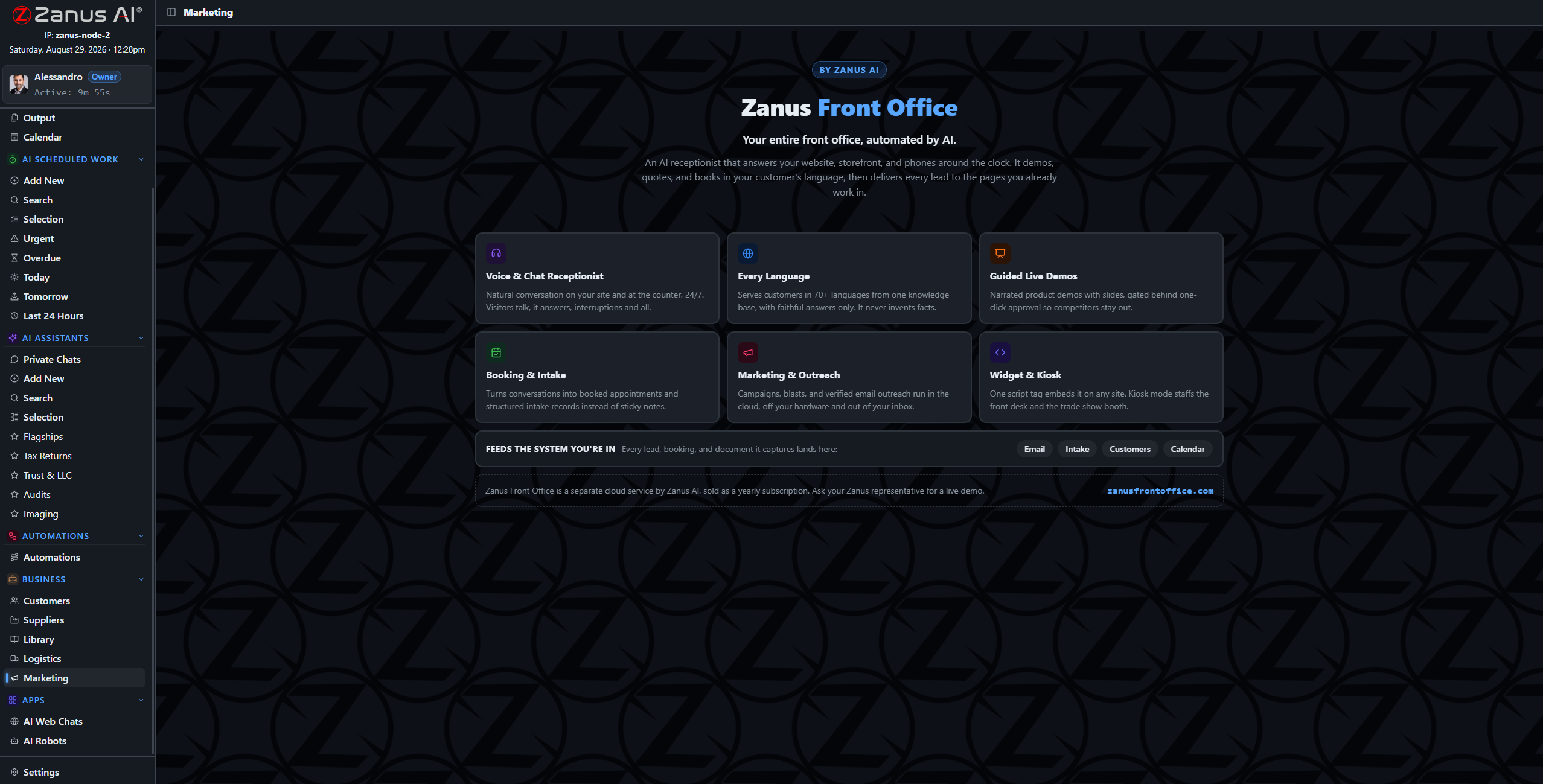
Campaigns and sequences drafted from the service records — reminders, tune-ups, renewals — awaiting approval.
What it does
Units past the service interval, warranties expiring in 60 days, maintenance contracts up for renewal: audiences built from your own equipment and job history — no list ever exported.
The tune-up offer reads naturally in Spanish to the restaurant owner and in English to the property manager — your shop’s voice, their language.
Opt-outs and contact preferences are enforced by the system, not by memory. Every send is on the record.
From the job history to the campaign, without export
The audience, the content and the sending all live in the same system as the service records — nothing leaves your tenant to reach a mailing platform. “Remind every customer whose unit we installed in 2021 that the compressor warranty ends this year” becomes a drafted, scheduled campaign in minutes.
- Audiences from your own service data — private by architecture
- Campaigns and sequences drafted for review
- Results tracked: bookings, replies, renewed contracts

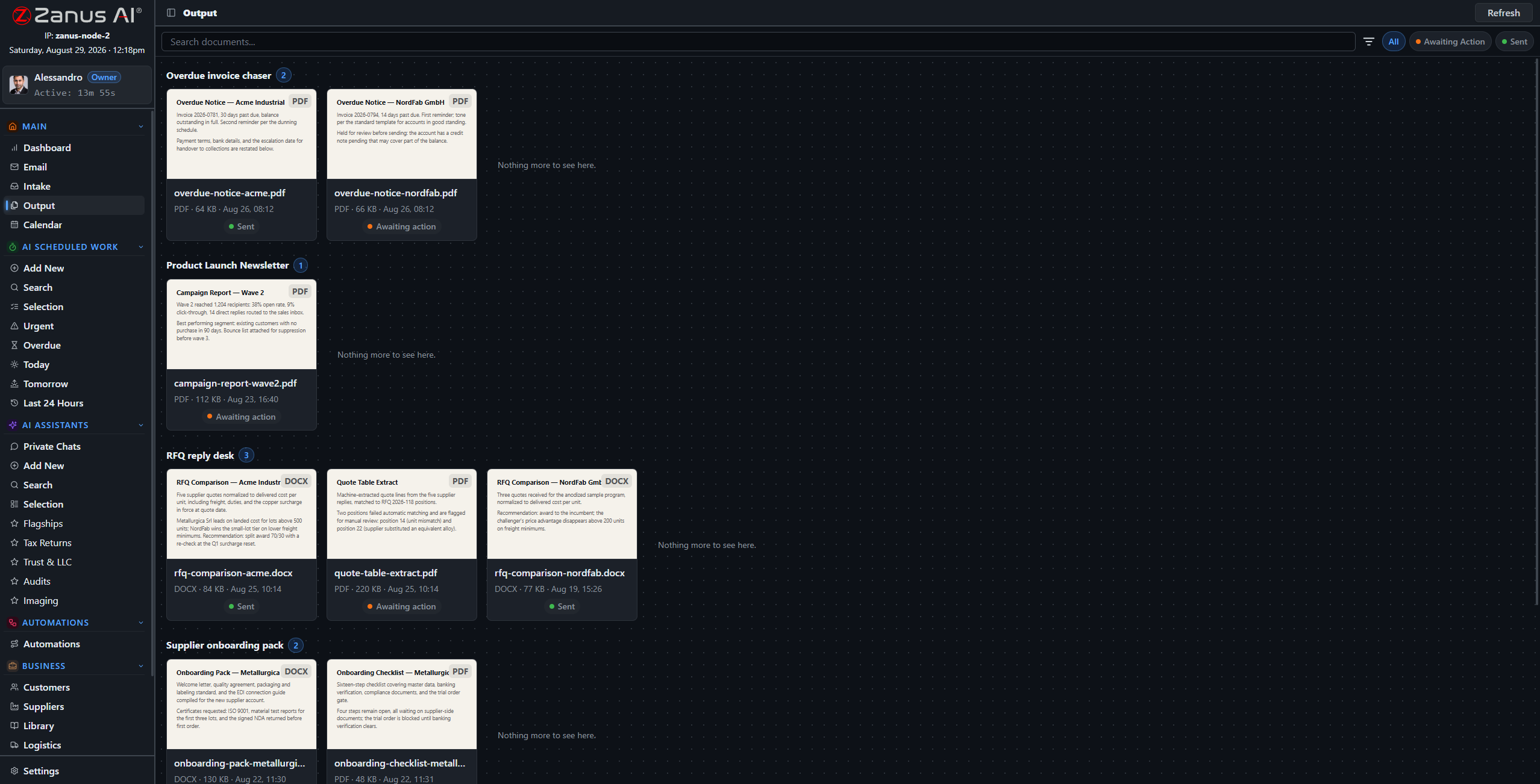
Approval first, always
Every outbound customer communication lands in the approval queue unless you designate the category as auto-send. The shop stays in control of every word that reaches a customer.
- Approval workflow per communication type
- Full history of what was sent to whom
- Sequences pause automatically when a customer replies
Questions, answered
Can it smooth out the seasonal trough?
That is the point: the shoulder-season tune-up campaign is drafted from units due for service in exactly those weeks — reviewed by you, booked into the same calendars the AI phone uses.
Do customer lists ever leave our tenant?
No. Audiences, drafts and sends all happen inside your isolated tenant — your customer and equipment data is not shared with a mailing platform or anyone else.
See it working on YOUR fleet — the demo IS the product.
ZANUS AI FOR FIELD SERVICE & REPAIR — FSM & INTEGRATIONS
Keep your FSM. Add the intelligence.
Your FSM stays the system of record for work orders and dispatch. Zanus becomes the system of work: API connectors sync jobs, customers and documents both ways, the intake pipeline files what arrives, and AI-drafted reports flow back where they belong. No rip and replace.
Private tenant or your own server · unlimited technicians · your manuals never train a public model

No rip and replace: the FSM, dispatch board and accounting stay — the AI layer connects to all of them.
What it does
Work orders, customers and equipment mapped field by field, with a dry-run preview before anything writes — push, pull or two-way, your choice per object.
Connectors for the leading CRM suites sync commercial accounts and maintenance-contract leads push, pull or two-way — sales and service finally read one story.
A full API for whatever else the shop runs: the parts supplier portal, the accounting export, the GPS feed — data in, results out, under scoped keys.
One question across all your systems
The work order lives in the FSM, the invoice in accounting, the manual in the library, the complaint in the inbox — and the AI reads across all of it. “What is the full history on this rooftop unit?” becomes one question with one grounded answer.
- Field mapping with dry-run preview
- Each system stays master of its own records
- Every sync event on the audit record
- External systems appear as blocks on the automation canvas
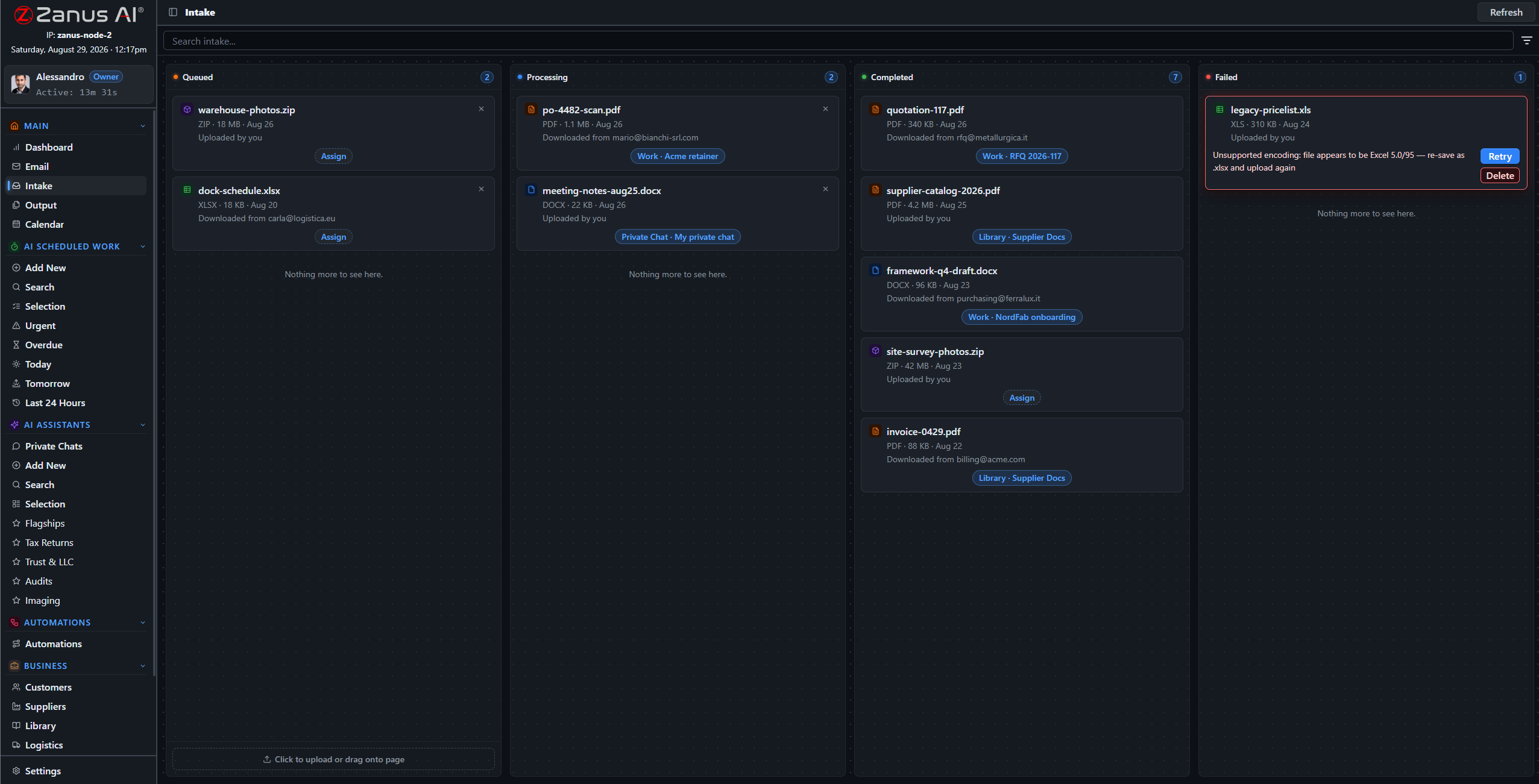
Reports flow back where they belong
The service report the AI drafted, the warranty claim, the maintenance-due list: finished documents return to the systems that own them through the same connectors — reviewed and signed by your service manager first.
- AI output filed back to the work order
- Approval workflow before anything writes back
- Webhooks notify your systems in real time
Questions, answered
Which FSM platforms do you support?
Connectors are mapped per deployment — bring your FSM, dispatch board and accounting to the demo and we walk through the exact integration path for your stack.
Does job data pass through third parties?
No. The connectors run inside your tenant — or inside your building on the on-premises option. Data moves directly between your systems.
See it working on YOUR fleet — the demo IS the product.
ZANUS AI FOR FIELD SERVICE & REPAIR — DATA CUSTODY
The OEM trusted you with the manual. Keep it that way.
Repair documentation is often confidential by contract: OEM manuals under NDA, proprietary procedures, customer site details. Zanus holds them accordingly: isolated private tenants where nothing trains outside models, permissions to the field level, server-side redaction, a searchable audit trail.
Private tenant or your own server · unlimited technicians · your manuals never train a public model
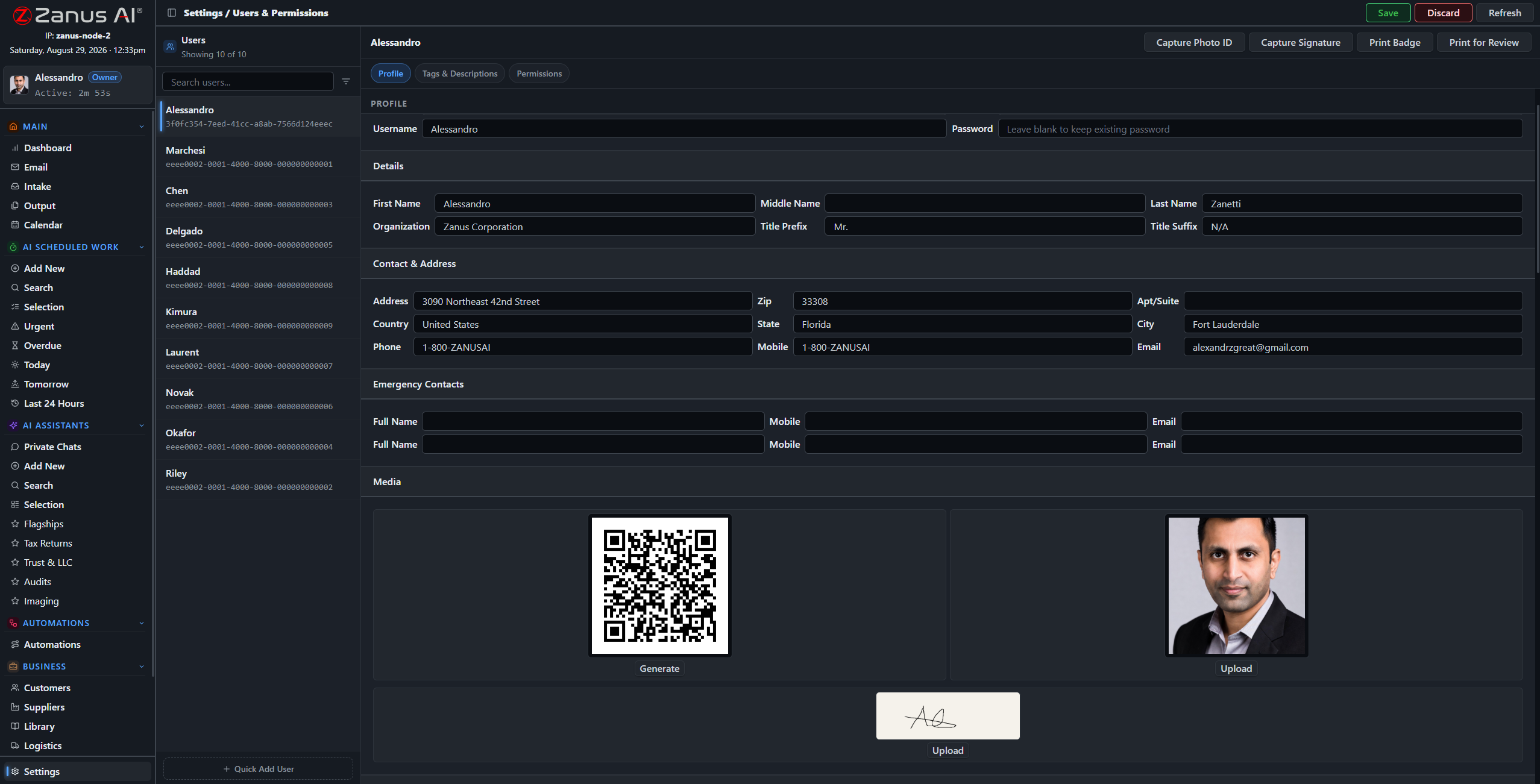
One record per user: role, tags, and granular permissions over every domain of the system.
What it does
The server redacts what a role cannot see — the subcontractor sees the checklist for the job at hand, not the OEM manual library or the customer’s contract terms.
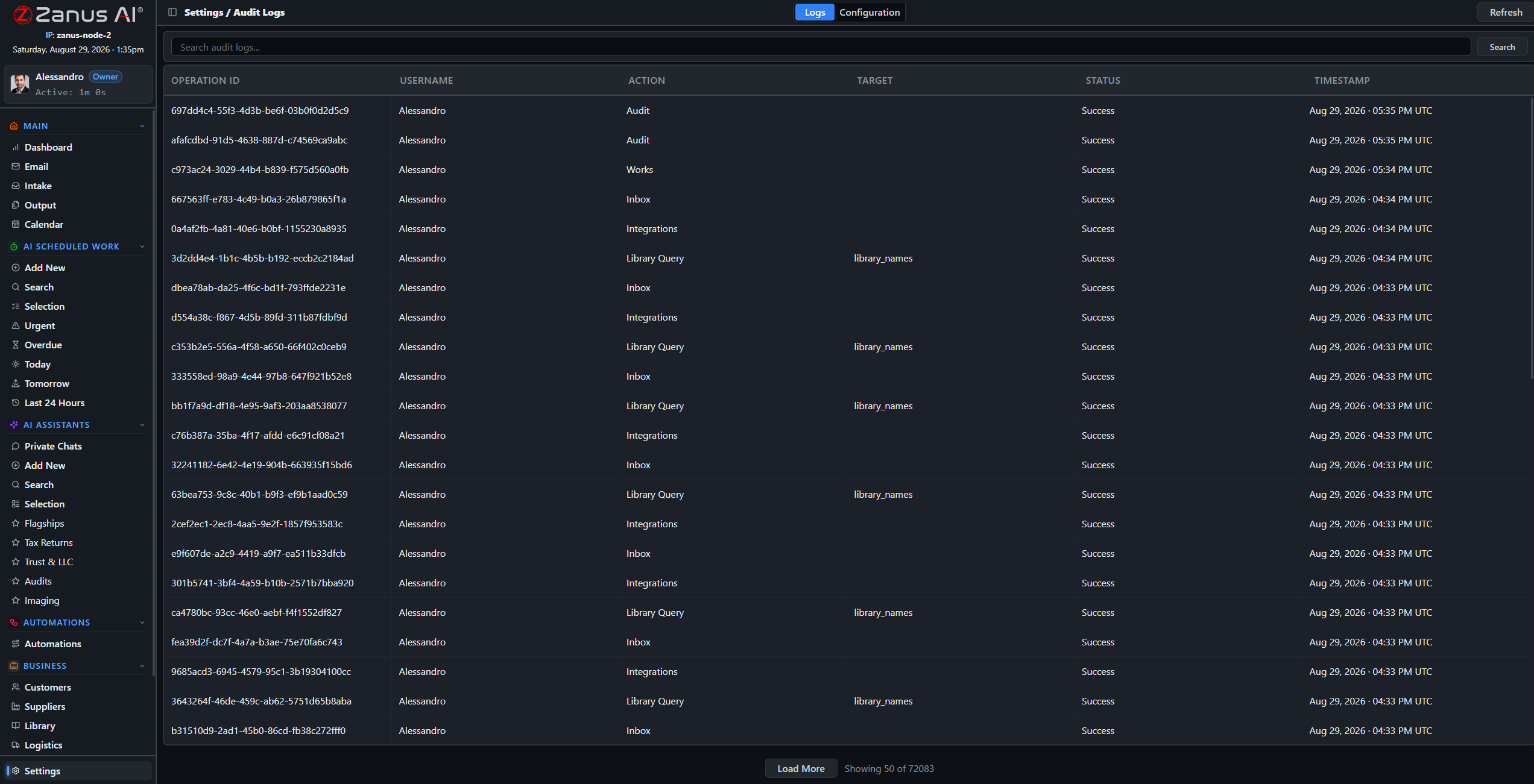
A searchable log of every audited action: who queried which manual, who exported the customer list, who changed a procedure, and when — the NDA audit answers itself.
Five-level workgroups map branches, crews and OEM programs; the air-gap-capable on-premises option puts the manuals physically inside your building, updated by USB.
The audit that takes minutes, not weeks
When the question comes — from an OEM auditing NDA handling, a commercial customer’s security review or your own insurer — the answer is a search away: access records, document trails, update history, all in one place.
- Searchable audit trail
- Automatic pre-update snapshots with rollback
- USB updates for air-gapped deployments
Questions, answered
Where do our manuals live?
In your isolated tenant — never training outside models — or fully on-premises on hardware you own, air-gap capable. Either way, they are yours alone.
Can we prove NDA-conscious handling to an OEM?
The architecture is built for that conversation: isolation, role-based access, redaction, audit trail. Bring the OEM’s requirements to the demo and we walk them together.
See it working on YOUR fleet — the demo IS the product.
ZANUS AI FOR FIELD SERVICE & REPAIR — LIVE DEMO
Do not watch a video.
Talk to your AI.
Big vendors show field-service demos as videos behind a form. Ours is the product itself, configured for service and repair: open the chat below-right and try it — book a repair visit, ask a spec question the way a tech on a roof would.
The conversation you have with us IS the demo
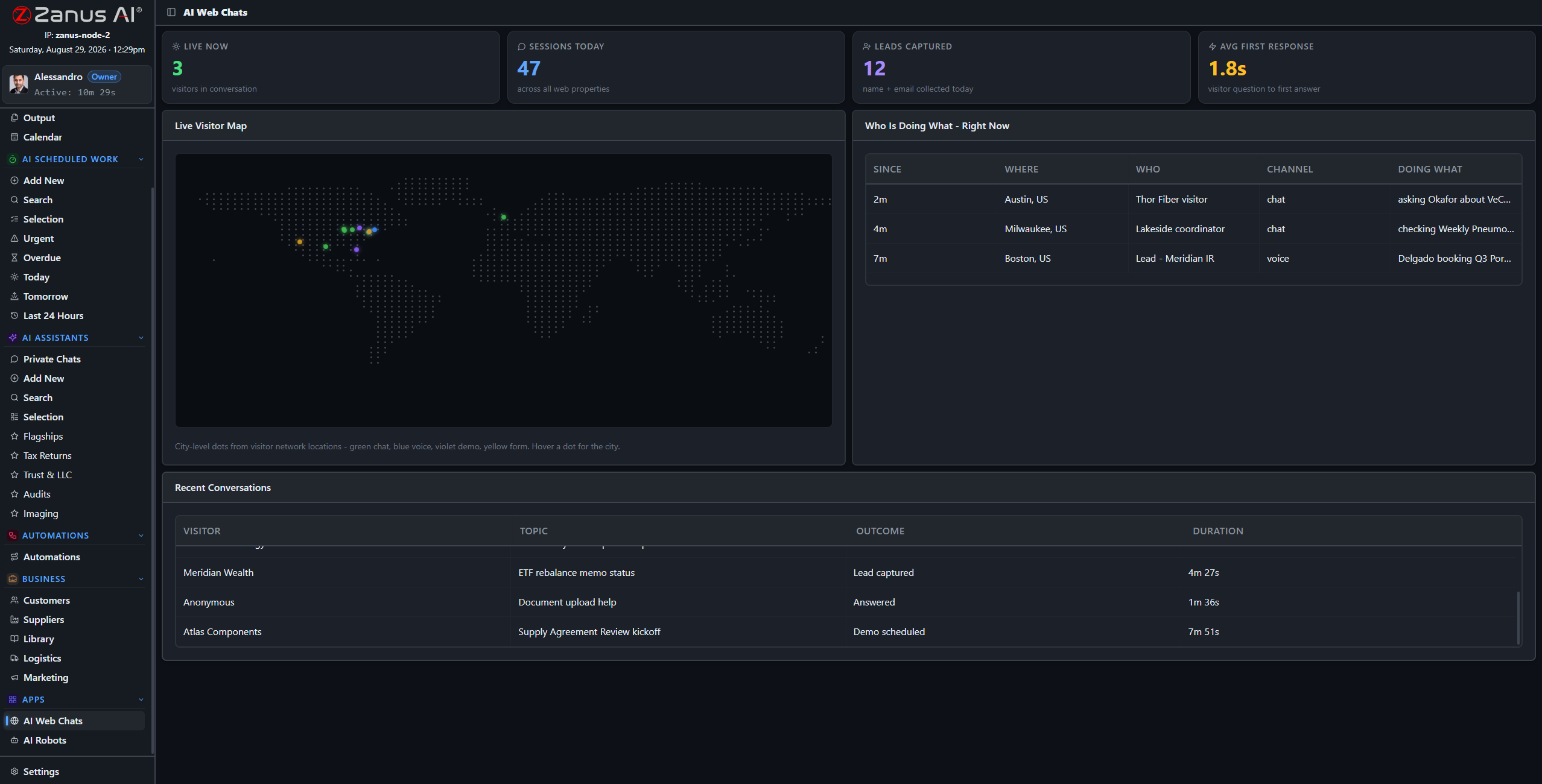
This screen is watching demos like yours happen: live conversations, outcomes, first response in seconds.
What it does
Ask the chat: “my AC quit — can someone come Thursday?” — watch it qualify the problem, offer windows and confirm like your best dispatcher.
Ask: “how would a tech get a torque spec from the field?” — it walks the cited-answer workflow it would run in your tenant, manual page and all.
The full demo loads a field-service tenant with sample manuals and jobs: spec queries, service reports, warranty drafts — your fleet, working.
Or pick your exact business
Every link below is a full live-demo page for that specific business — its vocabulary, its calls, its booking rules.
Two minutes to your inbox
Request the demo and the interactive field-service demo arrives in about two minutes — no sales call, no calendar dance. Watch it, interrupt it with questions, and book the human conversation when YOU are ready.
- Interactive demo, field-service-configured
- Ask questions mid-demo — it answers and resumes
- In your inbox in ~2 minutes, free

Questions, answered
Is the demo really the product?
Yes — the same AI, configured with a sample field-service tenant. What you see is what your techs get, with your manuals instead of the samples.
See it working on YOUR fleet — the demo IS the product.
Sharing with a colleague? 📄 Get the PDF · ✉️ Email this page ·