ZANUS AI FOR CORPORATE HEADQUARTERS — OVERVIEW
Every department. Every office. One brain.
Finance closes the books, HR onboards, legal reviews, marketing drafts — each in its own tool, blind to the others. Zanus AI puts headquarters on one operating system for every department and every office: the outside world handled up front, the corporate machine drafted, coordinated and audited in the back.
Private tenant or your own servers · your whole team · role-scoped by department
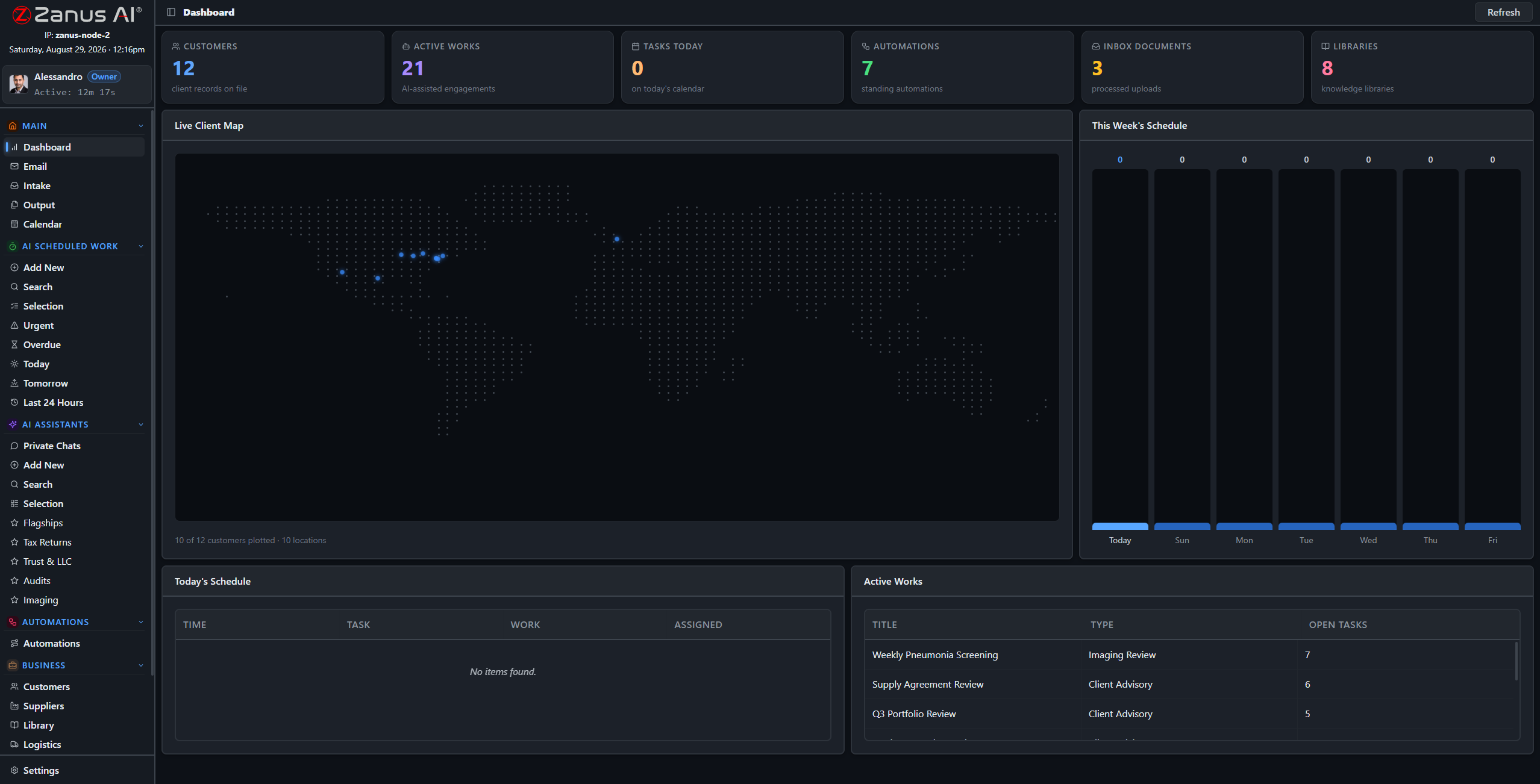
The HQ view: department workgroups, scheduled AI works, the board pack in progress — one screen.
What it does
“Which contracts renew next quarter and what did we budget for them?” spans legal and finance — and used to die in a reply-all. Now it is one question with a cited answer.
The monthly board pack drafts itself from finance records, department reports and prior minutes — assembled on schedule, cited, waiting for the CFO’s red pen.
The policy ratified at HQ answers questions in every office the moment it is ratified — not after the regional all-hands three weeks later.
Front office: the corporate face, kept
Vendors chasing invoices, candidates checking on applications, partners and press finding the right person: the HQ main line and inboxes answered 24/7 in up to 40 languages, routed by your rules, every conversation on the record.
- Main line answered and routed, every hour
- Vendor and candidate questions handled from approved knowledge
- Meetings booked into real executive calendars
- See the Front Office for headquarters →

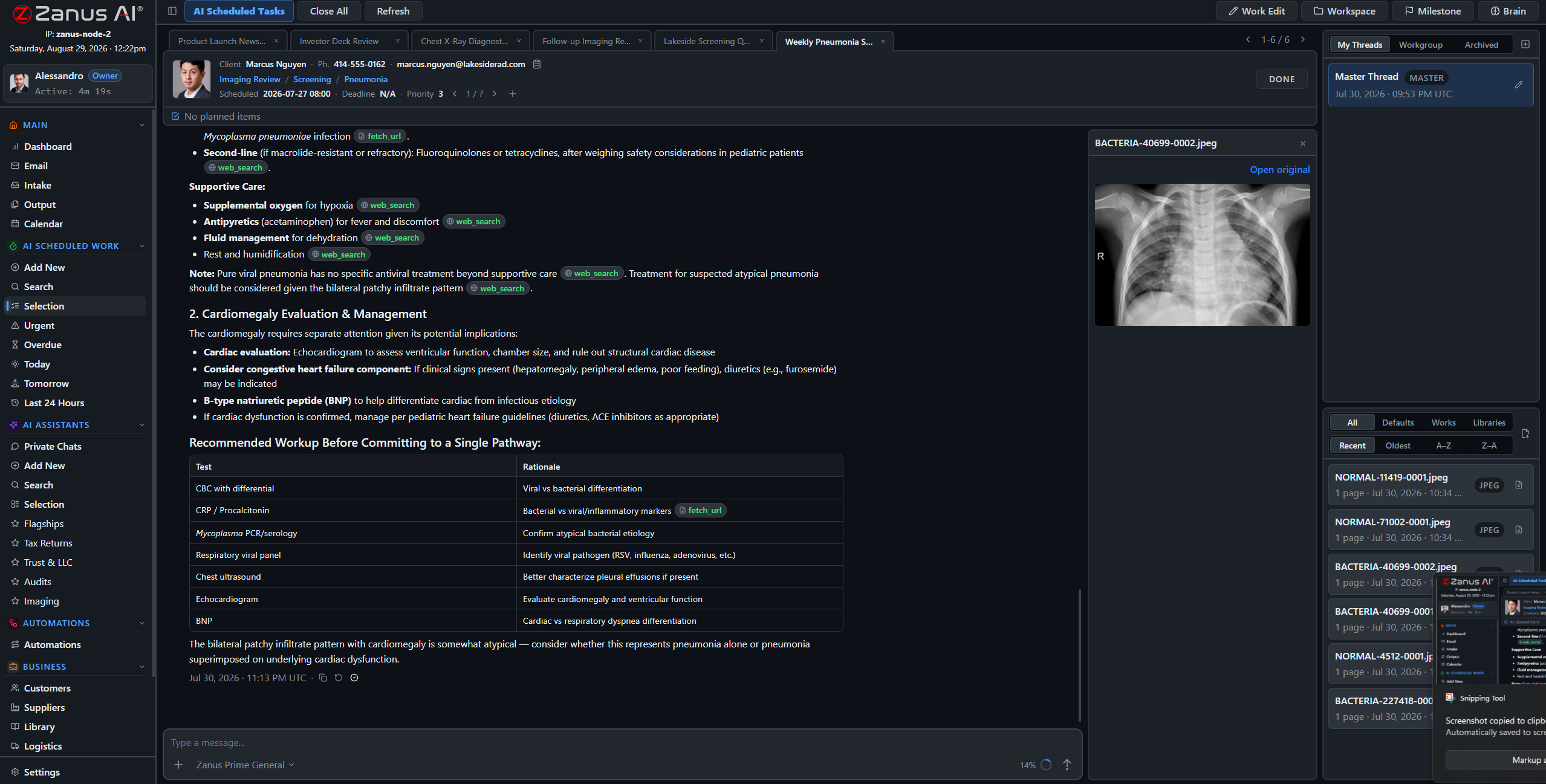
Back office: the corporate machine, drafted
Finance memos, HR letters, contract summaries, policy rollouts and the board pack — drafted from your own records in your templates as scheduled AI work, each department’s output waiting for its own sign-off.
- Board and committee packs compiled on schedule
- HR and legal documents drafted, humans decide
- Each department scoped to its own domain
- See the Back Office for headquarters →
The crown jewels, in your custody
Board minutes, payroll data and legal files are the most sensitive documents a company owns. Run the identical OS on Zanus servers inside your own building: air-gap capable, USB updates, owned outright — with a zero-migration path from the cloud tenant.
- Private On-Premises AI: owned, no recurring fees
- Cloud tenant to on-prem: same system, zero migration
- Explore the AI Servers →

Questions, answered
Can departments really share one system safely?
That is the architecture: workgroups per department and office, permissions to the field level, redaction server-side. Finance never sees HR’s cases; HR never sees the deal room — and cross-department questions work only for roles allowed to ask them.
We have offices in four countries. One tenant?
One tenant with workgroups per office is the common pattern; separate tenants per legal entity where counsel requires it. The AI answers each office in its own language either way.
What does the C-suite actually see?
A morning briefing scoped to the whole company: yesterday’s numbers, open decisions, drafted documents awaiting sign-off — with drill-down governed by role, not by which tool holds the data.
See it working on YOUR headquarters — the demo IS the product.
ZANUS AI FOR CORPORATE HEADQUARTERS — FRONT OFFICE
The main line, actually answered.
Headquarters is a switchboard wearing a suit: vendors chasing payments, candidates chasing recruiters, partners chasing the right department. The Zanus front office answers on your menus, in up to 40 languages, resolves what it can from approved knowledge, and routes the rest — with the context attached.
Private tenant or your own servers · your whole team · role-scoped by department

Calls, emails and chats into HQ — answered, routed and logged on one screen reception can read.
What it does
“Was invoice 8814 paid?” answered from the records vendors are allowed to hear about — not bounced through three departments and a callback promise.
Application status, interview logistics and directions handled instantly in the candidate’s language — the employer brand stops leaking at the switchboard.
Press to communications, auditors to finance, the courier to the right floor — by rules you set, with escalation paths per topic and per hour.
Executive calendars, guarded and filled
Meetings with outside counsel, auditors, investors and vendors get booked into real synced calendars — the AI qualifies who is asking, checks the rules for that calendar, offers real slots and confirms. The gatekeeping is policy, not a heroic assistant.
- Real calendar sync across the executive floor
- Booking rules per calendar and per requester type
- Confirmations and reschedules handled end to end


The corporate inbox, worked
info@, careers@, procurement@: shared inboxes where messages age into apologies. Inbound email is answered from approved knowledge, routed with a drafted reply attached, and every thread lands on the permanent record.
- Inbound answered from approved knowledge only
- Drafted replies attached to routed threads
- Full transcripts searchable forever
- See the full Front Office tour →
Questions, answered
Can it tell a journalist from a vendor?
It qualifies conversationally and routes by your rules — press to communications with no improvised statements, vendors to the answer they are entitled to. Anything ambiguous escalates to a human.
Does each office get its own reception?
Each office gets its own lines, menus, languages and routing — one tenant, local behavior, central visibility.
See it working on YOUR headquarters — the demo IS the product.
ZANUS AI FOR CORPORATE HEADQUARTERS — BACK OFFICE
Board-ready by Tuesday morning.
The corporate calendar is a drumbeat of documents: the board pack, the close memo, the offer letters, the contract summaries. The Zanus back office drafts them from your own records, in your templates, on schedule — and each department’s output waits for that department’s sign-off.
Private tenant or your own servers · your whole team · role-scoped by department
A real session: the monthly pack assembled — figures cited, minutes referenced, filed for the CFO’s review.
What it does
The close memo and variance commentary drafted from the numbers with every figure cited — finance corrects a draft instead of writing at midnight on day five.
Offer letters, promotion letters, policy acknowledgments — drafted from the employee record in the approved template, queued for HR’s eyes, never sent raw.
Every agreement summarized on arrival — parties, terms, renewal dates, obligations — filed to the contract record, flagged to counsel. Counsel reviews; the AI never advises.
One brief from four departments
The CEO asks what Q3 looked like. Finance owns the numbers, HR the headcount, legal the disputes, marketing the pipeline — and the AI drafts one brief across all four, each section cited to its department’s records, each department seeing only its own slice on review.
- Cross-department briefs, permission-scoped
- Every section cited to its source records
- Executive summary drafted last, from the signed parts


Templates are law
The board pack looks like the board pack; the offer letter reads like the company. The AI drafts inside your templates and letterheads — structure, tone and disclaimers included — so review is about substance, not formatting.
- Your templates, letterheads and clause banks
- Record excerpts attached automatically
- Approval workflow per document type
Questions, answered
Does the AI make HR or legal decisions?
No. It drafts, summarizes and organizes; HR decides, counsel reviews, finance signs. Regulated judgment stays with the professionals — the AI removes the assembly, not the accountability.
Can the CFO see everything and HR see only HR?
Yes — that is role-based access with field-level permissions, enforced server-side. Visibility follows the role you define, not the tool the data happens to sit in.
YOU MIGHT ALSO LIKE
The Back Office executes. Who answers the phone?
Front Office AI picks up every call and chat — books, quotes, follows up, 24/7 in 40 languages. Watch it run a business like yours, live.
See it working on YOUR headquarters — the demo IS the product.
ZANUS AI FOR CORPORATE HEADQUARTERS — CORPORATE RECORDS
Twenty years of minutes, one question away.
Board minutes, signed contracts, corporate policies, entity filings, the lease for every office — loaded into priority-ordered libraries the AI reads from. Ask in plain language; the answer arrives with the governing document attached, scoped to who is asking.
Private tenant or your own servers · your whole team · role-scoped by department
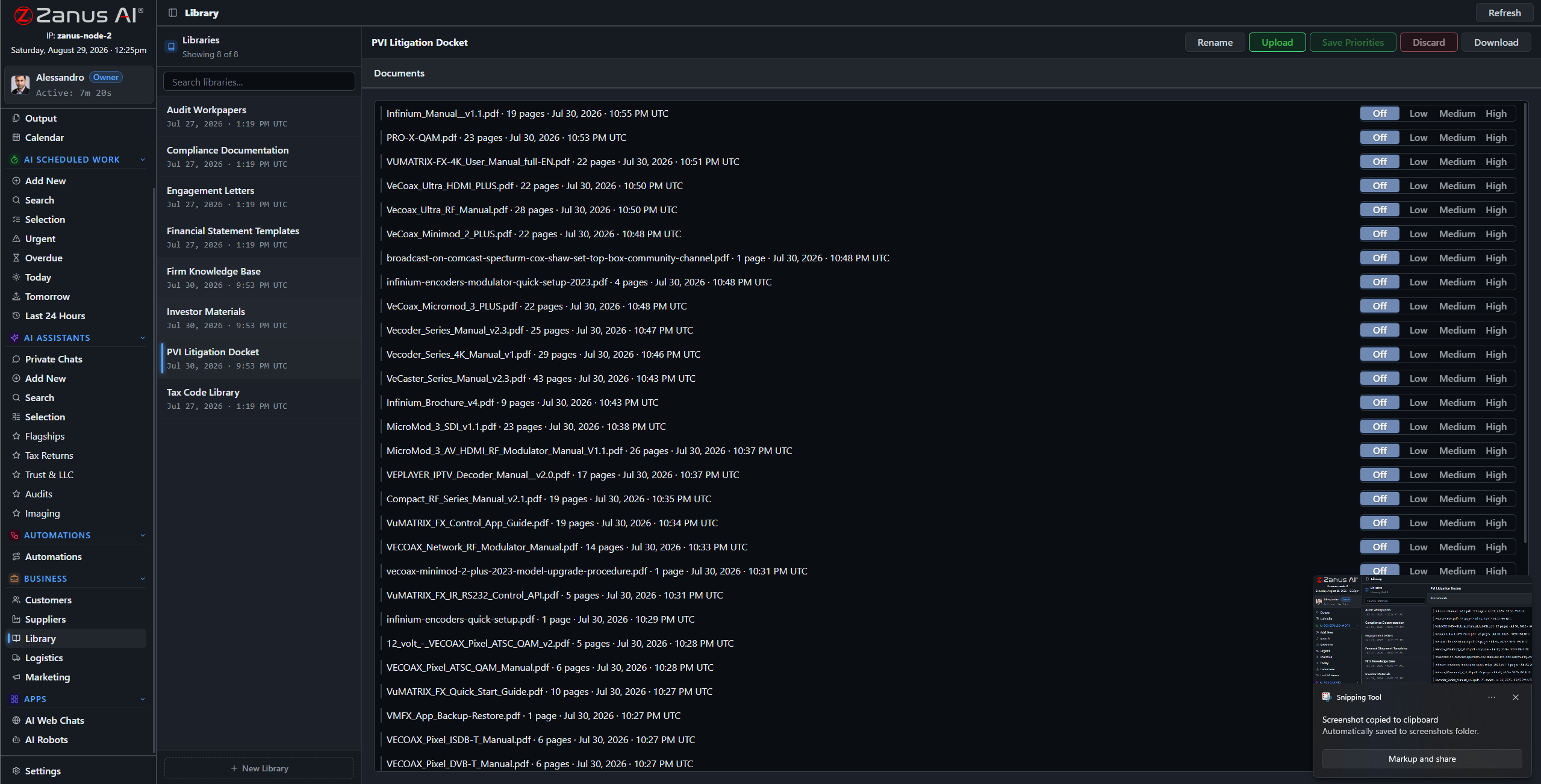
Libraries: ratified policies outrank drafts, executed contracts outrank redlines — the order is yours.
What it does
Minutes, resolutions, contracts, filings, policies, insurance schedules — any format including scans of the pre-digital decades — ingested and queryable.
“What did the board resolve on the dividend in 2019?” gets the resolution quoted with the minutes attached — or an honest “not in the record.” Never a guess.
The deal room, HR’s cases and board materials are visible only to the roles you name — the same question returns different answers per role, redacted at the server.
Due diligence at conversation speed
An acquirer, auditor or new general counsel asks for every contract with a change-of-control clause. That used to be a paralegal-month; now the archive answers with the clauses quoted and the documents attached — and the access itself is on the audit trail.
- Clause-level questions across the contract archive
- Governing versions identified and attached
- Every retrieval on the audit record

Questions, answered
Our records span five legal entities. One archive?
Libraries per entity with distinct permissions in one tenant — or separate tenants where counsel requires hard walls. Cross-entity questions work only for roles cleared for them.
Do board materials ever leave our control?
No. The tenant is isolated and trains no outside model — and the on-premises option keeps the archive physically inside headquarters.
See it working on YOUR headquarters — the demo IS the product.
ZANUS AI FOR CORPORATE HEADQUARTERS — AI WORKFORCE
Staff work for the C-suite, on schedule.
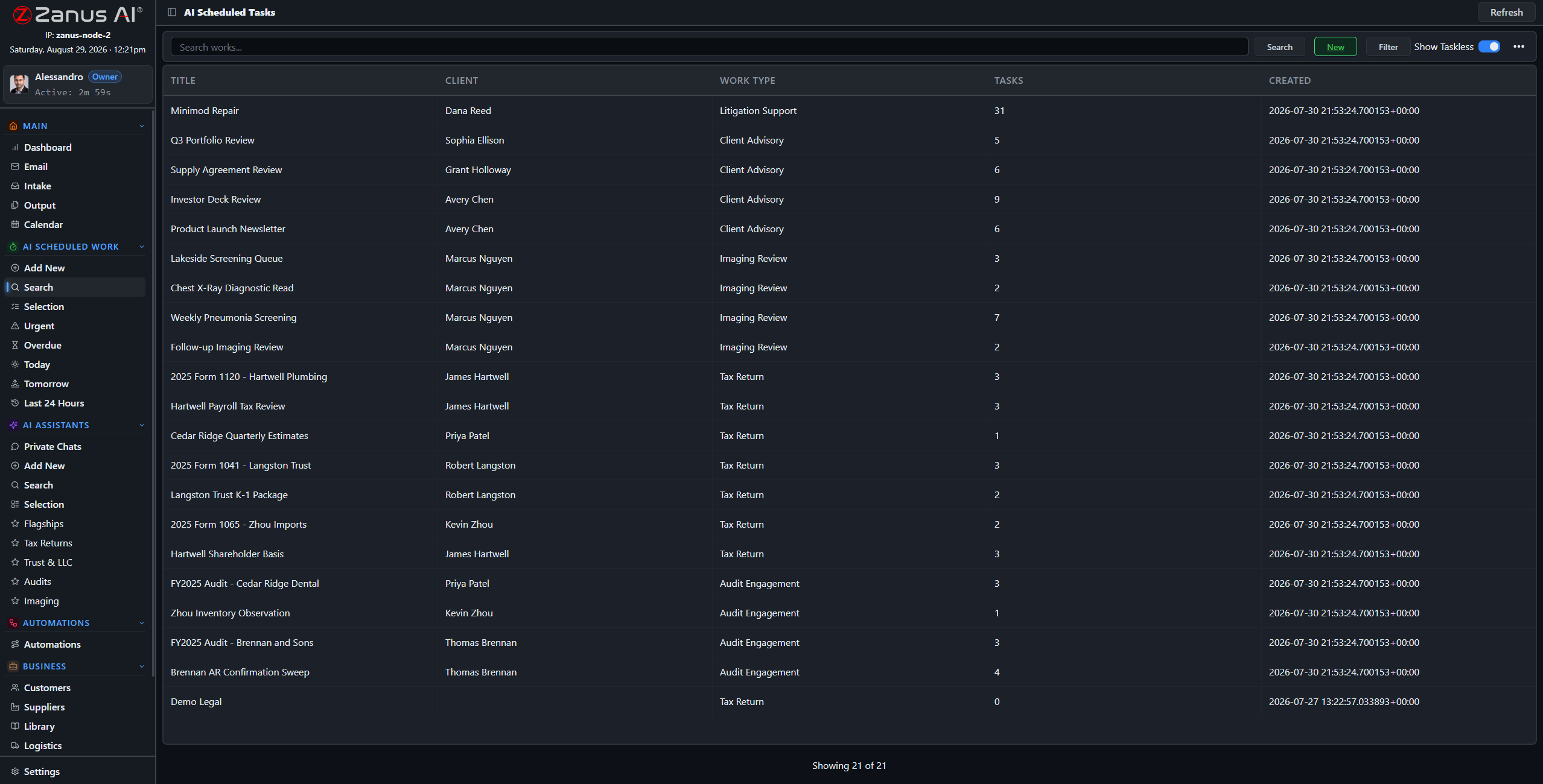
Headquarters runs on recurring deliverables nobody has slack to produce. Assign them to the AI like staff: type, sources, deadline, recurrence — the board pack, the cash summary, the policy review — executed on the corporate calendar, cited, awaiting sign-off.
Private tenant or your own servers · your whole team · role-scoped by department
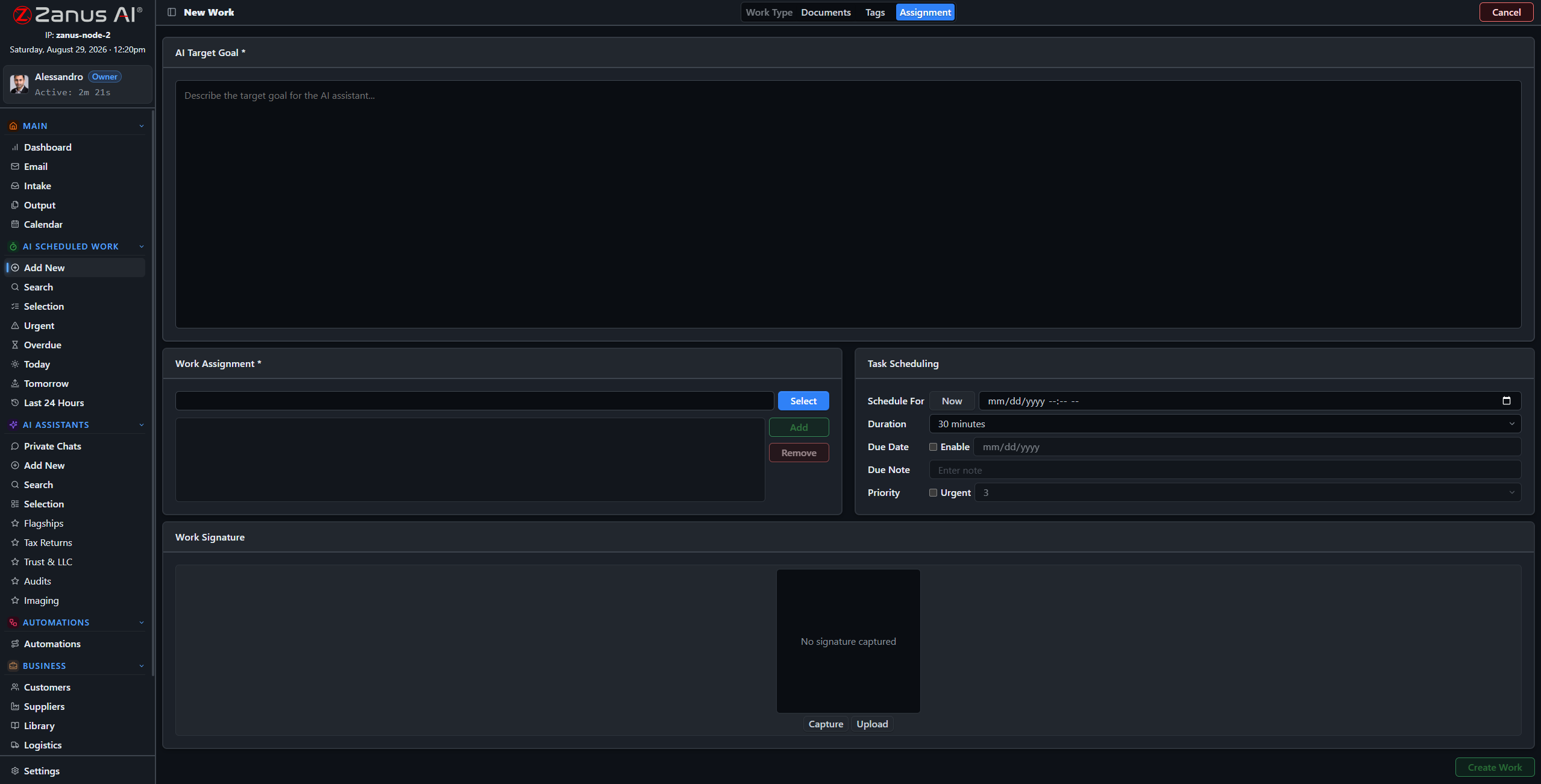
Four steps: work type, records and libraries, tags, schedule — the corporate drumbeat, staffed.
What it does
Financials, department summaries and open resolutions compiled against the agenda — in Output ten days before the meeting, waiting for the CFO, not the other way around.
The weekly cash position and aging receivables summary drafted from the records, exceptions flagged — on the CFO’s desk before the weekend, every week.
Every corporate policy checked for staleness and contradiction, renewal-critical dates flagged, an update digest drafted for the leadership meeting.
Delegation with a paper trail
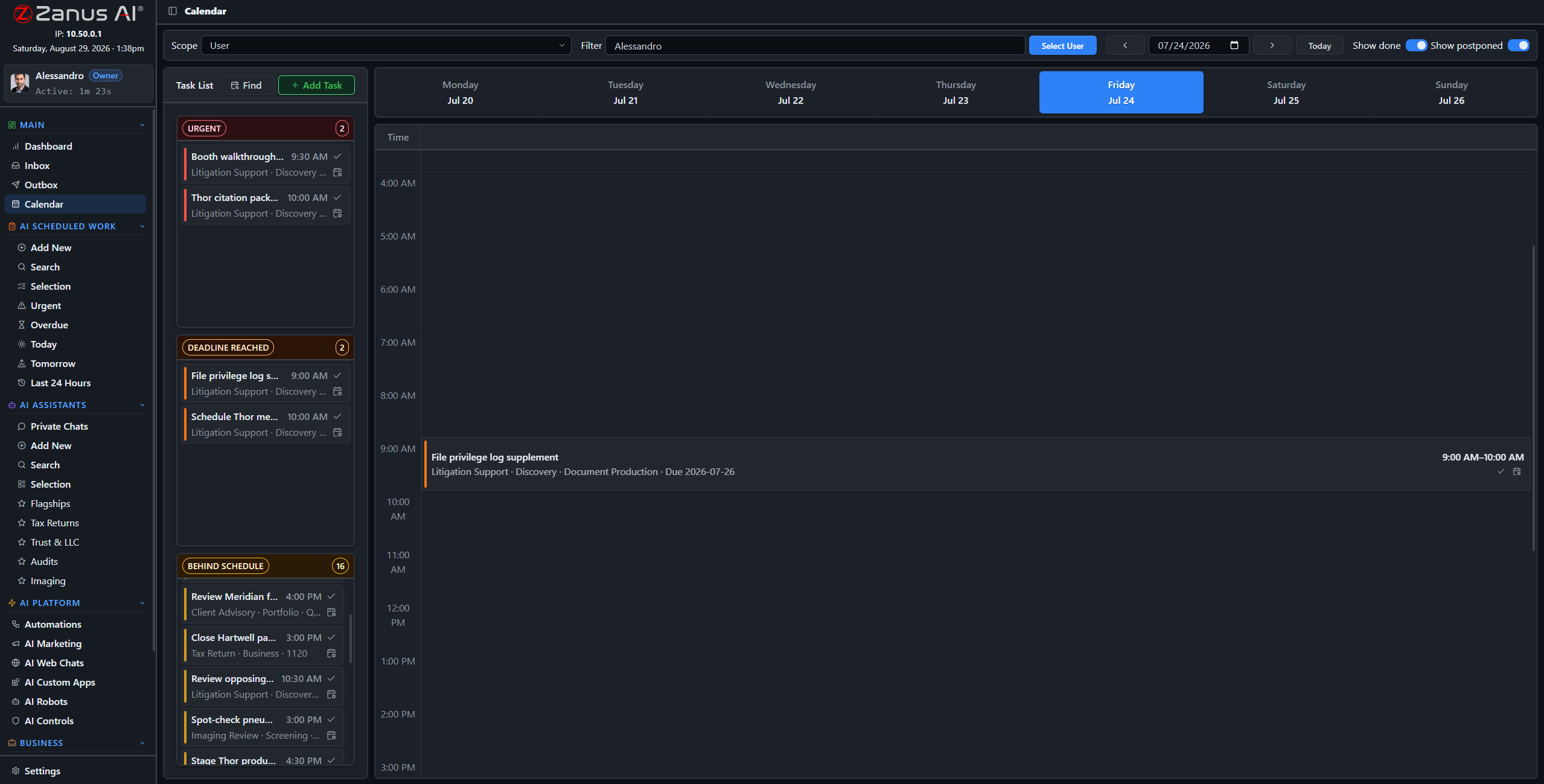
Every work session streams its reasoning, cites its sources, and files its result for the owning department’s sign-off. The general counsel can watch the contract review build its list; the CFO can redirect the pack’s emphasis mid-run — supervision like managing staff, evidence like an audit file.
- Reasoning and citations visible per session
- Urgent / Overdue / Today views over the AI’s queue
- Sign-off per department before anything distributes
Questions, answered
Who in HQ owns these works?
Each department owns its own: finance schedules the cash summary, legal the contract review, HR the policy digest — scoped by workgroup, visible to the roles each department allows.
What if the board moves the meeting?
Move the deadline and the work reschedules — recurrence and deadlines behave like they do for staff, minus the weekend apology emails.
See it working on YOUR headquarters — the demo IS the product.
ZANUS AI FOR CORPORATE HEADQUARTERS — POLICIES
Policy updates that actually land.
A corporate policy has two lives: the ratified PDF, and whatever each office actually does. Zanus collapses them into one — policies become living documents: answerable in chat in every office, wired into the AI work that touches them, versioned so the ratified copy always wins.
Private tenant or your own servers · your whole team · role-scoped by department
The policy library: ratified versions on top, superseded ones archived with their dates — no folklore.
What it does
The travel policy updated Tuesday answers questions in every office Tuesday — in each employee’s language, with the document attached, no cascade of briefings required.
The AI drafting an offer letter reads the compensation policy by construction; the expense automation reads the expense policy. Compliance becomes the default path, not the memo.
When practice deviates from policy, the review works surface it — the gap between what headquarters ratified and what offices do becomes measurable, not anecdotal.
The policy lifecycle, scheduled
Annual reviews, regulatory-change checks and acknowledgment campaigns run as recurring AI works: drafts proposed, counsel and HR ratify, the new version goes on top — and every office’s answers, and every dependent workflow, update that instant.
- Review works on the corporate calendar
- Acknowledgment tracking per office and role
- Superseded versions archived for audit
Questions, answered
Offices have local legal variations. How?
Local addenda live in office-scoped libraries that outrank the global policy where you say they do — the hierarchy is explicit in the priority order, not implied in a footnote.
See it working on YOUR headquarters — the demo IS the product.
ZANUS AI FOR CORPORATE HEADQUARTERS — TEAM TRAINING
Every office onboards the same way.
Every office invents its own onboarding, and HR answers the same handbook question forty times a week. In Zanus, new employees learn corporate systems and policies from the AI — identically in every office, in their language — and keep an assistant that answers from the ratified source.
Private tenant or your own servers · your whole team · role-scoped by department

Training runs inside the software, on your own policies — the same first week in every office.
What it does
Systems, policies, who-does-what and how-to — guided training from the corporate libraries, so the Madrid hire and the Chicago hire learn the same company.
“How many vacation days carry over?” goes to the assistant and comes back sourced from the ratified policy — HR handles cases, not FAQs.
Completion and coverage per hire, per office, per department — onboarding becomes a dashboard, not a hope.
The new system rollout, absorbed
Headquarters swaps the expense tool and three thousand people need retraining. Because training reads from the same living libraries the company runs on, updating the source retrains every future answer and session — the rollout survives contact with the org chart.
- Content updates with the library, automatically
- Role- and office-scoped training paths
- Any device with a login, any language
Questions, answered
Does this cover compliance training?
It delivers and tracks training on YOUR policies and systems; formal certified compliance courseware can stay in your LMS — bring it to the demo and we map the boundary.
See it working on YOUR headquarters — the demo IS the product.
ZANUS AI FOR CORPORATE HEADQUARTERS — AUTOMATIONS
The corporate calendar, wired to act.
Headquarters runs on dates: renewals, closes, reviews, anniversaries. Describe what each date should set in motion — in plain words — and it becomes connected blocks on a canvas: trigger, sources, AI step, actions — running across departments, visibly.
Private tenant or your own servers · your whole team · role-scoped by department
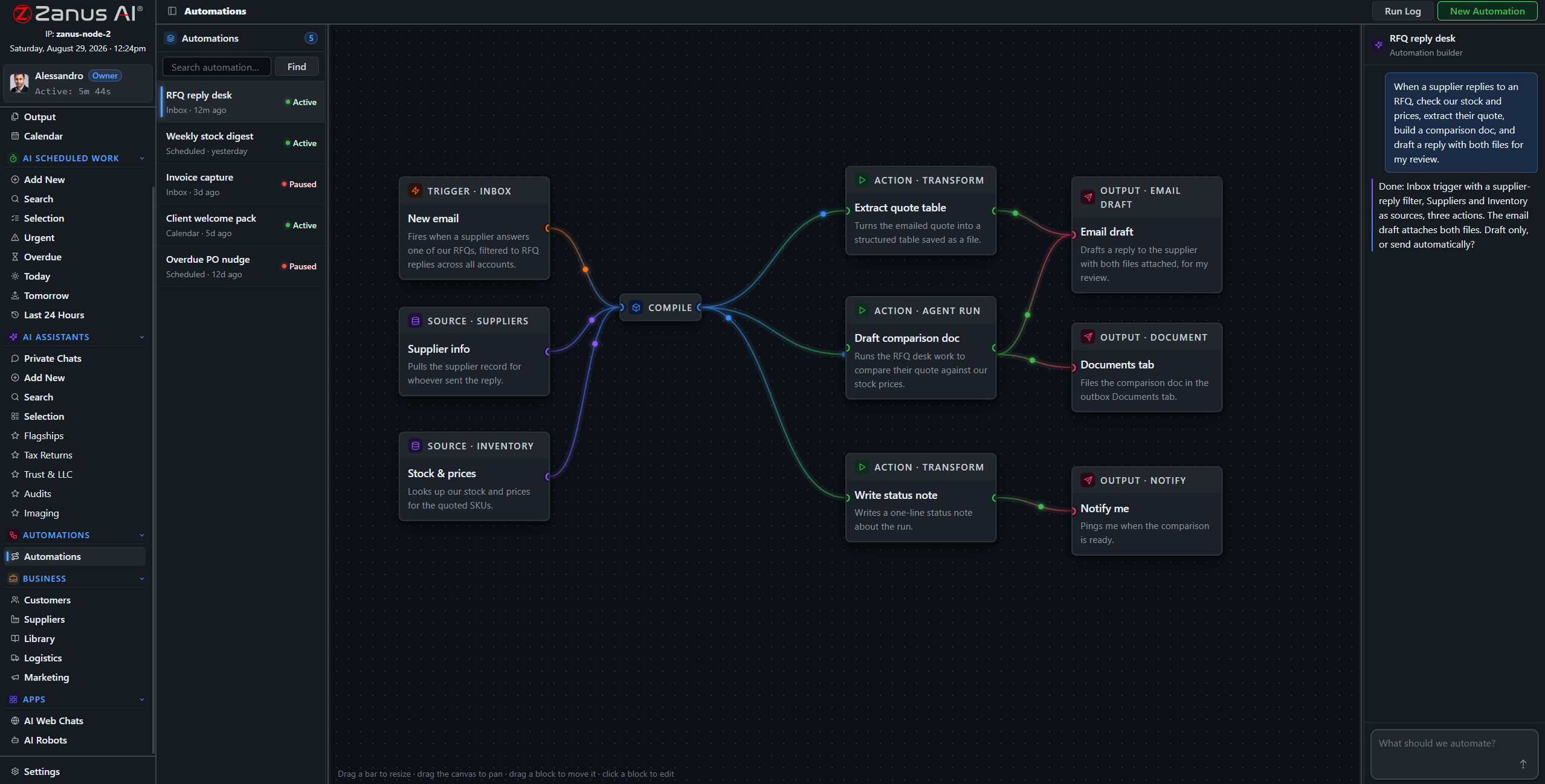
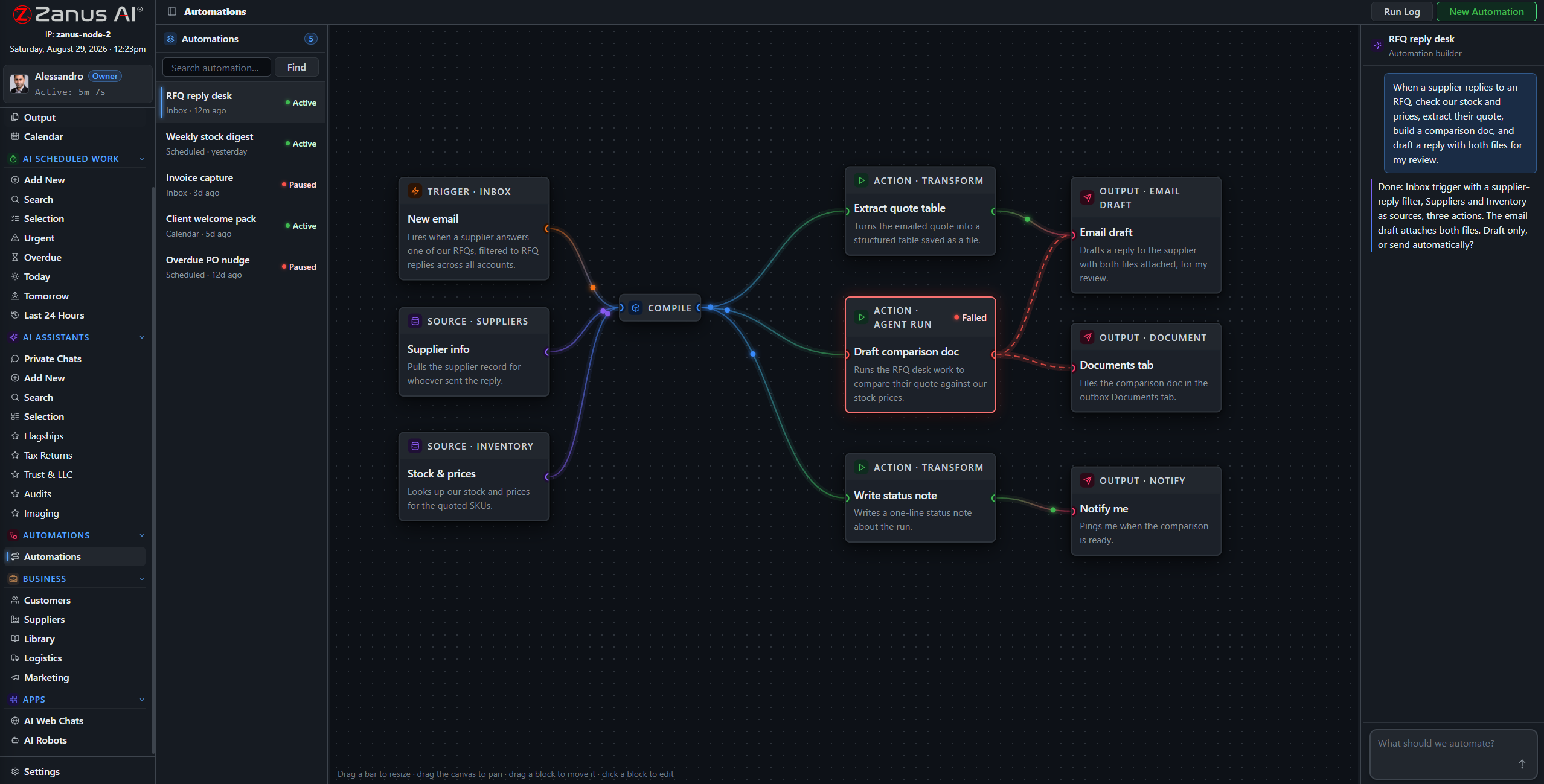
A real flow: date trigger, record sources, AI draft, routed approvals — drawn from a description.
What it does
A contract enters its renewal window → summary drafted with terms and spend history, flagged to legal and the budget owner — no more renewals discovered by invoice.
The signed offer triggers the pack: accounts requested, equipment ordered, first-week training scheduled, the manager briefed — day one works because day minus-ten did.
Month-end opens the checklist: statements gathered, reconciliations queued as AI works, exceptions flagged to finance — the close becomes a status page, not a scramble.
Cross-department flows, without the turf war
The onboarding flow touches HR, IT and finance — and each block runs under its own department’s permissions and approvals. The canvas shows the whole flow; each department controls its own segment. Coordination becomes architecture instead of meetings.
- Blocks scoped to each department’s authority
- Run states visible end to end, failures isolated
- One-click retry on the exact failed block
Questions, answered
Can a department break another department’s flow?
No — blocks execute under the owning department’s permissions, and changes are versioned and audited. The flow is shared; the authority is not.
See it working on YOUR headquarters — the demo IS the product.
ZANUS AI FOR CORPORATE HEADQUARTERS — STAKEHOLDER OUTREACH
The company speaks with one voice.
Headquarters communicates in every direction — investors, partners, all-staff, customers of every office — and every message represents the company. Zanus drafts them from your own corporate records, in your voice, and nothing leaves without the owner’s approval.
Private tenant or your own servers · your whole team · role-scoped by department
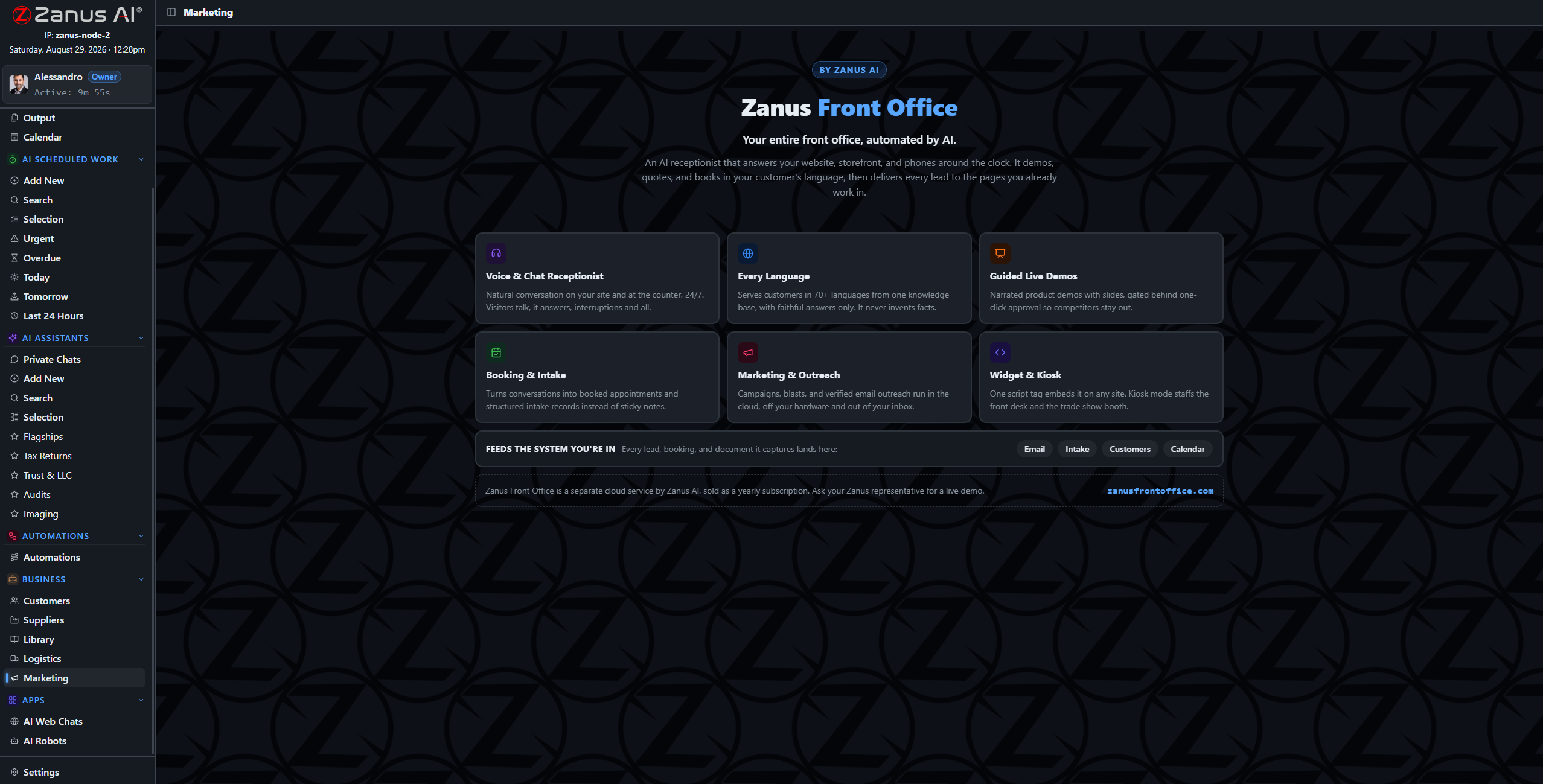
Campaigns and announcements drafted from corporate records — investor notes, all-staff, partner updates.
What it does
“All partners on the legacy agreement” or “every employee in the Berlin office” — built from your own records inside the tenant, never exported to a mailing platform.
The investor and partner update assembles from the same cited numbers as the board pack — one version of the truth, retold per audience, in each recipient’s language.
Announcements drafted once and delivered in each office’s language, acknowledgment tracked — the org chart’s telephone game, retired.
Consistency across four departments and forty markets
Marketing’s campaign, HR’s policy announcement and finance’s vendor notice all draw from the same records and the same approved voice — so the company never contradicts itself in writing. Sequences and campaigns are drafted for review, never fired blind.
- Drafts grounded in corporate records, cited
- Corporate voice and templates enforced at drafting
- Replies land on the permanent record

Approval is the point
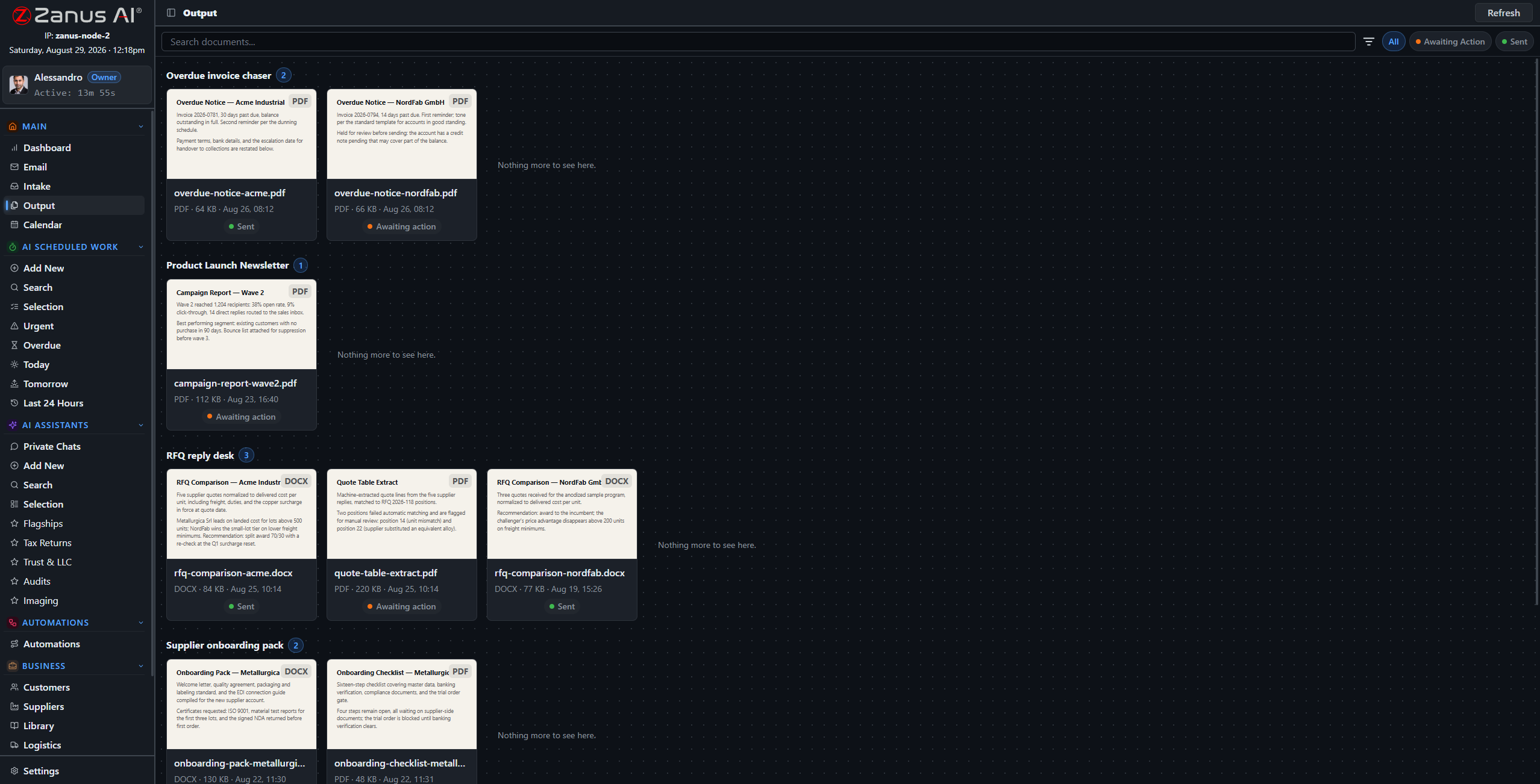
Every outbound lands in the approval queue of the owner you designate — communications, the CFO, counsel — with the full send history on the audit trail. Delegation of drafting, never of authority.
- Approval workflow per audience and category
- Consent and opt-outs enforced by the system
- Who approved what, when — always answerable
Questions, answered
Can this handle investor communications safely?
It drafts from your records under your approval chain — disclosure decisions stay with your officers and counsel. The system’s contribution is grounding, consistency and the audit trail.
Do offices keep local newsletters?
Yes — office-scoped audiences and templates, under the approval rules headquarters sets. Local voice, corporate guardrails.
See it working on YOUR headquarters — the demo IS the product.
ZANUS AI FOR CORPORATE HEADQUARTERS — SYSTEMS & INTEGRATIONS
Keep the ERP, the HRIS, the CLM. Add the connective tissue.
Headquarters already owns an ERP for finance, an HRIS for people, a contract system for legal — each a fine system of record and a terrible neighbor. Zanus becomes the system of work across them: field-mapped connectors, dry-run previews, REST API and webhooks.
Private tenant or your own servers · your whole team · role-scoped by department

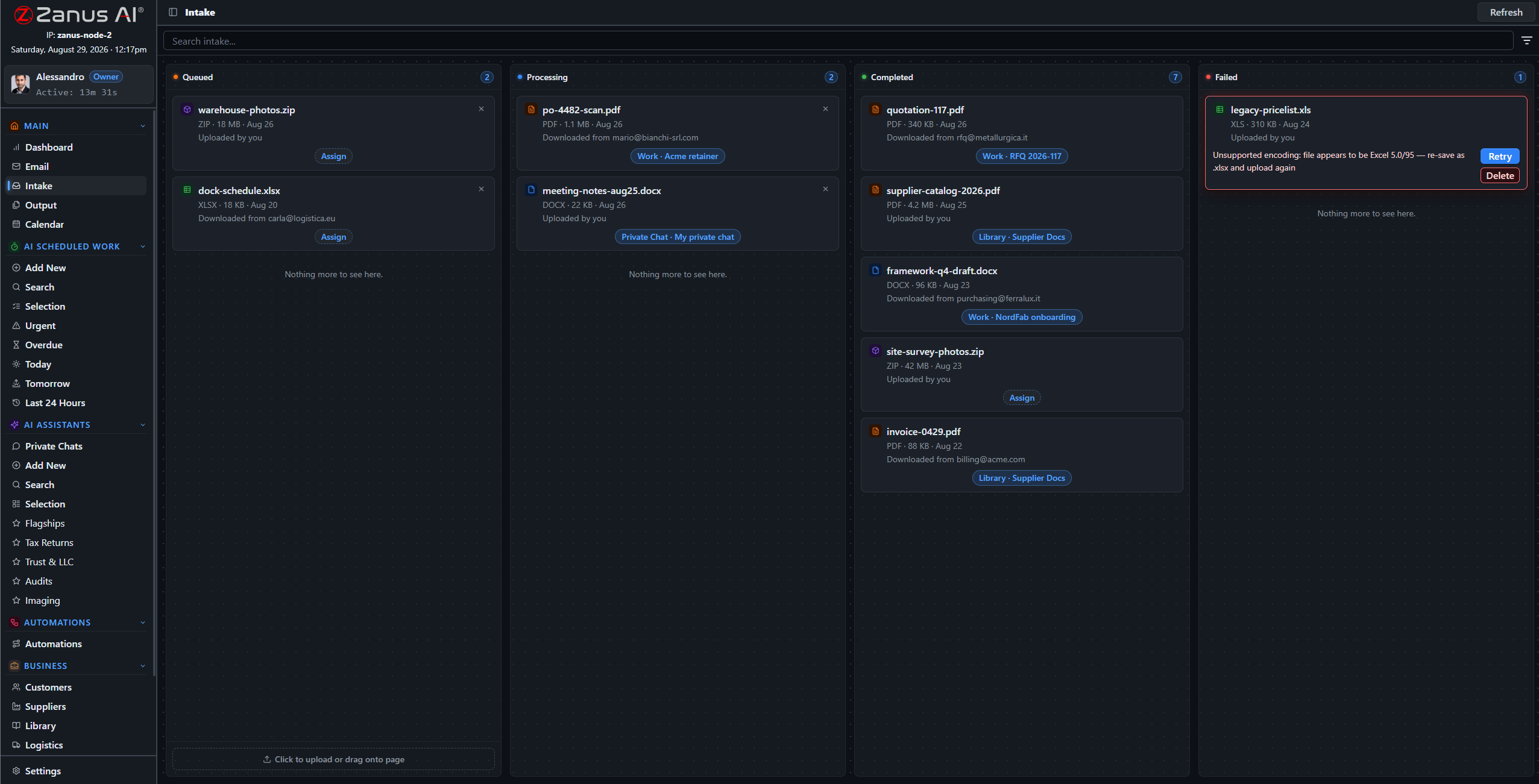
No rip and replace: ERP, HRIS and contract systems stay — the AI layer connects to all of them.
What it does
ERP, HRIS, CLM and the CRM (connectors for the leading CRM suites included) mapped field by field — push, pull or two-way, with a dry-run preview before anything writes.
The offer letter files to the HRIS record, the executed contract to the CLM, the close memo to the ERP trail — after the owning department approves, never before.
The travel tool, the board portal, the regional payroll system — reachable under scoped keys, with webhooks pushing corporate events back in real time.
The cross-system question, grounded
“What is our total commitment to this vendor?” lives in the ERP (spend), the CLM (contracts) and the inbox (the renegotiation thread). Connected to one tenant, it is one question with one cited answer — for the roles entitled to ask it.
- Each system stays master of its own records
- External systems appear as blocks on the automation canvas
- Every sync event on the audit trail
- Bring your ERP and HRIS to the demo and we map them
Questions, answered
Our ERP took three years to implement. Is this another one?
No — nothing is replaced and nothing is migrated. Connectors map to what exists, the dry-run shows every change before it happens, and the tenant is live in days to weeks.
See it working on YOUR headquarters — the demo IS the product.
ZANUS AI FOR CORPORATE HEADQUARTERS — DATA CUSTODY
HR can’t read finance. By architecture.
One system for every department only works if the walls are real. In Zanus they are structural: permissions to the field level, redaction at the server, workgroups mapping departments and offices, a searchable audit trail — and an air-gapped option for the material that must never leave the building.
Private tenant or your own servers · your whole team · role-scoped by department
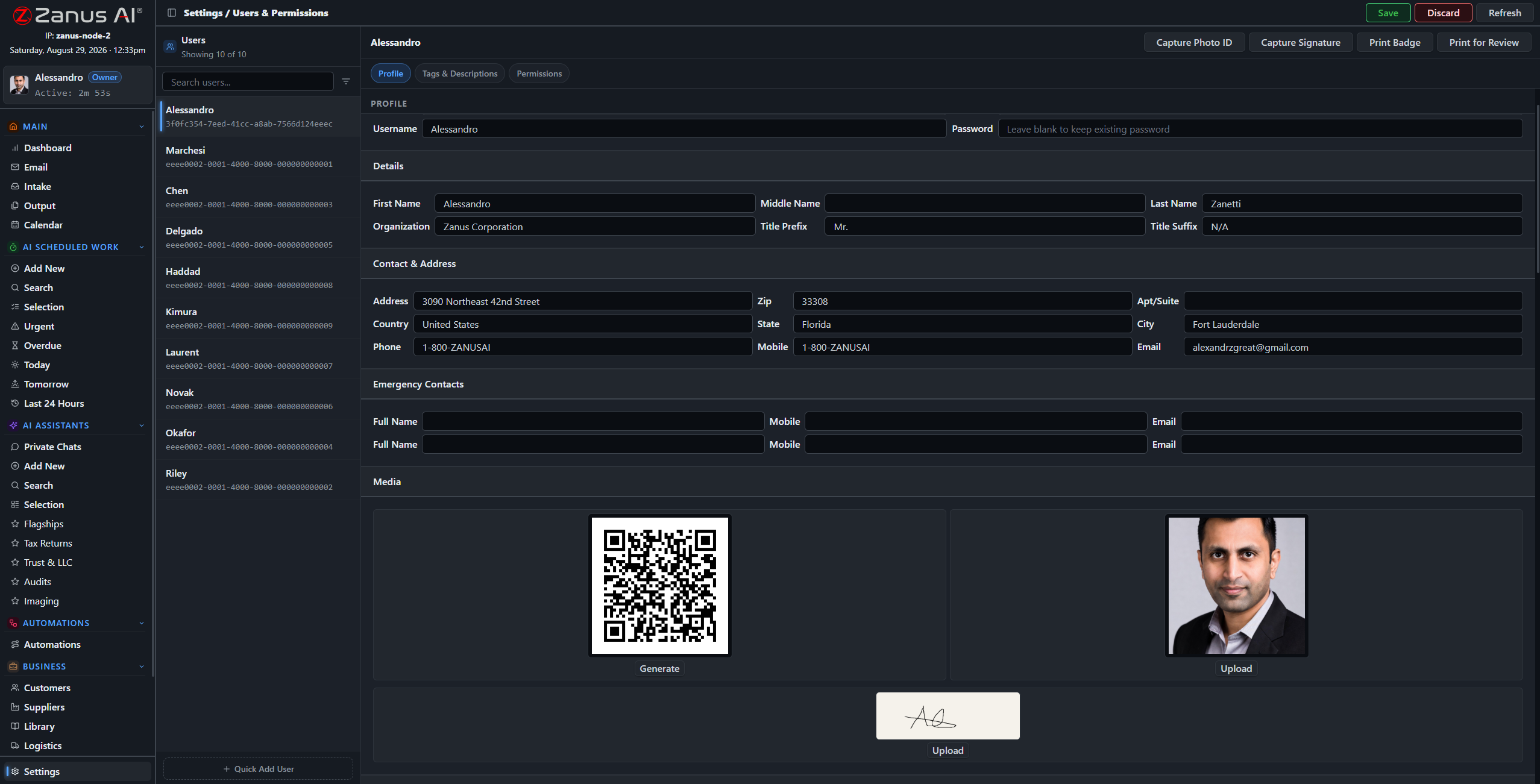
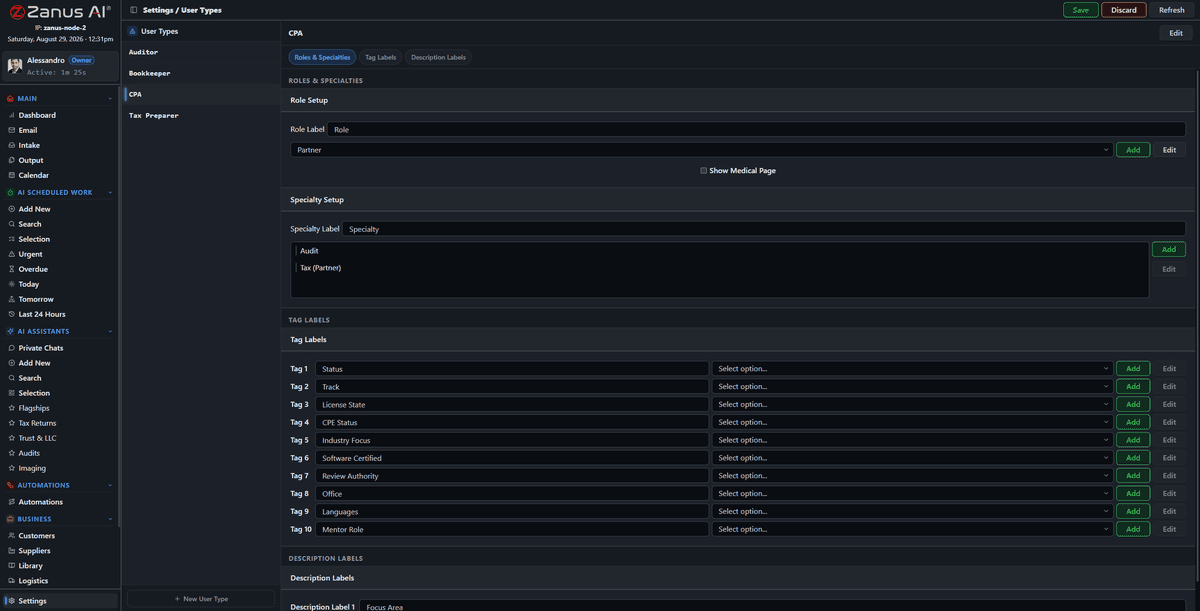
One record per user: role, department, office and field-level rights over every domain of the system.
What it does
A user without rights to compensation data never receives it — the server redacts before sending, so the wall holds in exports, searches and shared calendars alike.
Five-level workgroups map offices, departments and teams; access follows the structure, and moving a person updates what they see — everywhere, at once.
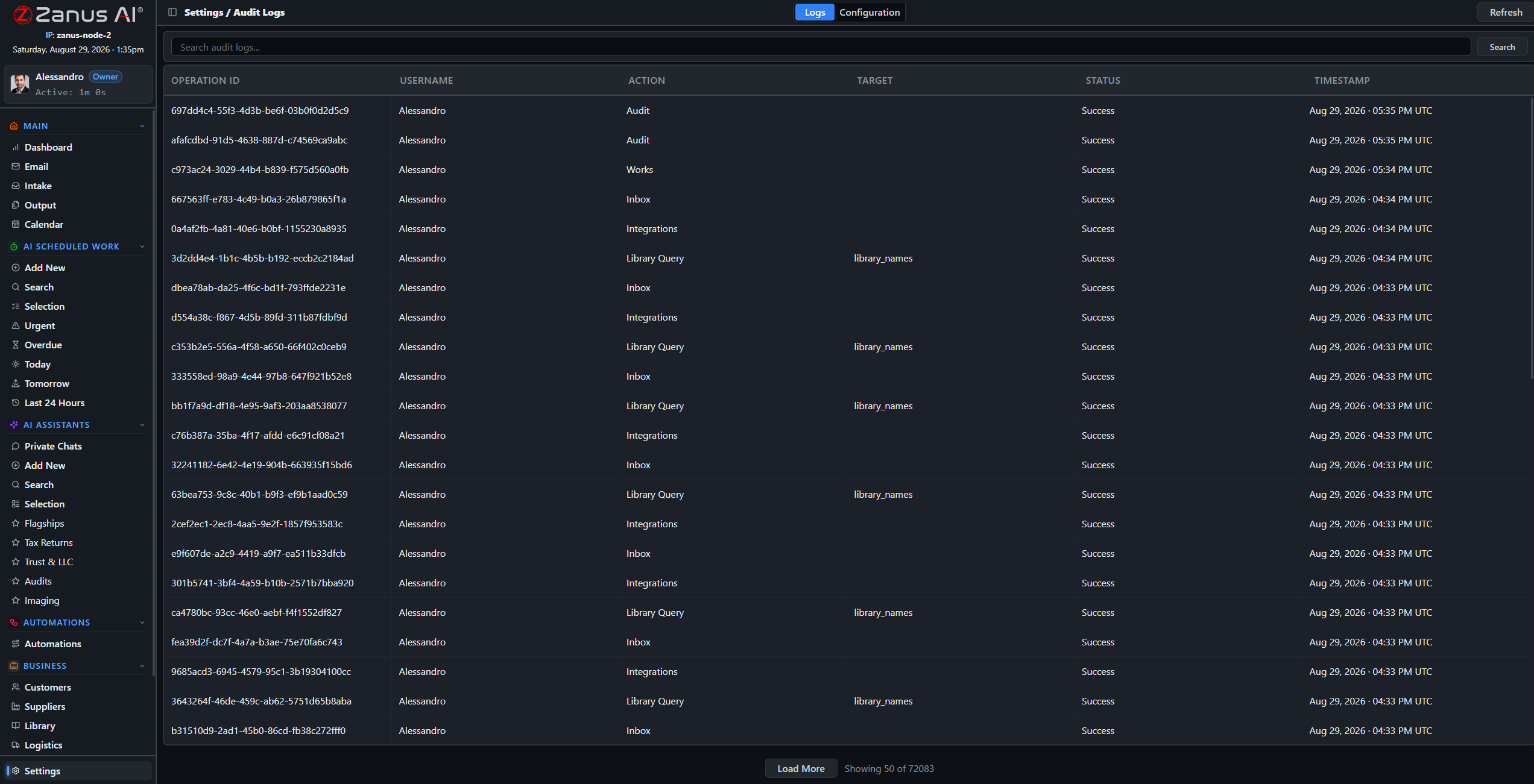
Every audited access and change is searchable: who read the minutes, who edited the policy, what it said before — with pre-update snapshots for one-click rollback.
Custody for the material that defines the company
Board minutes, M&A files and payroll are not “data” — they are the company. The tenant is isolated and trains no outside model; and where policy demands physical custody, the identical system runs air-gapped on servers headquarters owns, updated by USB, on a SOC-2-aligned deployment path.
- Isolated tenant — nothing trains outside models
- Air-gap-capable on-premises deployment
- Same system cloud or owned — zero-migration move
Questions, answered
Can we prove separation to an auditor?
Yes — the permission model, the redaction behavior and the audit trail are inspectable, and access reviews become searches. Bring the audit checklist to the demo.
Who administers all this?
Your admins, with admin-created accounts and role templates — the safe configuration is the default one, and every administrative change is itself on the audit trail.
See it working on YOUR headquarters — the demo IS the product.
ZANUS AI FOR CORPORATE HEADQUARTERS — LIVE DEMO
Do not watch a video.
Talk to your AI.
Corporate software is sold through steering committees and slideware. Ours is the product itself, configured for a headquarters: open the chat below-right and try it — ask for a board pack draft, a policy answer, a cross-department brief.
The conversation you have with us IS the demo
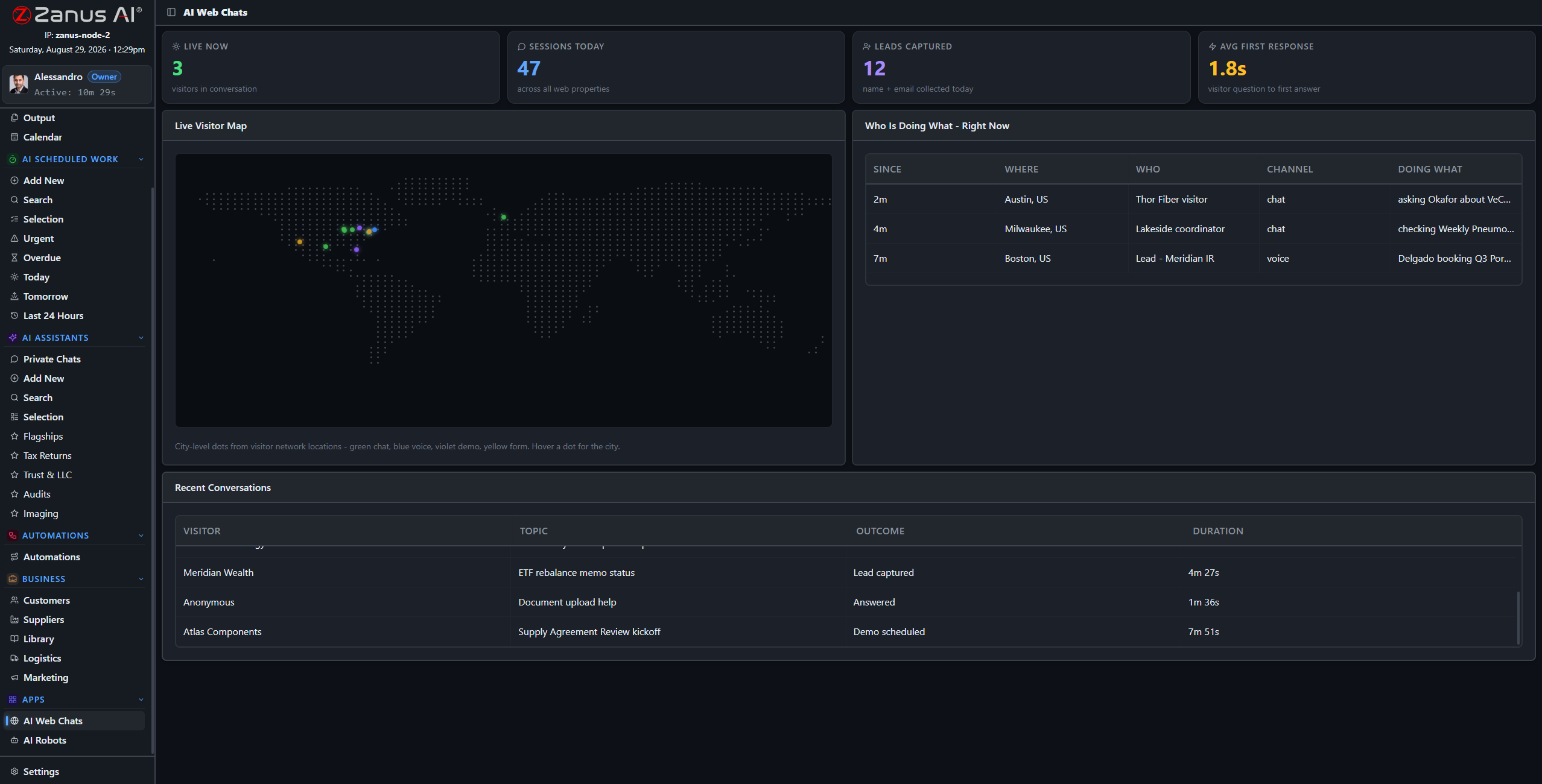
This screen watches demos like yours happen: live conversations, outcomes, first response in seconds.
What it does
Ask the chat: “I’m a vendor — when will invoice 2291 be paid?” — watch it answer what the role allows and route the rest, like your best switchboard never could.
Ask: “draft the monthly board pack” — it walks the exact work it would run in your tenant: records read, figures cited, sections routed to each department’s sign-off.
The full demo loads a corporate tenant with sample departments: policy answers per office, the close checklist, the renewal radar — your headquarters, working.
Or pick your exact business
Every link below is a full live-demo page for that specific business — its vocabulary, its calls, its booking rules.
Two minutes to your inbox
Request the demo and the interactive corporate demo arrives in about two minutes — no steering committee required to see the product. Watch it, interrupt it with questions, and convene the committee when YOU are ready.
- Interactive demo, corporate-configured
- Ask questions mid-demo — it answers and resumes
- In your inbox in ~2 minutes, free

Questions, answered
Is the demo really the product?
Yes — the same AI, configured with a sample corporate tenant. What you see is what your departments get, with your records instead of the samples.
See it working on YOUR headquarters — the demo IS the product.
Sharing with a colleague? 📄 Get the PDF · ✉️ Email this page ·