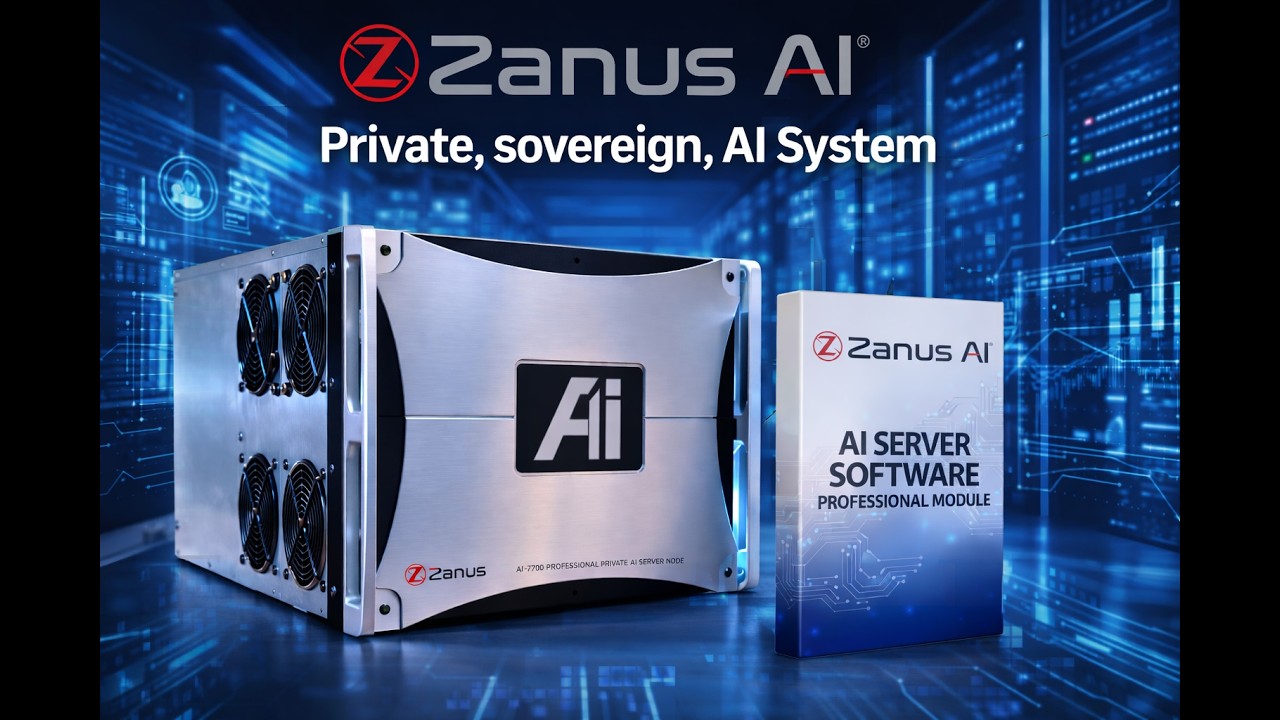
In this episode of AI Confidential, host Giacomo interviews Giorgio Zanetti, co-founder of Zanus AI, about the growing divide between centralized Big Tech AI and distributed sovereign AI solutions. Recorded after Zanus AI's CES 2026 award win, this 30-minute conversation explores the real-world challenges businesses face when adopting AI — and why private, on-premises systems are the future.
Watch the Full Interview (31 minutes, Italian)
Key Takeaways (English Summary)
- A family of technology innovators — The Zanetti family brings 25+ years of hardware expertise in broadcast and fiber optics, giving Zanus AI a deep engineering foundation that pure-software AI companies lack
- The real problem with cloud AI — When you use cloud AI for business, you're training the next version of that AI model with your proprietary data, your clients' information, and your trade secrets. Your competitors will benefit from your investment
- Accuracy from YOUR data — Unlike general-purpose AI that hallucinates because it serves millions of users, Zanus AI works specifically with your documents, your cases, your procedures — delivering consistent, accurate answers
- A finished product, not a DIY project — Many companies try to build custom AI agents using cloud APIs, but they still use the same cloud models (often worse versions), lose privacy, and end up with incomplete solutions. Zanus delivers a complete, ready-to-use system
- Patent-protected technology — Zanus AI holds patents on its architecture, meaning Big Tech companies like OpenAI or Google would need to license from Zanus to build similar on-premises systems — but they have no incentive to do so because their business model depends on selling tokens
- The future is hybrid — General-purpose cloud AI for casual use will coexist with specialized, sovereign AI systems for businesses that need privacy, accuracy, and data ownership
- AI as a tool, not a replacement — Just as factory robots in the 1960s didn't eliminate workers but made them more productive, AI should help humans do better work rather than replace them entirely
- Bootstrapped and independent — Zanus AI is entirely self-funded with no external investment, maintaining full control over its product direction and customer relationships
About This Interview
This interview was conducted by AI Confidential, an Italian-language technology podcast that explores AI through conversations with industry innovators. The host, who personally knows the Zanetti family, provides a uniquely candid perspective on Zanus AI's origins, technology, and vision.
The conversation covers topics including the CES 2026 award, the difference between sovereign and cloud AI, how Zanus handles data accuracy through local vector stores, patent protection, the competitive landscape, and the impact of AI on youth employment.
Trascrizione completa (Italian Transcript)
La seguente è la trascrizione completa dell'intervista in italiano.
Ciao a tutti e benvenuti a AI Confidential, la rubrica dove chiacchiero di intelligenza artificiale con persone che ci raccontano la loro esperienza.
La settimana scorsa sono stato al CES di Las Vegas — il Consumer Electronics Show, il luogo dove secondo me ogni anno si cerca di capire la direzione che sta prendendo la tecnologia in generale e ovviamente l'intelligenza artificiale in particolare.
Tra le tante cose che ho visto, una cosa mi ha attirato particolarmente: Zanus AI ha vinto il CES Award 2026 nella categoria TechRadar PRO Picks.
Dire che è decisamente un premio molto interessante, molto importante, non solo per il premio di per sé, ma anche per quello che rappresenta — perché dietro Zanus AI c'è una storia di imprenditoria italiana, di giovani, una famiglia che tra l'altro conosco personalmente, un approccio all'AI molto concreto, lontano dall'hype e vicino ai problemi reali.
Per questo, invece di raccontare come normalmente faccio queste innovazioni, ho deciso di sedermi con Giorgio che insieme a suo fratello ha di fatto inventato, ideato e fondato Zanus AI.
Giorgio Zanetti: La nostra famiglia è una famiglia molto tecnologica. I miei genitori hanno un paio di compagnie tecnologiche — una che fa la fibra ottica e un'altra che fa i regolatori di AC/DC. Abbiamo sempre aiutato, abbiamo sempre visto come i nostri genitori fanno le cose e quello ci ha dato tanta esperienza già nel settore. Quando abbiamo dovuto fare la nostra compagnia, ci siamo trovati con un salto avanti.
Io e Alessandro abbiamo sempre amato la tecnologia. Alessandro in questo momento è in un programma di ricerca AI e io lo aiuto con quello — gli ho fatto tutte le literature review, dove guardi tutti i paper, fai le riassunti e vedi cosa succede.
Interviewer: Dagli Stati Uniti, com'è vista l'intelligenza artificiale?
Giorgio: Ci sono due prospettive. Le persone normali vedono l'AI quasi come un gioco — vanno lì, parlano, si fanno aiutare con dei lavoretti. Poi ci sono le compagnie. Le compagnie stanno iniziando molto di più ad usare l'AI, però il problema è che non hanno una soluzione chiara. Ci sono tantissime compagnie AI che fanno del fumo — non si sa bene cosa fanno. Le compagnie che vogliono l'AI sanno che è il futuro, ma sono molto confuse su come diventa il futuro.
Interviewer: Prova a spiegare ad alto livello in cosa consiste Zanus AI.
Giorgio: La parte più basica: è il tuo server, è un bene nella tua azienda che nessuno ti può rubare. Archivia clienti e progetti e mantiene il segreto professionale per dottori e avvocati. Non dipende dall'internet, non soffre la congestione della banda perché è locale.
Nessuno ti può rubare i dati — e questa è una grande cosa. Se metti i tuoi dati sul cloud, te li usano per il training e poi i tuoi dati sono fuori. Trainano i tuoi competitori sui tuoi dati e poi sviluppano i tuoi competitori. Se hai roba sensitiva non puoi usare questi cloud AI perché non rispettano le regolazioni — non puoi mettere gli articoli e i documenti dei pazienti sopra.
Giorgio: Il Zanus AI ti dà una performance costante. I cloud AI a tempi differenti del giorno hanno più persone che chiedono roba e iniziano a rispondere male perché non c'è potenza abbastanza per tutti. Il nostro hardware è direttamente per te — una performance costante sempre.
Interviewer: Se società come OpenAI, Google, Anthropic cominciassero a proporre soluzioni di Sovereign AI, per voi cambierebbe qualcosa?
Giorgio: Noi abbiamo i brevetti. Se volessero fare un sistema simile, dovrebbero comprare i diritti da noi. OpenAI o Google non hanno interesse a fare un'AI privata — non possono vendere i token. Sono troppo grandi, devono vendere a tutti e fare qualcosa per tutti.
Interviewer: Il futuro sarà ibrido?
Giorgio: Sì, sicuramente. Ci sarà l'AI generale che fa tante cose ma non è specifica, e ci sarà l'AI specifica per le compagnie e le applicazioni.
Giorgio: Il punto più grande nostro è che siamo un sistema privato — tieni i tuoi dati, ti rispondiamo bene e ti diamo un prodotto finito. Ti diamo un prodotto in cui puoi avere fiducia, che sai che funziona, che è tuo e che ti rassicura.