ZANUS AI FOR GOVERNMENT — OVERVIEW
The backlog ends. The data stays yours.
Citizen lines answered every hour the public calls. Records requests triaged, responsive documents located, responses drafted with sources cited. One AI system for the public-facing side and the records side — piloted in an isolated tenant, run in production on air-gapped hardware your agency owns.
Cloud pilot or sovereign on-premises · your whole team · public-records-conscious architecture
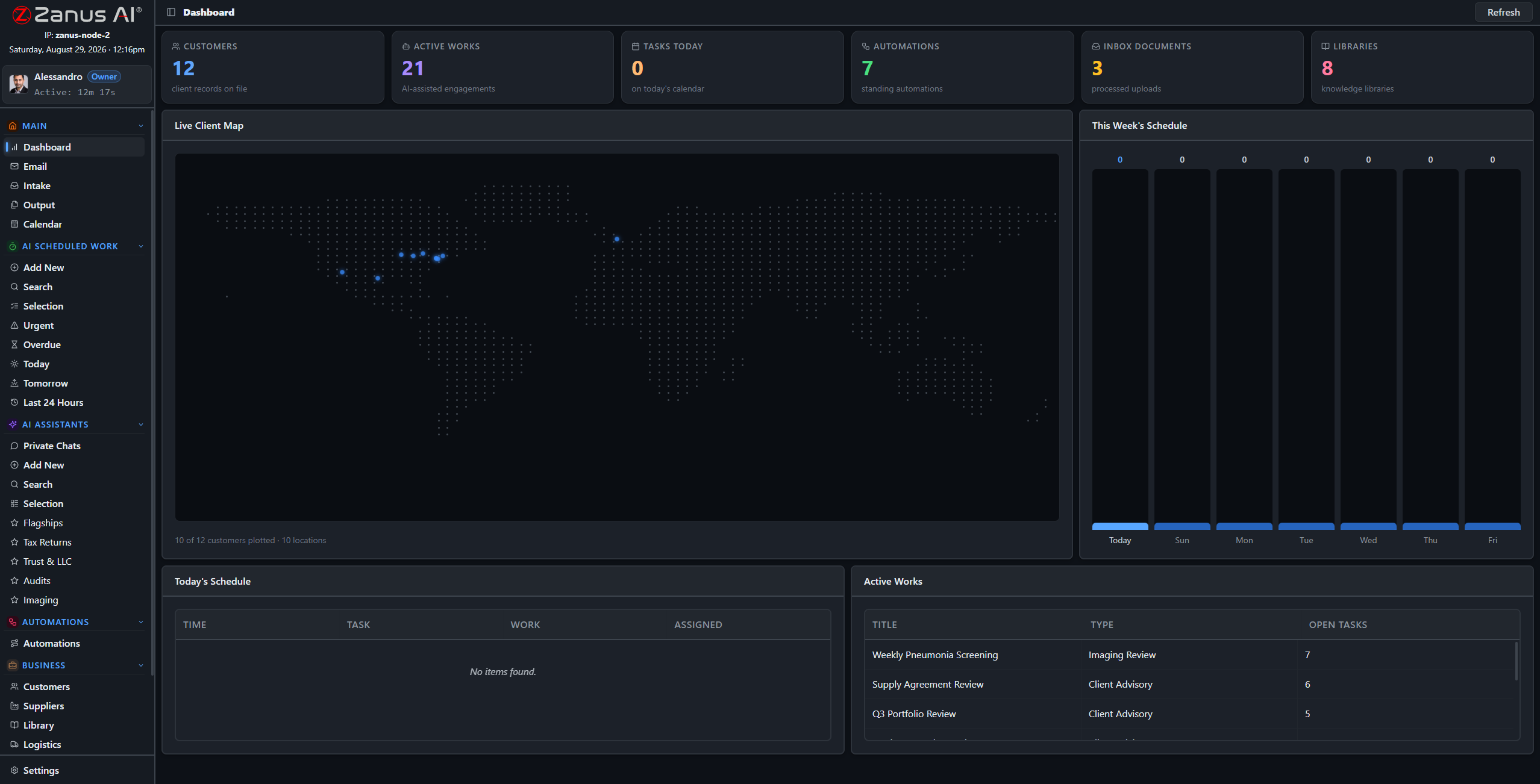
A real deployment view: records libraries, scheduled request triage, program reporting works in flight.
What it does
The AI answers your public lines 24/7 in up to 40 languages — office hours, form questions, application status — and routes case-specific matters to your staff, by your rules.
The AI locates responsive documents across the archive, drafts the response with every excerpt cited, and files it for your records officer’s review — the backlog becomes a workflow.
Pilot on an isolated private tenant this month. For production, the identical system runs air-gapped on hardware the agency owns — no recurring fees, USB updates, full custody.
Front office: the public side, handled
Every unanswered ring is a citizen calling back tomorrow — or standing at the counter. The Zanus front office answers on your menu, in your approved language, books counter appointments into real staff calendars and answers the questions your phone tree loses — identically, every time.
- AI phone on your lines, 24/7, up to 40 languages
- Counter and hearing appointments booked into synced calendars
- Official information only — no source, no claim
- See the Front Office for government →

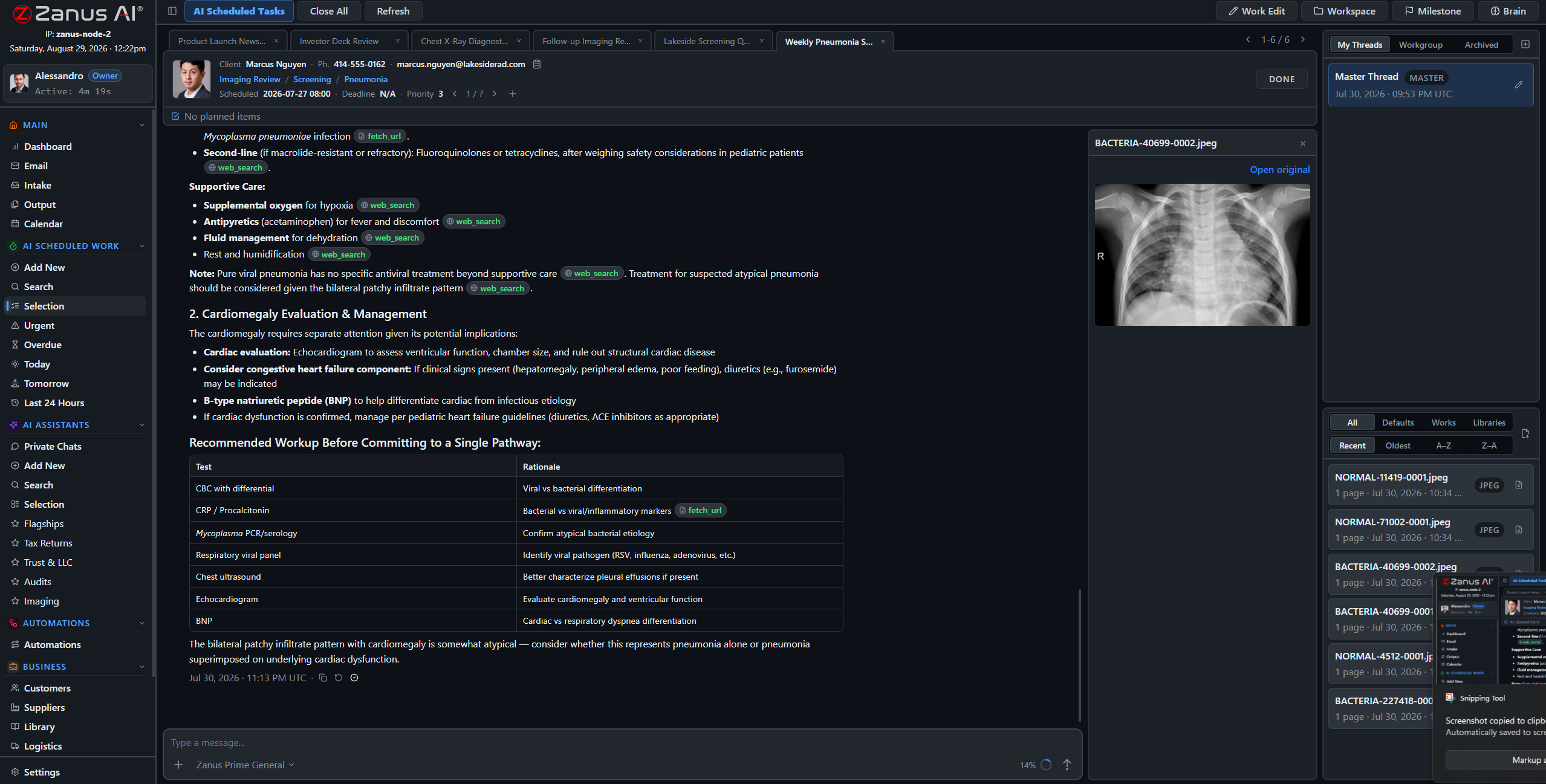
Back office: the records side, working
A public-records request arrives Tuesday; by Wednesday the AI has searched the archive, assembled candidate responsive documents with citations, and drafted the response letter — waiting in Output for the records officer’s judgment. Directives, program files and correspondence become a system that answers back.
- Scheduled AI work: request triage, report drafts, summaries
- Verified answers from official documents only
- Every draft awaits human sign-off — the official decides
- See the Back Office for government →
When the data must never leave
Public records belong to the public — not to a vendor’s model. Agencies pilot on the isolated cloud tenant, then move the identical OS onto Zanus hardware inside their own facility: air-gap capable, USB updates, owned outright, zero migration pain.
- Private On-Premises AI: owned, no recurring fees
- On-Prem Tokens Server for high-volume document processing
- Same system cloud and on-prem — the pilot IS the production rehearsal
- Explore the AI Servers →

Questions, answered
Can an agency use a cloud AI at all?
The tenant is isolated and nothing trains outside models — suitable for piloting on lower-sensitivity records under your counsel’s guidance. Production for sensitive holdings moves to the air-gapped on-premises system, where data is physically incapable of leaving. Bring your security officer to the demo.
Does the AI invent policy?
No. Answers are grounded in the official documents you load — directives, manuals, statutes — with the source cited. If your library holds no answer, the AI says so instead of guessing.
How does procurement work?
The cloud pilot is a flat subscription with your whole team — no per-seat math to justify. The on-premises servers are quoted by RFQ, owned outright, with no recurring fees. Live in days for the pilot, not fiscal years.
See it working on YOUR agency — the demo IS the product.
ZANUS AI FOR GOVERNMENT — FRONT OFFICE
Every citizen call answered. Every answer official.
Monday 8 AM the public line lights up: form questions, office locations, application status, “which department do I need?” Every abandoned call becomes a counter visit or a complaint. The Zanus front office answers on your menu, from your approved information — 24/7, in up to 40 languages.
Cloud pilot or sovereign on-premises · your whole team · public-records-conscious architecture

Calls, chats and appointments — one dashboard the public information officer can actually read.
What it does
Renewal deadlines and benefit cycles flood the lines on schedule. The AI answers every ring simultaneously — no hold queue, no abandoned calls, no overtime.
“What documents do I bring for a license renewal?” answered identically at 8 AM and 8 PM, from the current official instructions — not from whichever clerk picked up.
Up to 40 languages on the same line, same official content. Residents get served in their language without a callback from the one bilingual staffer.
From call to counter appointment, hands-free
A resident calls about a permit hearing; the AI confirms the case type, offers real open slots on the clerk’s calendar, books the appointment and sends the document checklist — while your staff serve the people already at the counter.
- Appointments synced to real staff calendars
- Document checklists sent before the visit
- Status questions answered from your published information
- Case-specific and legal matters escalated to staff, never improvised


The web counter never closes
Website chat grounded in your approved public information, web forms for records requests and service applications worked in minutes — the citizen who starts a request at 9 PM gets an acknowledgment at 9:01, not next Thursday.
- Grounded chat on your site — no source, no claim
- Records-request and service forms acknowledged instantly
- Every conversation logged with a transcript
- See the full Front Office tour →
Questions, answered
What if a caller asks about their specific case?
The AI handles general information and logistics; case-specific matters route to your staff by your rules — it never speculates about an individual’s file on a public line.
Do we keep our published phone numbers?
Yes. Your numbers stay; calls route AI-first, staff-first, or any mix per line and per hour — the after-hours overflow alone pays for itself.
Is every call on the record?
Every conversation produces a transcript in the system — searchable, auditable, retained under your rules.
See it working on YOUR agency — the demo IS the product.
ZANUS AI FOR GOVERNMENT — BACK OFFICE
Government runs on records.
Now the records work back.
Records requests, decision memos, grant reports, inspection files, meeting minutes: an agency is its paperwork. The Zanus back office turns that archive into a working AI staff — searching, drafting and cross-referencing with sources cited, under your officials’ sign-off.
Cloud pilot or sovereign on-premises · your whole team · public-records-conscious architecture
A real session: responsive documents located, excerpts cited, response letter drafted — the officer decides.
What it does
Intake, archive search, responsive-document assembly, response draft with citations — executed by the AI in hours, reviewed and released by your records officer.
Decision memoranda, grant expenditure reports, program summaries drafted from your own files in your agency templates — the analyst edits instead of starting blank.
Every AI-drafted document lands in Output awaiting review. Nothing leaves the agency — or reaches a requester — without a human decision on the record.
The request that took three weeks takes a day
A records request names a program and a date range. The AI searches every authorized library, assembles the candidate responsive set with each document cited, flags material that may need review for exemptions, and drafts the cover letter — the records officer reviews, redacts and releases. Diligence at machine speed, judgment at human hands.
- Archive search across decades in minutes
- Candidate responsive set with citations attached
- Exemption-sensitive material flagged for officer review


The reporting calendar, met
Quarterly program reports, grant closeouts, legislative responses: the documents that consume analyst weeks are drafted from the agency’s own records, in the agency’s own formats, on the agency’s own deadlines — with every figure traceable to its source.
- Drafts in your templates and letterheads
- Source excerpts attached to every claim
- Approval workflow before anything is filed or sent
Questions, answered
Does the AI decide what gets released?
Never. It locates, assembles and drafts; your records officer applies exemptions, performs redactions and makes every release decision — with the audit trail recording both.
Can it work across our legacy archives?
The ingestion pipeline handles PDFs, Word files, scans and images — the boxes digitized in 2009 become as searchable as last week’s memo. Bring a sample set to the demo.
YOU MIGHT ALSO LIKE
The Back Office executes. Who answers the phone?
Front Office AI picks up every call and chat — books, quotes, follows up, 24/7 in 40 languages. Watch it run a business like yours, live.
See it working on YOUR agency — the demo IS the product.
ZANUS AI FOR GOVERNMENT — DOCUMENTS
Ask the archive. It answers.
Directives, policy manuals, grant files, inspection reports, meeting minutes, decades of correspondence — loaded into curated libraries the AI reads from. Ask in plain language; get the answer with the source cited, at the permission level of whoever asks.
Cloud pilot or sovereign on-premises · your whole team · public-records-conscious architecture
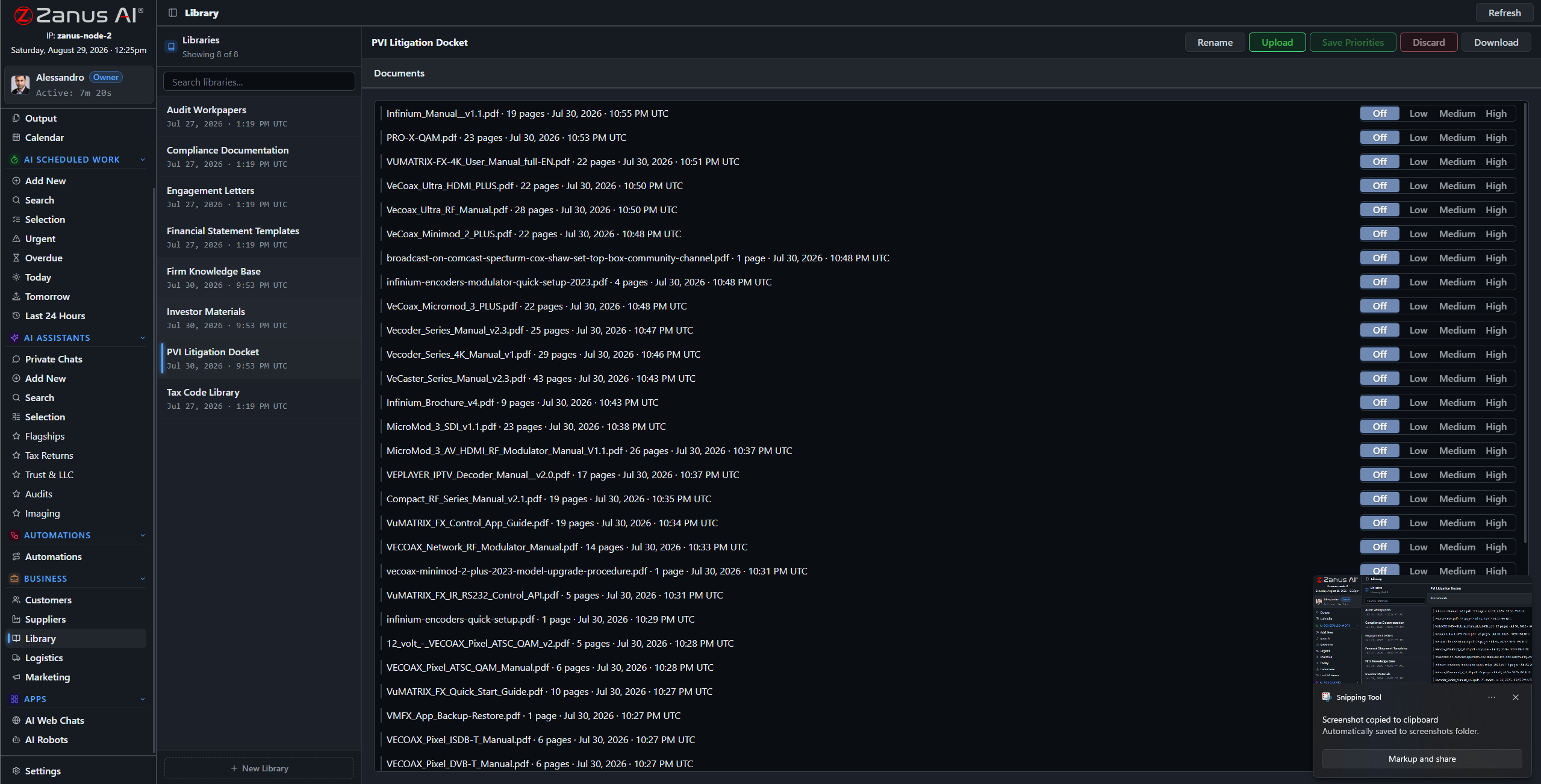
Libraries: current directives outrank superseded ones, official policy outranks drafts — you set the order.
What it does
PDFs, Word files, scanned boxes, microfilm-era images, recorded meetings — the ingestion pipeline turns what government actually keeps into queryable knowledge.
No source in your library, no claim: the AI cites the directive, the file, the minutes — or says it cannot answer. There is no hallucinated policy.
The front counter asks about published procedures; the program officer asks about the grant file: each gets answers scoped to their role, enforced server-side.
Forty years of files, one question away
“When was this delegation of authority last revised?” “Which inspections cited this facility?” “What did the 2016 memorandum actually authorize?” The archive answers in seconds with the documents attached — instead of a week of requests to the records room.
- Plain-language questions across the whole archive
- Sources attached to every answer
- Priority order: current authority always wins

Questions, answered
Who can see which records?
Only roles you authorize. Permissions reach the field level and the server redacts what a user cannot see — even inside shared views and calendars.
Do our records train outside models?
Never. The tenant is isolated; your holdings are yours alone — and the on-premises option keeps them physically inside your facility, air-gapped.
See it working on YOUR agency — the demo IS the product.
ZANUS AI FOR GOVERNMENT — AI WORKFORCE
An analyst corps that never falls behind.
Assign work to the AI the way you assign it to staff: type, sources, deadline, priority. Weekly request triage, monthly grant reports, quarterly program summaries — executed on schedule, with citations, under review.
Cloud pilot or sovereign on-premises · your whole team · public-records-conscious architecture
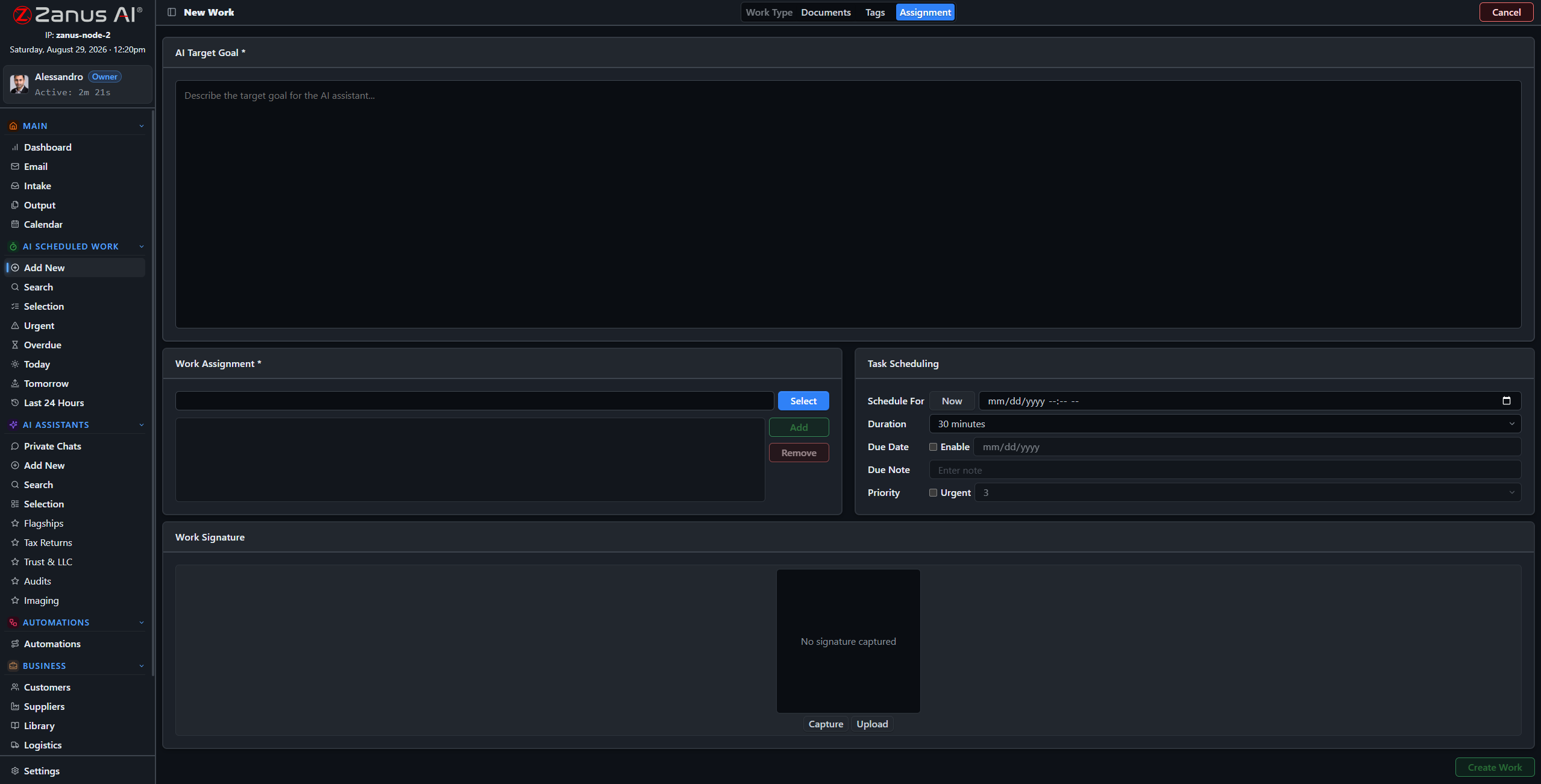
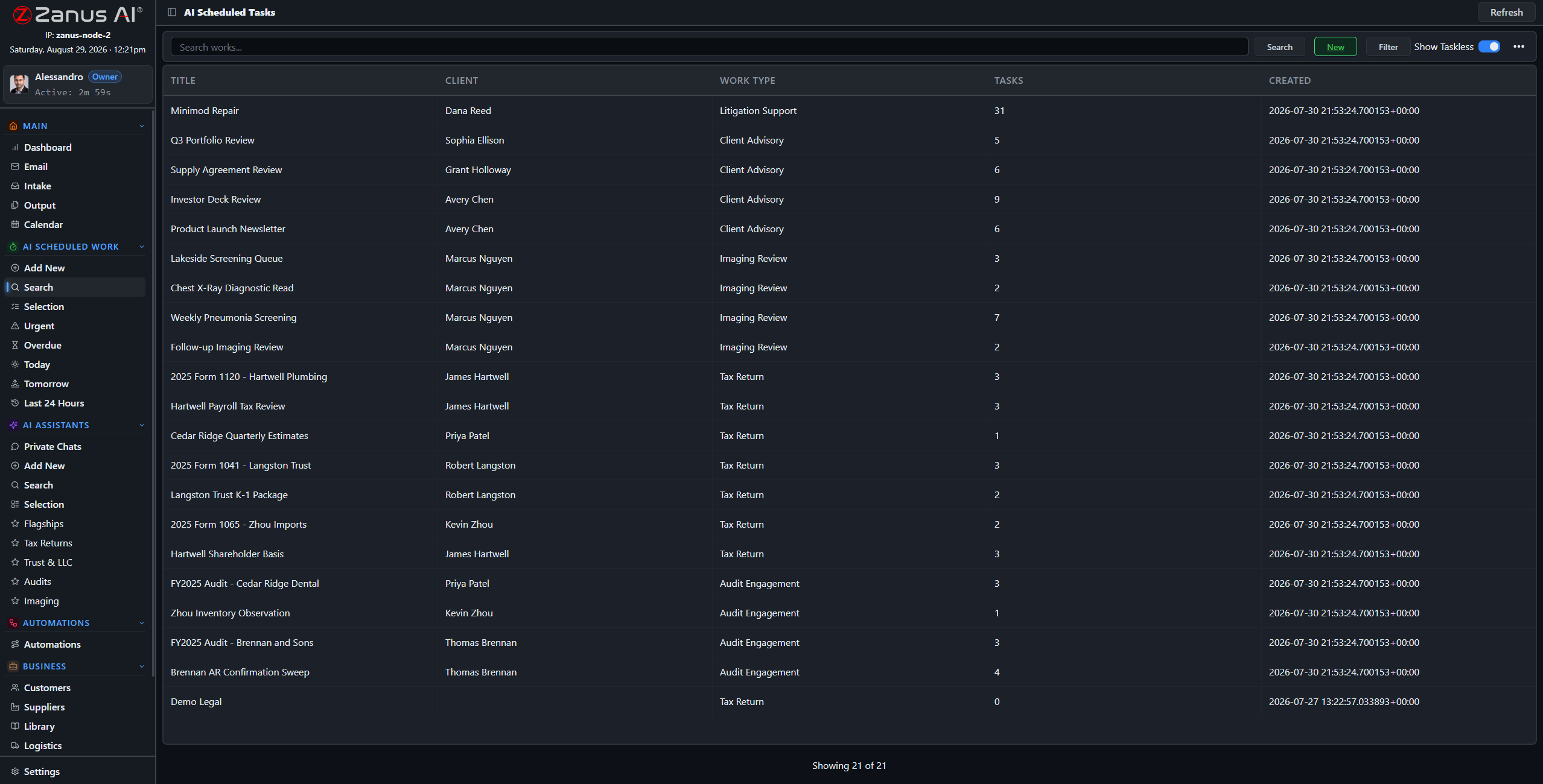
Four steps: work type, records and libraries, tags, schedule — the AI takes it from there.
What it does
Records-request triage, grant expenditure report, correspondence summary, program performance draft: work types molded to your operation, with default libraries per type.
The AI’s workload is managed like the team’s: one-click views show what is urgent, late, today and tomorrow — statutory deadlines never slip silently.
Every work is a full session: reasoning streamed, sources cited, milestones tracked, linked to the case file and the calendar.
Monday, 7 AM: the request triage is done
Set “Weekly Records-Request Triage” once: every Monday the AI reviews the week’s incoming requests, matches each against the archive, drafts acknowledgments and assembles candidate responsive sets — filed for the records officer before the office opens.
- Recurring schedules for statutory and reporting cycles
- Findings cited to the underlying records
- Drafts in Output, awaiting official sign-off
Questions, answered
Can supervisors watch mid-work?
Yes — open any session, read the reasoning, redirect it, or stop it. The AI works like staff: visible, accountable, interruptible.
What about surge periods?
Legislative sessions, fiscal-year close, request spikes after a news cycle: the AI does not get tired — the constraint is your review capacity, not its throughput.
See it working on YOUR agency — the demo IS the product.
ZANUS AI FOR GOVERNMENT — DIRECTIVES & SOPS
The directive binder, alive.
A directive only governs when staff can find it — and the current revision at that. In Zanus, directives, delegation orders and SOPs are living documents: answerable in chat, attached to work, priority-ordered so the operative version always wins.
Cloud pilot or sovereign on-premises · your whole team · public-records-conscious architecture
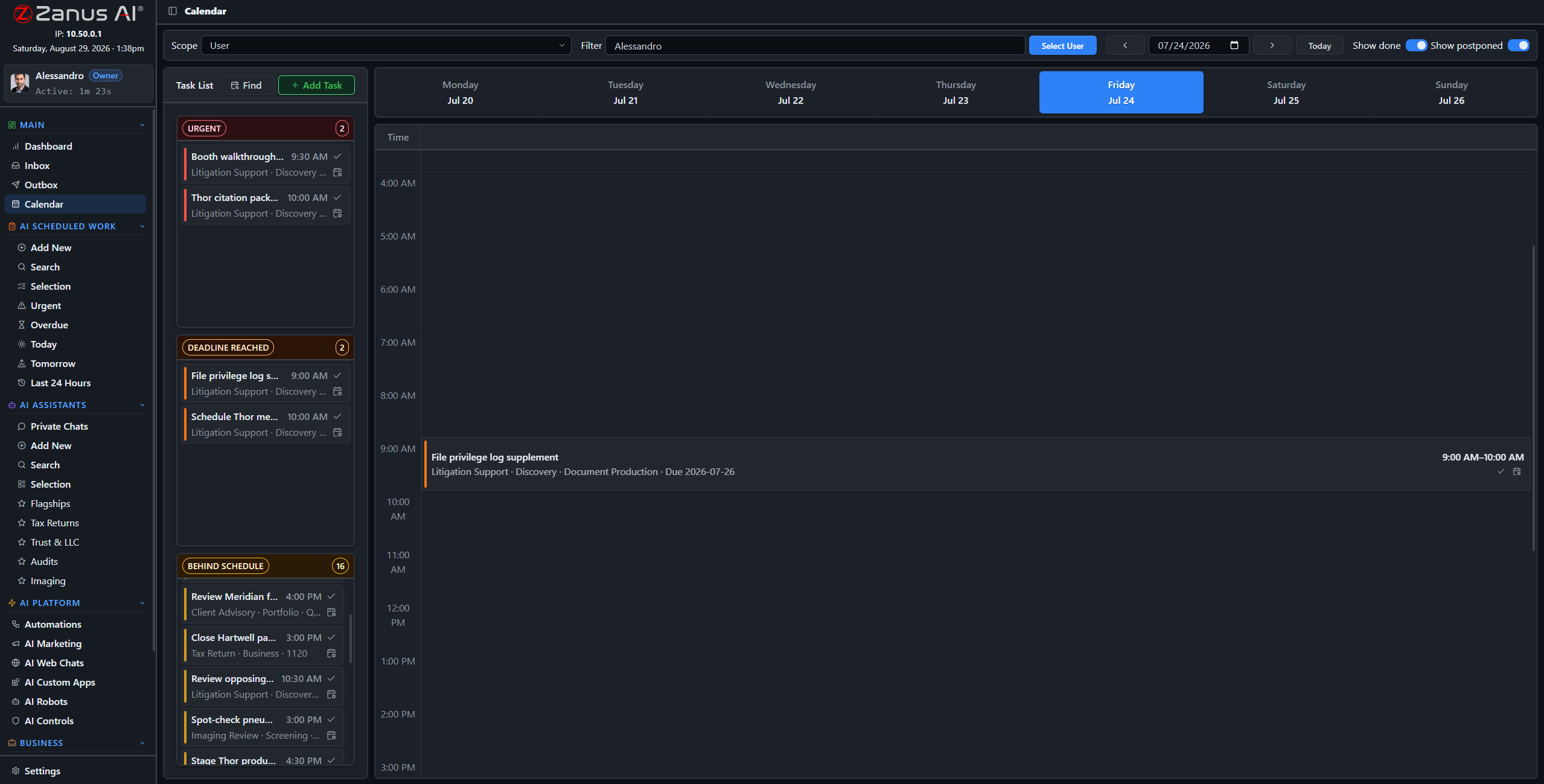
Policy upkeep, scheduled like casework: annual directive reviews and expiration checks on the calendar.
What it does
Directives, delegation orders, records-retention schedules, emergency and continuity plans: one library, operative versions on top, superseded revisions outranked but archived.
“Who can approve a purchase over $10,000?” — answered in seconds with the delegation order attached, to any authorized employee, at the counter or in the field.
Work types carry their governing procedures: the AI drafting a records response reads from the disclosure SOP — by construction, not by memory.
Policy upkeep, scheduled like casework
Annual directive reviews, delegation-order expiration checks, summaries of new requirements for staff briefings: assign them once as recurring AI work and the binder never goes stale — every review lands on the audit record.
- Recurring review works with deadlines
- Change summaries drafted for staff briefings
- Every review event on the audit trail
Questions, answered
How do revisions roll out?
Upload the new revision, set it on top: from that moment every answer and every AI work cites the new authority. Superseded versions stay archived — auditors can see exactly what governed when.
See it working on YOUR agency — the demo IS the product.
ZANUS AI FOR GOVERNMENT — TEAM TRAINING
Retirements without institutional amnesia.
A thirty-year records clerk retires and the knowledge of where everything is walks out with her. In Zanus, procedures live in the system: new hires learn your agency’s own processes from the AI, and every employee has an assistant that answers “how do we…?” instantly.
Cloud pilot or sovereign on-premises · your whole team · public-records-conscious architecture

Training lives inside the software: the AI walks each new hire through the agency’s own procedures.
What it does
New employees learn your case-handling rules, correspondence standards and systems through guided training — productive in days, not the customary six months.
“How do I log an incoming records request?” — asked to the assistant, answered from the SOP with the source attached, without pulling the supervisor off a deadline.
Private chats work on any device with a login — the how-to knowledge follows the employee to the counter, the field office or the hearing room.

The trainer that never rotates out
The tenth “how do I route this correspondence?” gets the same patient, sourced answer as the first. Training content never goes stale, because the assistant reads from the same living directive libraries as everything else — update the SOP once and every future answer updates with it.
- Answers cite the current SOP or directive
- Preset assistants per role: clerk, analyst, officer
- Training progress visible to supervisors
Questions, answered
Can we capture a retiring expert’s knowledge?
Load their procedures, notes and correspondence into the libraries before they leave: their answers keep answering. Several agencies treat this as the first project.
See it working on YOUR agency — the demo IS the product.
ZANUS AI FOR GOVERNMENT — AUTOMATIONS
The agency’s repetitive work, set once.
Describe the job in plain words — “when a records request arrives, acknowledge it, open a case, and draft the responsive-documents search” — and it becomes connected blocks on a canvas, running on its own, with every run visible.
Cloud pilot or sovereign on-premises · your whole team · public-records-conscious architecture
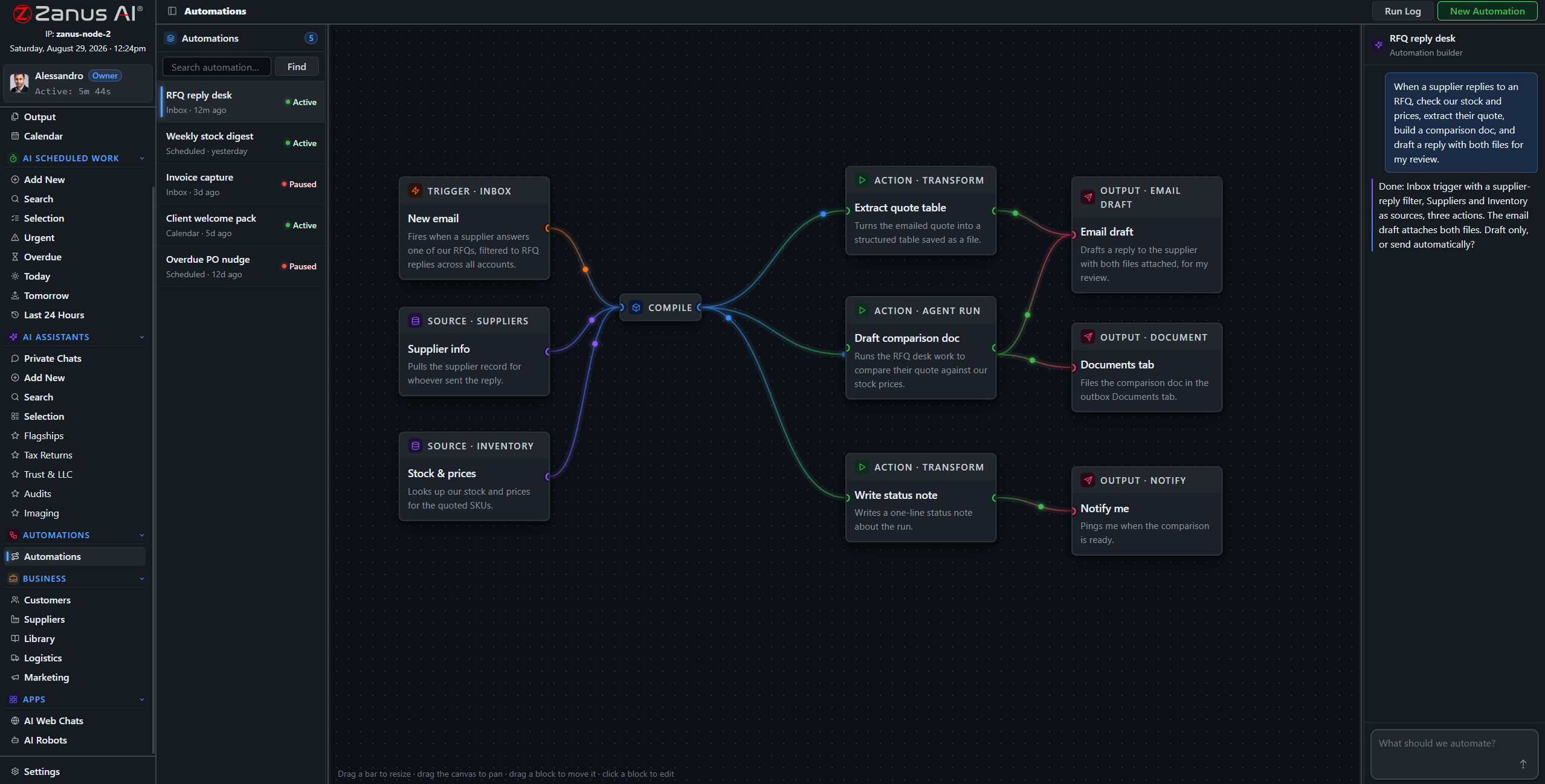
A real flow: inbox trigger, records sources, AI compile, three outputs — drawn from a description.
What it does
A records request hits the inbox: acknowledgment drafted, statutory clock logged, case opened, archive search queued — before a clerk touches it.
Incoming mail classified and routed to the right program office with a drafted summary — the three-day routing slip becomes a three-minute event.
The Friday operations summary, the monthly grant status, the quarterly performance report: compiled by the AI, filed to Output, on time every cycle.
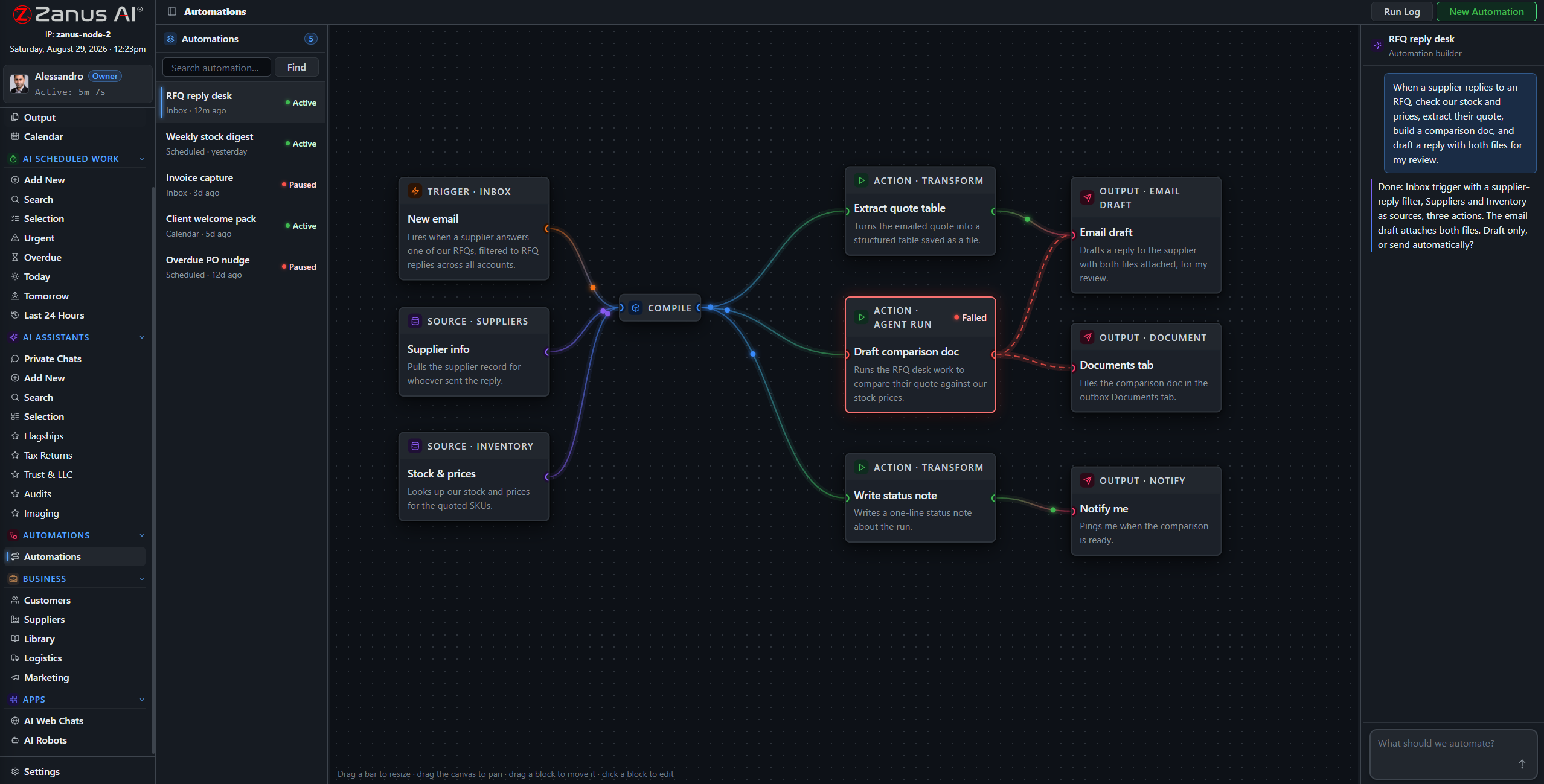
When something fails, you SEE it
Run states live on the flow: green success, red failure on the exact block. In an agency with statutory deadlines, silent failures are unacceptable — here, nothing fails silently and every run is on the audit record.
- Run log per automation
- One-click retry on failures
- Finished documents in Output, statused
Questions, answered
Who approves what an automation sends?
Your rules: queue everything for human approval, or auto-send only the categories your counsel designates as safe — acknowledgments yes, releases never.
See it working on YOUR agency — the demo IS the product.
ZANUS AI FOR GOVERNMENT — PUBLIC OUTREACH
Official communications, drafted and on the record.
Public notices, program announcements, constituent correspondence, comment-period summaries — drafted by the AI from your own official records, in plain language, queued for your approval. Nothing reaches the public without an official’s decision.
Cloud pilot or sovereign on-premises · your whole team · public-records-conscious architecture
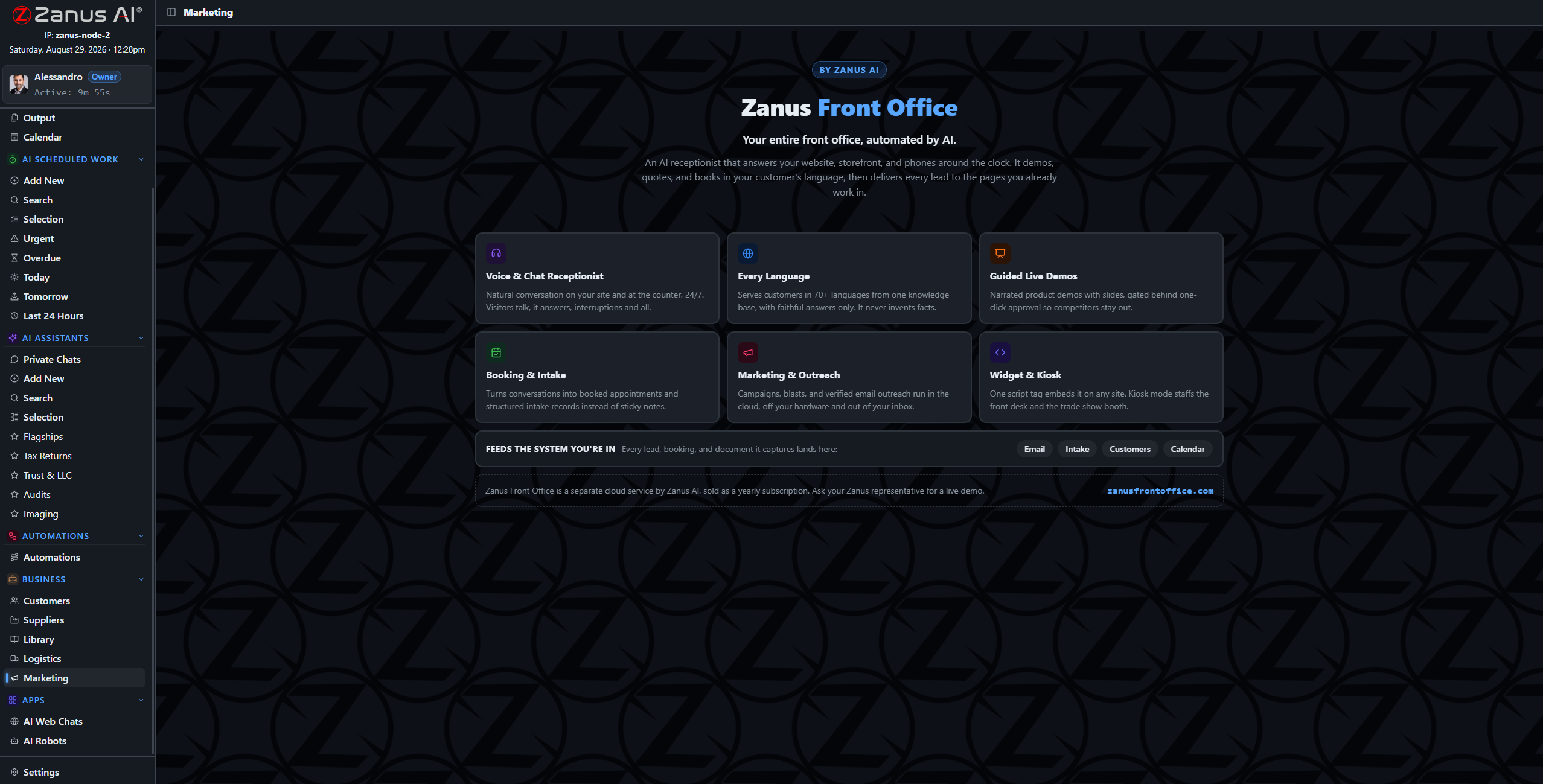
Notices and announcements drafted from the official record — every one awaiting approval.
What it does
Comment-period openings, program deadline reminders, service-change notices: drafted from the underlying directive or decision document, with the source on file.
The public reads at every level and in every language. The AI drafts the same official content in plain language and translates it — your review, one send.
Every outbound communication lands in the approval queue. The public information officer releases; the system records who approved what, when.
From the decision to the notice, without a scramble
A program deadline moves. The AI drafts the public notice from the amending memorandum, the website text, and the constituent reply template — consistent with each other because they share one source — and files all three for approval before close of business.
- Audiences built from your own records, not exported lists
- Consistent language across notice, web and correspondence
- Every send on the audit record

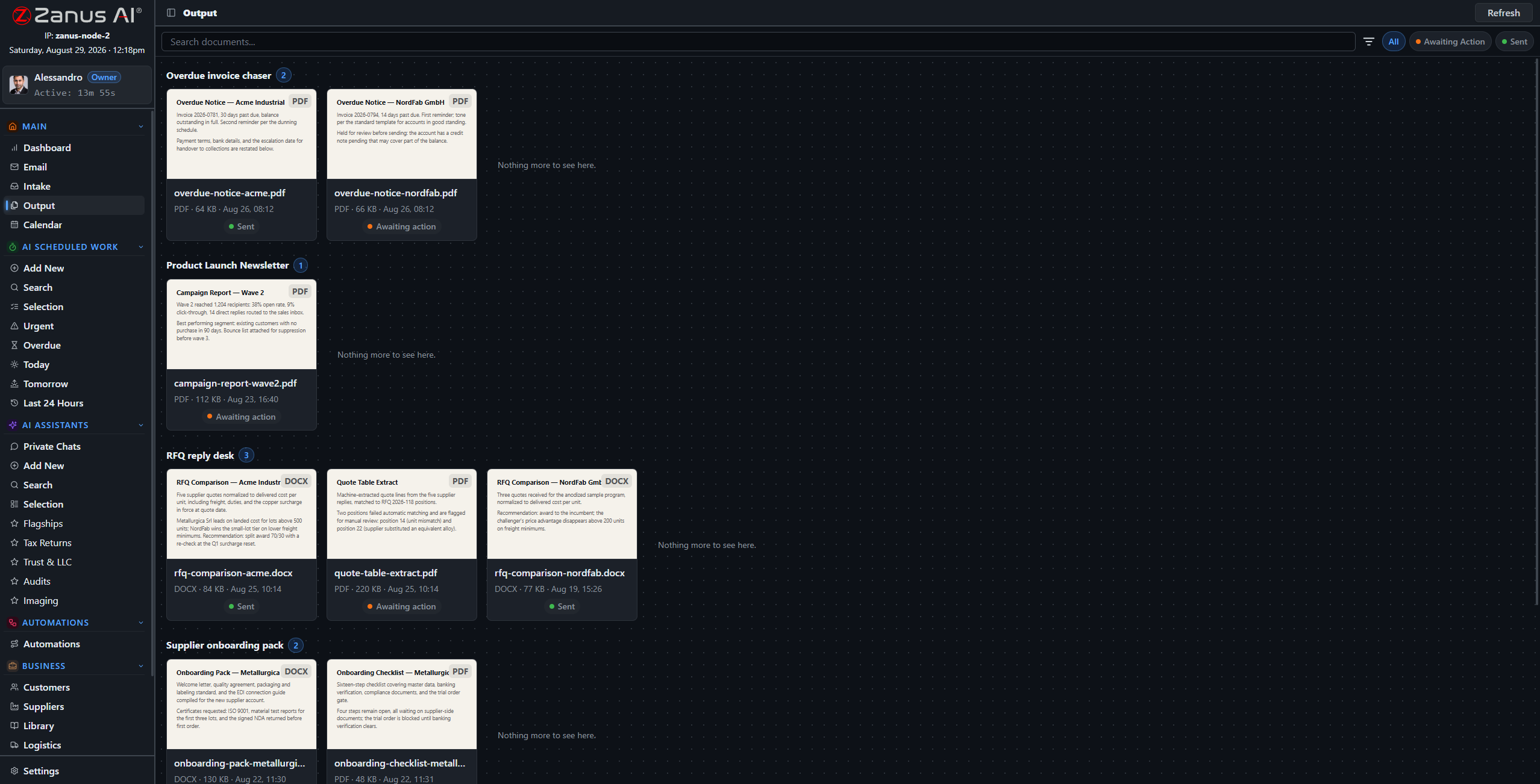
Constituent correspondence, answered in kind
The letters and emails the public sends deserve answers grounded in the record. The AI drafts responses citing the operative policy, in the constituent’s language, for staff review — the backlog of unanswered mail becomes a review queue.
- Responses cite the operative directive or policy
- Approval workflow per correspondence category
- Full history of what was sent to whom
Questions, answered
Is this marketing?
No — it is official communication. The same module commercial firms use for campaigns is configured here for notices, announcements and correspondence: drafted from the record, approved by officials, logged.
Can it handle a comment period?
It can acknowledge submissions, organize them into a searchable library, and draft the summary of comments for your team’s review — the analysis and the response remain yours.
See it working on YOUR agency — the demo IS the product.
ZANUS AI FOR GOVERNMENT — RECORDS & INTEGRATIONS
Keep the systems of record. Add the system of work.
Your records management system, case systems and financial system stay exactly where they are. Zanus becomes the system of work: API connectors sync cases, documents and contacts both ways, the intake pipeline files what arrives, and AI-drafted documents flow back where they belong. No rip and replace.
Cloud pilot or sovereign on-premises · your whole team · public-records-conscious architecture

No rip and replace: the RMS, case systems and financials stay — the AI layer connects to all of them.
What it does
Cases, documents and contacts mapped field by field, with a dry-run preview before anything writes — push, pull or two-way, your choice per system.
Grant documents, invoices and budget files route through the intake pipeline to the right program record — and the AI drafts the reports that cite them.
A full API for whatever else the agency runs: permitting portals, GIS, legacy databases — data in, results out, under scoped keys.
One question across every system
The case lives in the case system, the invoice in financials, the correspondence in the library — and the AI reads across all of it. “What is outstanding on this grant?” becomes one question with one grounded, cited answer.
- Field mapping with dry-run preview
- Each system stays master of its own records
- Every sync event on the audit record
- External systems appear as blocks on the automation canvas
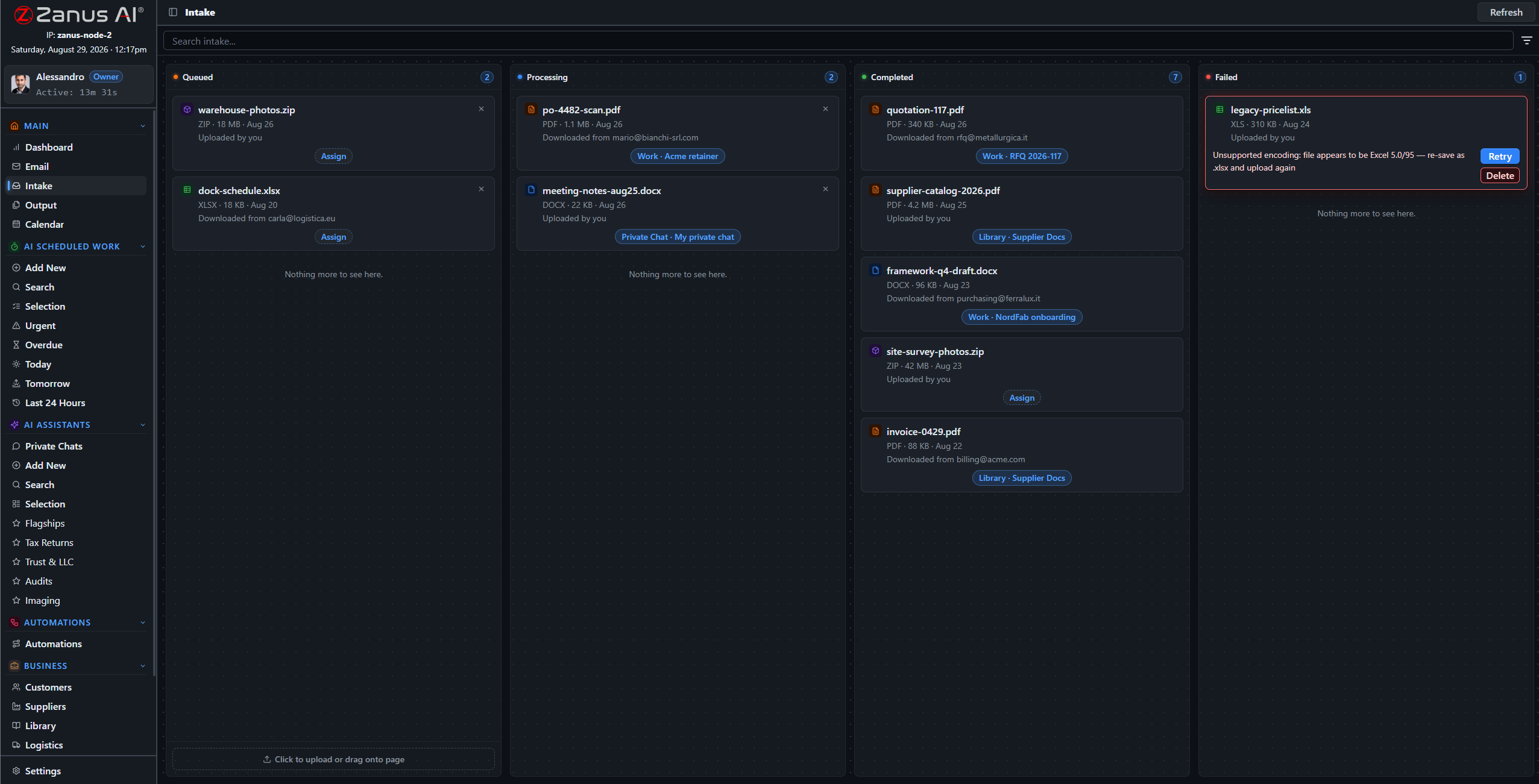
Documents flow back where they belong
The response letter the AI drafted, the program report, the meeting summary: finished documents return to the case file in your records system through the same connectors — reviewed and approved by your officials first.
- AI output filed back to the system of record
- Approval workflow before anything writes back
- Webhooks notify your systems in real time
Questions, answered
Which records systems do you support?
Connectors are mapped per deployment — bring your RMS and case systems to the demo and we walk through the exact integration path for your stack.
Does agency data pass through third parties?
No. Connectors run inside your tenant — or entirely inside your facility on the on-premises option. Data moves directly between your systems.
See it working on YOUR agency — the demo IS the product.
ZANUS AI FOR GOVERNMENT — DATA SOVEREIGNTY
Built like the public record depends on it.
Public-sector accountability is not a feature checkbox — it is the architecture. Admin-created accounts, permissions to the field level, server-side redaction, a searchable audit trail, and a sovereign on-premises option where agency data never touches the internet.
Cloud pilot or sovereign on-premises · your whole team · public-records-conscious architecture
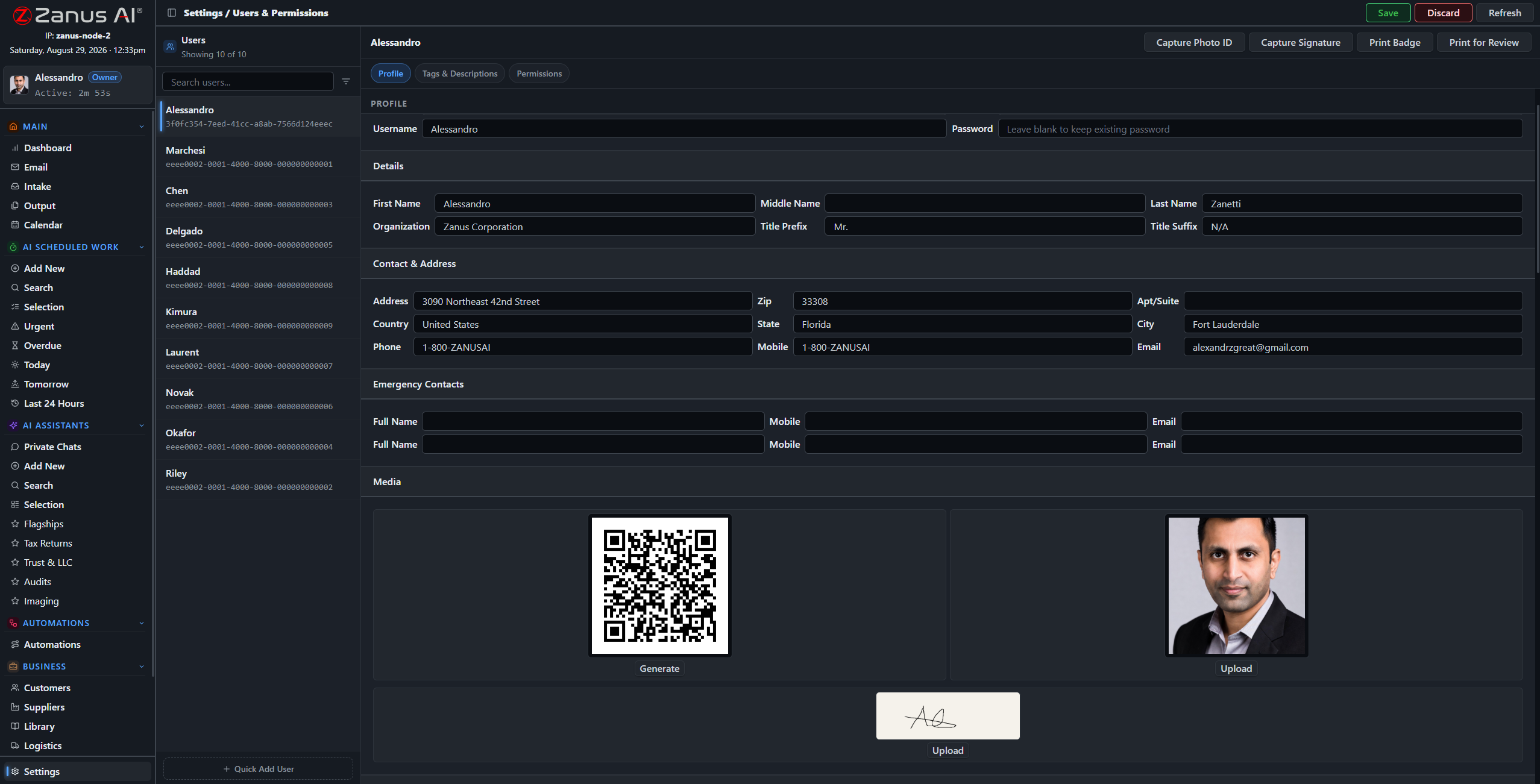
One record per user: role, tags, and granular permissions over every domain of the system.
What it does
The server redacts what a role cannot see — even in shared calendars, a clerk without rights to a case sees the entry, not the parties.
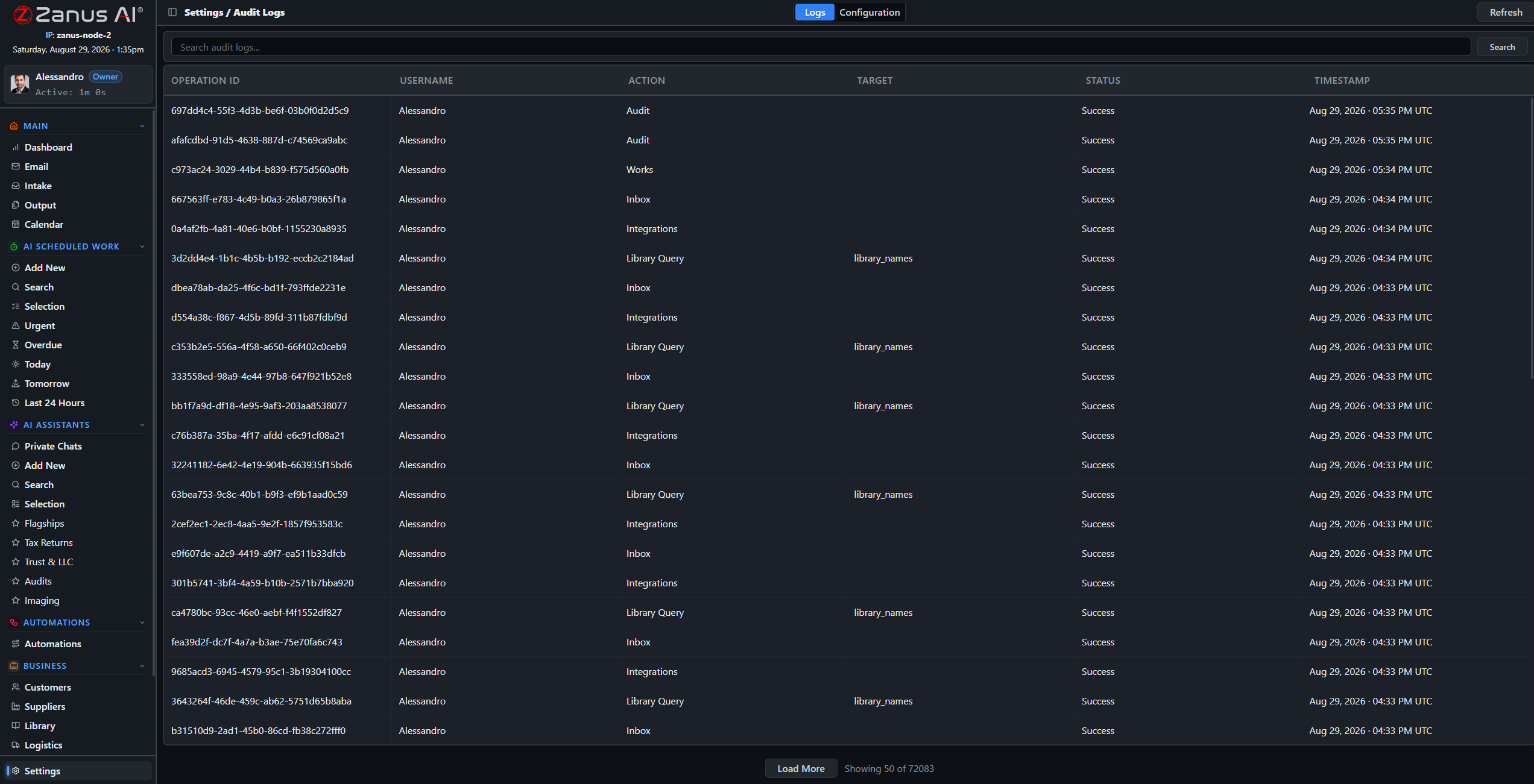
A searchable log of every audited action, with configurable categories: who viewed which record, who changed what, when — the oversight answer is a search away.
Pilot on an isolated tenant with a FedRAMP-aligned deployment path; run production air-gapped on owned hardware with USB updates — FISMA-conscious architecture either way.
The audit that takes minutes, not weeks
When the question comes — from an inspector general, an auditor, or a records request about the records process itself — the answer is a search away: access records, document trails, update history, all in one place, with pre-update snapshots and rollback.
- Searchable audit trail across the system
- Automatic pre-update snapshots with rollback
- USB updates keep air-gapped deployments current
The sovereignty path, concretely
Month one: isolated cloud tenant, real records, real workflows, nothing training outside models. When the pilot proves out, the identical OS moves onto Zanus hardware inside your facility — same screens, same libraries, zero migration pain. The vendor cannot hold your data because the vendor no longer has it.
- Cloud tenant → sovereign on-premises, same system
- Air-gap capable: data physically cannot leave
- Owned outright — no recurring fees on the server
- Explore the AI Servers →
Questions, answered
Is this FedRAMP / FISMA certified?
We describe the architecture precisely: isolated tenants, field-level permissions, server-side redaction, full audit trail, and a FedRAMP-aligned deployment path with an air-gapped option. Certification specifics are reviewed with your security team during onboarding — bring your ISSO to the demo.
What about records-retention rules?
Retention schedules live in the libraries like any directive; the audit trail and snapshot history support your retention and disposition process — your records officer sets the rules once.
See it working on YOUR agency — the demo IS the product.
ZANUS AI FOR GOVERNMENT — LIVE DEMO
Do not watch a video.
Talk to your AI.
Big vendors show public-sector demos as videos behind a procurement form. Ours is the product itself, configured for government: open the chat below-right and try it — ask a citizen question, walk through a records request, see the sovereignty path explained.
The conversation you have with us IS the demo
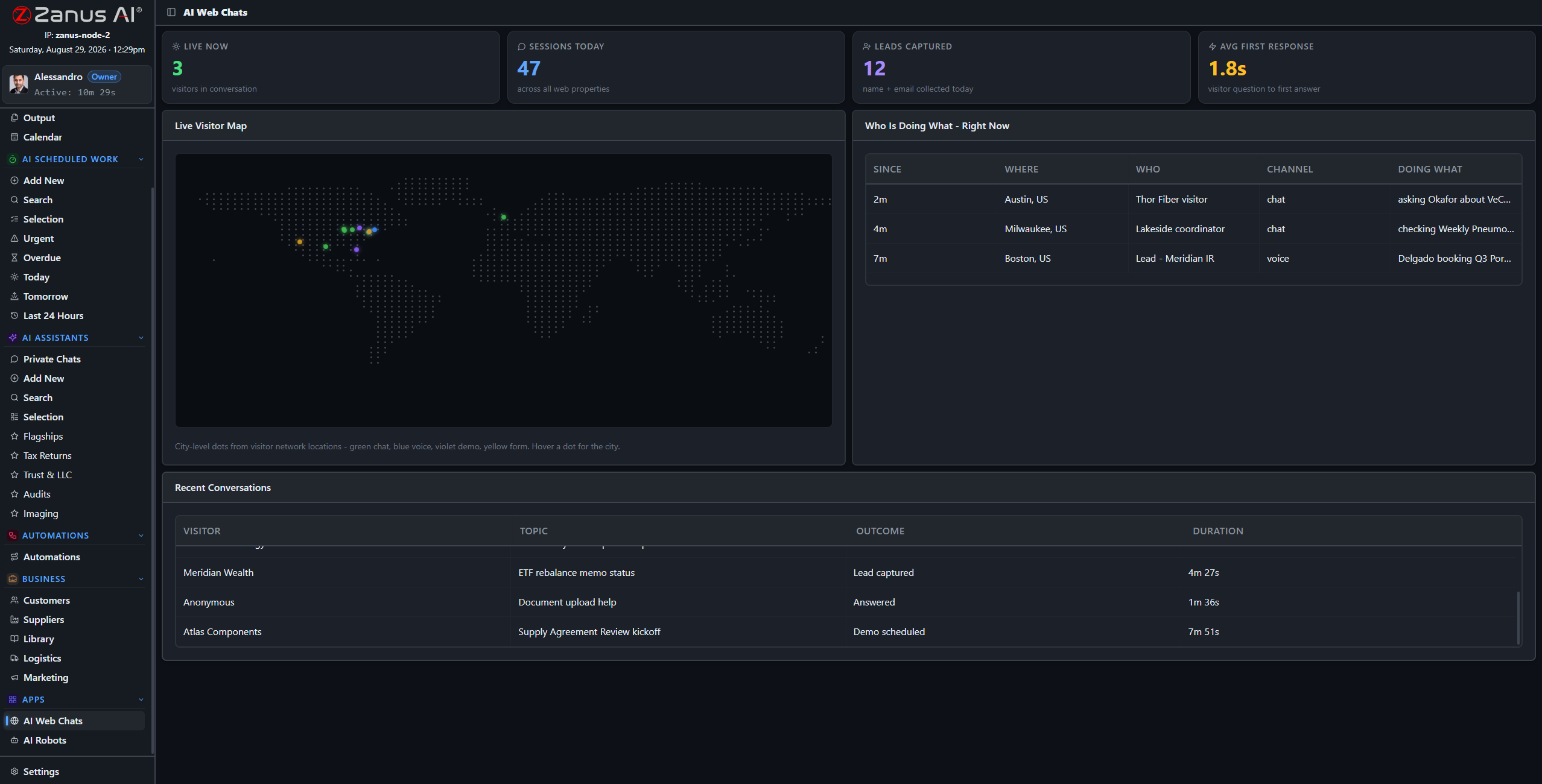
This screen is watching demos like yours happen: live conversations, outcomes, first response in seconds.
What it does
Ask the chat: “how do I submit a public-records request?” — watch it answer from official information, offer the form, and log the conversation.
Ask: “how would you triage a records request?” — it walks the workflow it would run in your tenant: search, cite, draft, sign-off included.
The full demo loads a government tenant with sample records: request triage, directive answers, program reporting — your world, working.
Or pick your exact business
Every link below is a full live-demo page for that specific business — its vocabulary, its calls, its booking rules.
Two minutes to your inbox
Request the demo and the interactive government demo arrives in about two minutes — no sales call, no calendar dance. Watch it, interrupt it with questions, and bring your records officer and security lead when YOU are ready.
- Interactive demo, government-configured
- Ask questions mid-demo — it answers and resumes
- In your inbox in ~2 minutes, free

Questions, answered
Is the demo really the product?
Yes — the same AI, configured with a sample government tenant. What you see is what your staff gets, with your records instead of the samples — in the cloud for the pilot, on your own hardware for production.
See it working on YOUR agency — the demo IS the product.
Sharing with a colleague? 📄 Get the PDF · ✉️ Email this page ·