ZANUS AI FOR BUSINESS OPERATIONS — OVERVIEW
The process only works when it’s followed.
Every operation has two failure modes: the customer request nobody routed, and the SOP nobody read. Zanus AI covers both sides of the operation — intake and status handled up front, SOPs answering back and exceptions worked in the back — with every step on the record.
Private tenant or your own server · your whole team · no per-run automation metering
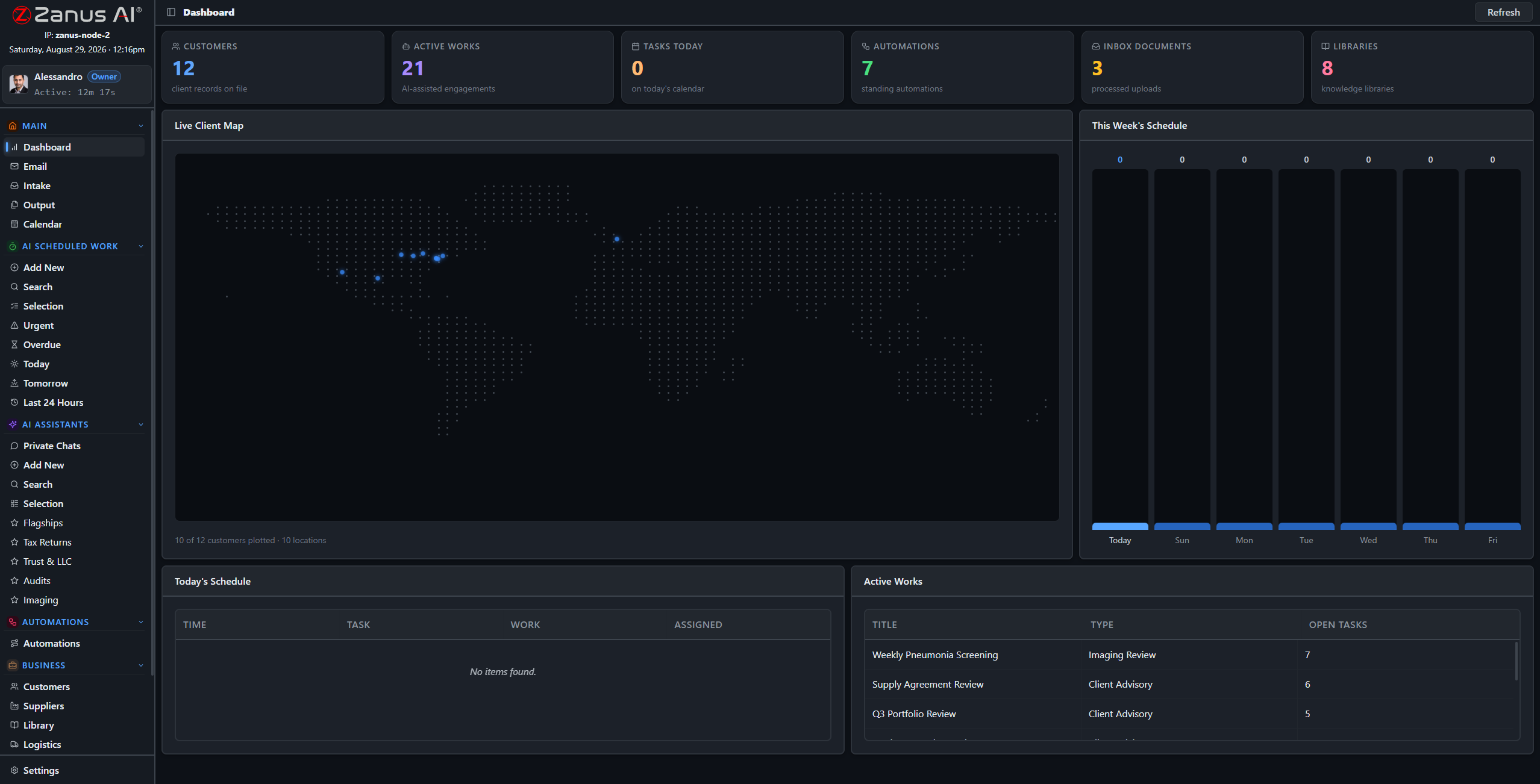
An ops manager’s view: open exceptions, scheduled AI works, team workload and today’s runs, one screen.
What it does
Your procedures are written, versioned — and buried in a drive. Here they become a system staff actually query, because asking beats searching and the answer cites the current version.
Wrong shipment, missed handover, angry escalation: the AI classifies each exception, pulls the relevant records and drafts the resolution — your team decides instead of digs.
The weekly ops report assembles itself from the actual operational data — throughput, exceptions, SLA status — drafted and filed before Friday standup, every week, without a hero.
Front office: intake and status, off your team’s desk
Status calls, order questions and service requests are volume work, not judgment work. The Zanus front office answers them 24/7 from your real records and rules — and routes the genuine exceptions to humans with context attached, not bare tickets.
- Status questions answered from live records
- Requests qualified and routed by your rules
- Every conversation transcribed and searchable
- See the Front Office for operations →

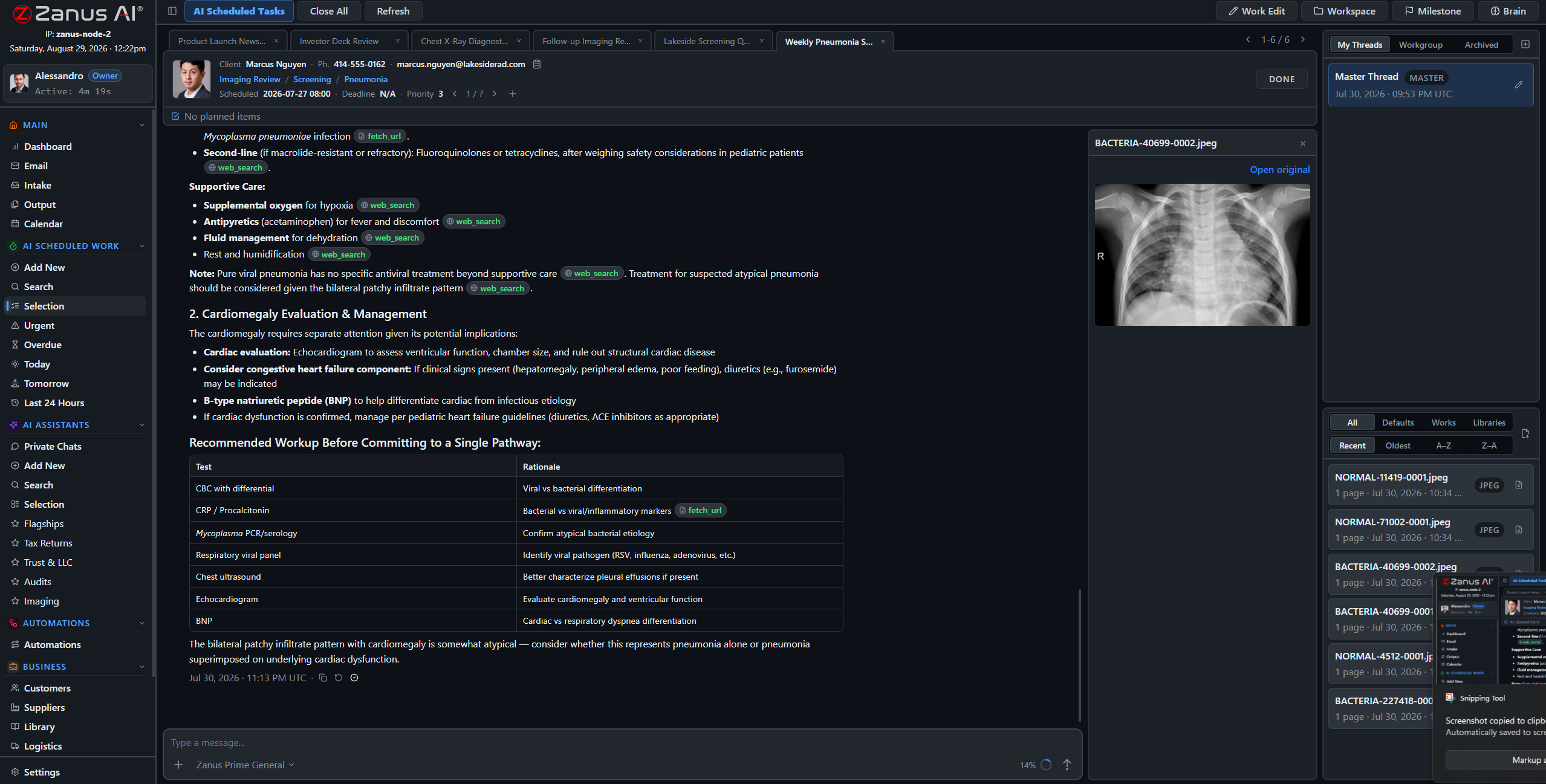
Back office: the process, executing
Exception queues worked on schedule, handover notes drafted at shift end, the ops report compiled from real data — assigned to the AI like staff work, executed with citations, reviewed by your team.
- Scheduled AI work on exceptions and reporting
- Answers cite the current SOP, always
- Human sign-off before anything final
- See the Back Office for operations →
When the process data must stay home
Operations data maps your whole business — volumes, costs, weak points. Run the identical OS on a Zanus server inside your building: air-gap capable, USB updates, owned outright, your whole team.
- Private On-Premises AI: owned, no recurring fees
- On-Prem Tokens Server for high-volume processing
- Explore the AI Servers →

Questions, answered
We already have a process tool. Why this?
Process tools describe work; this one performs it. The SOPs become answerable, the exceptions get worked, the reports get drafted — in the same system, without per-run metering.
How fast can an ops team be live?
Days to weeks: upload the SOPs and manuals you have, connect the systems you run, and the first scheduled works start producing. No agent development project.
Does every automation run cost extra?
No. one price per company, your whole team, no AI metering — the economics do not punish you for automating more.
See it working on YOUR operation — the demo IS the product.
ZANUS AI FOR BUSINESS OPERATIONS — FRONT OFFICE
“Where’s my order?” Never reaches your team again.
Eighty percent of inbound to an operation is status, logistics and the same routine requests — volume that buries the people hired for judgment. The Zanus front office answers it from your real records, by your rules, and hands humans only the exceptions, with context.
Private tenant or your own server · your whole team · no per-run automation metering

Calls, chats and requests — answered, classified and routed, visible on one operations screen.
What it does
The AI reads the actual order, shipment or ticket state and answers — no agent toggling between five systems to say “it ships Thursday.”
Service requests come in qualified: what, where, urgency, account — collected conversationally and filed as structured work, not free-text voicemail.
When a human is needed, the human gets the transcript, the record and the AI’s summary — the customer never repeats the story a third time.
The 6 AM shift that never gets sick
Operations do not keep office hours. The night-shift driver, the overseas supplier, the customer checking at dawn — all get answered in one ring, in up to 40 languages, with the same current information your best coordinator would give.
- 24/7 phone on your menu and voices
- Answers grounded in live operational records
- Rules decide what auto-answers and what escalates
- Morning briefing summarizes the night for your team


Web intake, worked in minutes
Web forms and site chat feed the same engine: requests qualified, records created, confirmations sent — while the inquiry is minutes old, not aging in a shared inbox.
- Grounded website chat, zero improvising
- Forms become structured, routed work items
- Full transcripts joined to the customer record
- See the full Front Office tour →
Questions, answered
Can it really read our order status live?
Through connectors to your systems of record, yes — with a dry-run preview when we map the fields. Bring your ERP or order system to the demo.
What decides AI-versus-human?
Your routing rules: by topic, account tier, hour, keyword or urgency — and you tune them anytime as you watch the transcripts.
See it working on YOUR operation — the demo IS the product.
ZANUS AI FOR BUSINESS OPERATIONS — BACK OFFICE
Exceptions worked. Reports written. Before standup.
The ops manager’s real job is judgment; the ops manager’s actual day is assembling context. The Zanus back office does the assembly: exceptions pre-worked with records attached, reports drafted from live data — your team reviews and decides.
Private tenant or your own server · your whole team · no per-run automation metering
A real session: exception investigated — records pulled, cause identified, resolution drafted, human decides.
What it does
The mismatched delivery, the double-booked crew, the SLA at risk: the AI pulls the order, the correspondence and the SOP, then drafts the fix — minutes of review instead of an hour of digging.
Shift end → the day’s events, open items and watch-outs drafted from the actual records — the next shift starts informed instead of archaeological.
Throughput, exception counts, aging queues, SLA performance — compiled on schedule from the records themselves, with the numbers traceable to their source.
The queue is managed like a team’s
The AI’s workload runs on the same discipline you hold people to: Urgent, Overdue, Today, Tomorrow — one-click views over everything assigned. Nothing slips silently; anything late is visibly late.
- Urgent / Overdue / Today views on AI work
- Reasoning streamed, sources cited per session
- Milestones tracked, linked to records and calendar


Vendor and customer paperwork, drafted
The claim letter for the damaged shipment, the vendor performance summary, the customer apology with the make-good — drafted from the records in your templates, filed in Output for approval.
- Your templates and letterheads
- Records excerpts attached automatically
- Approval workflow before anything sends
Questions, answered
Does the AI close exceptions on its own?
Only if you designate the category as safe. By default it investigates and drafts; your team approves — judgment stays human, digging goes to the machine.
Can it work across departments?
Yes — workgroups scope who sees what, and a single exception can pull records from every domain the work is permitted to read.
YOU MIGHT ALSO LIKE
The Back Office executes. Who answers the phone?
Front Office AI picks up every call and chat — books, quotes, follows up, 24/7 in 40 languages. Watch it run a business like yours, live.
See it working on YOUR operation — the demo IS the product.
ZANUS AI FOR BUSINESS OPERATIONS — DOCUMENTS
Every work instruction, one question away.
Work instructions, vendor contracts, quality checklists, escalation matrices, rate cards — loaded into priority-ordered libraries the AI reads from. Ask in plain language; get the answer with the current version cited, scoped to who’s asking.
Private tenant or your own server · your whole team · no per-run automation metering
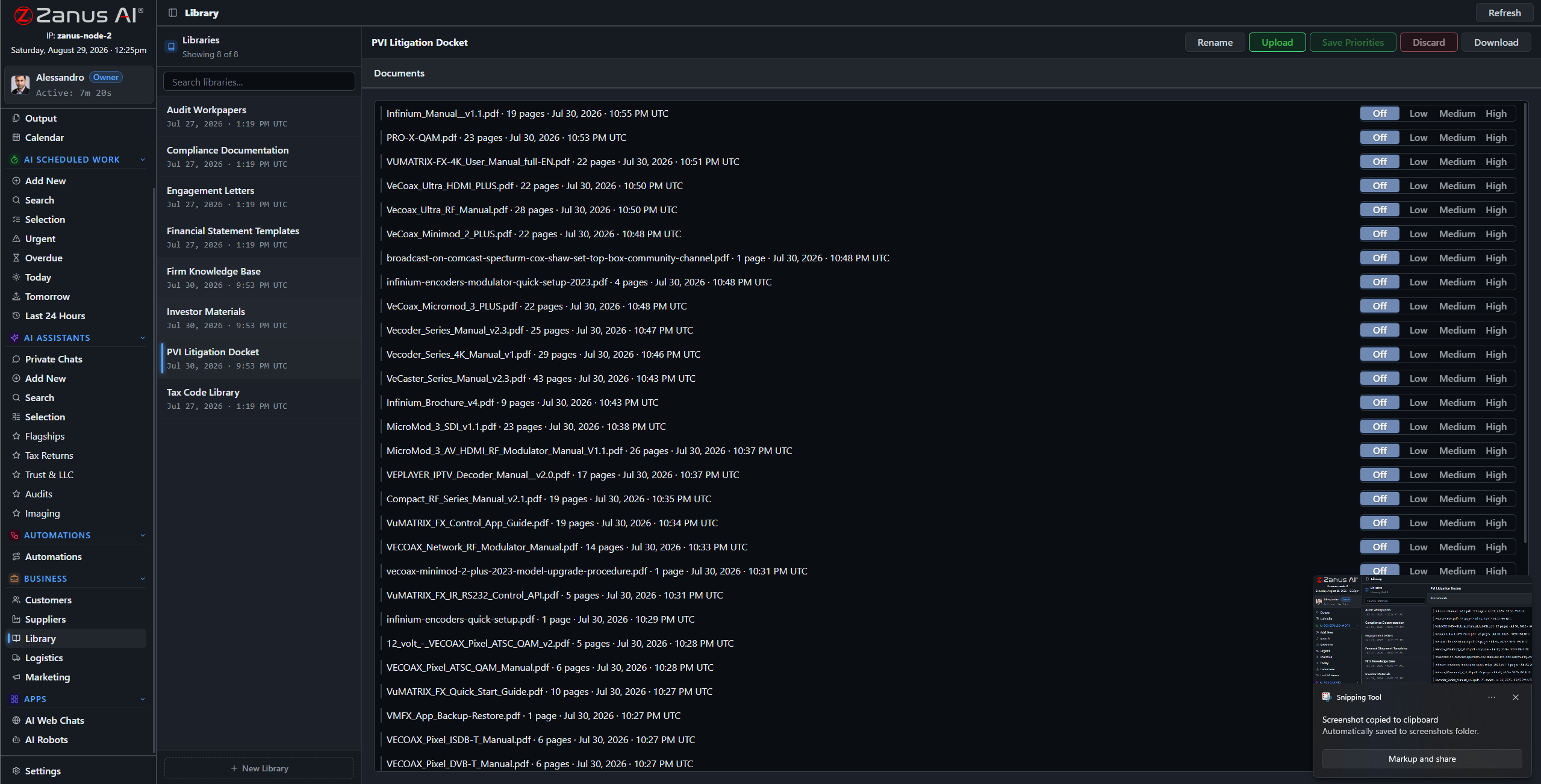
Libraries: released procedures outrank drafts, the current rate card outranks last year’s — you set the order.
What it does
PDFs, spreadsheets, scanned delivery notes, whiteboard photos, training videos — the ingestion pipeline turns operational debris into queryable knowledge.
Priority-ordered libraries mean the released SOP outranks the draft and the signed contract outranks the redline — the AI answers from the version that governs.
The floor lead asks about the checklist; the ops director asks about vendor terms: each gets answers their role permits, enforced at the server, not the interface.
The contract question at 4:55 PM
“What’s the penalty clause if we miss Thursday’s window?” — answered in seconds with the clause quoted and the contract attached, instead of a scramble through email attachments while the truck waits.
- Plain-language questions across the archive
- Clause-level answers with the source attached
- No source in the library, no claim — ever

Questions, answered
How do we keep documents current?
Upload the new version and set it on top — every answer and every AI work cites it from that moment. Superseded versions stay archived for audit.
Do our vendor contracts leak into a model?
No. Your tenant is isolated; nothing trains outside models — and the on-premises option keeps the archive physically inside your walls.
See it working on YOUR operation — the demo IS the product.
ZANUS AI FOR BUSINESS OPERATIONS — AI WORKFORCE
An analyst that never misses a Monday.
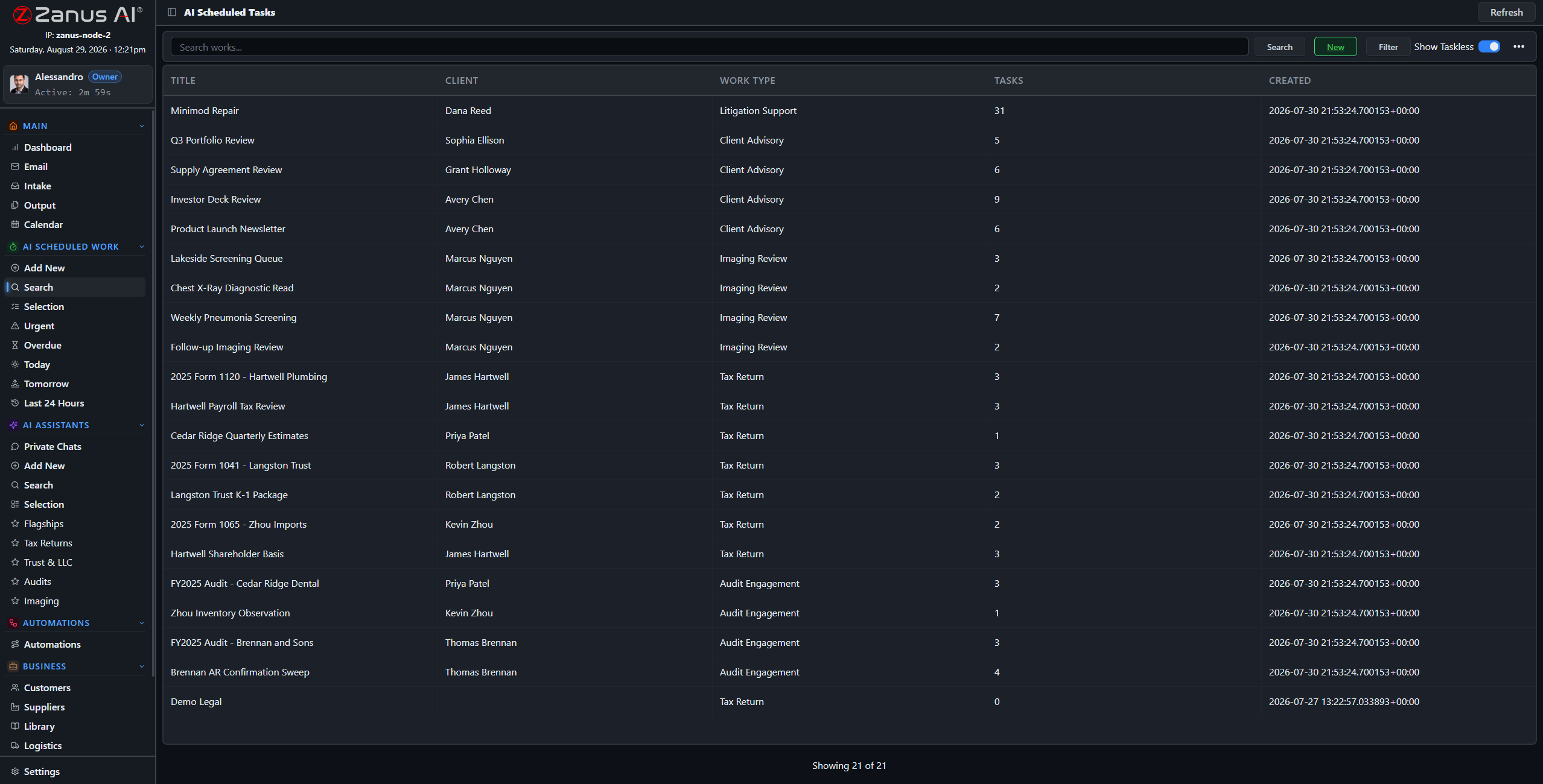
Assign work to the AI the way you assign it to a coordinator: type, sources, deadline, recurrence. The daily exception review, the weekly ops report, the monthly SOP audit — executed on schedule, cited, waiting for sign-off.
Private tenant or your own server · your whole team · no per-run automation metering
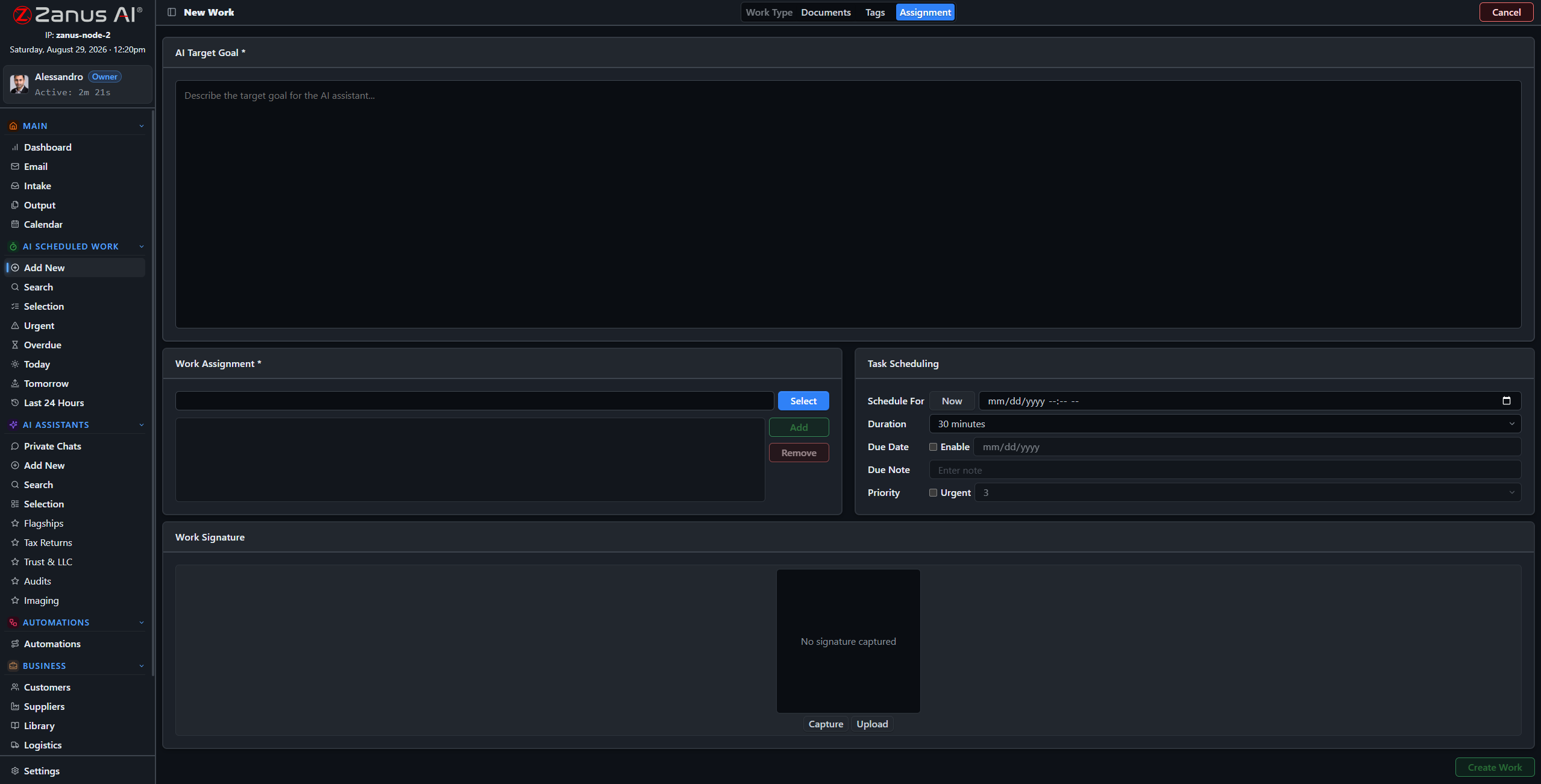
Four steps: work type, sources, tags, schedule — the operational drumbeat, automated.
What it does
Exception review, shift summary, vendor scorecard, SOP audit — work types carry their default libraries and examples, so every run starts from your standards.
The daily review reads the day’s exceptions, groups them by cause, flags repeat offenders and drafts the actions — filed before the ops huddle convenes.
Every procedure checked for staleness, contradictions and gaps against the month’s actual exceptions — the binder confronted with reality, monthly, automatically.
Visible, redirectable, accountable
Every AI work is a full session: reasoning streamed as it runs, sources cited, milestones tracked. Open the Tuesday vendor scorecard mid-run, redirect its emphasis, or stop it — it works like staff, on the record.
- Reasoning and citations visible per session
- Urgent / Overdue / Today views over the AI’s queue
- Output review: nothing final without a human yes
Questions, answered
What if two works need the same data at once?
They run in parallel — the AI does not queue like a person. Your review capacity is the constraint, not its throughput.
Can works trigger other works?
Chain them through the automation canvas: the exception review’s output can trigger the escalation draft, visibly, with run states per block.
See it working on YOUR operation — the demo IS the product.
ZANUS AI FOR BUSINESS OPERATIONS — SOP LIBRARY
SOPs people actually use.
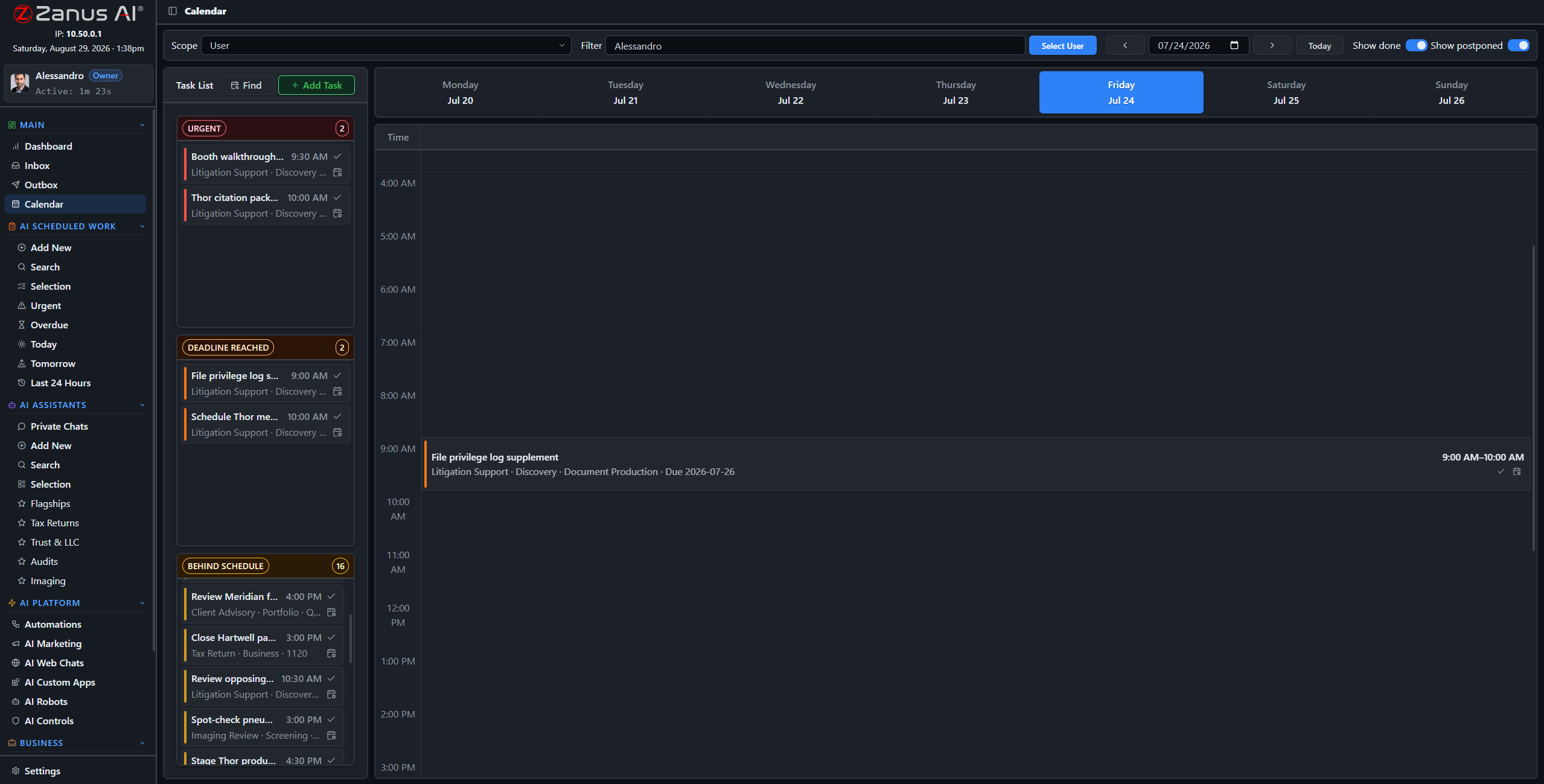
An SOP in a drive folder is a compliance artifact; an SOP people query at the moment of doubt is an operating system. In Zanus, procedures are living documents: answerable in chat, wired into work types, priority-ordered so the released version always wins.
Private tenant or your own server · your whole team · no per-run automation metering
The SOP library as it should be: current releases on top, drafts outranked, every answer sourced.
What it does
“What’s the procedure when a delivery arrives damaged?” — answered in seconds with the SOP attached, at the dock door, from a phone, at 5 AM.
Work types carry their governing procedures: the AI drafting an exception resolution reads the escalation SOP by construction — compliance becomes the default path.
When what happened diverges from what the SOP says, the review works flag it — the gap between paper process and real process finally measurable.
The rollout that actually lands
A revised procedure used to mean an email nobody read. Now: upload the new version, set it on top, and every answer, every AI work and every training session cites it from that second — with an update summary drafted for the team briefing.
- New version live everywhere, instantly
- Update summaries drafted for shift briefings
- Superseded versions archived for audit
Questions, answered
Our SOPs are half-outdated. Start anyway?
Yes — load what exists, and the monthly SOP audit works surface the stale and contradictory ones against real exceptions. Fixing the library becomes scheduled work, not a someday project.
See it working on YOUR operation — the demo IS the product.
ZANUS AI FOR BUSINESS OPERATIONS — TEAM TRAINING
The process survives the handover.
Operations knowledge concentrates in a few veterans — and leaves with them. In Zanus, new coordinators learn your SOPs and systems from the AI, guided, in your vocabulary — and every team member keeps an assistant that answers “how do we…?” from the current procedure.
Private tenant or your own server · your whole team · no per-run automation metering

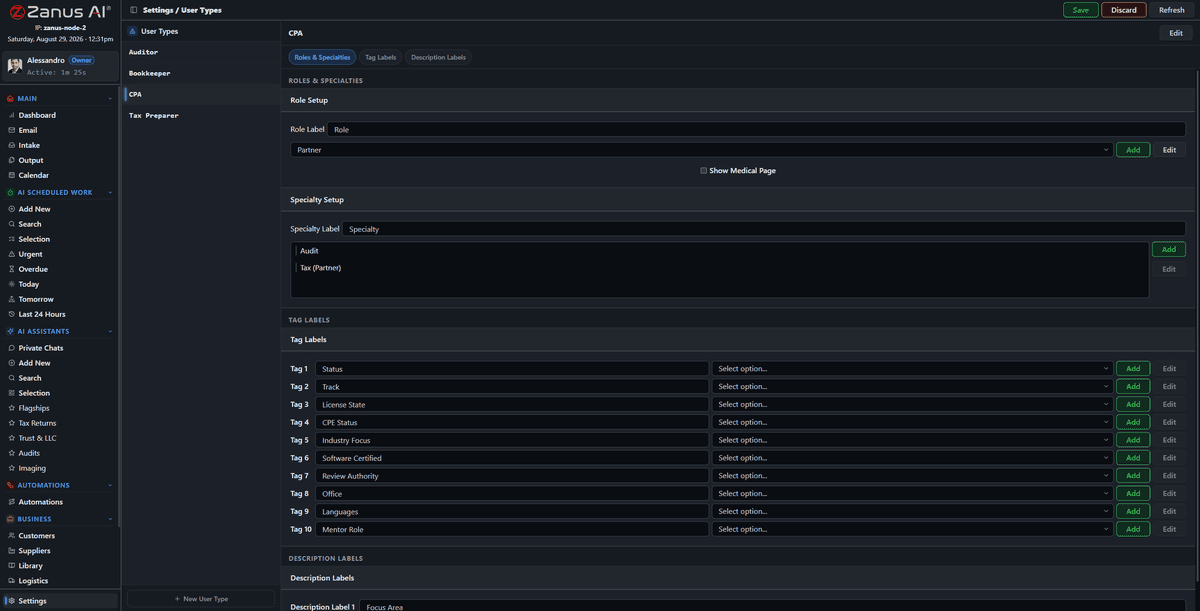
Training runs inside the software, on your own procedures — not generic courseware.
What it does
The new coordinator’s first week is guided training on your actual SOPs, escalation rules and systems — productive before the veteran would have finished explaining the filing system.
“Who approves a rush order over 10k?” — asked to the assistant, answered from the current procedure with the source attached, without tapping the one person who knows.
Day shift and night shift get the same answer to the same question — because both ask the same living library, not different veterans with different habits.
Cross-training without the calendar Tetris
Coverage requires people trained beyond their lane — but pulling a veteran to teach costs a shift. AI-guided training runs whenever the trainee has an hour, tracks progress visibly, and always teaches the current version of the procedure.
- Self-paced guided training per role
- Manager view of who has covered what
- Content updates itself with the SOP library
Questions, answered
Does this replace our LMS?
For procedure and systems training it typically can — the advantage is the content never goes stale, because it reads from the live SOP library. Bring your LMS to the demo and we map the boundary.
See it working on YOUR operation — the demo IS the product.
ZANUS AI FOR BUSINESS OPERATIONS — AUTOMATIONS
The human router, relieved of duty.
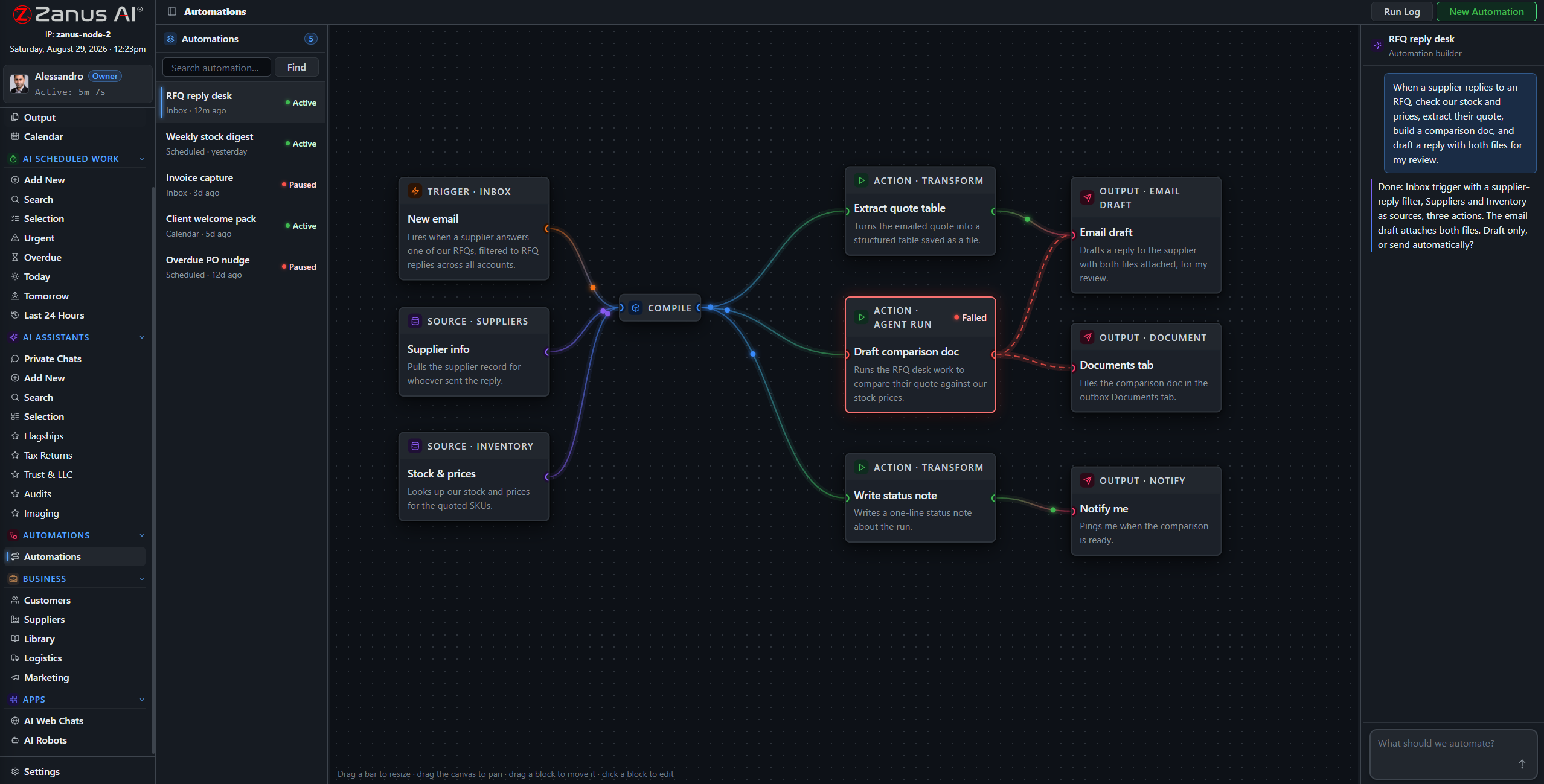
So much of operations is routing: this email to that queue, this delay to those customers, this data to that report. Describe each rule in plain words and it becomes connected blocks on a canvas — trigger, sources, AI step, actions — running unmetered.
Private tenant or your own server · your whole team · no per-run automation metering
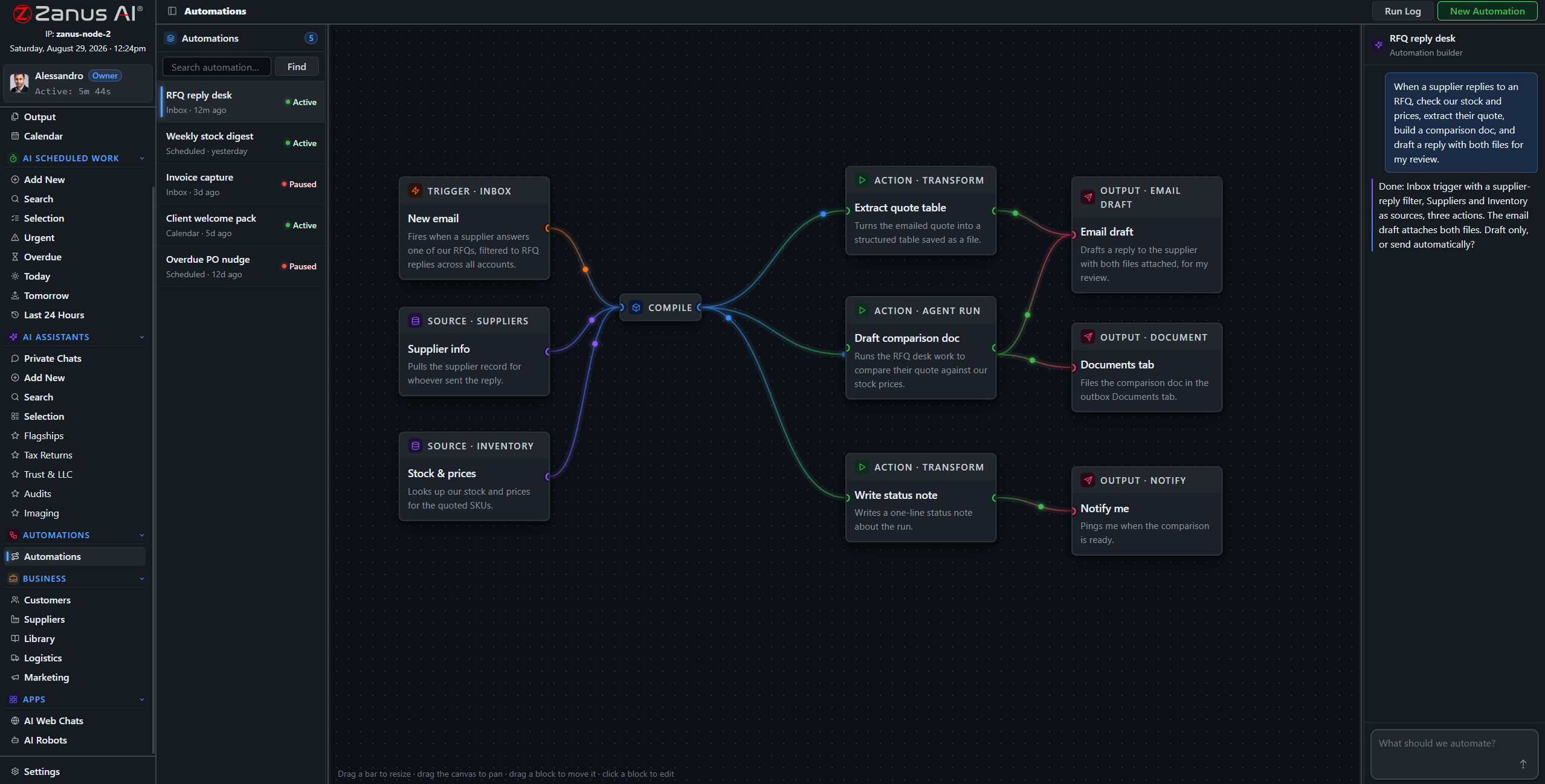
A real flow: trigger, record sources, AI compile, three actions — drawn from a plain description.
What it does
A delay email arrives → affected orders identified from the records → customer notices drafted per account, queued for approval — the scramble becomes a review.
Every inbound issue classified by type and urgency, routed to the right queue with the relevant SOP and a drafted first response attached.
Exception stats, SLA performance, aging queues and vendor scores assembled into the weekly pack and filed to Output — on time whether or not anyone remembered.
Run states you can audit at a glance
Every run paints the canvas: green where it succeeded, red on the exact block that failed, with a one-click retry. An operation lives on reliability — here the automation layer is as inspectable as the process it runs.
- Run log per automation, every execution
- Failures isolated to the block, retried in one click
- No per-run metering — automate without a bill anxiety
Questions, answered
Who builds these flows — IT?
The ops team does: describe the rule in plain language and the canvas assembles it. If you can write the routing rule on a whiteboard, you can automate it.
See it working on YOUR operation — the demo IS the product.
ZANUS AI FOR BUSINESS OPERATIONS — CUSTOMER OUTREACH
Tell them before they call.
Every status call your team answers is an update you could have sent first. Proactive delay notices, service-change announcements, win-back sequences for lapsed accounts — drafted by the AI from your own operational records, queued for approval, consent enforced.
Private tenant or your own server · your whole team · no per-run automation metering
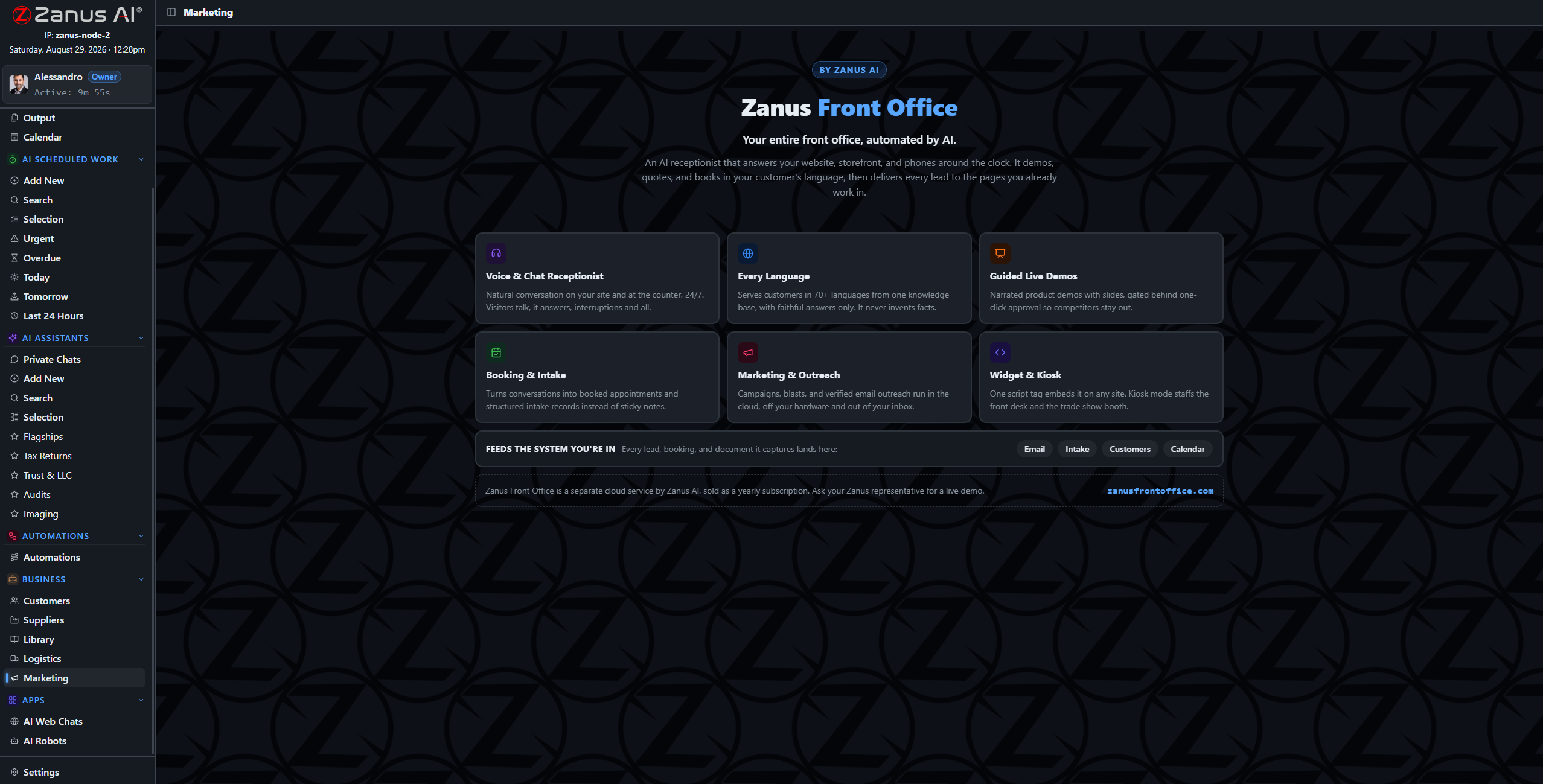
Campaigns and sequences drafted from operational records — notices, updates, win-backs — awaiting approval.
What it does
“Every account affected by Thursday’s carrier change” — built from your own records inside the tenant, precise, never exported to a mailing tool.
Proactive notices on delays and changes reach customers before the phone rings — measured directly in the drop of “where is it?” volume.
Accounts quiet for 90 days enter a drafted win-back sequence in their language — approval-first, opt-outs enforced by the system, results tracked.
From the records to the notice, no export
The audience, the drafting and the sending live where the operational records live — nothing leaves your tenant to reach a campaign tool. “Notify everyone on the Friday route about the schedule change” becomes a drafted, scheduled send in minutes.
- Customer data stays in the tenant — private by architecture
- Sequences drafted for review, sent on approval
- Replies land back in the same conversation history

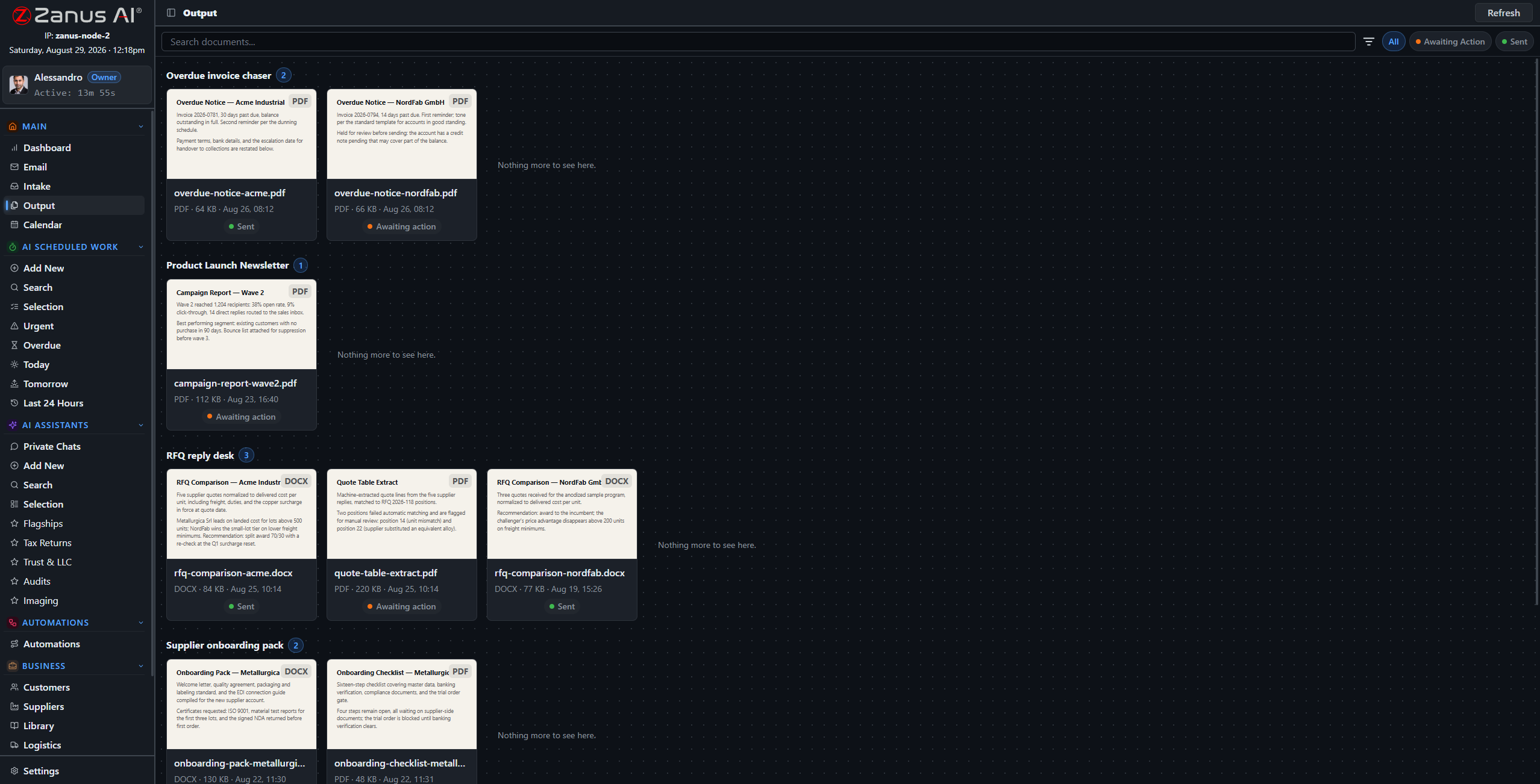
Approval-first, category by category
Routine status notices can auto-send if you designate them safe; anything with commercial weight queues for a human. The rules are yours, per communication type, changeable anytime.
- Approval workflow per category
- Full send history: what, to whom, when
- Results tracked: replies, reactivations, call-volume drop
Questions, answered
Is this a marketing tool or an ops tool?
It is the same module doing both: audiences from your records, drafts for approval. Operations uses it for notices and win-backs; if marketing wants campaigns, it is already there.
How is consent handled?
Opt-outs and channel preferences are enforced by the system on every send, automatically — and every send is on the audit record.
See it working on YOUR operation — the demo IS the product.
ZANUS AI FOR BUSINESS OPERATIONS — ERP & INTEGRATIONS
The ERP keeps the records. Zanus does the work.
Nobody should rip out an ERP to get intelligence on top of it. Your ERP, order management and ticketing stay the systems of record; Zanus becomes the system of work — reading across them, drafting from them, writing back only what you approve, dry-run first.
Private tenant or your own server · your whole team · no per-run automation metering

No rip and replace: ERP, order system and ticketing stay — the AI layer connects to all of them.
What it does
Connectors map orders, accounts and documents field by field — push, pull or two-way — with a dry-run preview showing exactly what would change before anything writes.
The leading CRM suites connect with the same discipline: two-way sync, field mapping, preview before write — the account story unified with the operational one.
The WMS, the dispatch board, the homegrown tool from 2011 — all reachable through the API under scoped keys, and webhooks push events back in real time.
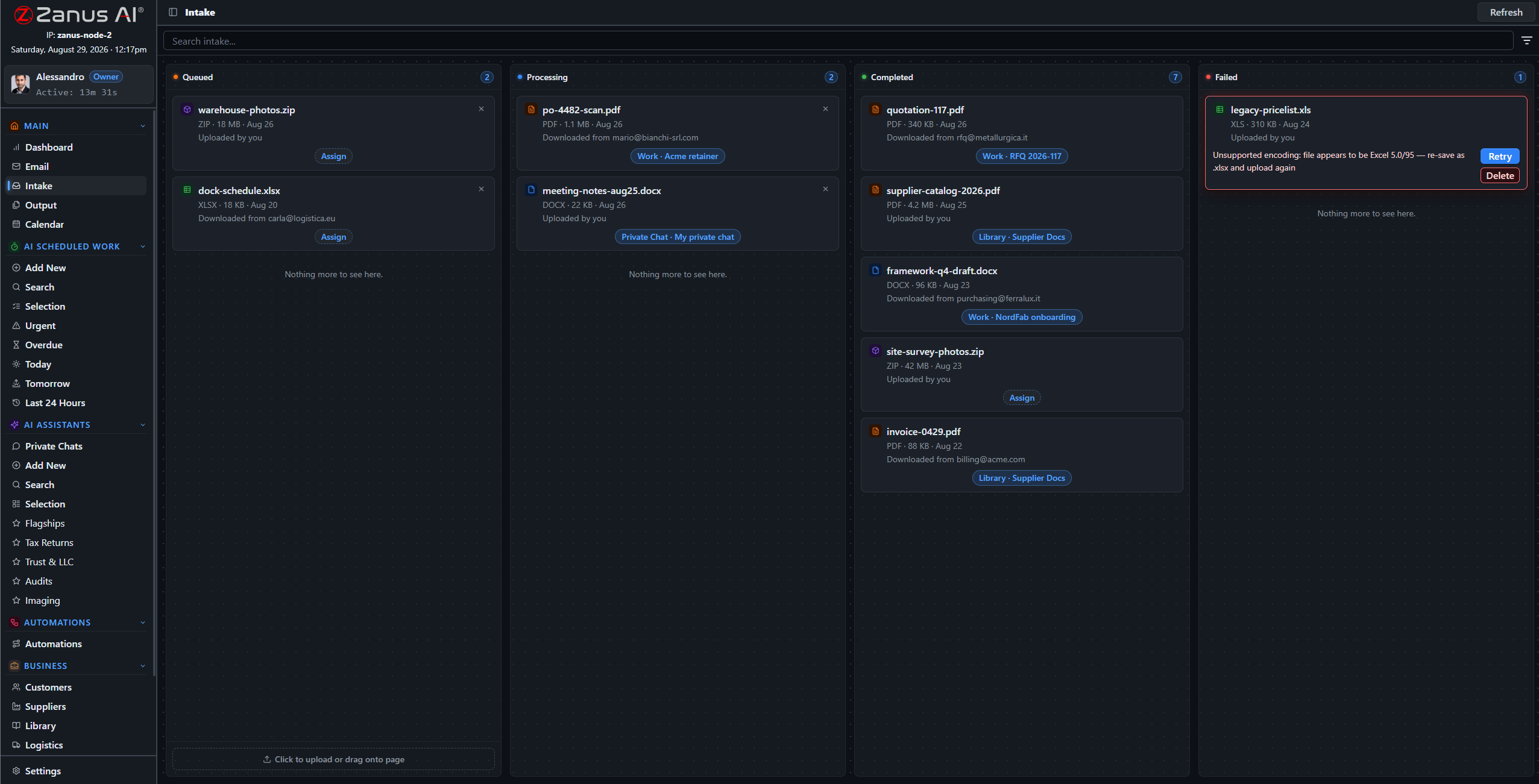
One grounded answer across five systems
The order is in the ERP, the complaint in ticketing, the contract in the library, the delivery scan in the carrier feed — and the AI reads across all of it. “What happened with order 4471?” becomes one question, one sourced answer, whole story.
- Each system stays master of its own records
- External systems appear as blocks on the automation canvas
- Every sync event on the audit record
- Bring your ERP to the demo and we map it
Questions, answered
Our ERP is heavily customized. Problem?
Custom fields are what field mapping is for — the connector maps YOUR schema, and the dry-run preview proves the mapping before a single record moves. Bring the ERP to the demo.
See it working on YOUR operation — the demo IS the product.
ZANUS AI FOR BUSINESS OPERATIONS — COMPLIANCE
When the auditor asks, you search.
Operational accountability means proving what happened: who changed the procedure, who approved the exception, which version governed in March. In Zanus that proof is a search away — audit trail, version history and permissions built into the architecture, on a SOC-2-aligned deployment path.
Private tenant or your own server · your whole team · no per-run automation metering
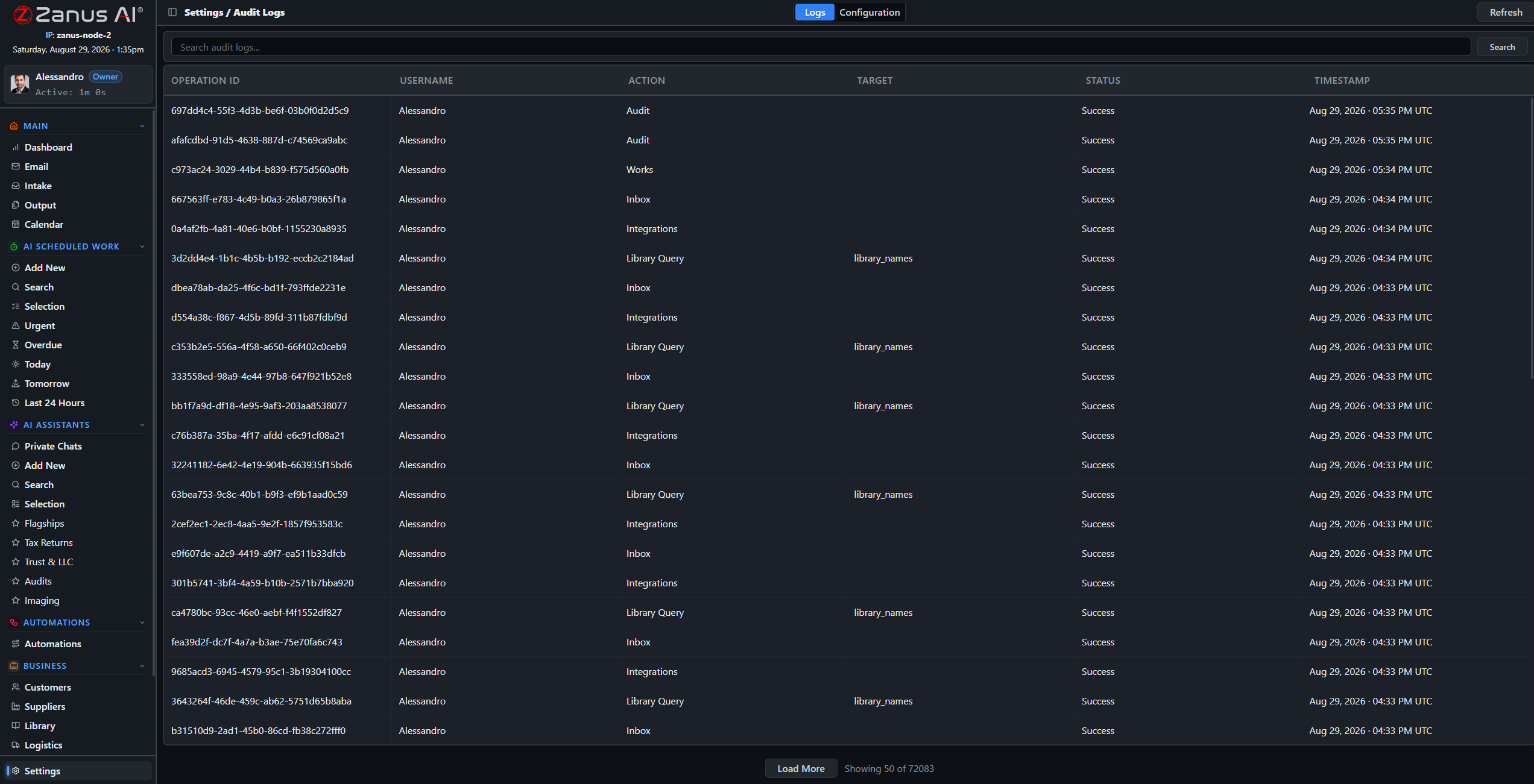
Every audited action searchable: who saw what, who changed what, when — with configurable categories.
What it does
Every exception worked, SOP updated and approval given lands on the audit record as a side effect of working — not as a separate documentation chore.
Roles scope access down to individual fields, enforced server-side: the coordinator sees the order, not the margin; the vendor portal sees its own records, nothing else.
Pre-update snapshots mean a bad change — to a procedure, a record, a configuration — rolls back in one click, with the incident on the record.
Certification prep without the war room
Quality and security audits reward exactly what the system produces by default: current controlled documents, access records, change history, evidence of review. The pre-audit scramble becomes a set of searches — and the on-premises option answers the strictest data-residency clause.
- Searchable audit trail, configurable categories
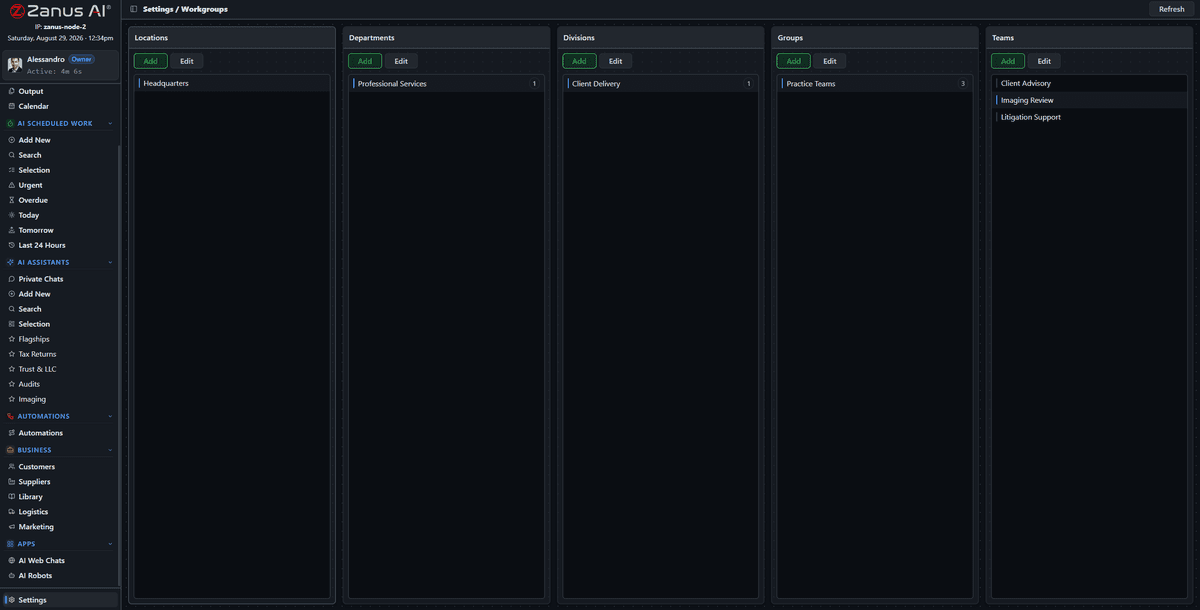
- Five-level workgroups map your org structure
- Air-gap-capable on-premises deployment available
Questions, answered
Are you SOC 2 certified?
We provide a SOC-2-aligned deployment path and the architectural controls auditors look for — specifics are reviewed with your compliance team during onboarding. Bring your auditor’s checklist to the demo.
Can we prove which SOP version governed a past decision?
Yes — superseded versions stay archived with their dates, and the audit trail ties each answer and work session to the version it cited.
See it working on YOUR operation — the demo IS the product.
ZANUS AI FOR BUSINESS OPERATIONS — LIVE DEMO
Do not watch a video.
Talk to your AI.
Enterprise vendors demo operations software with slideware and a sandbox six weeks away. Ours is the product itself, configured for operations: open the chat below-right and try it — ask it to work an exception, compile a report, route a request.
The conversation you have with us IS the demo
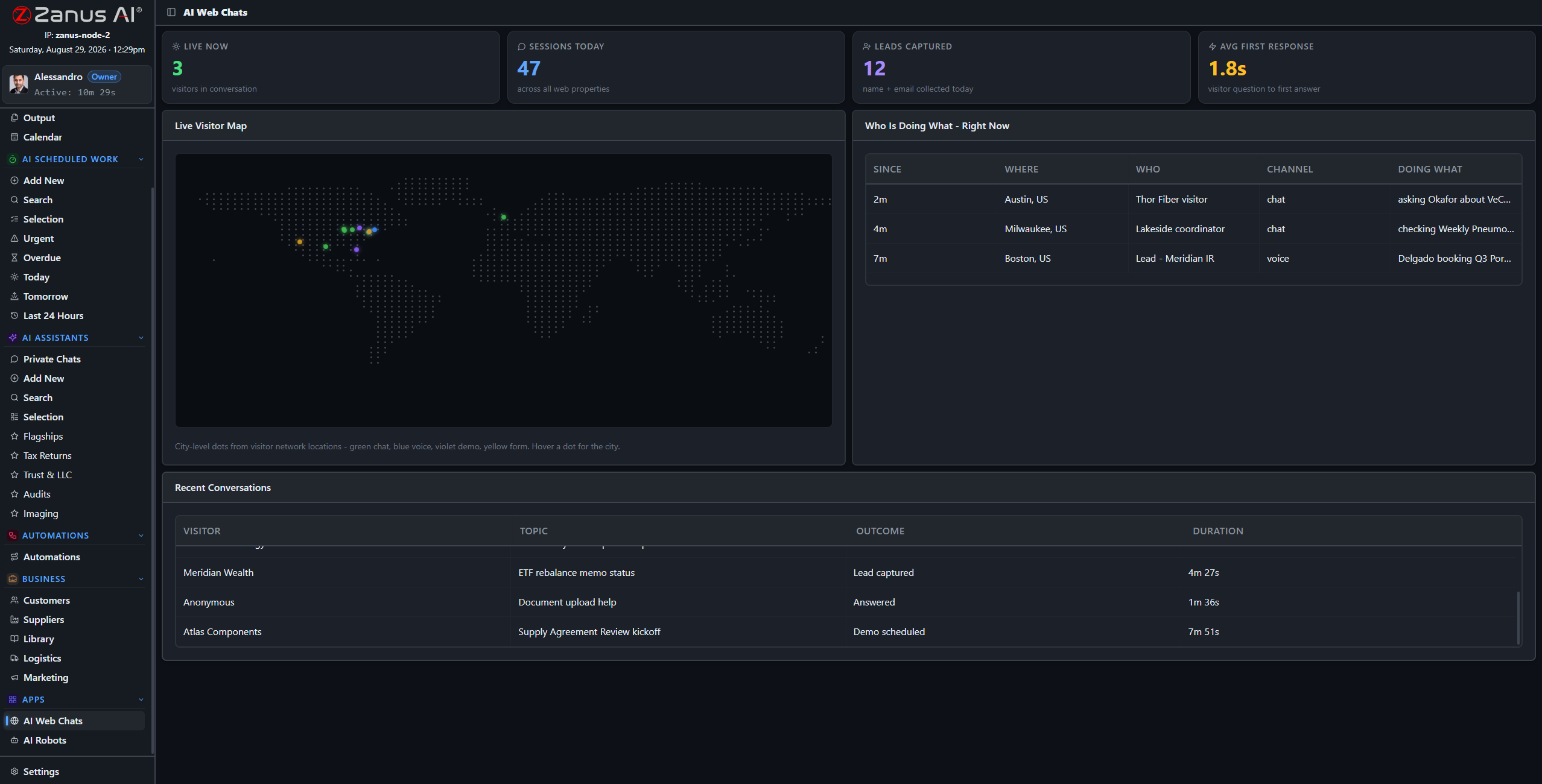
This screen watches demos like yours happen: live conversations, outcomes, first response in seconds.
What it does
Ask the chat: “where is my order and what happens if it misses Friday?” — watch it answer from records and rules the way it would on your lines.
Ask: “how would you handle a damaged-delivery exception?” — it walks the workflow it would run in your tenant: records pulled, SOP cited, resolution drafted, sign-off last.
The full demo loads an operations tenant with sample data: exception queues, SOP answers, the weekly report compiling — your operation, minus the swivel-chair.
Or pick your exact business
Every link below is a full live-demo page for that specific business — its vocabulary, its calls, its booking rules.
Two minutes to your inbox
Request the demo and the interactive operations demo arrives in about two minutes — no discovery call, no proof-of-concept negotiation. Watch it, interrupt it with questions, and book the human conversation when YOU are ready.
- Interactive demo, operations-configured
- Ask questions mid-demo — it answers and resumes
- In your inbox in ~2 minutes, free

Questions, answered
Is the demo really the product?
Yes — the same AI, configured with a sample operations tenant. What you see is what your team gets, with your SOPs and systems instead of the samples.
See it working on YOUR operation — the demo IS the product.
Sharing with a colleague? 📄 Get the PDF · ✉️ Email this page ·