ZANUS AI FOR TECHNOLOGY COMPANIES — OVERVIEW
The trial signup is timing you.
Trial signups answered in minutes, not days. Support questions deflected with answers grounded in your own docs. Runbooks, release notes and postmortems that answer back with citations. One AI system for the customer side and the engineering side — built for SaaS vendors, IT services and MSPs, hardware makers and dev shops.
Private tenant or your own server · your whole team · SOC-2-aligned deployment path
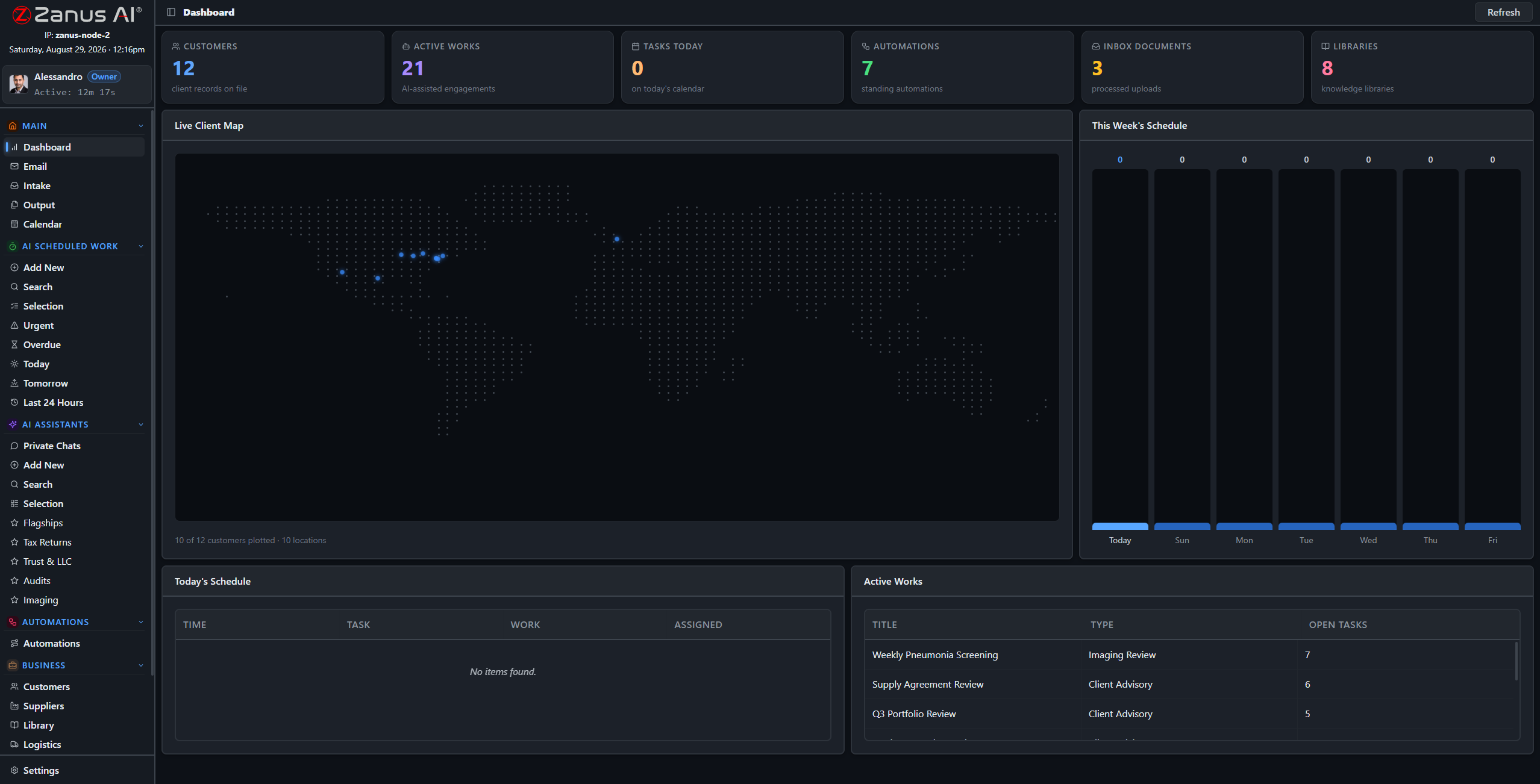
A real deployment view: customer records, scheduled AI works, the week’s releases and follow-ups.
What it does
The 2 AM signup from Singapore gets a grounded answer, a qualification conversation and a booked demo before your team wakes up — 24/7 coverage across time zones, in up to 40 languages.
Website chat and inbound email answered from your product docs and release notes — no source, no claim, no hallucinated features promised to a customer.
Runbooks, postmortems, ADRs and API references become a library the whole team queries — with the source one click away, at 3 PM or mid-incident at 3 AM.
Front office: the customer side, handled
The trial user who waits two days for an answer churns before the demo. The Zanus front office answers signups, support questions, demo requests and RFP inquiries the minute they arrive — grounded in your approved docs, booked into your real calendars.
- Trial signups qualified and answered in minutes
- Demos booked into synced calendars across time zones
- RFP and security-questionnaire inquiries routed and drafted
- See the Front Office for technology →

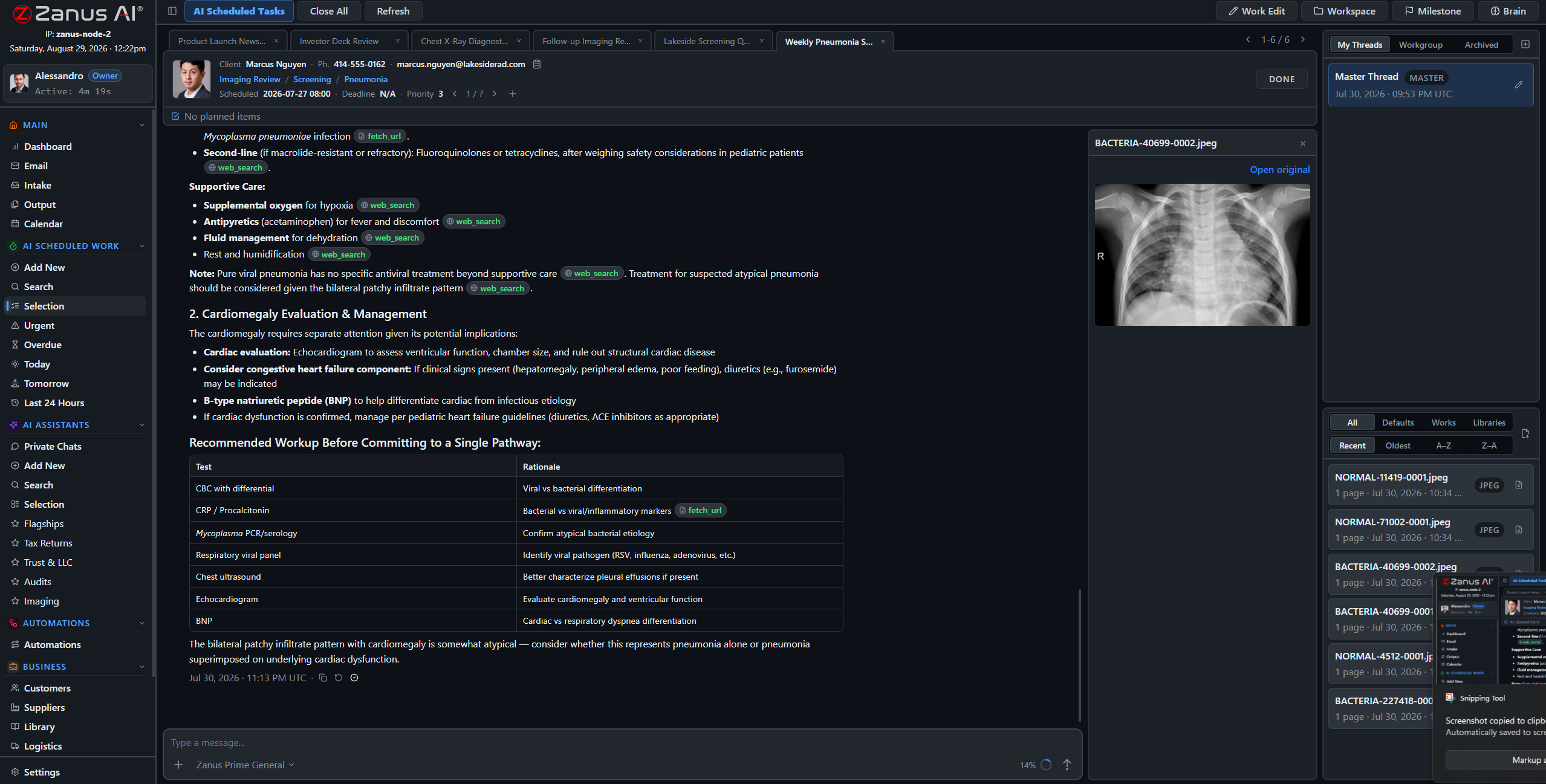
Back office: the engineering side, working
A Monday-morning ticket-trends report, executed by the AI on schedule, every finding cited to the tickets and the postmortems — that is real scheduled work. Product docs, runbooks and eng SOPs become a system that answers back, and roadmap items live in shared projects.
- Scheduled AI work: release-notes drafts, ticket-trend reports
- Verified answers from YOUR docs and postmortems
- Roadmap and OKR tracking in shared projects
- See the Back Office for technology →
For the security-sensitive: your own hardware
Companies serving government, defense or regulated customers — or simply unwilling to let source-adjacent knowledge leave the building — run the identical OS on Zanus hardware inside their walls: air-gap capable, USB updates, your whole team.
- Private On-Premises AI: owned, no recurring fees
- On-Prem Tokens Server for high-volume processing
- Explore the AI Servers →

Questions, answered
Does our data train your models?
No. Your tenant is private and isolated; your docs, tickets and customer records never train outside models — and the on-premises option keeps everything physically inside your building.
We already run a helpdesk and an issue tracker — replace them?
Keep them. They stay the system of record; Zanus becomes the system of work, syncing through API connectors with field mapping and a dry-run preview before anything writes.
We are an MSP with dozens of client environments — does this fit?
Yes: workgroups and field-level permissions keep client knowledge separated, and the same libraries-plus-citations model answers from each client’s runbooks without cross-contamination.
See it working on YOUR company — the demo IS the product.
ZANUS AI FOR TECHNOLOGY COMPANIES — FRONT OFFICE
Answer the trial in minutes, not days.
Speed to lead decides SaaS deals: the signup answered in five minutes converts; the one answered Thursday churns. The Zanus front office answers on your site, your inbox and your phone lines — qualifies, books demos, deflects support — 24/7, in up to 40 languages.
Private tenant or your own server · your whole team · SOC-2-aligned deployment path

Signups, support chats, demo bookings and follow-ups — one dashboard your head of growth can read.
What it does
A developer in another time zone starts a trial at your 2 AM. The AI answers the setup question from your docs, qualifies the account, and books a demo in the prospect’s morning — before your team’s standup.
“Does the API support bulk export?” Answered from your actual documentation with the page cited — not a guess, not a queue. No source in the docs, no claim made.
The inbound RFP or 300-row security questionnaire is recognized, routed to the right owner, and the first-pass answers drafted from your approved knowledge — days of grind cut to a review.
From signup to booked demo, hands-free
A trial user signs up; the AI answers the first product question from your docs, asks the qualifying questions you defined, offers real open slots across your AEs’ calendars and time zones, books the demo and logs the whole conversation — while your team sleeps.
- Real calendar sync across time zones — no double-booking
- Qualification rules you define, applied to every signup
- Interactive AI demos delivered in ~2 minutes
- Hot accounts escalated to a human by your rules


Email and chat, grounded in your docs
Website chat that answers like your best solutions engineer, inbound email answered with citations to docs and release notes, and outbound sequences with approval rules — every conversation logged with a transcript your team can audit.
- Grounded chat on your site, 40 languages
- Inbound email answered from approved knowledge
- Every conversation logged with transcript
- See the full Front Office tour →
Questions, answered
Will it promise features we do not have?
No. The claim guard is architectural: the AI answers only from the docs and knowledge you approved, and cites the source. No source, no claim — it says so and escalates.
Can it handle technical support questions?
It answers what your documentation answers — setup, configuration, API usage — with citations, and routes what needs an engineer into your queue with the context attached.
What about phone?
Yes — the AI answers your lines 24/7 on your menu and voices, in up to 40 languages. For many software companies that is the after-hours and international coverage they never staffed.
See it working on YOUR company — the demo IS the product.
ZANUS AI FOR TECHNOLOGY COMPANIES — BACK OFFICE
The wiki is where knowledge goes to die.
Product docs, release notes, runbooks, postmortems, ADRs: software companies produce enormous knowledge and then cannot find it mid-incident. The Zanus back office turns that archive into a working AI staff — drafting, triaging and answering with sources cited, under your team’s sign-off.
Private tenant or your own server · your whole team · SOC-2-aligned deployment path
A real session: ticket-trends report drafted, sources cited, the engineering lead decides.
What it does
Release-notes drafts from the merged changes you feed it, weekly ticket-trend reports, postmortem summaries — assigned to the AI like to a teammate, executed on schedule, fully auditable.
“What is the failover procedure for the EU cluster?” Answered in seconds with the runbook cited — not a frantic wiki search while the pager screams.
Every AI-drafted release note, report and customer-facing doc lands in Output awaiting review. Nothing ships without your lead’s decision.
Postmortems that actually get re-read
The postmortem from eighteen months ago predicted this incident — but nobody remembered it existed. With postmortems, runbooks and ADRs in cited libraries, the on-call engineer asks and gets the relevant document in seconds, with the exact section quoted.
- Runbooks, postmortems and ADRs answered with citations
- Priority order: current runbook outranks the stale draft
- Answers scoped by role — contractors see only what you allow


Roadmap, OKRs and tickets in one working view
Roadmap items and OKRs live in shared projects and goals — human and AI working the same board. Ticket triage automations tag, route and suggest answers; the weekly status report drafts itself from what actually moved.
- Projects, tasks and goals shared human + AI
- Ticket triage automations with suggested answers
- Weekly status drafted from the real record
Questions, answered
Does it write code?
That is not the job here. It drafts, triages, summarizes and answers from your engineering knowledge — release notes, runbooks, reports — with your engineers making every technical decision.
Does it connect to our issue tracker?
Your tracker stays the system of record; API connectors and webhooks move tickets and updates both ways under your field mapping, with a dry-run preview. Bring your stack to the demo and we map it.
YOU MIGHT ALSO LIKE
The Back Office executes. Who answers the phone?
Front Office AI picks up every call and chat — books, quotes, follows up, 24/7 in 40 languages. Watch it run a business like yours, live.
See it working on YOUR company — the demo IS the product.
ZANUS AI FOR TECHNOLOGY COMPANIES — DOCS & RUNBOOKS
Ask the runbook. It answers.
Product docs, API references, release notes, runbooks, postmortems, architecture decision records — loaded into curated libraries the AI reads from. Ask in plain language; get the answer with the source cited, at the permission level of whoever asks.
Private tenant or your own server · your whole team · SOC-2-aligned deployment path
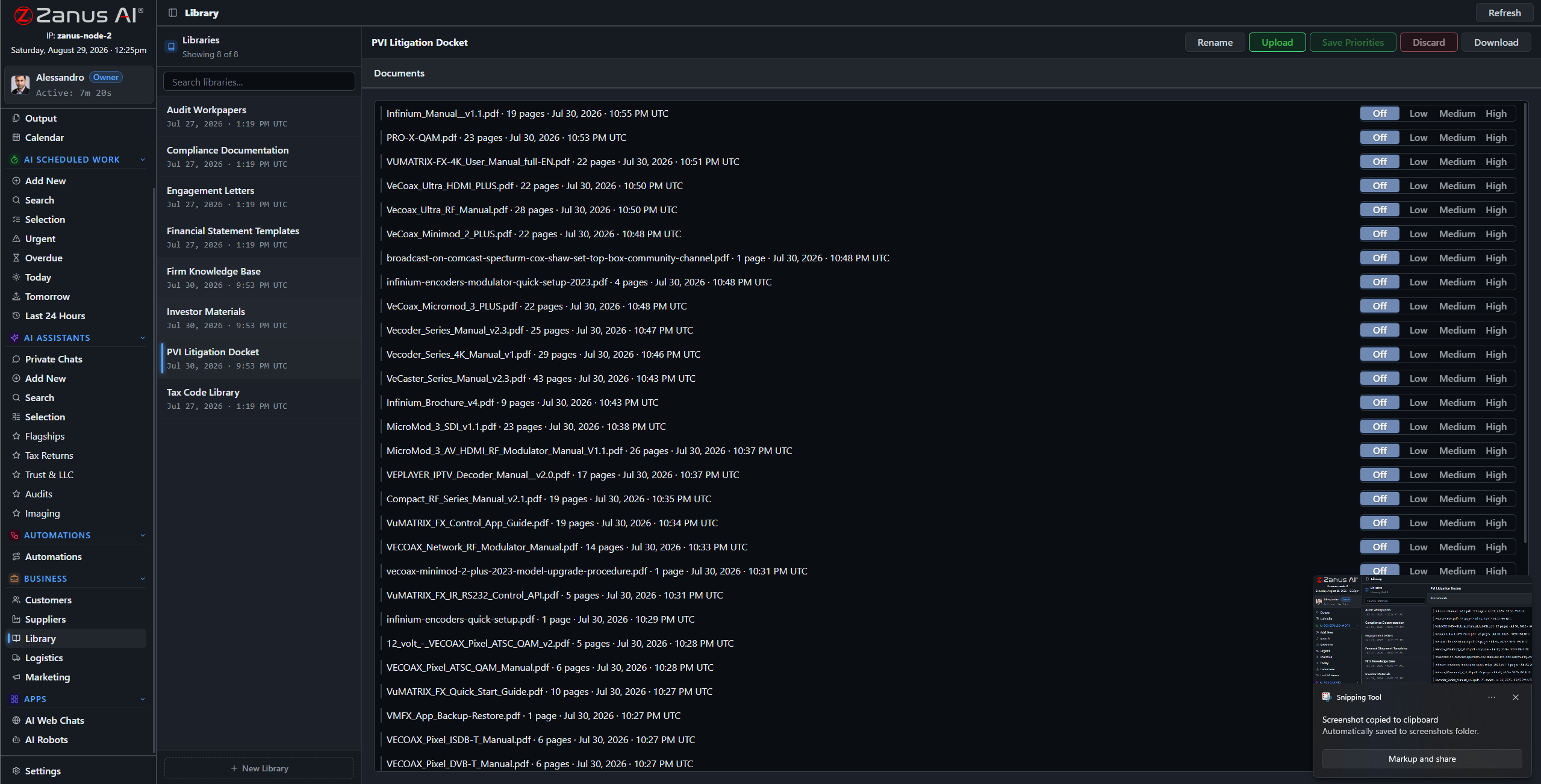
Libraries: the current runbook outranks the stale draft, this release’s notes outrank last quarter’s — you set the order.
What it does
Markdown exports, PDFs, diagrams, screenshots, recorded demos — the ingestion pipeline turns what your teams produce into queryable knowledge.
No source in your library, no claim: the AI cites the doc page, the postmortem, the ADR — or says it cannot answer. The same guard protects customer-facing chat.
The support rep asks about a public API limit; the SRE asks about the internal failover runbook: each gets answers scoped to their role, enforced server-side.
Five years of engineering memory, one question away
“Why did we choose this queue architecture?” “Which versions are affected by the auth regression?” “What did the Q3 postmortem recommend?” The archive answers in seconds with the documents attached — instead of an afternoon spelunking the wiki and pinging departed engineers.
- Plain-language questions across the whole archive
- Sources attached to every answer
- Priority order: current docs and runbooks rule

Questions, answered
Who can see internal engineering docs?
Only roles you authorize. Permissions reach the field level and the server redacts what a user cannot see — a contractor queries the public docs, not the incident history.
Do our documents train outside models?
Never. Your tenant is isolated; your docs, runbooks and postmortems are yours alone — and the on-premises option keeps them physically inside your building.
See it working on YOUR company — the demo IS the product.
ZANUS AI FOR TECHNOLOGY COMPANIES — AI WORKFORCE
The teammate that never falls behind.
Assign work to the AI the way you assign it to staff: type, sources, deadline, priority. Release-notes drafts, weekly ticket-trend reports, security-questionnaire refreshes — executed on schedule, with citations, under review.
Private tenant or your own server · your whole team · SOC-2-aligned deployment path
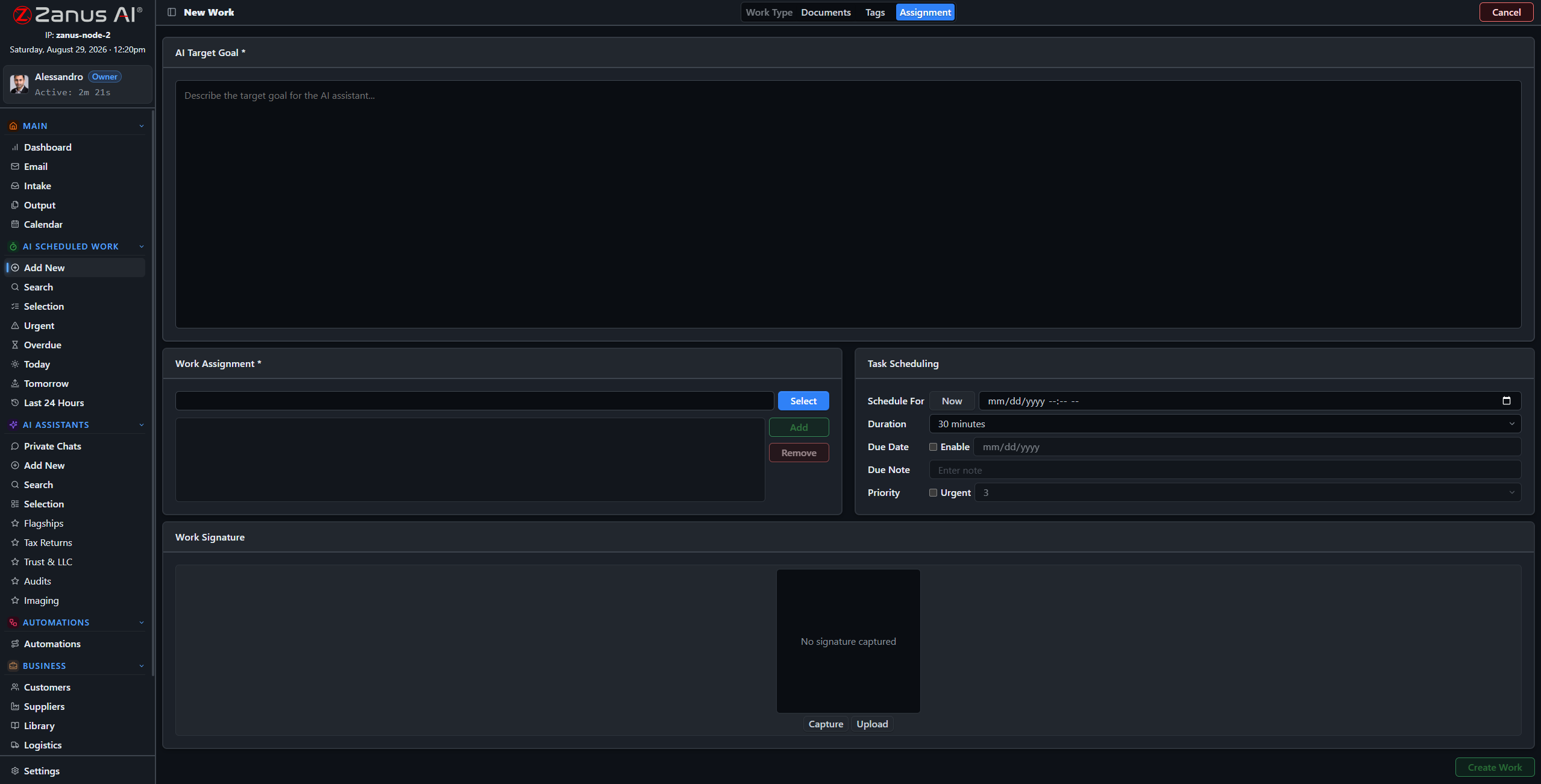
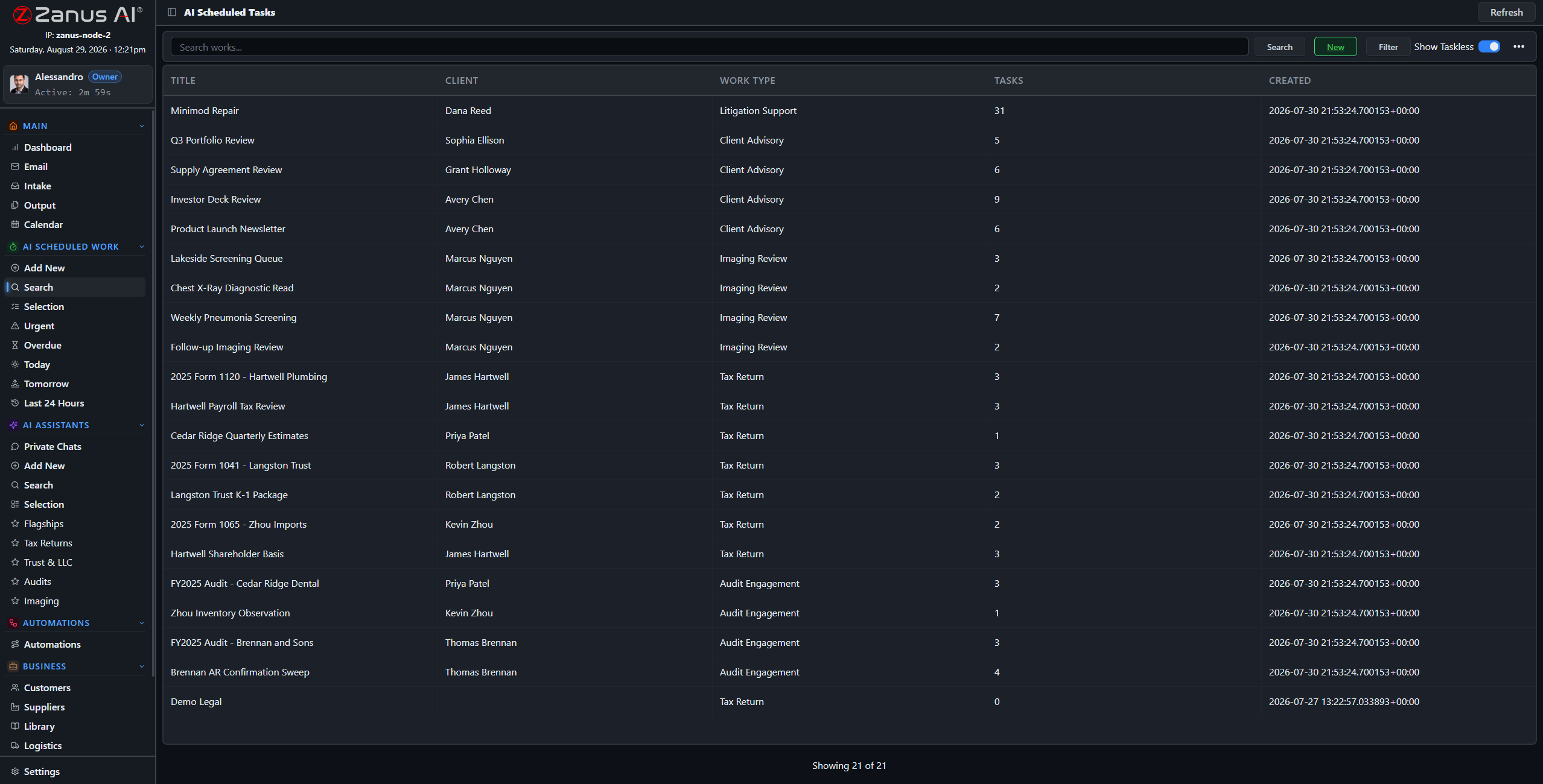
Four steps: work type, sources and libraries, tags, schedule — the AI takes it from there.
What it does
Release-notes draft, ticket-trend report, postmortem summary, questionnaire-answer refresh: work types molded to your company, with default libraries and examples per type.
The AI’s workload is managed like the team’s: one-click views show what is urgent, late, today and tomorrow — the release-day draft never slips silently.
Every work is a full session: reasoning streamed, sources cited, milestones tracked, linked to the project and the calendar.
Monday, 7 AM: the ticket-trends report is done
Set “Weekly Ticket Trends” once: every Monday the AI reads the week’s tickets, clusters the recurring issues, cross-references the known bugs and the postmortems, and files a cited report for the engineering lead — before standup.
- Recurring schedules for periodic engineering work
- Findings cited to tickets and postmortems
- Report in Output, awaiting sign-off
Questions, answered
Can we supervise mid-work?
Yes — open any session, read the reasoning, redirect it, or stop it. The AI works like a teammate: visible, accountable, interruptible.
What volume can it handle?
It does not get tired: the constraint is your review capacity, not the AI’s. Configurations size from a five-person dev shop to a multi-product vendor or an MSP with dozens of clients.
See it working on YOUR company — the demo IS the product.
ZANUS AI FOR TECHNOLOGY COMPANIES — ENG SOPS
The runbook, alive at 3 AM.
Incident-response runbooks, deploy checklists, code-review SOPs, on-call handoff procedures — they only work when the on-call can find them, and the current version at that. In Zanus they are living documents: answerable in chat, attached to work, priority-ordered so the latest version always wins.
Private tenant or your own server · your whole team · SOC-2-aligned deployment path
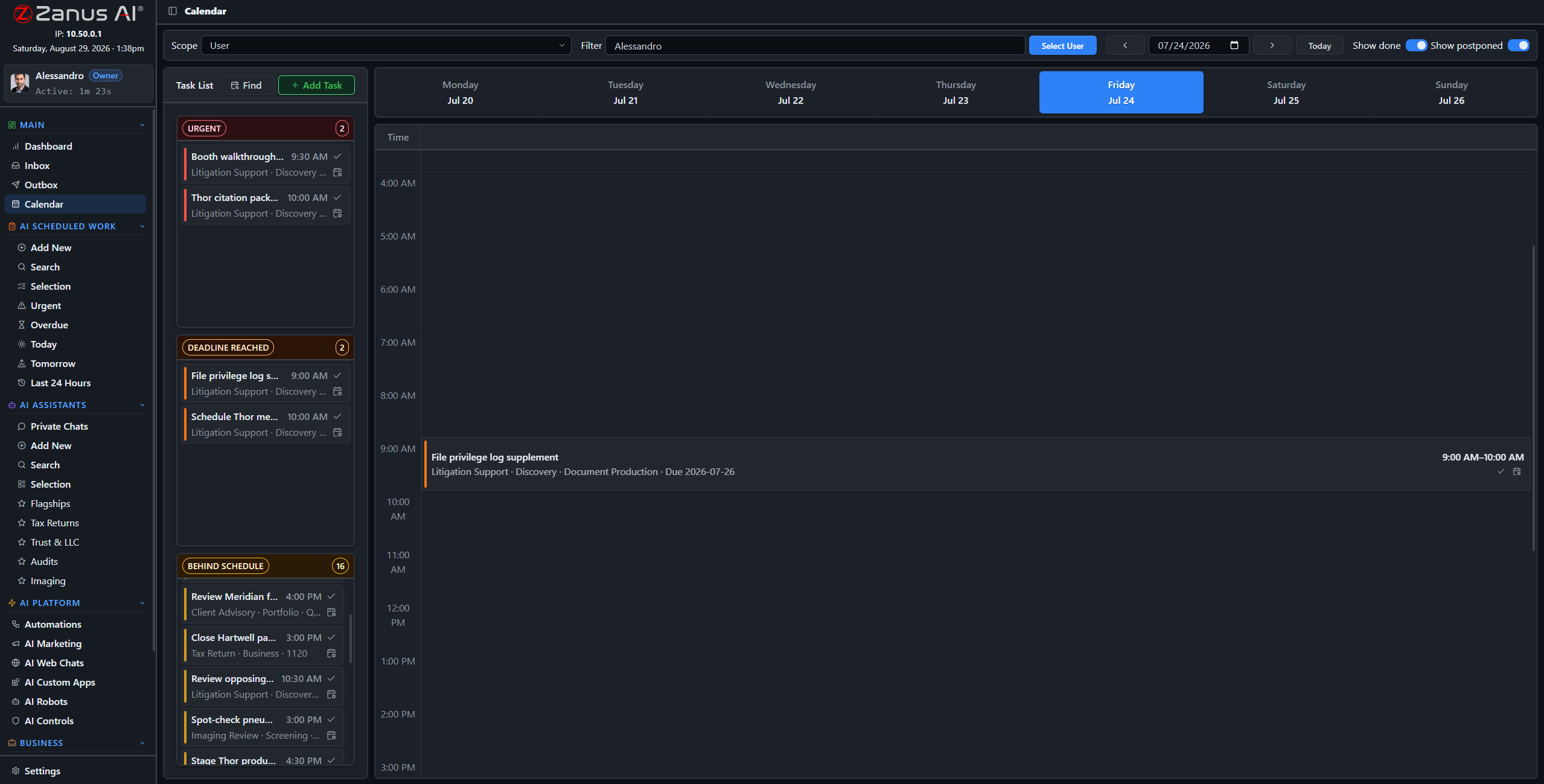
SOP upkeep, scheduled like engineering work: quarterly runbook reviews and staleness checks on the calendar.
What it does
Incident response, deploy and rollback, access provisioning, release sign-off: one library, current versions on top, superseded drafts outranked.
“What is the rollback procedure for the billing service?” — answered in seconds with the runbook attached, during the Tuesday deploy or the 3 AM page.
Work types carry their default SOPs: the AI drafting an incident summary reads from the incident-response runbook — by construction.
Runbook upkeep, scheduled like sprint work
Quarterly runbook reviews, staleness checks against the last quarter’s incidents, SOP-update summaries for the eng all-hands: assign them once as recurring AI work and the runbooks never rot in the wiki again.
- Recurring review works with deadlines
- Update summaries drafted for team briefings
- Every review on the audit record
Questions, answered
How do updates roll out?
Upload the new version, set it on top: from that moment every answer and every AI work cites the new runbook. Old versions remain archived for audit.
See it working on YOUR company — the demo IS the product.
ZANUS AI FOR TECHNOLOGY COMPANIES — TEAM TRAINING
Onboarding without burning a senior’s sprint.
Every new engineer costs a senior engineer’s sprint in interruptions; every new support rep repeats the same fifty questions. New hires learn your systems from the AI, and every teammate has an assistant that answers “how do we…?” instantly, with the source attached.
Private tenant or your own server · your whole team · SOC-2-aligned deployment path

Training lives inside the software: the AI walks each new hire through the company’s own procedures.
What it does
A new engineer learns your architecture decisions, deploy process and coding SOPs through guided training grounded in your own ADRs and runbooks — productive in days, not a quarter.
A new support rep answers like a veteran from week one, because the assistant answers from the same product docs and release notes the veterans wrote.
“How do I get staging access?” — asked to the assistant, answered from the provisioning SOP with the source attached, without breaking a senior’s focus block.

The trainer that never tires of the question
The tenth “how do I run the migration locally?” gets the same patient, sourced answer as the first. Training material stays current automatically, because the assistant reads from the same living libraries as everything else — ship a new release, the answers update.
- Answers cite the current doc or SOP
- Personal preset assistants per role — eng, support, sales
- Training progress visible to managers
Questions, answered
Does training content go stale between releases?
No — the assistant answers from the live libraries. Update the docs with the release and every future answer updates with them.
See it working on YOUR company — the demo IS the product.
ZANUS AI FOR TECHNOLOGY COMPANIES — AUTOMATIONS
The team’s repetitive work, set once.
Describe the job in plain words — “when a support ticket arrives, classify it, route it, and draft a suggested answer from the docs” — and it becomes connected blocks on a canvas, running on its own, with every run visible.
Private tenant or your own server · your whole team · SOC-2-aligned deployment path
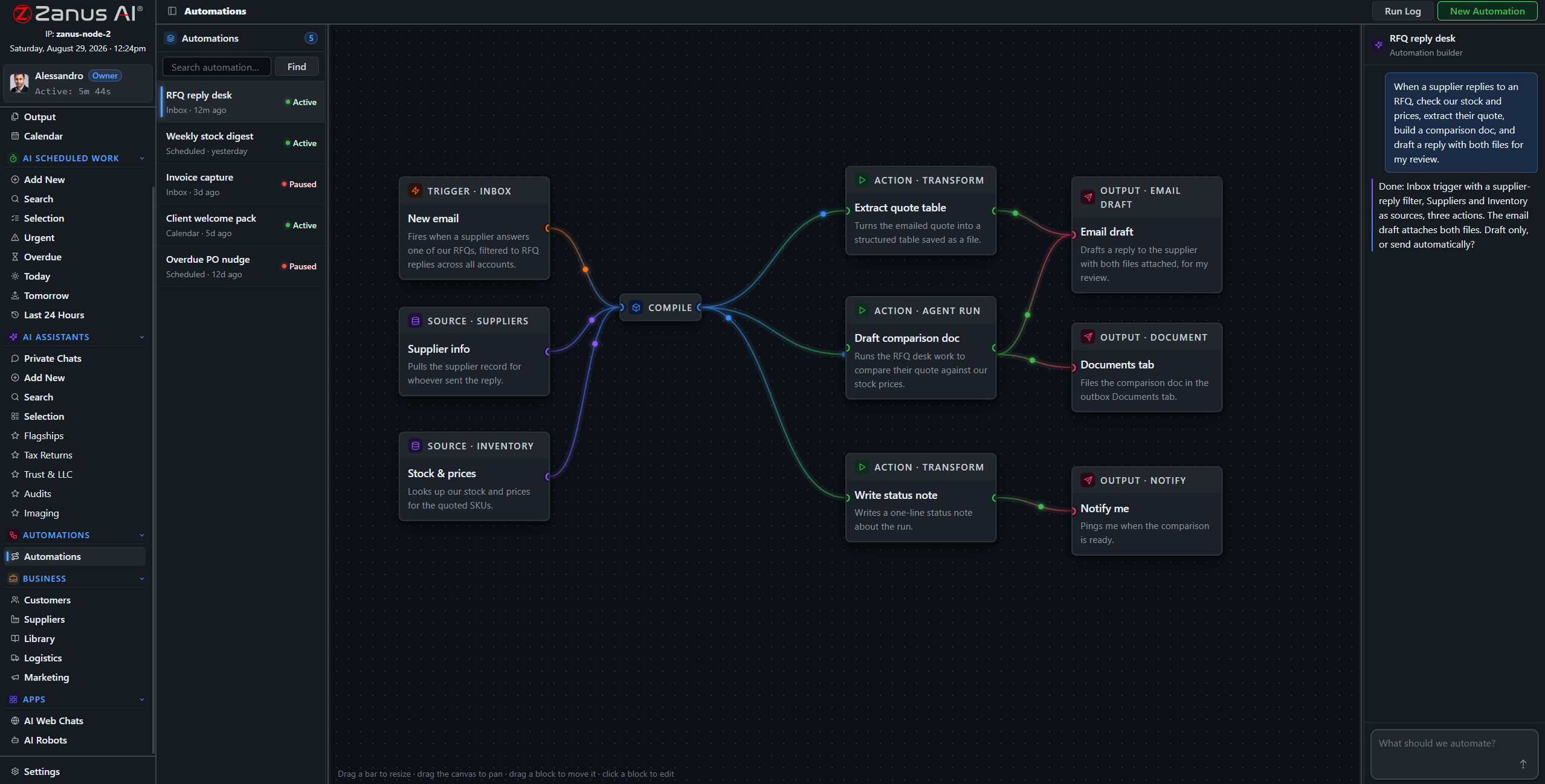
A real flow: inbox trigger, knowledge sources, AI step, three outputs — drawn from a description.
What it does
A ticket arrives → classified against known issues, tagged, routed to the right queue, a suggested answer drafted from the docs with citations — your reps review and send instead of writing from scratch.
A signup lands → the account is created in the CRM through the connector, the qualification questions go out, and the follow-up sequence is drafted for approval — speed to lead without a human in the loop until it matters.
A postmortem is filed → action items are extracted, created as tasks in the right project with owners suggested, and the follow-up review lands on the calendar — lessons that stop evaporating.
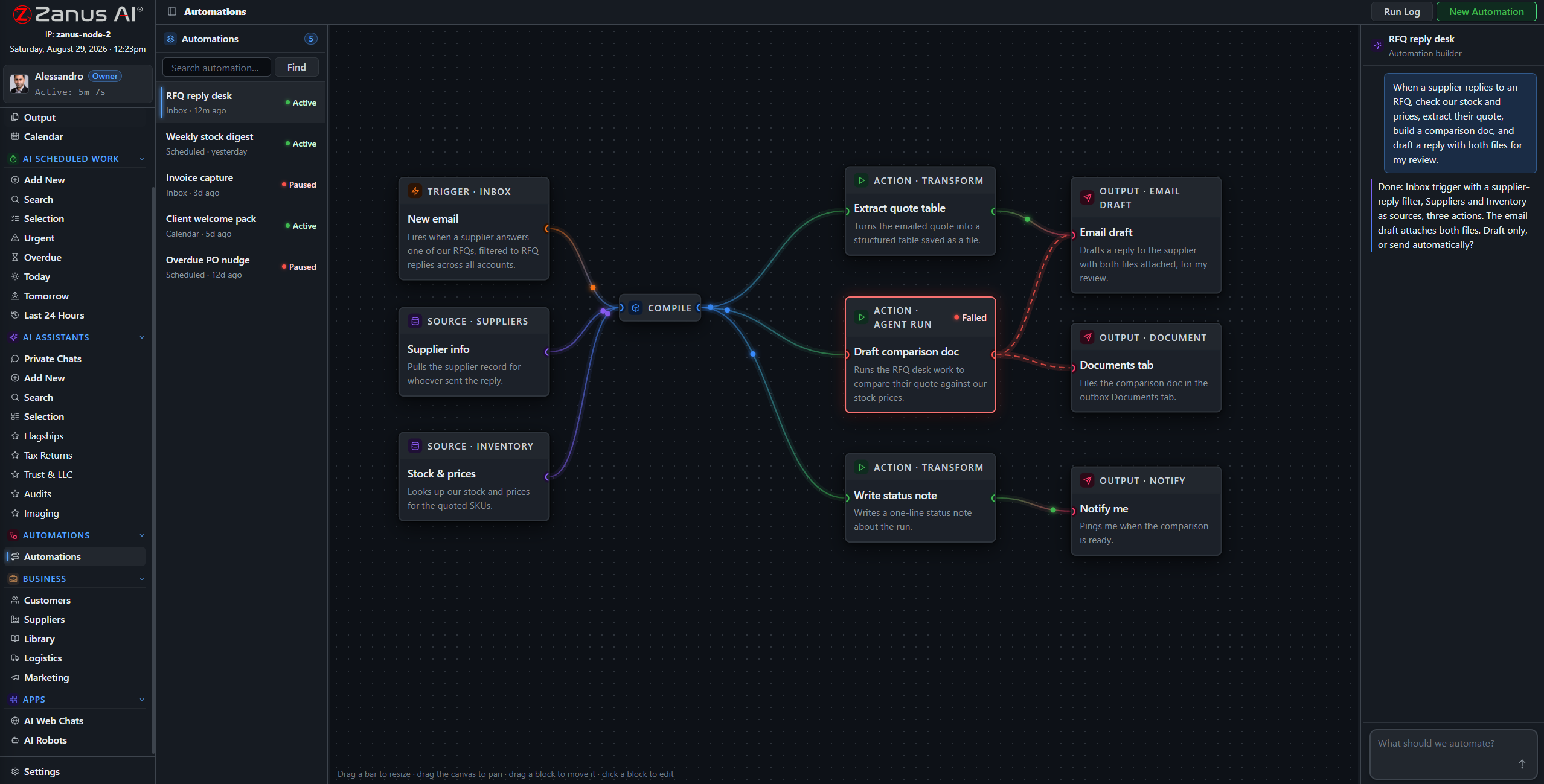
When something fails, you SEE it
Run states live on the flow: green success, red failure on the exact block. An enrichment step that silently died for a week is a pipeline of lost deals — here, nothing fails silently, and retry is one click.
- Run log per automation
- One-click retry on failures
- Finished documents in Output, statused
Questions, answered
Who approves outgoing customer communications?
Your rules: queue everything for human approval, or auto-send only the categories you designate as safe — suggested ticket answers, for instance, can always require a rep’s review.
See it working on YOUR company — the demo IS the product.
ZANUS AI FOR TECHNOLOGY COMPANIES — CUSTOMER OUTREACH
The customer base that renews itself.
Renewal reminders, feature-launch announcements to the accounts that asked for the feature, dormant-trial reactivation, changelog digests — drafted by the AI from your own records, in the customer’s language, queued for your approval. Lifecycle marketing without exporting your customer list to anyone.
Private tenant or your own server · your whole team · SOC-2-aligned deployment path
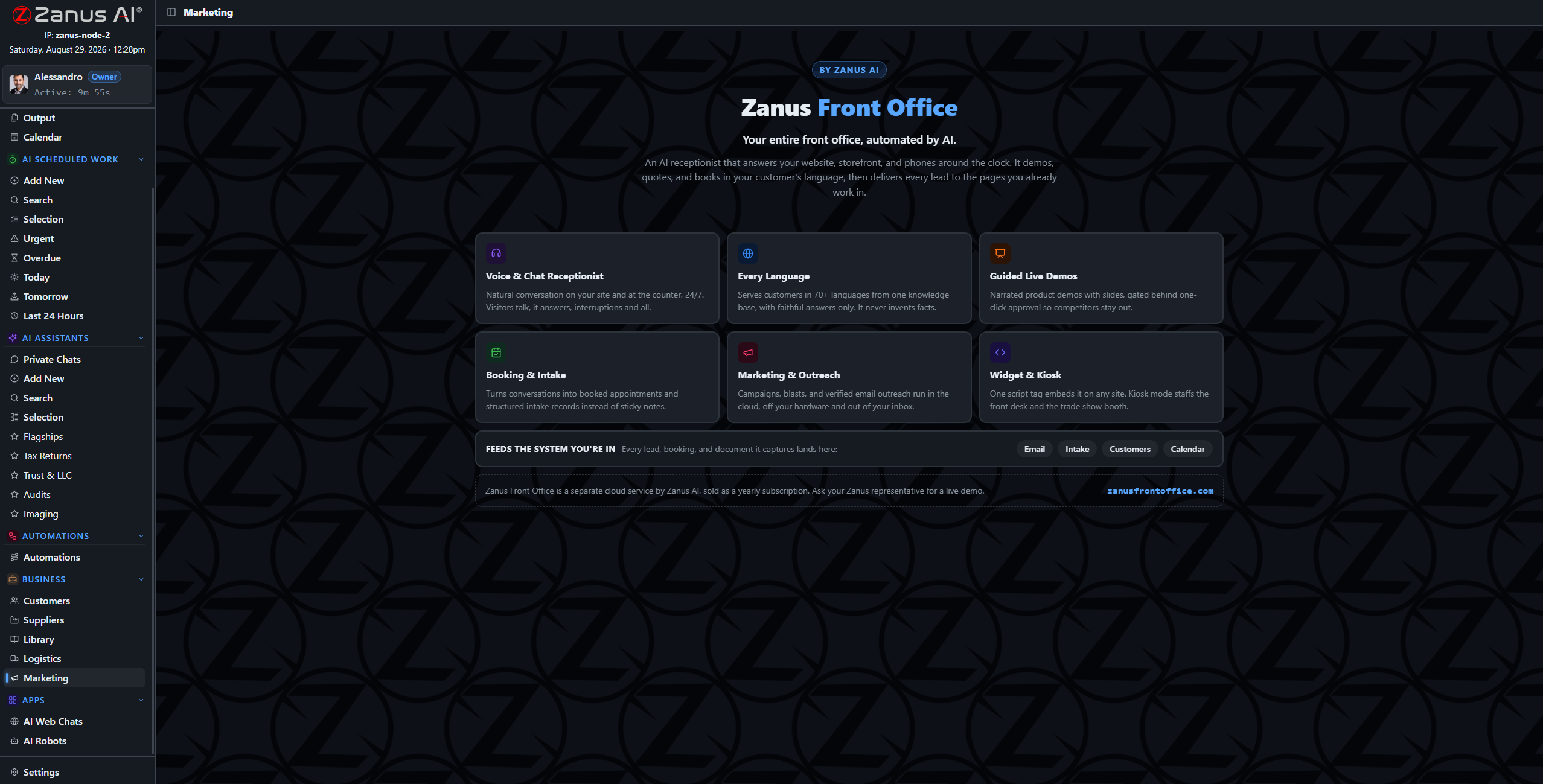
Campaigns and sequences drafted from the records — renewals, launches, reactivation — awaiting approval.
What it does
Renewal inside 90 days, requested-this-feature, trial expired unconverted, dormant 6 months: audiences built from your own customer categories and dates — no list ever leaves your tenant.
Launch notes and renewal reminders written the way customers actually read them — plain, specific, in the customer’s own language, with your company’s voice.
Opt-outs and communication preferences are enforced by the system, not by memory. Every send is on the record.
From the records to the campaign, without export
The audience, the content and the sending all live in the same system as the customer records — nothing leaves your tenant to reach a mailing platform. “Tell every account that requested SSO that it shipped” becomes a drafted, scheduled campaign in minutes.
- Audiences from your own customer data — private by architecture
- Campaigns and sequences drafted for review
- Feature-request lists turned into launch-day sends

Approval first, always
Every outbound customer communication lands in the approval queue unless you designate the category as auto-send. The launch note that reaches ten thousand accounts gets read by a human first — by your rules.
- Approval workflow per communication type
- Full history of what was sent to whom
- Results tracked: replies, reactivations, renewals
Questions, answered
Can it revive expired trials?
Yes — audiences like “trial expired in the last 90 days, never converted” are built from your own records, and the reactivation sequence is drafted for your approval, in the prospect’s language.
Does this replace our marketing platform?
It gives most software companies the lifecycle outreach they never staffed — from the same tenant as the records. Whatever else you run, connectors and the API keep it in sync.
See it working on YOUR company — the demo IS the product.
ZANUS AI FOR TECHNOLOGY COMPANIES — STACK & INTEGRATIONS
Keep your stack. Add the intelligence.
Your helpdesk, issue tracker and CRM stay the systems of record. Zanus becomes the system of work: API connectors sync tickets, accounts and documents both ways, the intake pipeline files what arrives, and AI-drafted output flows back where it belongs. No rip and replace.
Private tenant or your own server · your whole team · SOC-2-aligned deployment path

No rip and replace: the helpdesk, tracker and CRM stay — the AI layer connects to all of them.
What it does
Accounts, contacts and deals mapped field by field — push, pull or two-way, with a dry-run preview before anything writes. Connectors for the leading CRM suites ship built-in.
Tickets flow in for triage and suggested answers; updates, tags and drafted replies flow back — your queue stays your queue, with an AI working it alongside your reps.
A full API for the rest of the stack: build pipelines, monitoring, custom tools — data in, results out, under scoped keys, with webhooks notifying your systems in real time.
One question across all your systems
The account lives in the CRM, the bug in the tracker, the workaround in a postmortem — and the AI reads across all of it. “What is outstanding on this account?” becomes one question with one grounded answer.
- Field mapping with dry-run preview
- Each system stays master of its own records
- Every sync event on the audit record
- External systems appear as blocks on the automation canvas
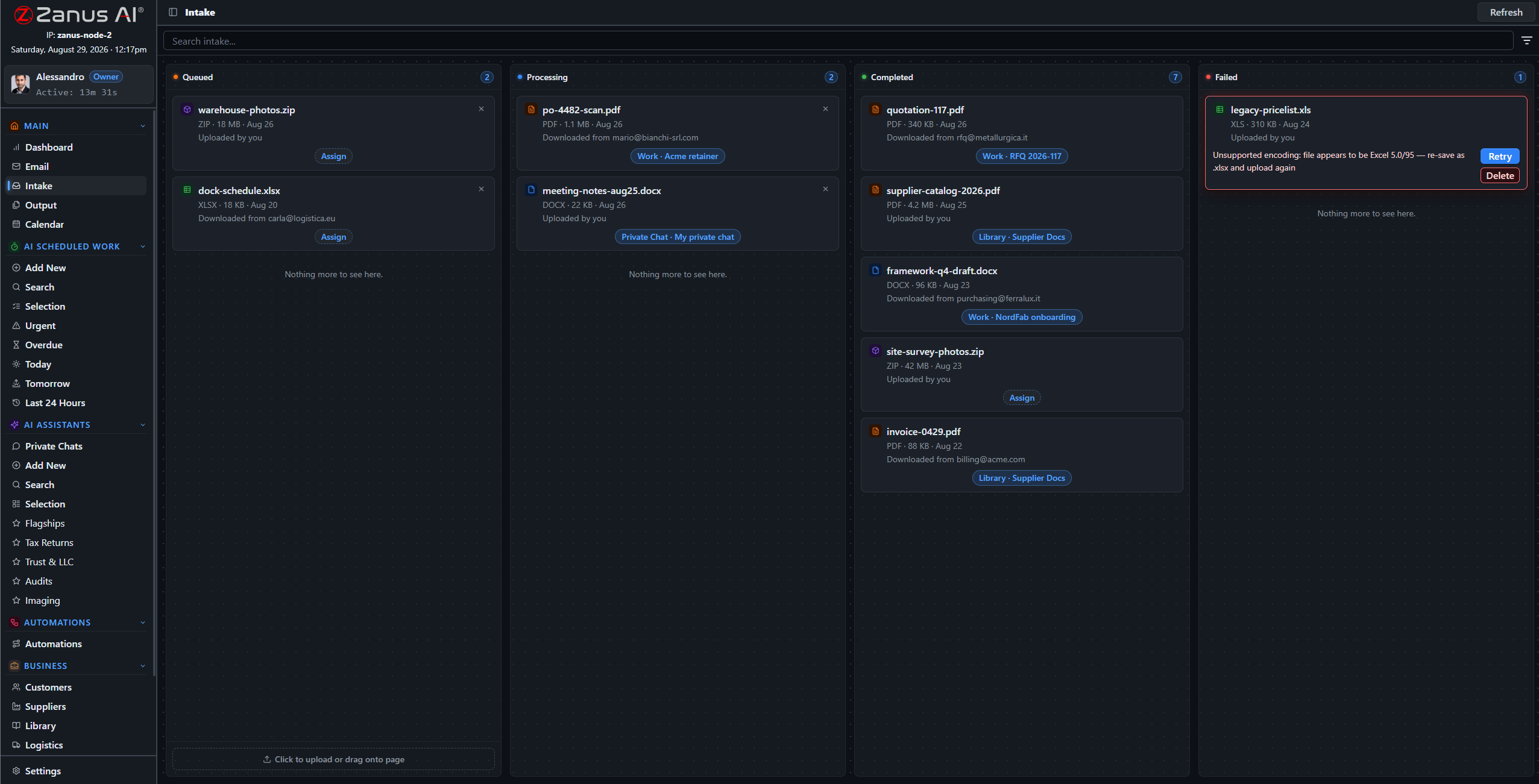
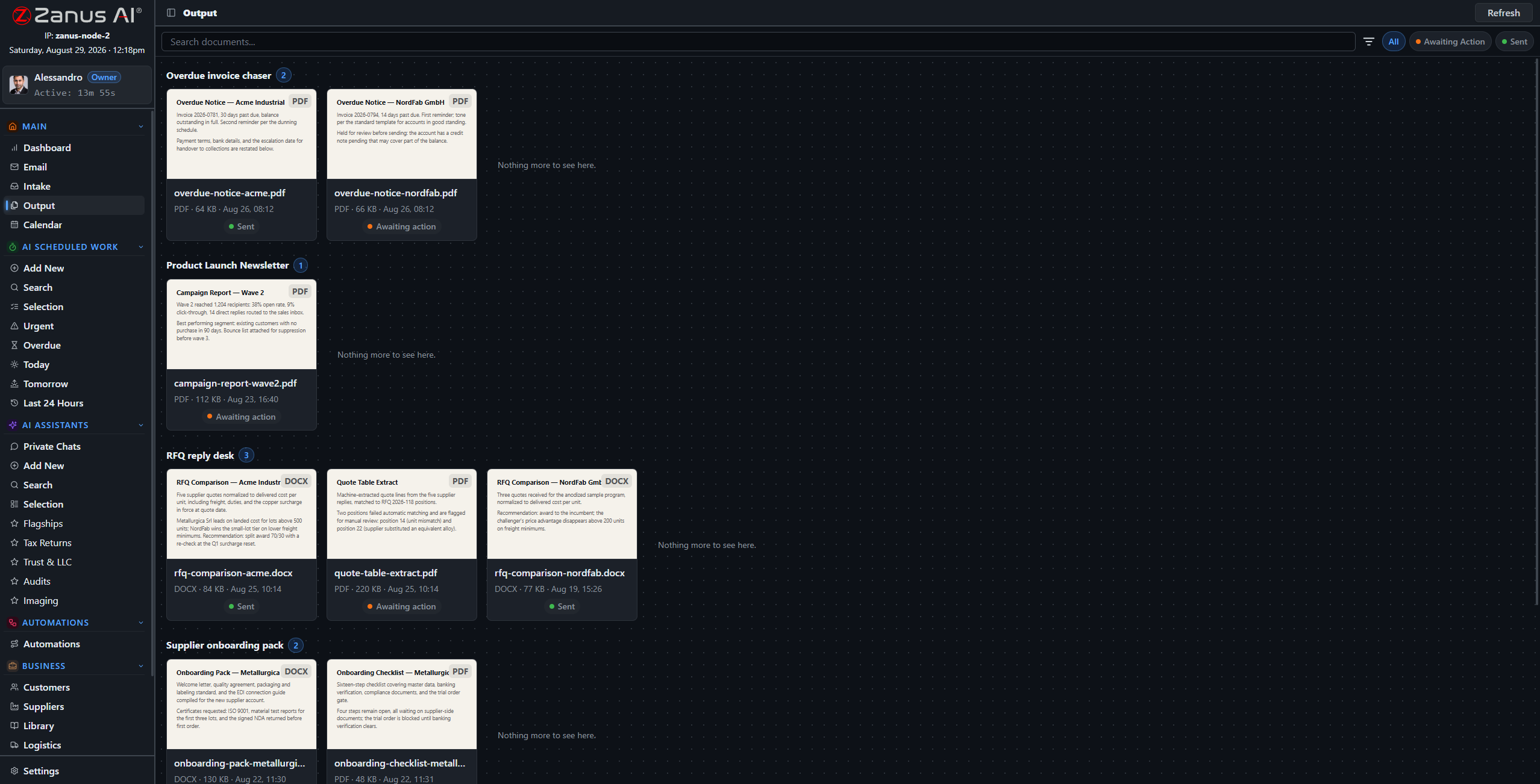
Documents flow back where they belong
The suggested ticket answer, the drafted release note, the questionnaire response: finished output returns to the helpdesk thread, the docs repo export or the CRM record through the same connectors — reviewed and approved by your team first.
- AI output filed to the system of record
- Approval workflow before anything writes back
- Webhooks notify your systems in real time
Questions, answered
Which helpdesks and trackers do you support?
Connectors are mapped per deployment — bring your stack to the demo and we walk through the exact integration path for your tools.
Does customer data pass through third parties?
No. The connectors run inside your tenant — or inside your building on the on-premises option. Data moves directly between your systems.
See it working on YOUR company — the demo IS the product.
ZANUS AI FOR TECHNOLOGY COMPANIES — COMPLIANCE
Built to survive your customer’s security review.
Your buyers send security questionnaires; your engineers guard the incident history; your customers’ data sits in your tickets. The answer is architecture: a SOC-2-aligned deployment path, an isolated private tenant where nothing trains outside models, permissions to the field level, a searchable audit trail — and an air-gap option for the truly security-sensitive.
Private tenant or your own server · your whole team · SOC-2-aligned deployment path
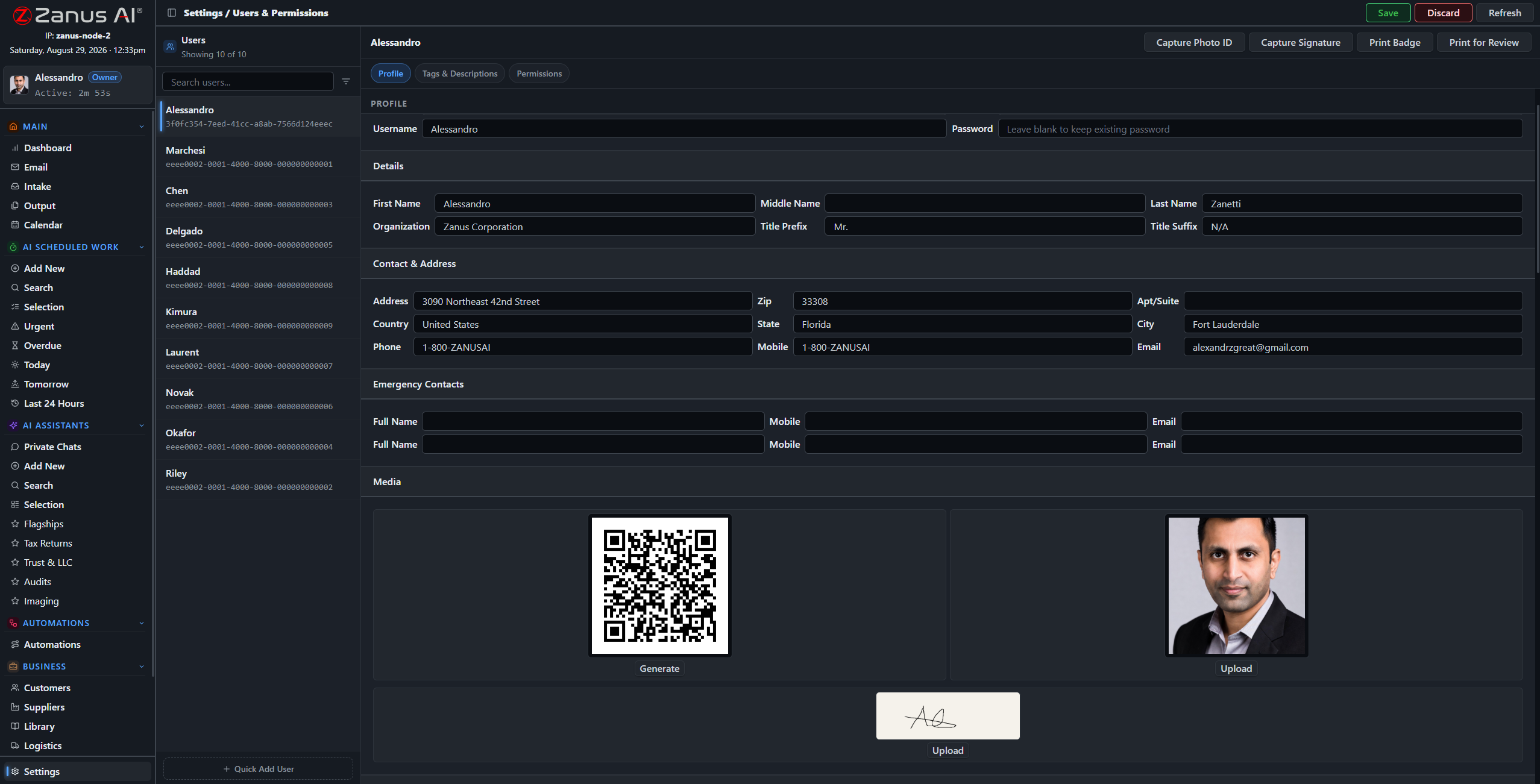
One record per user: role, tags, and granular permissions over every domain of the system.
What it does
Your tenant is private and isolated: docs, tickets and customer records never train outside models. What your customers trusted you with stays inside your walls — architecturally.
The server redacts what a role cannot see — a contractor working the public docs never touches the incident history or a customer’s ticket data. Five-level workgroups map teams and clients.
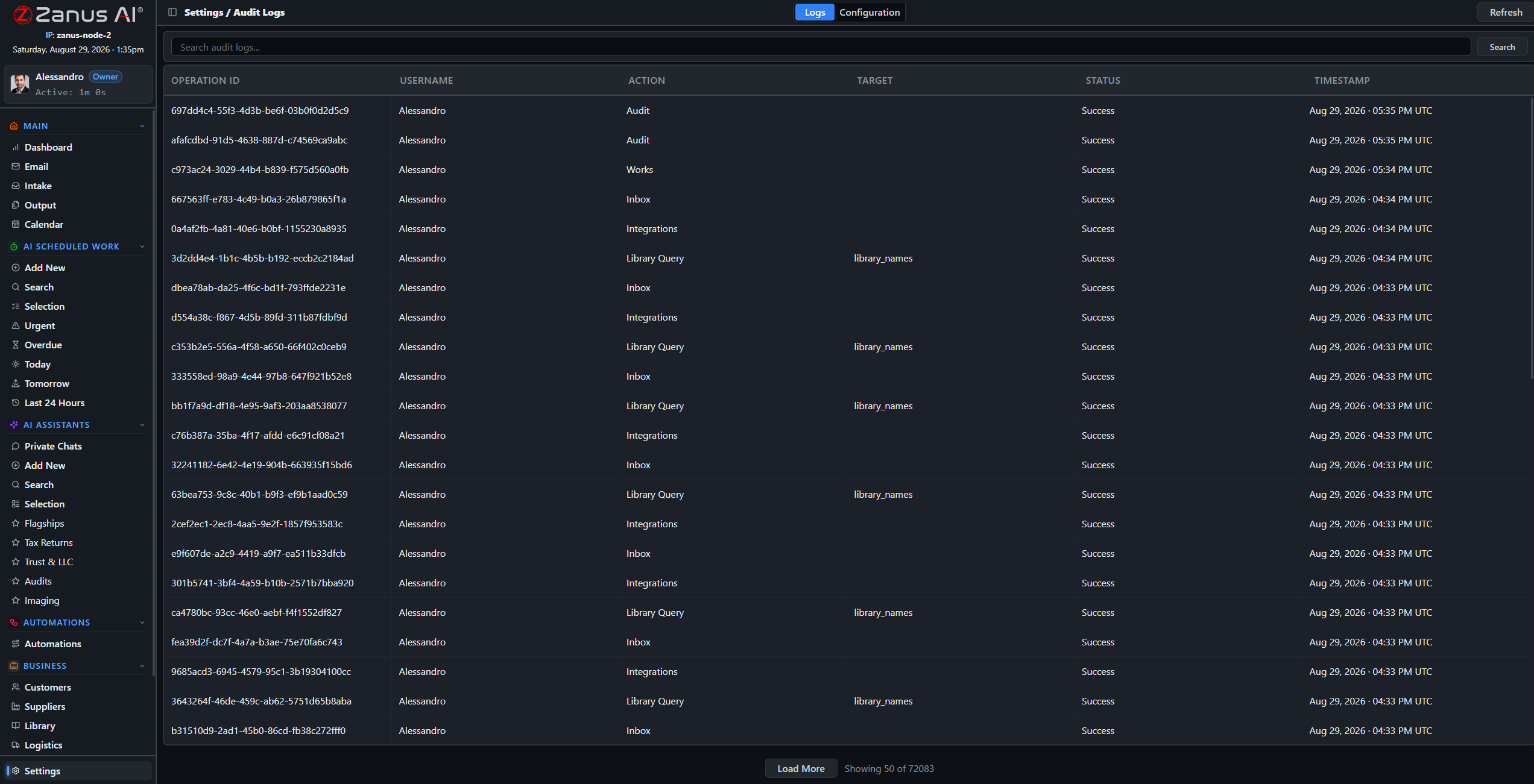
A searchable log of every audited action, with configurable categories: who saw what, who changed what, when — the evidence your next security review will ask for.
The security review that takes minutes, not weeks
When the enterprise prospect’s security team asks — or your own auditor does — the answer is a search away: access records, document trails, update history, pre-update snapshots with rollback. And for defense, government or source-adjacent work, the identical OS runs air-gapped on hardware you own, updated by USB.
- Searchable audit trail
- Automatic pre-update snapshots with rollback
- Air-gap capable on-premises option, USB updates
Questions, answered
Are you SOC 2 certified?
We offer a SOC-2-aligned deployment path — isolation, access control, auditability — and review the specifics against your framework during onboarding. Bring your security lead to the demo.
Can our deployment be fully offline?
Yes — the Private On-Premises AI runs air-gapped on hardware you own, updated by USB, with your whole team and no recurring fees. Nothing touches the internet.
See it working on YOUR company — the demo IS the product.
ZANUS AI FOR TECHNOLOGY COMPANIES — LIVE DEMO
Do not watch a video.
Talk to your AI.
Software vendors show demos as videos behind a form — you know, because you probably do it too. Ours is the product itself, configured for technology companies: open the chat below-right and try it — ask a trial question, an API question, or how it would triage a ticket.
The conversation you have with us IS the demo
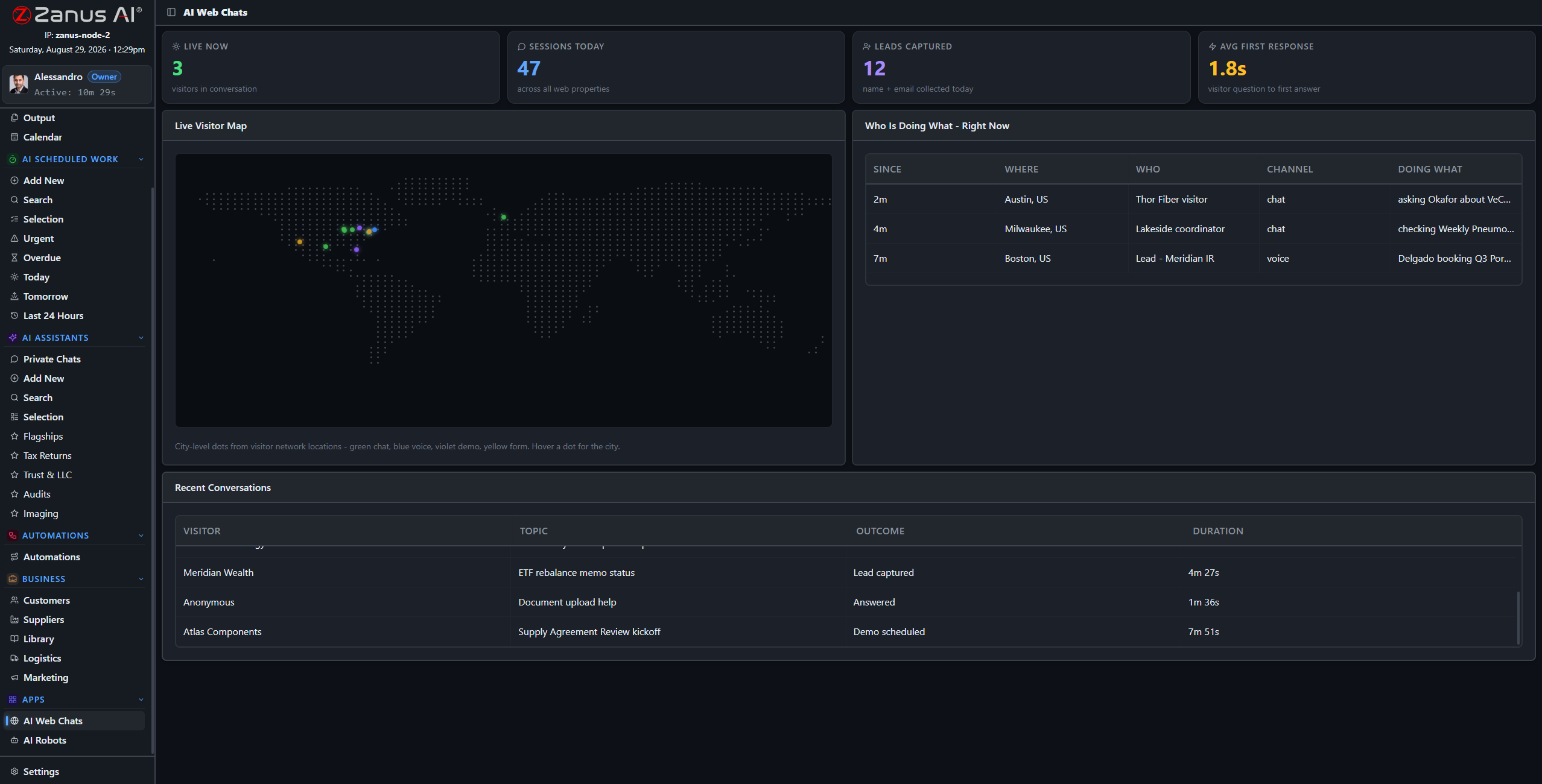
This screen is watching demos like yours happen: live conversations, outcomes, first response in seconds.
What it does
Ask the chat: “I want to trial this for my support team” — watch it qualify, answer from the docs with citations, and book the follow-up like your best SDR at 2 AM.
Ask: “how would you triage an incoming bug ticket?” — it walks the workflow it would run in your tenant, grounded, cited, sign-off included.
The full demo loads a technology tenant with sample records: ticket triage, release-notes drafting, runbook answers — your company’s world, working.
Or pick your exact business
Every link below is a full live-demo page for that specific business — its vocabulary, its calls, its booking rules.
Two minutes to your inbox
Request the demo and the interactive technology demo arrives in about two minutes — no sales call, no calendar dance. Watch it, interrupt it with questions, and book the human conversation when YOU are ready.
- Interactive demo, technology-configured
- Ask questions mid-demo — it answers and resumes
- In your inbox in ~2 minutes, free

Questions, answered
Is the demo really the product?
Yes — the same AI, configured with a sample technology tenant. What you see is what your team gets, with your docs, runbooks and customer records instead of the samples.
See it working on YOUR company — the demo IS the product.
Sharing with a colleague? 📄 Get the PDF · ✉️ Email this page ·