ZANUS AI FOR LAW FIRMS — OVERVIEW
Bill the judgment.
Delegate the drudgery.
Intake calls answered at 9 PM when the prospective client actually calls. Motions, engagement letters and deposition digests drafted from your own files and precedents, cited, waiting for attorney review. One AI system for the client-facing desk and the practice behind it — in YOUR isolated tenant, or on hardware the firm owns.
Private tenant or your own server · your whole team · privilege-conscious architecture
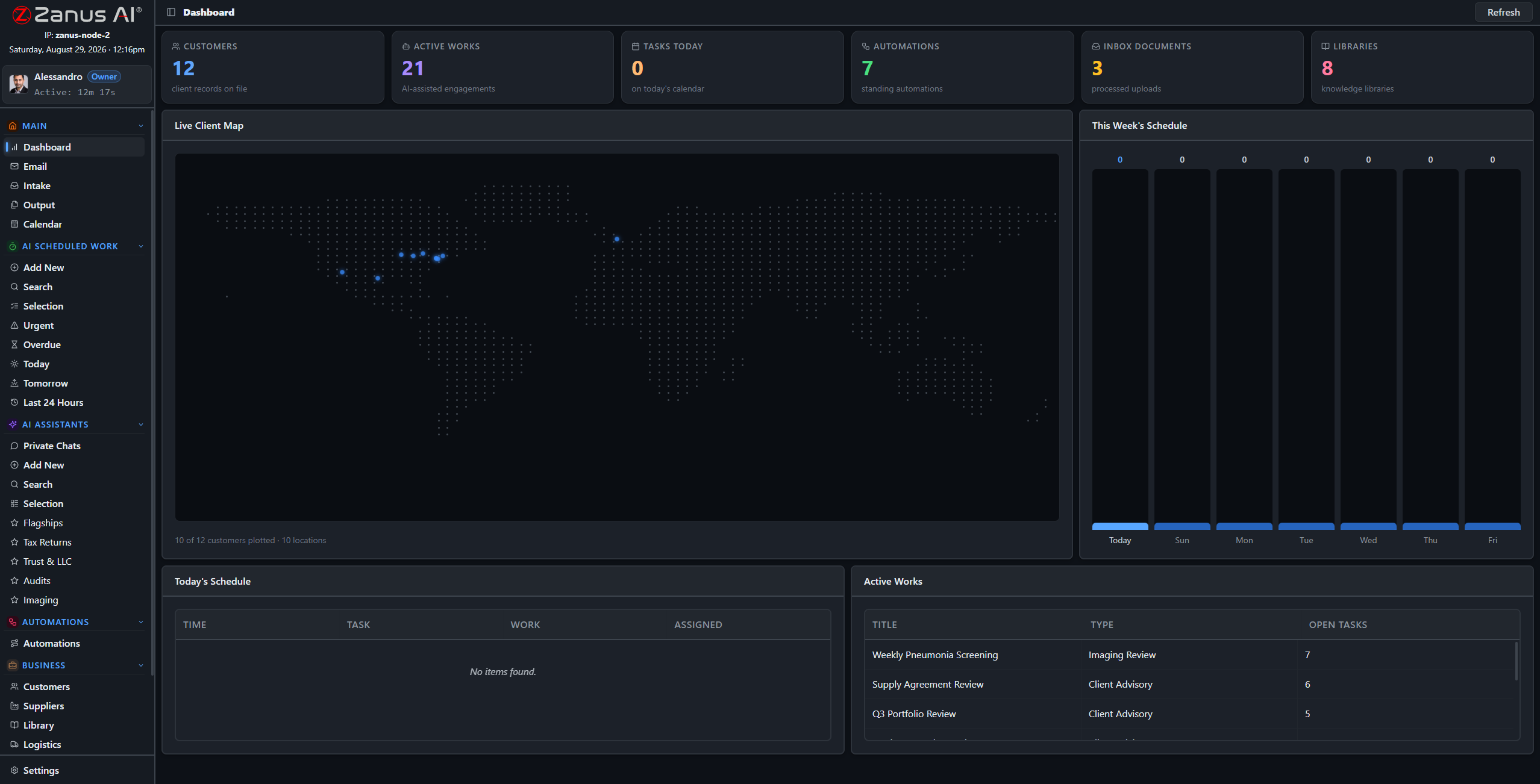
A real deployment view: matters, scheduled AI works, drafts awaiting attorney sign-off.
What it does
Prospective clients call after the arrest, after the accident, after the letter arrives — rarely at 10 AM. The AI answers 24/7, qualifies by your criteria, books the consultation and files the intake notes.
Motions, briefs, engagement letters and demand letters drafted in the firm’s own style from the firm’s own precedent bank — reviewed, edited and signed by the attorney, always.
Matter-level access walls, field-level permissions, server-side redaction, a searchable audit trail — and nothing in your tenant ever trains anyone else’s model.
Front office: the client side, covered
A missed intake call is a retained competitor. The Zanus front office answers every ring on your menu, screens by your practice-area criteria, books consultations into real attorney calendars, and gives existing clients the status update they called for — without pulling a paralegal off a filing deadline.
- AI phone on your menu and voices, 24/7, 40 languages
- Intake screening by YOUR criteria, notes filed to the matter
- Consultations booked into synced attorney calendars
- See the Front Office for law firms →

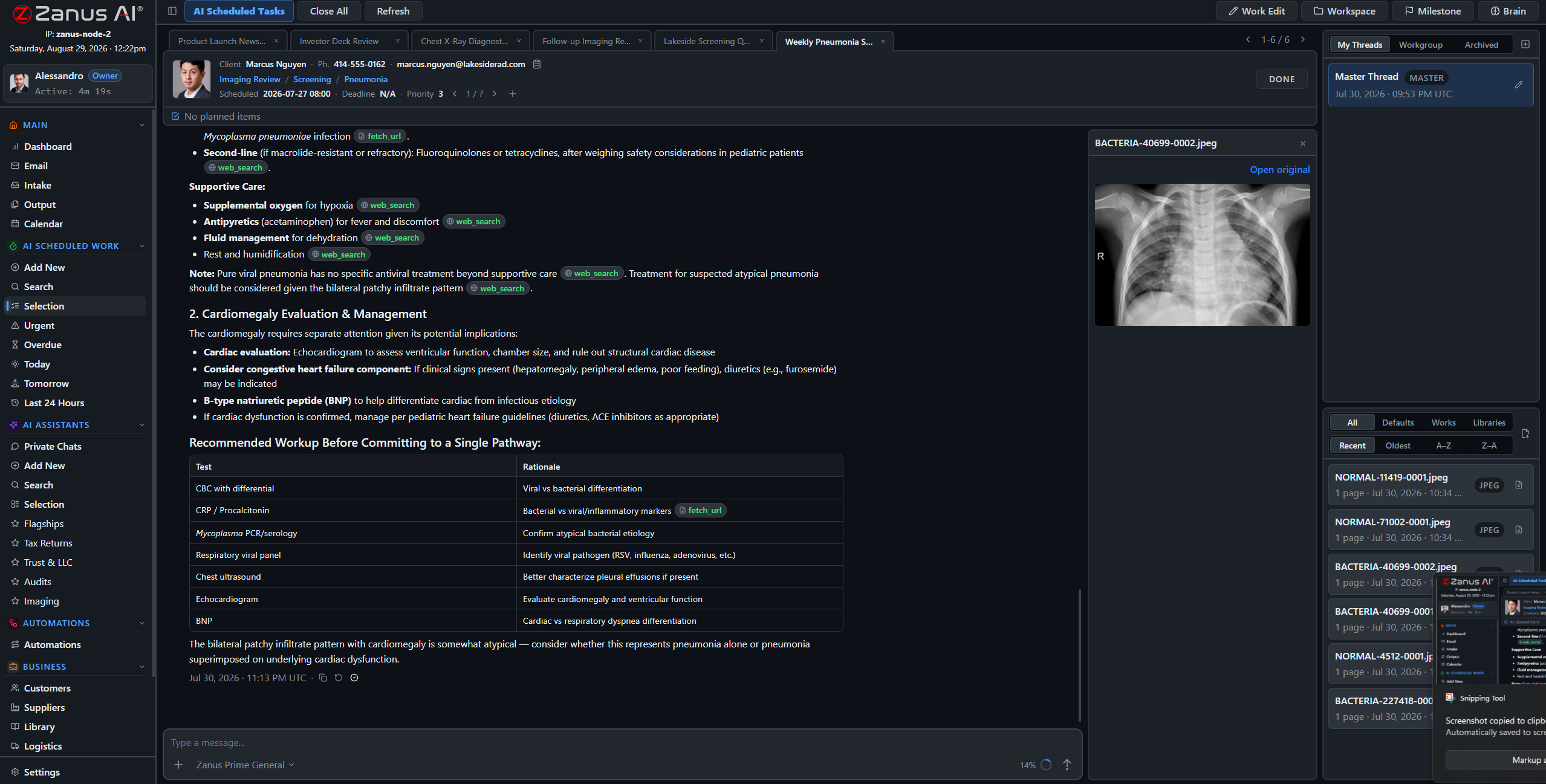
Back office: the practice, working
A deposition digested overnight with page-line citations, a motion shell drafted from the winning brief in a similar matter, a Friday docket summary filed before the partner’s coffee — that is the Zanus back office. The firm’s files become a staff that drafts and answers back.
- Scheduled AI work: digests, drafts, docket summaries
- Verified answers cited to YOUR files and precedents
- Every draft waits in Output for attorney review
- See the Back Office for law firms →
When the files cannot leave the firm
Some clients, some matters and some jurisdictions demand more than a private tenant. The identical OS runs on Zanus hardware inside your office: air-gap capable, USB updates, your whole team — client files physically incapable of leaving.
- Private On-Premises AI: owned, no recurring fees
- On-Prem Tokens Server for high-volume document work
- Explore the AI Servers →

Questions, answered
Is this the AI practicing law?
No. The AI drafts, digests, organizes and cites from the firm’s own files. Every document waits for attorney review and signature; every legal judgment is the lawyer’s. It is a tireless paralegal, not a practitioner.
How is privileged material protected?
Matter-level workgroups, permissions to the field level, server-side redaction and a searchable audit trail — plus an isolated tenant that never trains outside models, and a fully on-premises option. Bring your ethics counsel to the demo.
We are a 12-lawyer firm — is this enterprise-only?
No. one price per company, your whole team: the paralegal, the bookkeeper and every associate get full access without a per-seat bill. Firms go live in days to weeks.
See it working on YOUR firm — the demo IS the product.
ZANUS AI FOR LAW FIRMS — FRONT OFFICE
Every intake call answered. Every consultation booked.
People call lawyers at the worst moments of their lives — nights, weekends, from the courthouse steps. The Zanus front office answers on your menu, in your voices, screens by your practice-area criteria, books, and files the notes to the matter — 24/7, in up to 40 languages.
Private tenant or your own server · your whole team · privilege-conscious architecture

Calls, chats, consultations and follow-ups — one dashboard the office manager can actually read.
What it does
Call your own firm on a Saturday. Voicemail? The AI answers in one ring, screens the matter, books Monday’s consultation and emails the intake summary — before your competitor’s phone even rings.
“Any news on my case?” consumes hours of paralegal time. The AI answers from the matter record what you authorize it to share — and escalates anything beyond that to the team.
Practice area, jurisdiction, statute-of-limitations red flags, conflict-check basics: captured on the first call by YOUR intake criteria, filed before a human ever picks up.
From first call to booked consultation, hands-free
A prospective personal-injury client calls at 8 PM; the AI answers, runs your screening questions, checks the intake attorney’s real calendar, books the consultation and sends the retainer paperwork checklist — while the office is dark.
- Real calendar sync — no double-booked consultations
- Intake questionnaires completed before the meeting
- Fee and engagement questions answered from your approved rules
- Legal advice never improvised — escalation by your rules


The web and the inbox work too
Website chat that answers like your best intake coordinator, web forms worked in minutes instead of days, inbound email triaged and drafted for reply — every conversation transcribed and attached to the contact.
- Grounded website chat, 40 languages, no invented answers
- Web form inquiries answered in minutes, not Monday
- Every conversation logged with a transcript
- See the full Front Office tour →
Questions, answered
Does the AI give legal advice to callers?
No. It screens, schedules, informs and files — using only your approved information. Anything resembling a legal question is escalated to the team by your routing rules.
Can it check conflicts during intake?
It captures the parties and runs them against your records so the team sees potential conflicts flagged at intake — the conflicts decision itself stays with the firm.
Do we keep our numbers and our receptionist?
Yes and yes. Your numbers stay; calls route AI-first after hours, receptionist-first at noon, or any mix per line and per hour.
See it working on YOUR firm — the demo IS the product.
ZANUS AI FOR LAW FIRMS — BACK OFFICE
The associate’s evening, returned.
Deposition digests, motion shells, discovery summaries, engagement letters, demand packages: the work that eats billable evenings. The Zanus back office drafts it from the firm’s own files, with page-line citations — and every draft waits for the attorney’s red pen.
Private tenant or your own server · your whole team · privilege-conscious architecture
A real session: 240-page deposition digested — key admissions extracted, page-line cites attached, attorney decides.
What it does
A 240-page deposition becomes a themed digest overnight: admissions, contradictions and exhibits referenced by page and line — ready for the motion, verifiable in seconds.
The motion to compel starts from YOUR winning motion to compel: the AI drafts in the firm’s voice from the firm’s precedents, not from generic boilerplate.
Every draft lands in Output awaiting review. Nothing files, nothing sends, nothing leaves without an attorney’s decision — structurally.
The discovery mountain, mapped
Ten thousand produced documents, one question: “which emails discuss the indemnification clause?” The AI reads the production, answers with the documents attached, and drafts the summary memo — the associate reviews instead of excavating.
- Plain-language questions across productions and files
- Answers cited to the specific document and page
- Summary memos drafted for attorney review


Engagement letters, demand packages, client memos — drafted
The documents that stall on everyone’s desk: engagement letters from your templates with the matter terms filled, demand packages with the record excerpts attached, plain-language client memos explaining the ruling. Drafted in minutes, in the firm’s letterhead.
- Your templates, your letterhead, your voice
- Record excerpts and exhibits attached automatically
- Approval workflow before anything reaches a client
Questions, answered
Will it cite cases that do not exist?
It answers from YOUR libraries with the claim guard on: no source in the firm’s files, no claim — it says so rather than inventing. It drafts from your verified materials; external legal research remains the attorney’s domain and tools.
Can billing narratives be drafted too?
Yes — time-entry narratives and monthly billing summaries can be drafted from the work record for the billing partner’s review, in the firm’s conventions.
YOU MIGHT ALSO LIKE
The Back Office executes. Who answers the phone?
Front Office AI picks up every call and chat — books, quotes, follows up, 24/7 in 40 languages. Watch it run a business like yours, live.
See it working on YOUR firm — the demo IS the product.
ZANUS AI FOR LAW FIRMS — CASE FILES
Ask the file. It answers, cited.
Pleadings, discovery, deposition transcripts, contracts, the firm’s precedent bank — loaded into curated libraries the AI reads from. Ask in plain language; get the answer with the document and page attached, scoped to who is allowed to ask.
Private tenant or your own server · your whole team · privilege-conscious architecture
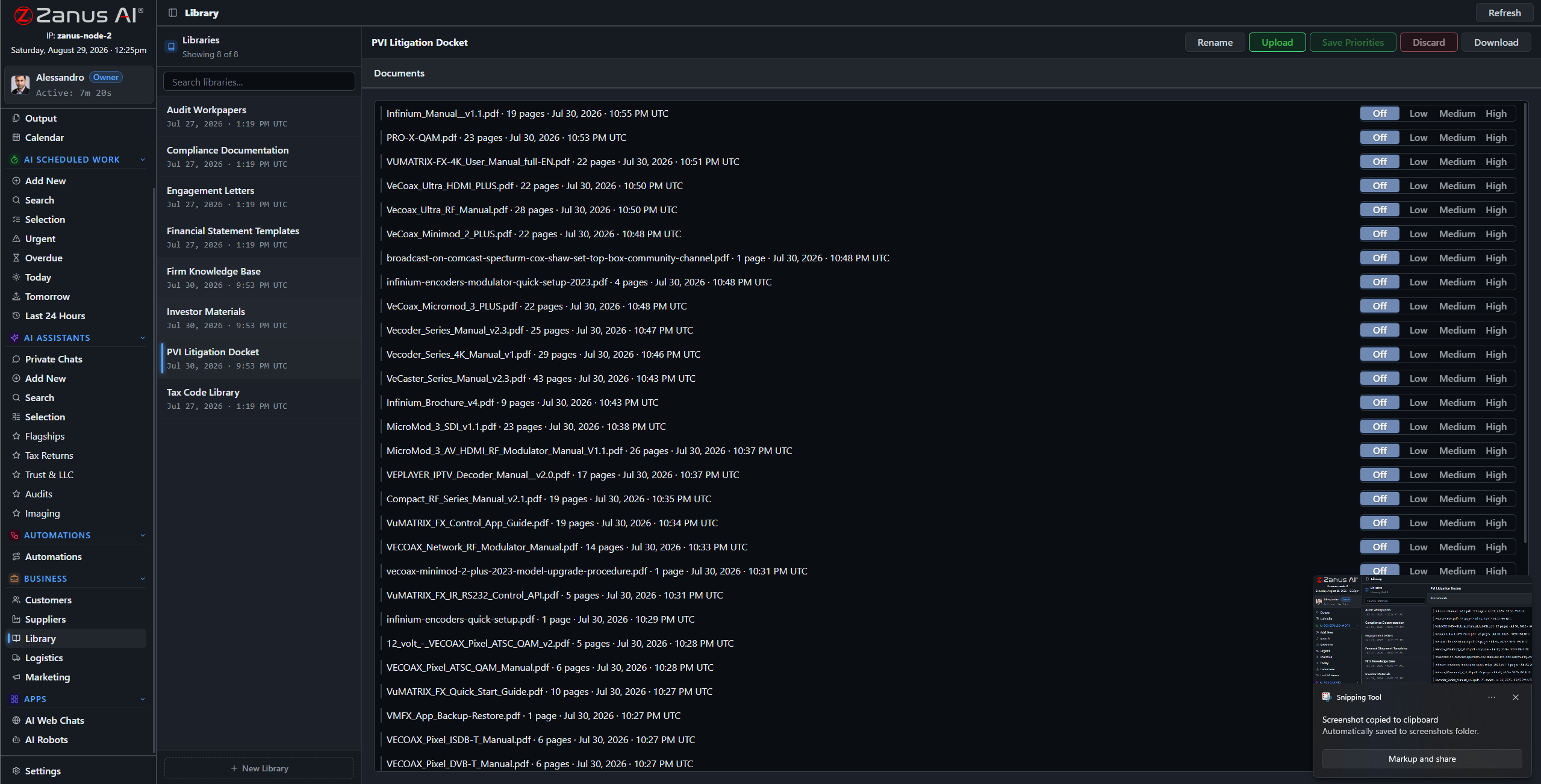
Libraries in priority order: executed agreements outrank drafts, current precedents outrank superseded ones.
What it does
PDFs, Word, scanned exhibits, faxed correspondence from 2009, hearing audio — the ingestion pipeline turns the banker’s boxes into queryable knowledge.
The AI cites the pleading, the transcript page, the contract clause — or says the answer is not in the file. In litigation, an invented citation is malpractice fuel; here it is structurally blocked.
The paralegal on the matter sees the matter; the associate on the other side of an ethical wall sees nothing — enforced server-side, not by folder etiquette.
Institutional memory, one question away
“Have we ever litigated against this expert?” “What did we argue in the 2021 non-compete appeal?” “Which engagement letters contain the arbitration clause?” The firm’s history answers in seconds with documents attached — instead of depending on which partner remembers.
- Plain-language questions across decades of matters
- Source documents attached to every answer
- Priority order: executed and current versions win

Questions, answered
Who can see a matter’s documents?
Only the roles and workgroups you authorize — ethical walls are workgroups, permissions reach the field level, and the server redacts what a user cannot see, even in shared calendars and searches.
Do our files train outside models?
Never. Your tenant is isolated; the firm’s knowledge is the firm’s alone — and the on-premises option keeps it physically inside your office.
See it working on YOUR firm — the demo IS the product.
ZANUS AI FOR LAW FIRMS — AI WORKFORCE
Staff the matter with work that never slips.
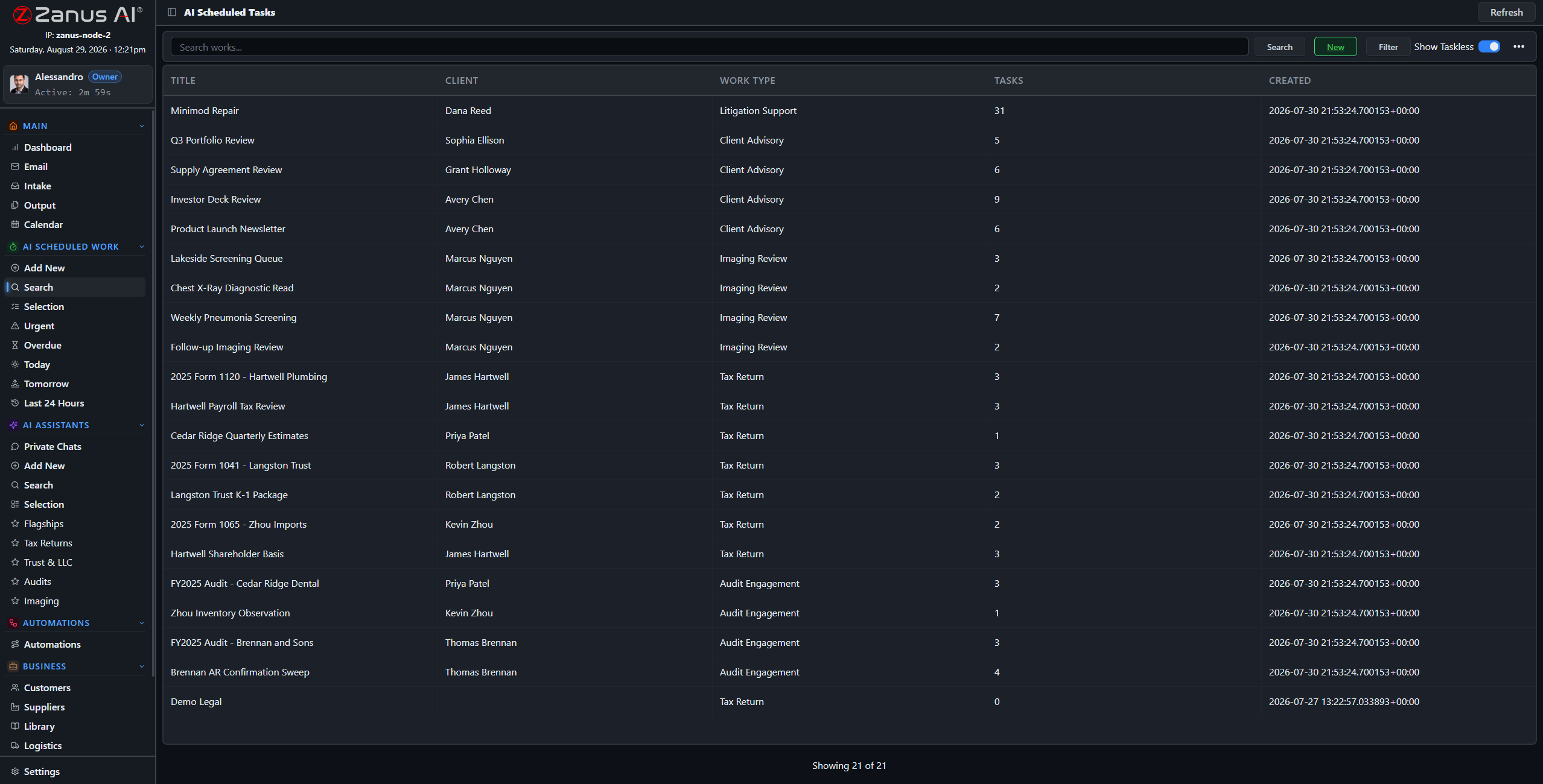
Assign work to the AI the way you assign it to a paralegal: type, files, deadline, priority. Overnight deposition digests, Friday docket summaries, weekly discovery reviews — executed on schedule, cited to page and line, under attorney review.
Private tenant or your own server · your whole team · privilege-conscious architecture
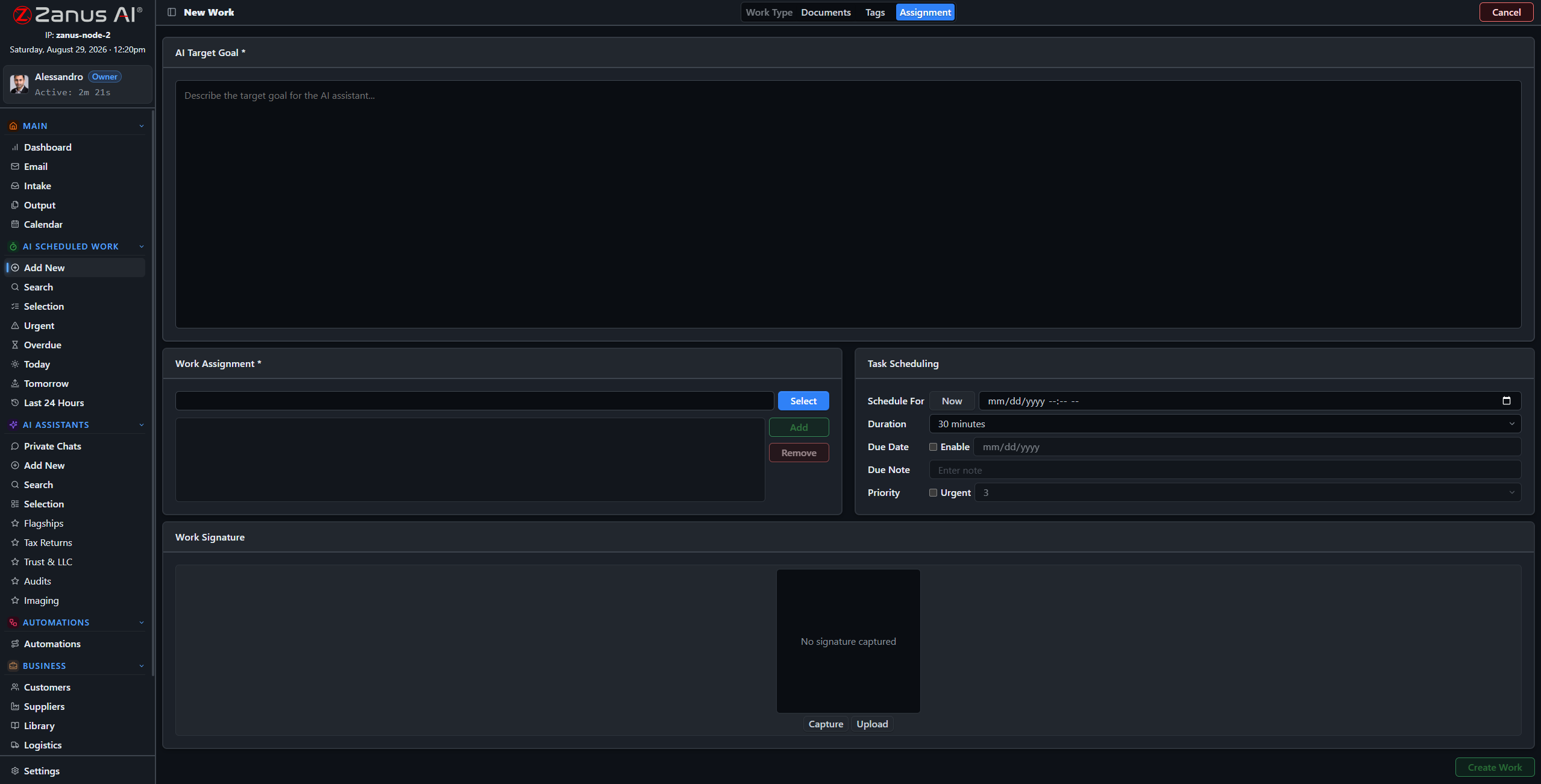
Four steps: work type, matter files, tags, schedule — the AI takes it from there.
What it does
Deposition digest, discovery summary, motion shell, engagement letter, chronology build: work types molded to your practice areas, with default sources and examples per type.
The AI’s workload reads like the firm’s docket: one-click views show what is urgent, late and due today — the pre-trial chronology does not slip while everyone briefs the appeal.
Every work is a full session: reasoning streamed, page-line sources cited, milestones tracked, linked to the matter and the calendar — supervisable and auditable.
Friday, 7 AM: the docket summary is filed
Set “Weekly Docket & Deadline Summary” once: every Friday the AI sweeps the matters, lists upcoming filing deadlines and hearing dates, flags anything within response windows, and files the memo before the partners meet.
- Recurring schedules for periodic matter work
- Deadlines and dates cited to the underlying order or rule in your files
- Memo waits in Output for the managing partner
Questions, answered
Can an attorney supervise mid-work?
Yes — open any session, read the streamed reasoning, redirect it or stop it. The AI works like staff: visible, accountable, interruptible.
What volume can it absorb in trial prep?
It does not bill by the hour and it does not tire — the constraint is attorney review capacity. Deployments size from solo practices to multi-office firms, flat price.
See it working on YOUR firm — the demo IS the product.
ZANUS AI FOR LAW FIRMS — PLAYBOOKS
The firm’s playbook, answerable.
Every firm has “the way we do it” — living in senior heads and a shared drive nobody searches. In Zanus, closing checklists, filing procedures and practice playbooks are living documents: answerable in chat, attached to AI work by construction, current version always on top.
Private tenant or your own server · your whole team · privilege-conscious architecture
The playbook library: current checklists and procedures on top, superseded versions outranked but archived.
What it does
Closing checklists, e-filing procedures, intake criteria, conflicts procedure, court-specific formatting rules: one library, current versions ranked first.
“What is our checklist for a UCC closing?” — answered in seconds with the document attached, at 4:55 PM before the wire deadline, to any authorized team member.
The AI drafting an engagement letter reads the engagement-letter playbook; the discovery summary work reads the discovery protocol — by construction, not by memory.
Playbook upkeep, scheduled like matter work
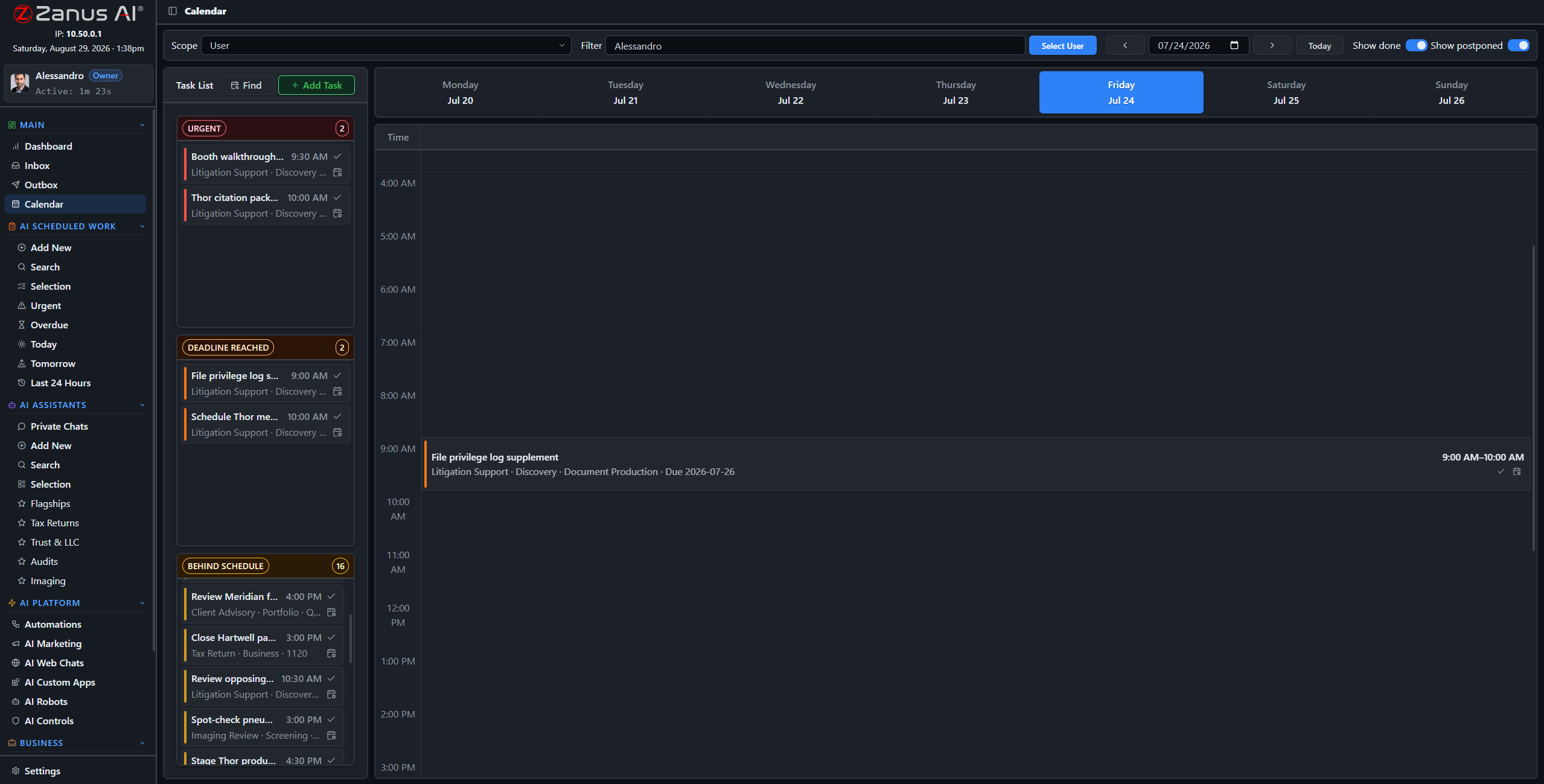
Quarterly checklist reviews, court-rule change summaries, template refreshes: assign them once as recurring AI work and the firm’s way stops going stale — review drafts prepared, changes flagged for the practice group leader, every cycle on the record.
- Recurring review works with deadlines
- Change summaries drafted for practice-group briefings
- Every review on the audit record
Questions, answered
How do updates roll out to the whole firm?
Upload the new checklist, set it on top: from that moment every answer and every AI work cites the new version. Old versions stay archived — useful when a matter turns on which procedure was current when.
See it working on YOUR firm — the demo IS the product.
ZANUS AI FOR LAW FIRMS — TEAM TRAINING
New associates learn the firm’s way, not the last firm’s.
Lateral hires and first-years arrive with habits from somewhere else. In Zanus, they learn your procedures from the AI itself — and every associate, paralegal and assistant has a private assistant that answers “how does this firm…?” with the current playbook cited.
Private tenant or your own server · your whole team · privilege-conscious architecture

Training lives inside the software: the AI walks each new hire through the firm’s own procedures.
What it does
New paralegals and associates learn your intake criteria, filing procedures, billing conventions and systems through guided training — productive in days, progress visible to the office manager.
“How do I e-file in the Northern District?” — asked to the assistant, answered from the firm’s procedure with the checklist attached, without burning a senior associate’s billable hour.
Private chats work on any device with a login — the procedure answer follows the associate to the courthouse hallway, in their language.

The mentor that never tires of the question
The tenth “how do I open a new matter?” gets the same patient, cited answer as the first. Training content never goes stale because the assistant reads from the same living playbook libraries as everything else — update the procedure once and every future answer follows.
- Answers cite the current firm procedure
- Preset assistants per role: associate, paralegal, billing, reception
- Training progress visible to managers
Questions, answered
Does this replace CLE or legal training?
No — it teaches the firm’s own procedures and systems, not the law. Substantive legal training and CLE remain the attorney’s professional domain.
See it working on YOUR firm — the demo IS the product.
ZANUS AI FOR LAW FIRMS — AUTOMATIONS
The firm’s repetitive work, set once.
Describe the job in plain words — “when an intake is accepted, draft the engagement letter and open the matter checklist” — and it becomes connected blocks on a canvas, running on its own, with every run visible and retryable.
Private tenant or your own server · your whole team · privilege-conscious architecture
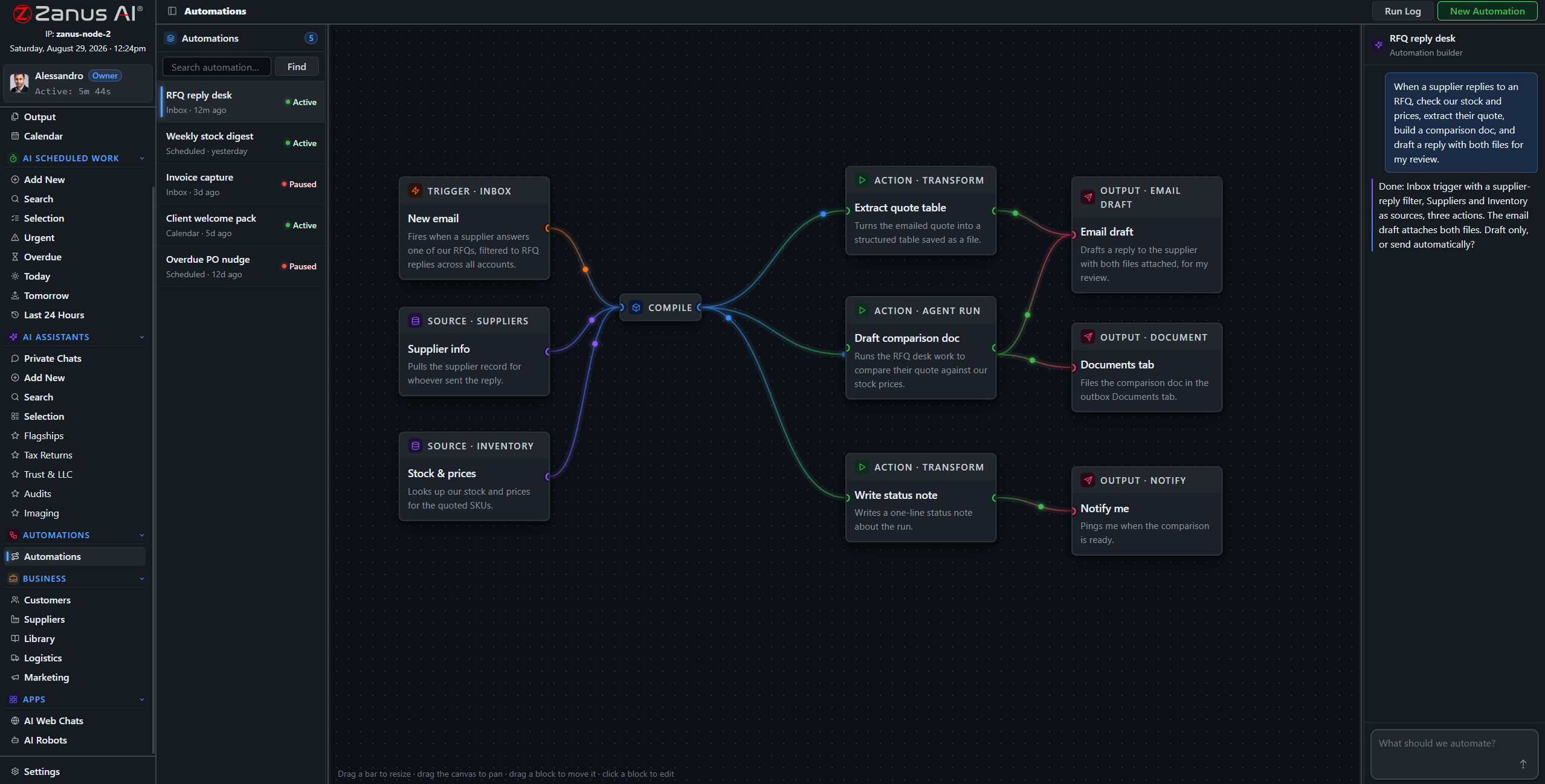
A real flow: intake trigger, matter sources, AI drafting step, three outputs — drawn from a description.
What it does
Intake accepted: the flow drafts the engagement letter from your template, opens the matter checklist, and queues the welcome email — the client signs while the enthusiasm is warm.
Court notices, opposing counsel letters and signed agreements arriving by email are routed to the right matter with handling instructions — no misfiled order discovered in week three.
A hearing notice arrives: the date lands on the attorney’s calendar, response deadlines are computed into the task list, and the pre-hearing checklist work is scheduled — from one trigger.
In a deadline business, silent failure is disqualifying
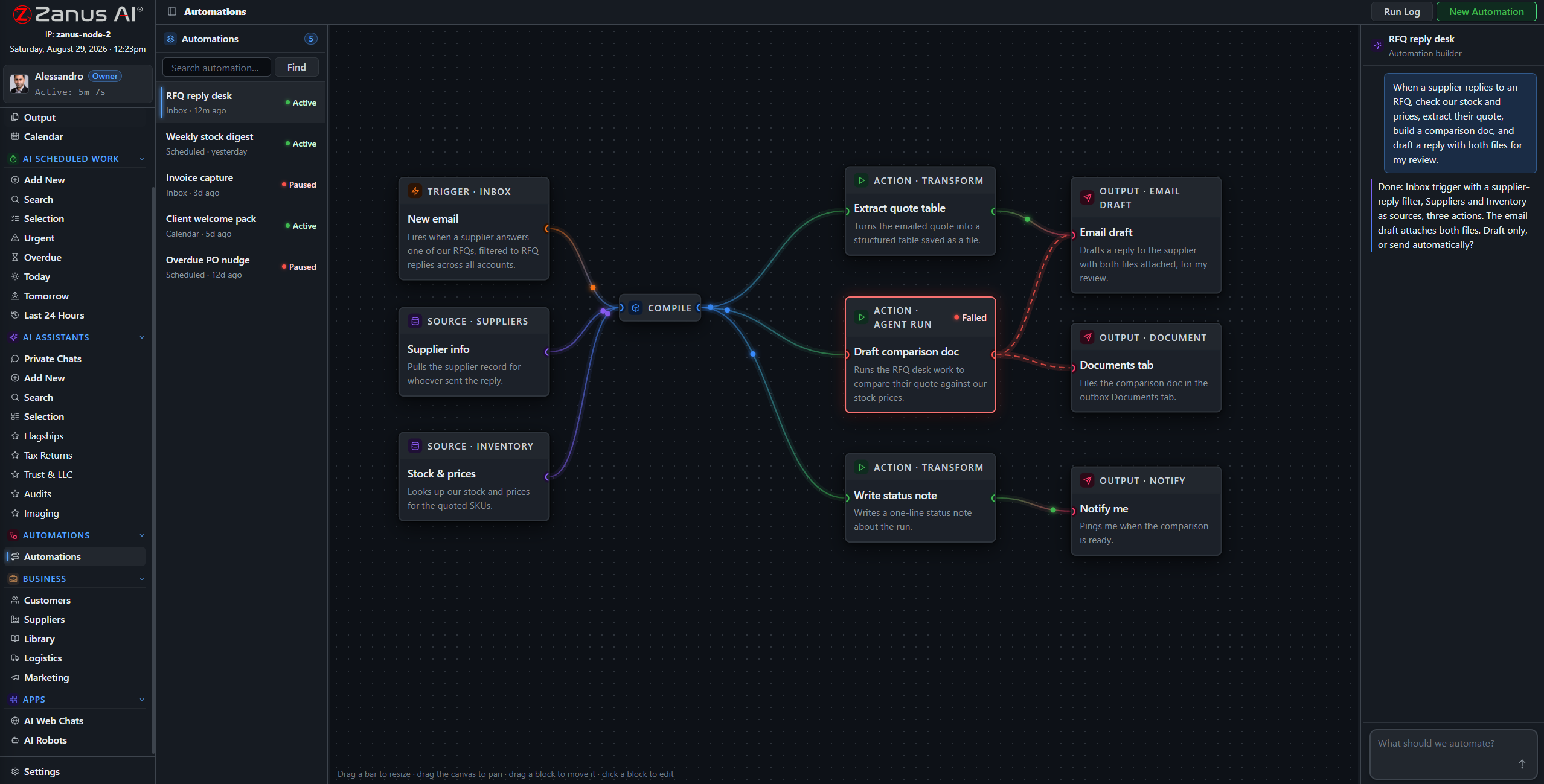
Run states live on the flow: green success, red failure on the exact block that broke. A deadline that failed to propagate or a letter that failed to file is visible the moment it happens — with one-click retry and a run log.
- Run log per automation, every execution recorded
- One-click retry on the failed block
- Finished documents in Output, statused for review
Questions, answered
Who approves what an automation sends?
Your rules: everything client-facing queues for human approval by default; auto-send only the categories the partners designate as safe. Approval gates are visible blocks on the canvas.
See it working on YOUR firm — the demo IS the product.
ZANUS AI FOR LAW FIRMS — CLIENT DEVELOPMENT
The rainmaking that actually gets done.
Law-change alerts to affected clients, dormant-client check-ins, referral thank-yous, the firm newsletter — drafted by the AI from your own client records, in the firm’s voice, queued for partner approval. Client development discipline without stealing billable hours.
Private tenant or your own server · your whole team · privilege-conscious architecture
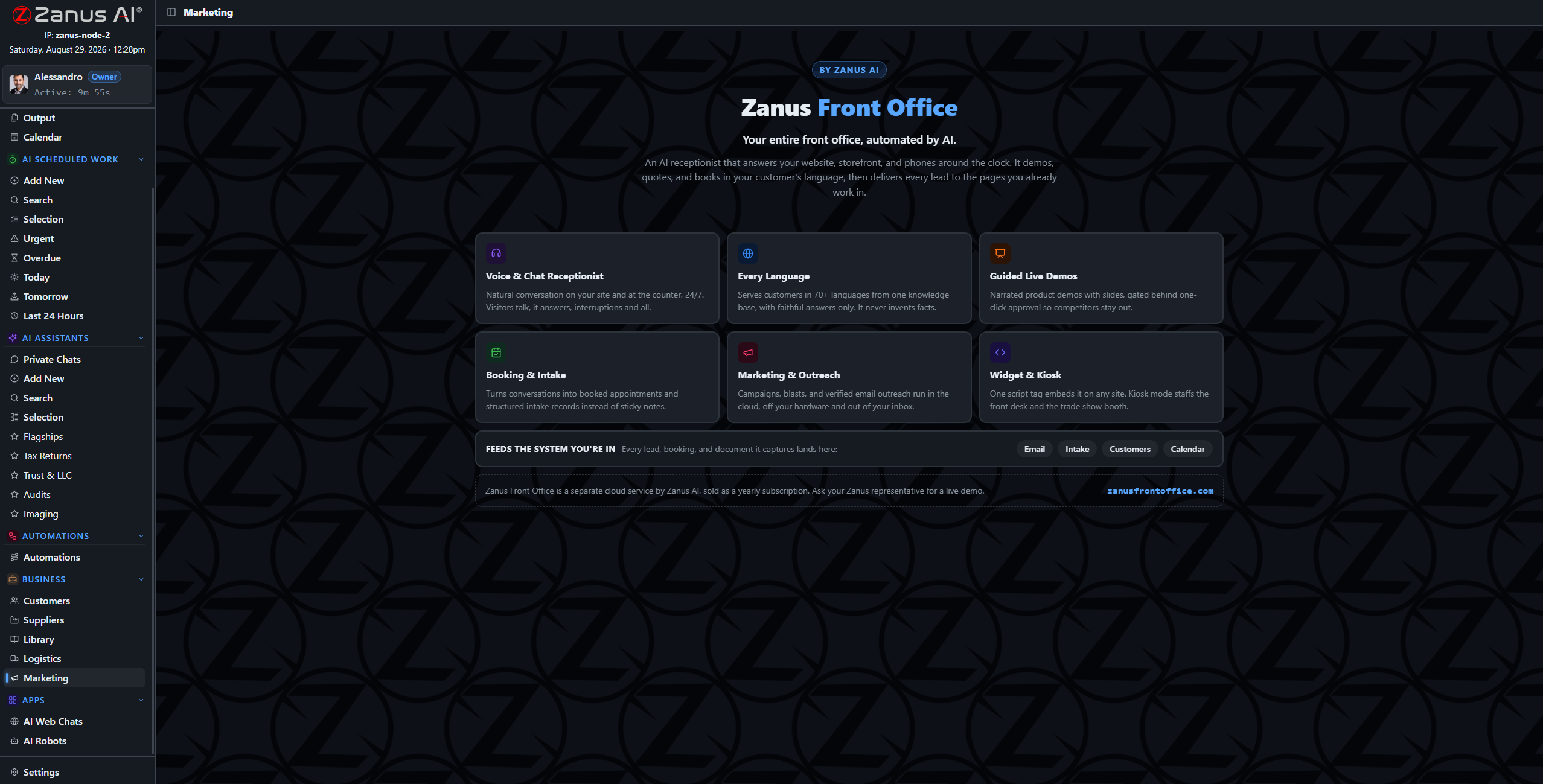
Campaigns and sequences drafted from the firm’s records — alerts, check-ins, newsletters — awaiting approval.
What it does
Every client with a commercial lease expiring within a year, every estate plan older than five years, every referral source gone quiet: audiences built from your own records — no list exports to a marketing tool.
The non-compete rules changed: the AI drafts a plain-language alert to the clients it affects, in the firm’s voice, with the partner’s sign-off before anything sends.
Opt-outs, do-not-contact flags and your jurisdiction’s solicitation sensitivities are enforced by the system, not by memory. Every send is on the record.
From the client records to the campaign, without export
Audience, content and sending live in the same system as the client records — nothing leaves your tenant to reach a mailing platform. “Check in with every corporate client we have not billed in 18 months” becomes a drafted, scheduled sequence in minutes.
- Audiences from your own client data — private by architecture
- Sequences drafted for review, in the firm’s voice
- Replies tracked back to the client record

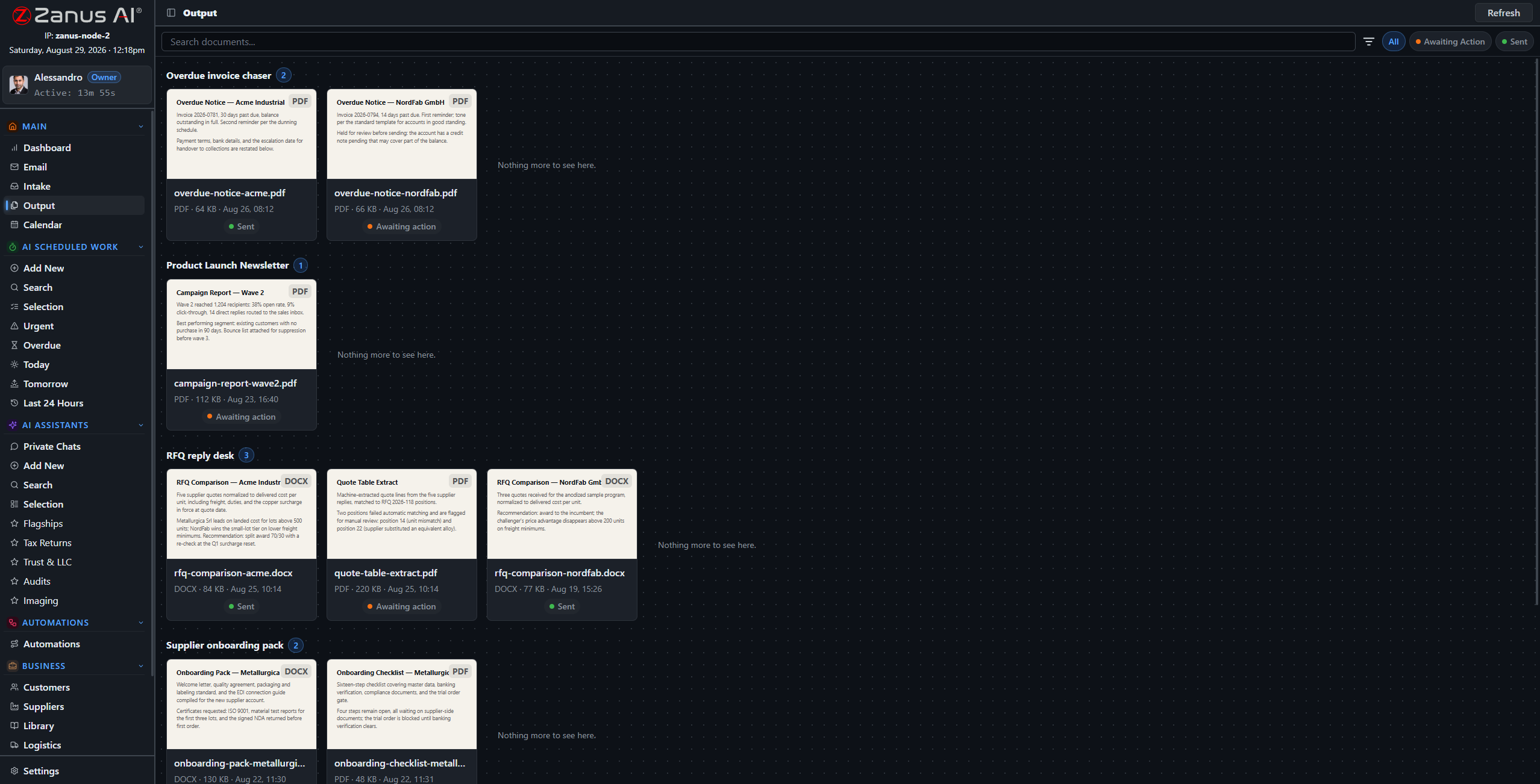
Partner approval first, always
Every outbound client communication waits in the approval queue unless the partners designate the category as auto-send. The firm controls every word that reaches a client — as it should.
- Approval workflow per communication type
- Full history of what was sent to whom
- Results tracked: replies, meetings, reopened matters
Questions, answered
Is this compatible with advertising and solicitation rules?
The system gives you the controls: approval-first workflows, preference enforcement, full send history. Your jurisdiction’s specific rules are applied by your partners — bring your ethics counsel to the demo.
Can it help win new business too?
Yes — website chat and interactive AI demos qualify prospective clients, and follow-up sequences keep the consultation pipeline warm, all under the same approval rules.
See it working on YOUR firm — the demo IS the product.
ZANUS AI FOR LAW FIRMS — DMS & INTEGRATIONS
Keep the DMS. Keep the billing system. Add the intelligence.
Your document management, practice management and billing systems stay the systems of record. Zanus becomes the system of work: API connectors sync matters, contacts and documents both ways, and AI drafts flow back where they belong. No rip and replace.
Private tenant or your own server · your whole team · privilege-conscious architecture

No rip and replace: the DMS, practice management and billing stay — the AI layer connects to all of them.
What it does
Matters, contacts, documents and calendar entries mapped field by field, with a dry-run preview before anything writes — push, pull or two-way, your choice.
Time entries, invoices and trust-accounting documents route through the intake pipeline to the right matter — and the AI can draft the billing narratives and follow-up letters.
A full API for whatever else the firm runs: e-filing portals, research platforms, client portals — data in, results out, under scoped keys, every event logged.
One question across the DMS, billing and the files
The pleading lives in the DMS, the unpaid invoice in billing, the correspondence in the matter library — and the AI reads across all of it. “What is outstanding on this matter?” becomes one question with one grounded, cited answer.
- Field mapping with dry-run preview
- Each system stays master of its own records
- Every sync event on the audit record
- External systems appear as blocks on the automation canvas
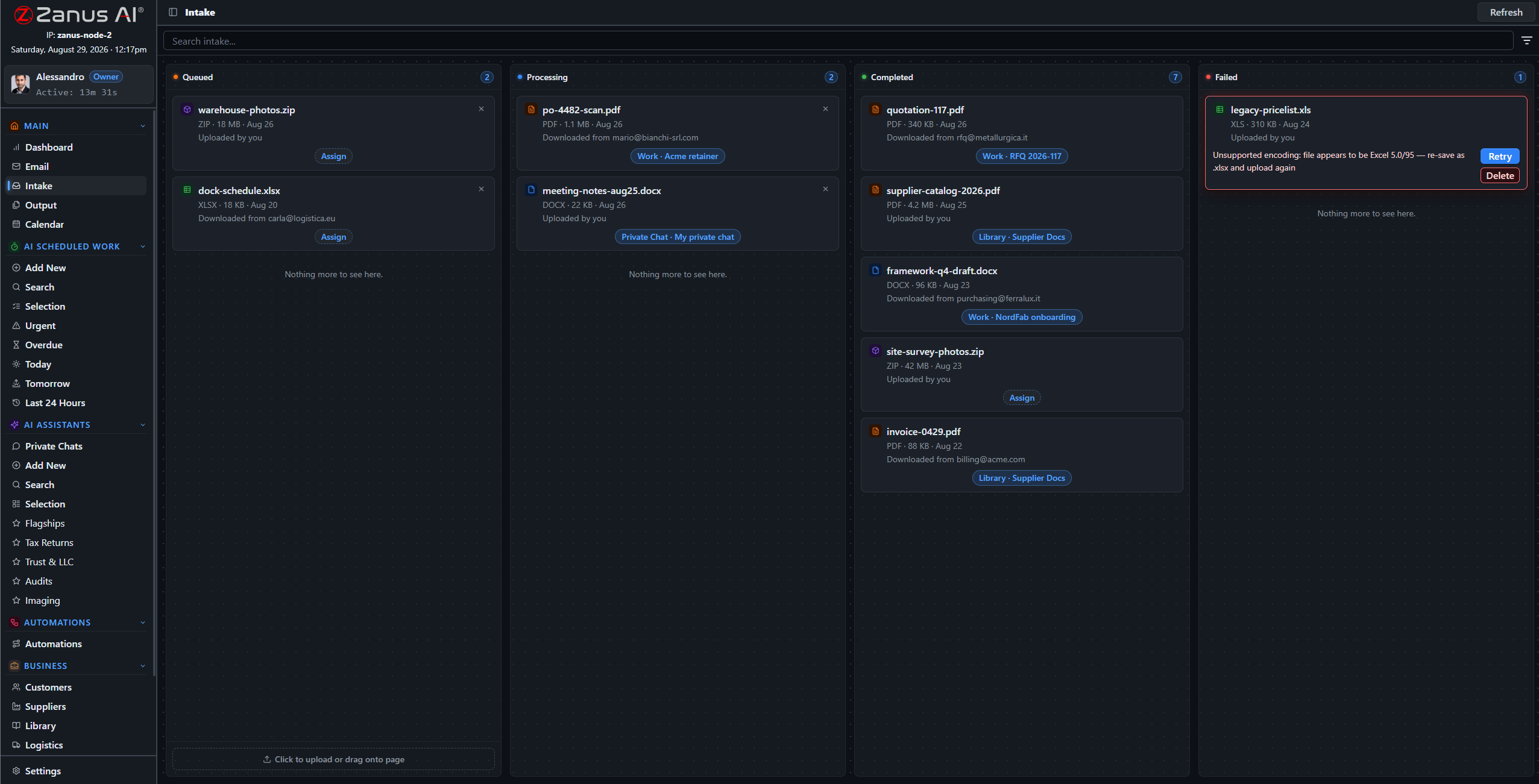
Drafts flow back where they belong
The engagement letter the AI drafted, the deposition digest, the billing narrative: finished documents return to the DMS matter workspace through the same connectors — after attorney review, never before.
- AI output filed back to the matter record
- Attorney approval gate before anything writes back
- Webhooks notify your systems in real time
Questions, answered
Which practice management systems do you support?
Connectors are mapped per deployment — bring your DMS, practice management and billing systems to the demo and we walk through the exact integration path.
Does client data pass through third parties?
No. The connectors run inside your tenant — or inside your office on the on-premises option. Data moves directly between your systems.
See it working on YOUR firm — the demo IS the product.
ZANUS AI FOR LAW FIRMS — PRIVILEGE
Built like privilege depends on it.
Client confidentiality is not a policy PDF — here it is the architecture. Admin-created accounts, matter walls as workgroups, permissions to the field level, server-side redaction, a searchable audit trail, and an on-premises option where files never touch the internet.
Private tenant or your own server · your whole team · privilege-conscious architecture
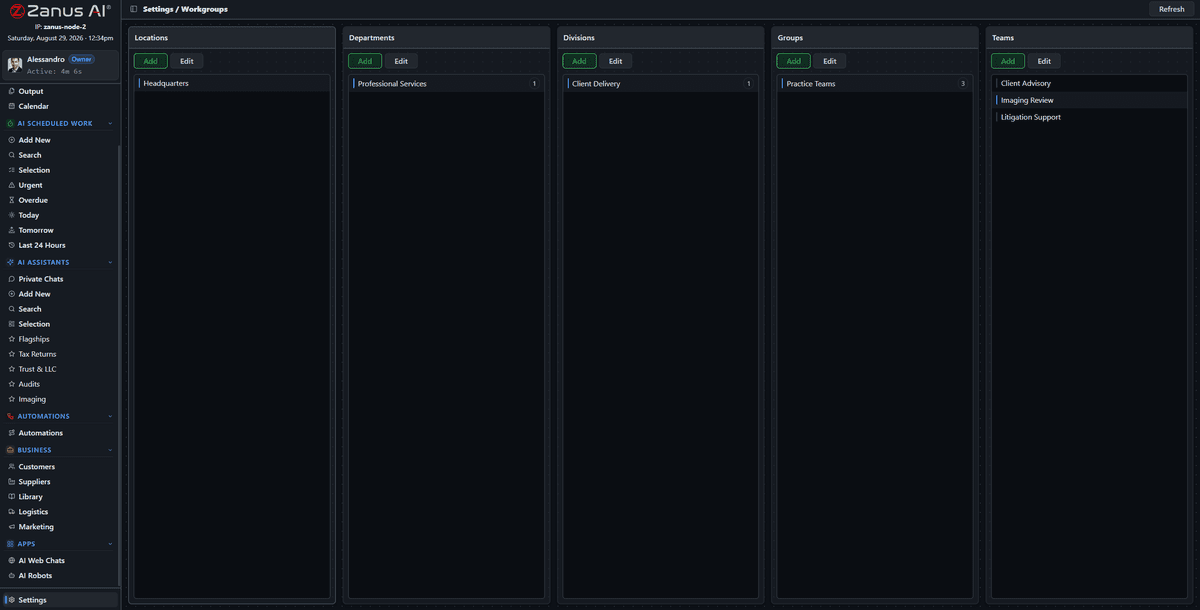
Five-level workgroups: offices, practice groups and walled matters — access shaped exactly to the engagement.
What it does
A screened attorney does not see the walled matter — not in search, not in calendars, not in AI answers. The server redacts it before it leaves the database.
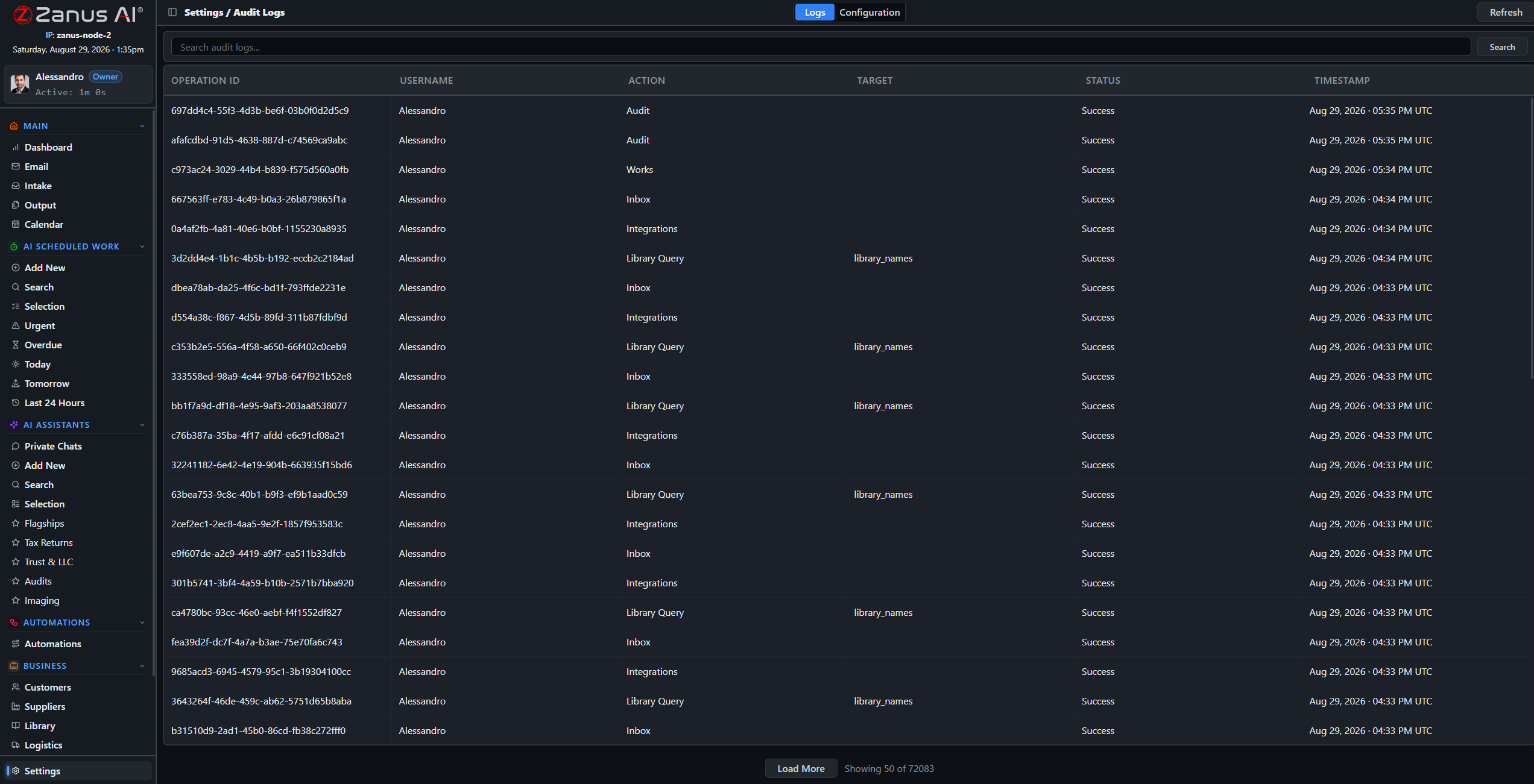
A searchable log of every audited action: who opened the file, who changed the draft, when — the answer to “who saw this?” in minutes, not a forensics engagement.
Your tenant is isolated: client files never train outside models. The on-premises option puts the entire system on hardware the firm owns, air-gap capable.
When the client audits the firm
Corporate clients increasingly ask law firms hard security questions. The answers are built in: isolated tenant or owned hardware, field-level access control, server-side redaction, audit trail, pre-update snapshots with rollback — walk their questionnaire through the architecture.
- Searchable audit trail with configurable categories
- Automatic pre-update snapshots with rollback
- USB updates for air-gapped deployments
Questions, answered
Does using AI waive privilege?
The architecture is built to support confidentiality: isolated tenant, no outside model training, access walls, audit trail — or fully on-premises where files never leave the office. How that maps to privilege doctrine in your jurisdiction is a question for your ethics counsel — bring them to the demo.
Can we run conflicts and walls across offices?
Yes — five-level workgroups model offices, practice groups and individual walled matters, and permissions reach the field level within them.
See it working on YOUR firm — the demo IS the product.
ZANUS AI FOR LAW FIRMS — LIVE DEMO
Do not watch a video.
Talk to your AI.
Legal tech vendors demo by webinar behind a lead form. Ours is the product itself, configured for law firms: open the chat below-right and try it — run an intake, ask how a deposition digest works, request the drafting walkthrough.
The conversation you have with us IS the demo
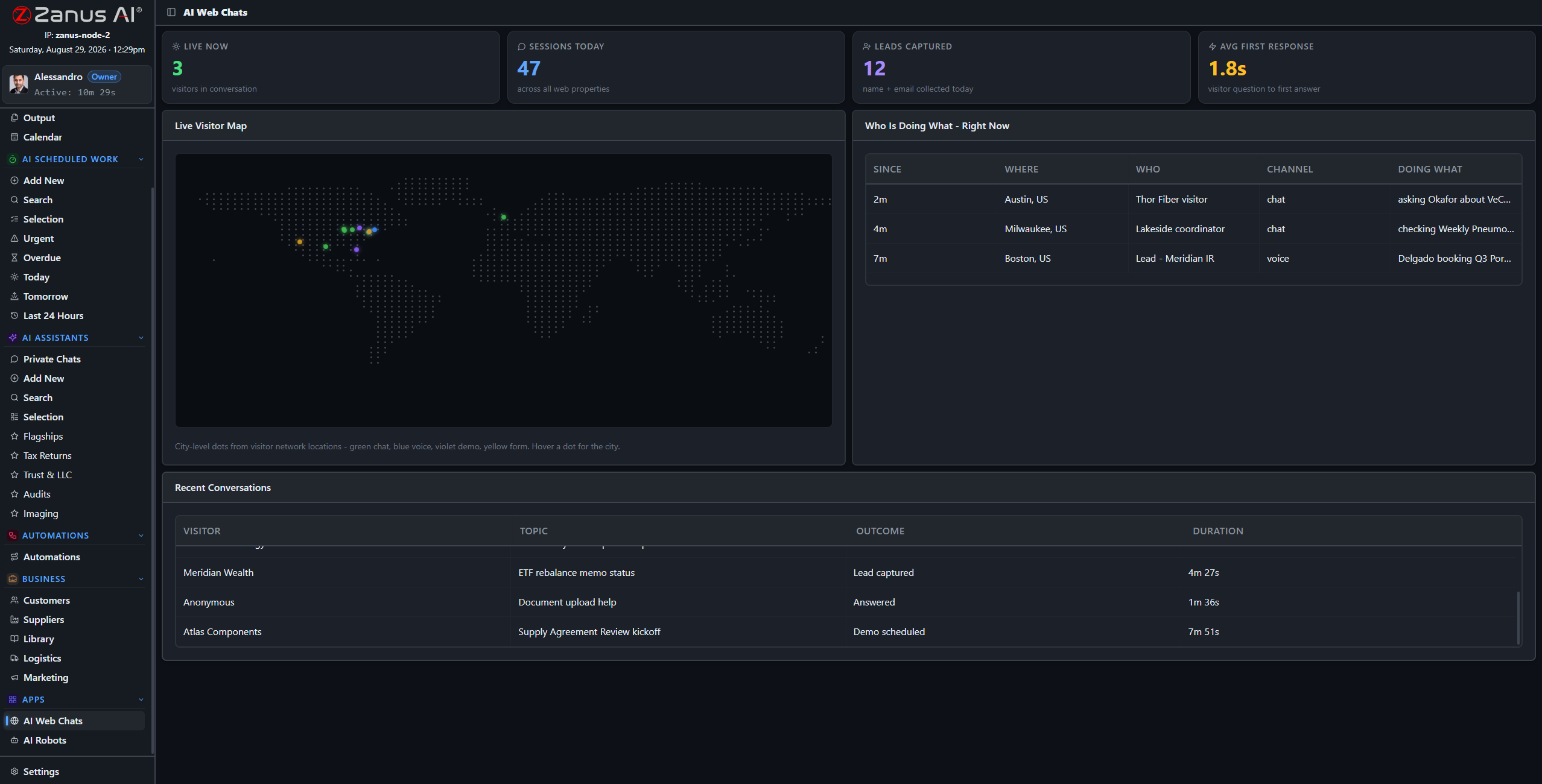
This screen is watching demos like yours happen: live conversations, outcomes, first response in seconds.
What it does
Ask the chat what a prospective client would: “I was rear-ended last week, can someone help me?” — watch it screen, qualify and offer the consultation slot.
Ask: “how would you digest a deposition?” — it walks the workflow it would run in your tenant: page-line cites, themes, attorney sign-off included.
The full demo loads a law-firm tenant with sample matters: intake screening, docket summaries, precedent answers — your world, working.
Or pick your exact business
Every link below is a full live-demo page for that specific business — its vocabulary, its calls, its booking rules.
Two minutes to your inbox
Request the demo and the interactive law-firm demo arrives in about two minutes — no sales call, no calendar dance. Watch it, interrupt it with questions, and book the human conversation when YOU are ready.
- Interactive demo, law-firm-configured
- Ask questions mid-demo — it answers and resumes
- In your inbox in ~2 minutes, free

Questions, answered
Is the demo really the product?
Yes — the same AI, configured with a sample law-firm tenant. What you see is what your firm gets, with your files and precedents instead of the samples.
See it working on YOUR firm — the demo IS the product.
Sharing with a colleague? 📄 Get the PDF · ✉️ Email this page ·