ZANUS AI FOR ENTERPRISE OPERATIONS — OVERVIEW
The Monday report writes itself. With reasons.
Dashboards show WHAT moved; someone still spends the week explaining WHY. Zanus AI runs both sides of the enterprise: customer conversations handled and transcribed at volume up front, and reporting, variance commentary and forecasts drafted with reasons across departments in the back.
Private tenant or your own servers · your whole team · SOC-2-aligned deployment path
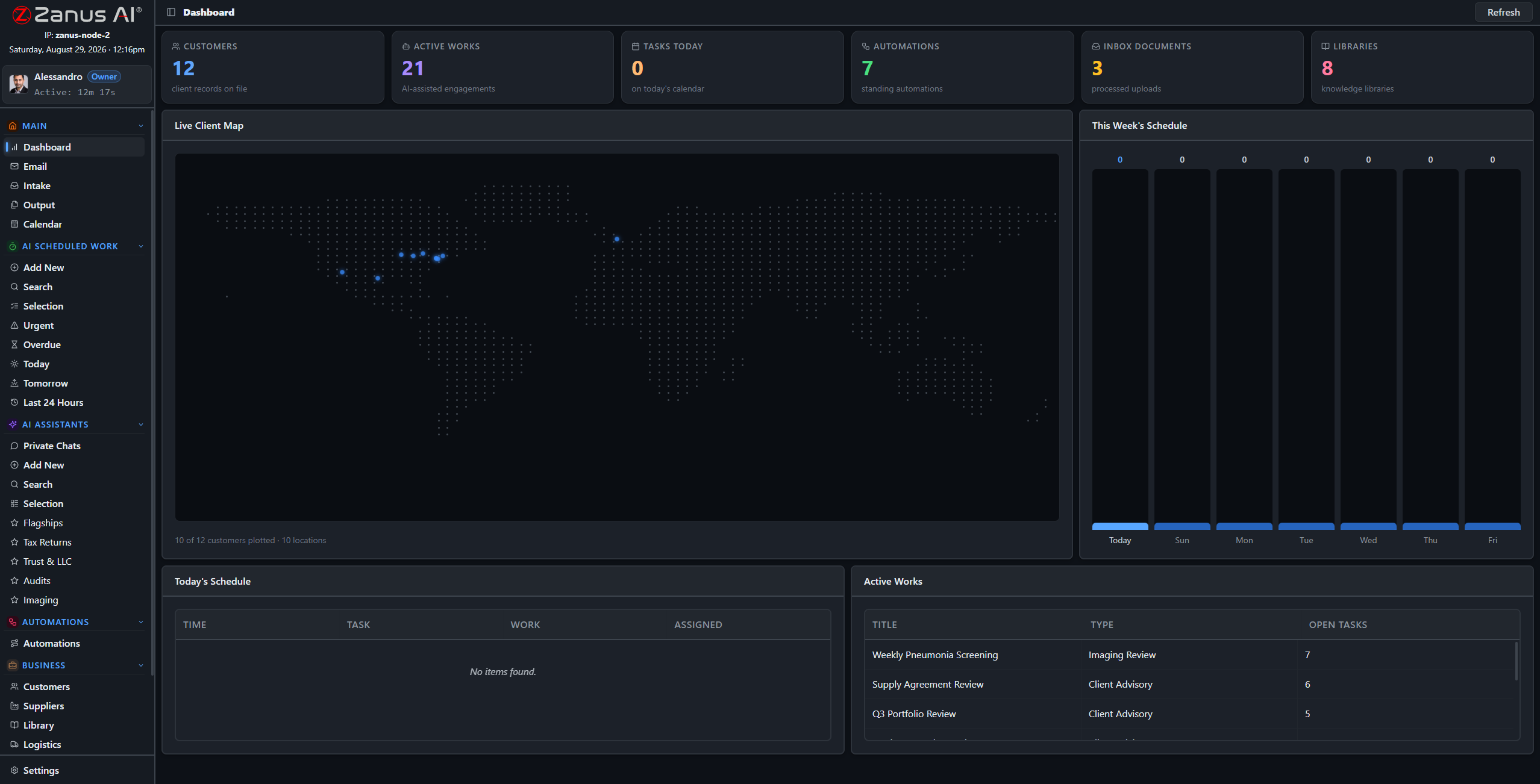
A division view: department rollups, scheduled reporting works, forecasts and open actions on one screen.
What it does
“Why did region West slip 8%?” used to be a ticket in a queue. Now the variance commentary is drafted with the numbers traced to source — the analyst reviews instead of assembles.
Sales, fulfillment, finance and support each hoard a slice of the truth. One tenant with workgroups per department means cross-department questions get one grounded answer.
Insight priced per viewer guarantees most of the company flies blind. Your whole team at a flat price means the shift lead reads the same truth the COO does.
Front office: customer volume, absorbed
At enterprise scale the phone and inbox are a firehose. The Zanus front office answers 24/7 in up to 40 languages, transcribes every conversation into searchable record, and feeds the morning briefing and the forecast — signal extracted from volume, daily.
- Every conversation answered and transcribed
- Morning AI briefing for each leader’s scope
- Forecast with reasons, refreshed from live activity
- See the Front Office at enterprise scale →

Back office: the reporting engine
The monthly close pack, the weekly KPI digest, the quarterly ops review deck — assigned to the AI as scheduled work, compiled from the actual records with every figure cited, filed in Output for review before the meeting is even booked.
- Scheduled reporting works per department
- Every figure traceable to its source record
- Human review and sign-off before distribution
- See the Back Office for enterprise →
Corporate knowledge, sovereign
An enterprise’s operational data is its strategy in numeric form. Run the identical OS on Zanus servers inside your own data center: air-gap capable, USB updates, owned outright — with a zero-migration path from the cloud tenant you pilot on.
- Private On-Premises AI: owned, no recurring fees
- On-Prem Tokens Server for high-volume processing
- Explore the AI Servers →

Questions, answered
We have a BI stack. Does this replace it?
It sits on top of and beside it: your warehouse and dashboards stay, and the AI drafts the narrative layer — commentary, digests, review packs — they never could. Bring the stack to the demo and we map the boundary.
How long does an enterprise deployment take?
Days to weeks for a pilot tenant, not quarters: connect the systems of record, load the document libraries, and the first scheduled reporting works run that week.
What does “your whole team” mean at our size?
Exactly what it says: every employee can have a login — executives, analysts, shift leads — without the bill moving. Access is governed by role, not by license count.
See it working on YOUR enterprise — the demo IS the product.
ZANUS AI FOR ENTERPRISE OPERATIONS — FRONT OFFICE
Ten thousand conversations. Zero lost.
At enterprise scale, the tragedy is not the missed call — it is the ten thousand answered ones that vanish into agent memory. The Zanus front office answers on your menus, in up to 40 languages, and turns every conversation into transcribed, searchable, reportable record.
Private tenant or your own servers · your whole team · SOC-2-aligned deployment path

Calls, chats, emails and bookings across business lines — one dashboard, every conversation on record.
What it does
Regional numbers, product lines and brands each get their own menus and voices — answered 24/7, escalated by rules you tune per line.
Transcripts of every interaction feed search, reporting and forecasting — what customers actually said, queryable, instead of anecdotes in a QBR.
Inbound leads qualified, followed up and booked into real calendars in minutes — the speed-to-lead metric your funnel reviews keep flagging, fixed structurally.
The morning briefing, per leader, per scope
Each executive starts the day with an AI briefing scoped to their world: last night’s volumes, emerging complaint clusters, at-risk accounts, forecast movement with the reasons attached. The same engine, a different lens per leader.
- Briefings scoped by role and workgroup
- Complaint and topic clusters surfaced from transcripts
- Forecast with reasons, not just a number


Email at scale, answered and sequenced
Shared inboxes at enterprise volume are where inquiries go to age. Inbound email is answered from approved knowledge, outbound sequences run under approval rules, and every thread joins the account’s permanent record.
- Inbound answered from approved knowledge only
- Outbound sequences with approval rules
- Threads joined to accounts, searchable forever
- See the full Front Office tour →
Questions, answered
Can it handle our call volume?
It answers every call simultaneously — concurrency is not a constraint. Sizing conversations belong in the demo, where we model your actual volumes.
Does it work across our regional entities?
Yes — menus, voices, languages and routing rules per line and per region, with workgroups keeping each entity’s view scoped.
See it working on YOUR enterprise — the demo IS the product.
ZANUS AI FOR ENTERPRISE OPERATIONS — BACK OFFICE
The reporting pack, drafted overnight.
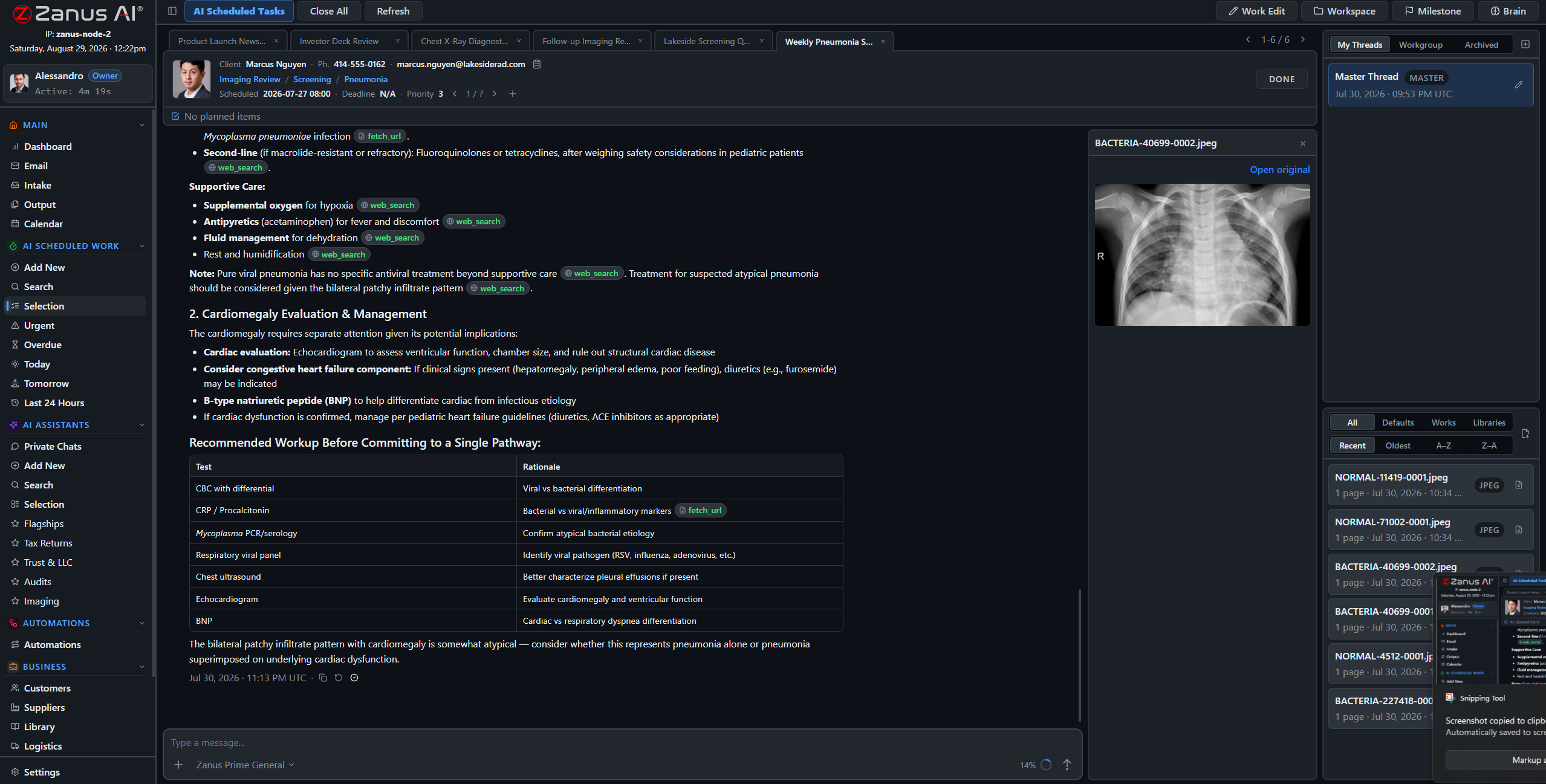
Enterprise reporting is a relay race of exports, pivot tables and “who owns this number?” The Zanus back office replaces the relay: packs compiled from the records themselves, every figure cited to source, variance explained — drafted overnight, reviewed by humans in the morning.
Private tenant or your own servers · your whole team · SOC-2-aligned deployment path
A real session: monthly rollup compiled — figures cited, variances explained, pack filed for review.
What it does
The monthly pack assembles itself as the data lands: rollups computed, movements flagged, commentary drafted — finance reviews and corrects instead of collates.
Every “driven by” claim in the draft traces to the records behind it — the review argument shifts from “is this number right?” to “what do we do about it?”
The CRM molded to YOUR terms — segments, tiers, regions as you define them — so the same word means the same thing in every department’s report.
Cross-department questions, finally answerable
“Which key accounts had both a support spike and an invoice dispute this quarter?” spans three departments’ systems — and used to die in email. With libraries and connectors feeding one tenant, it is a single question with a cited answer.
- Queries span departments, scoped by permission
- Answers cite records across every connected source
- Findings become tasks, owners and deadlines in one step


Board and review documents, in your templates
The quarterly ops review, the division scorecard, the exec summary of a bad month: drafted in your templates from the same cited data — hours of formatting and reconciliation returned to actual analysis.
- Your templates, your branding, your structure
- Data excerpts attached automatically
- Approval workflow before distribution
Questions, answered
Our numbers live in a data warehouse. Can it read them?
Through connectors and the API, yes — the warehouse stays master, and the AI drafts the narrative and packs from it. Bring the schema to the demo.
Who verifies what the AI writes?
Your people, structurally: every pack lands in Output awaiting sign-off, every figure carries its citation, and nothing distributes without a human yes.
YOU MIGHT ALSO LIKE
The Back Office executes. Who answers the phone?
Front Office AI picks up every call and chat — books, quotes, follows up, 24/7 in 40 languages. Watch it run a business like yours, live.
See it working on YOUR enterprise — the demo IS the product.
ZANUS AI FOR ENTERPRISE OPERATIONS — DOCUMENTS
Four departments. One answer.
Every division keeps its own repository, wiki and archive — and the same question gets four different answers. In Zanus, the corpus lives in priority-ordered libraries with verified, cited answers, scoped server-side so each role sees exactly its slice of the truth.
Private tenant or your own servers · your whole team · SOC-2-aligned deployment path
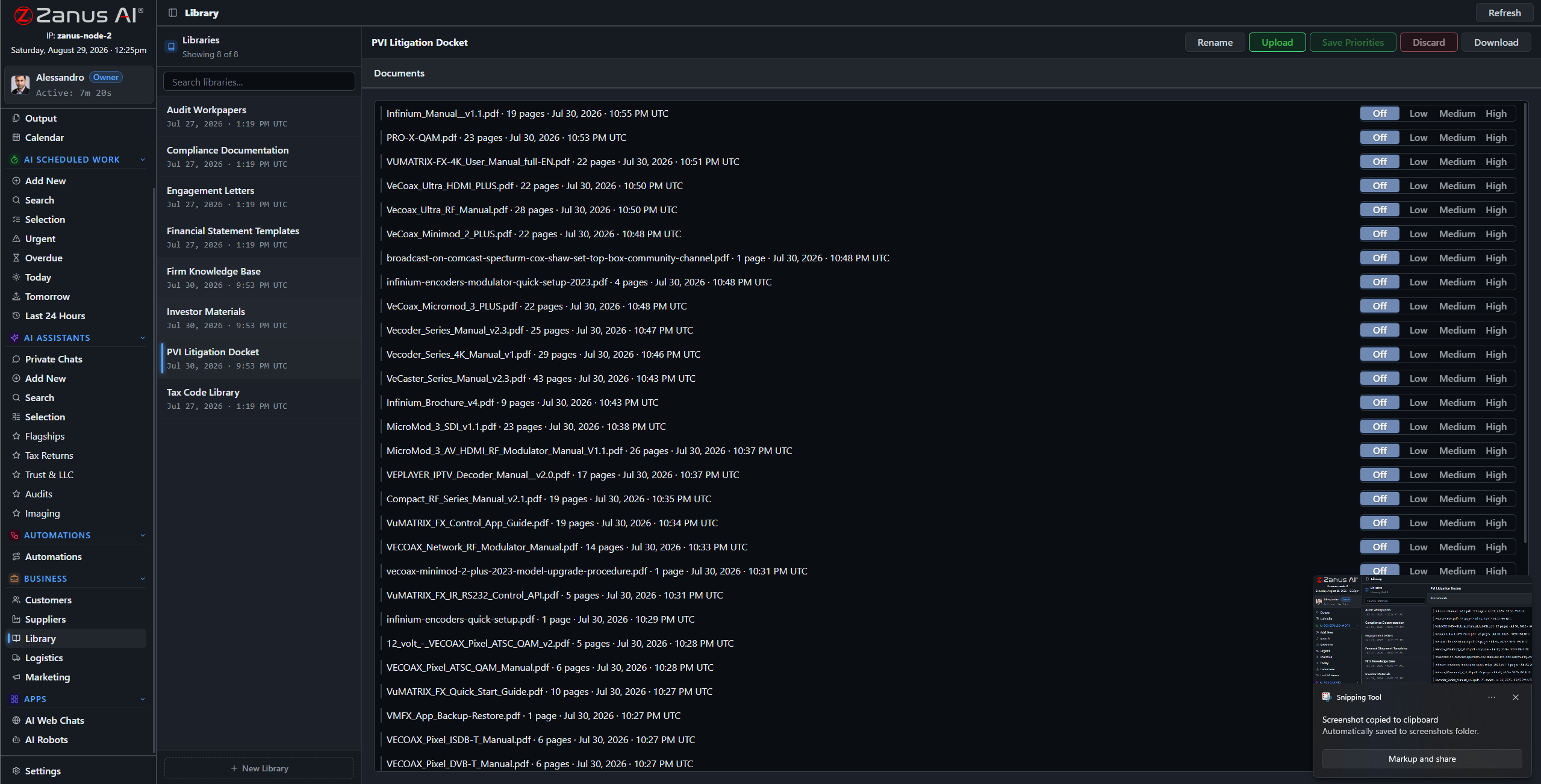
Libraries: ratified policy outranks the draft, the signed master agreement outranks the redline.
What it does
Contract archives, policy manuals, product documentation, historical reports — any format including scans and media — ingested into libraries the AI actually reads.
No source in the corpus, no claim in the answer: the AI cites the master agreement, the policy version, the spec — or states that it cannot answer.
Legal’s privileged folder, HR’s cases, finance’s models: the same question from different roles returns different answers, redacted server-side, by design.
Institutional memory that outlives reorgs
“What did we commit to in the 2021 master agreement?” “Which policy governed refunds before the merger?” Reorgs and departures stop erasing the past — the archive answers in seconds with the governing document attached.
- Plain-language questions across decades of archive
- Governing version identified and attached
- Priority order resolves conflicts between sources

Questions, answered
Millions of documents — realistic?
The library model is built for volume: priority ordering keeps answers governed by the right sources, and the on-prem Tokens Server option handles high-volume processing economically.
Can departments keep separate libraries?
Yes — libraries per department with distinct priorities and permissions, in one tenant, so cross-department questions still work for the roles allowed to ask them.
See it working on YOUR enterprise — the demo IS the product.
ZANUS AI FOR ENTERPRISE OPERATIONS — AI WORKFORCE
Analysts that scale without headcount.
Every enterprise rations analysis: the backlog decides which questions get answered. Assign the recurring ones to the AI — type, sources, deadline, recurrence — and the Monday digest, the monthly commentary and the quarterly pack simply happen, cited and reviewable.
Private tenant or your own servers · your whole team · SOC-2-aligned deployment path
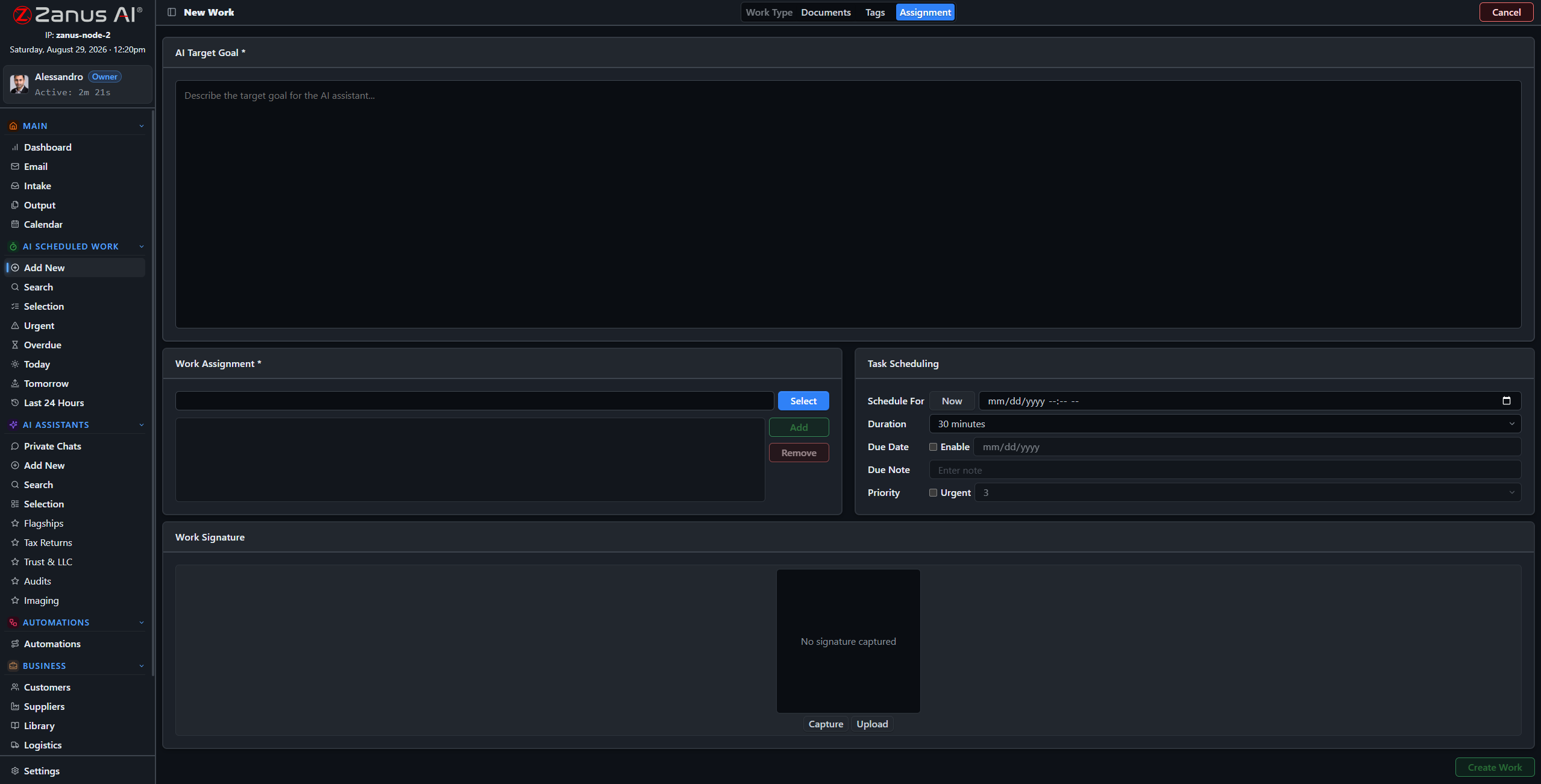
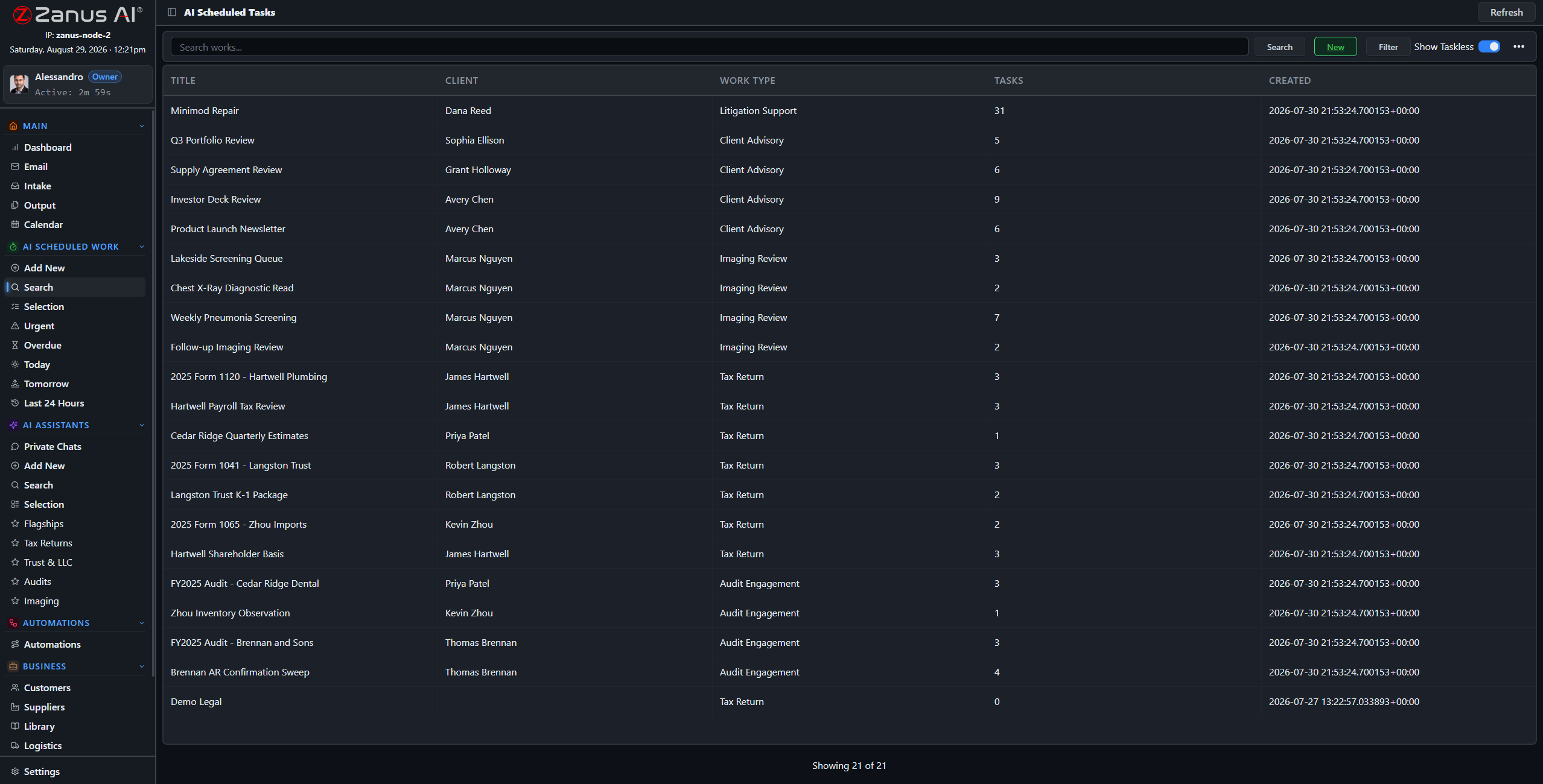
Four steps: work type, data sources, tags, schedule — the reporting calendar, staffed by AI.
What it does
Cross-department KPIs compiled, movements flagged, reasons drafted — in Output before the leadership call, every Monday, no analyst pulled off project work.
Actuals against plan, per division, with drivers named and cited — the commentary finance used to write at midnight arrives as a draft to correct.
Twelve weeks of operational record distilled into the QBR pack in your template — the deck-building fortnight compressed into a review afternoon.
An auditable analyst, not a black box
Every work session streams its reasoning, cites its sources and tracks its milestones. A department head can open the digest mid-run, watch how a number was built, redirect the emphasis or stop it — supervision identical to managing a human analyst, minus the backlog.
- Reasoning streamed live in every session
- Urgent / Overdue / Today views over the AI’s queue
- Sign-off in Output before anything distributes
Questions, answered
Can different departments run their own AI works?
Yes — works are created and scoped per workgroup, with sources limited to what that department may read. Central teams can run cross-department works where permitted.
What happens when the data is late?
The work is visibly overdue, exactly like a late deliverable from staff — and can retry on a schedule or trigger when the data actually lands.
See it working on YOUR enterprise — the demo IS the product.
ZANUS AI FOR ENTERPRISE OPERATIONS — PLAYBOOKS
One definition of every metric.
Half of enterprise reporting arguments are definition arguments: what counts as churn, when an escalation is Sev-1, which exchange rate the rollup uses. In Zanus, playbooks, runbooks and definitions are living documents — answerable, versioned, and wired into every AI work that reports.
Private tenant or your own servers · your whole team · SOC-2-aligned deployment path
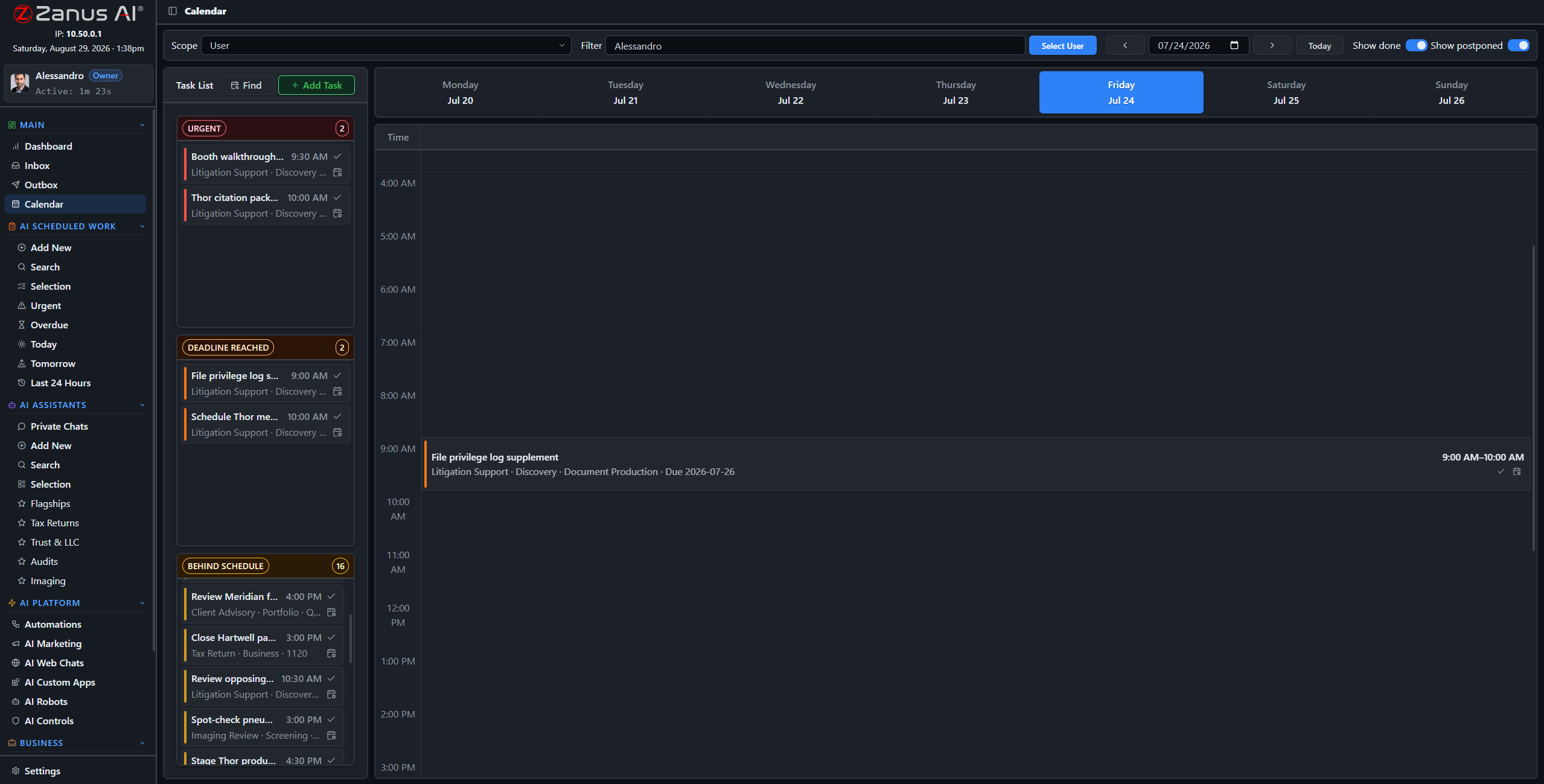
The playbook library: ratified definitions on top, drafts outranked — the arguments end at the source.
What it does
The AI compiling the Monday digest reads the metric definitions by construction — every report, every week, computed the way the ratified playbook says.
“Major outage, step four?” — the on-call lead asks and gets the current runbook step with the document attached, not a stale wiki page from two reorgs ago.
Who gets paged for a Sev-1 in region East on a Sunday? The playbook answers in seconds — and the automation canvas can execute the same path it describes.
Governance of the playbooks themselves
Quarterly definition reviews, runbook freshness checks and post-incident playbook updates run as recurring AI works: drafts proposed from what actually happened, humans ratify, the new version goes on top — and every dependent report updates its behavior instantly.
- Review works keep playbooks confronting reality
- Ratification is human; propagation is instant
- Superseded versions archived with their dates
Questions, answered
Different divisions define metrics differently. Now what?
Keep divisional definitions in divisional libraries where justified — and let the corporate library govern the rollup. The priority order makes the hierarchy explicit instead of political.
See it working on YOUR enterprise — the demo IS the product.
ZANUS AI FOR ENTERPRISE OPERATIONS — TEAM TRAINING
Hire number 400 onboards like hire number 4.
At enterprise hiring volume, onboarding quality decays with distance from headquarters. AI-guided training teaches your systems, playbooks and vocabulary identically in every region — and every employee keeps an assistant that answers “how do we…?” from the current source.
Private tenant or your own servers · your whole team · SOC-2-aligned deployment path

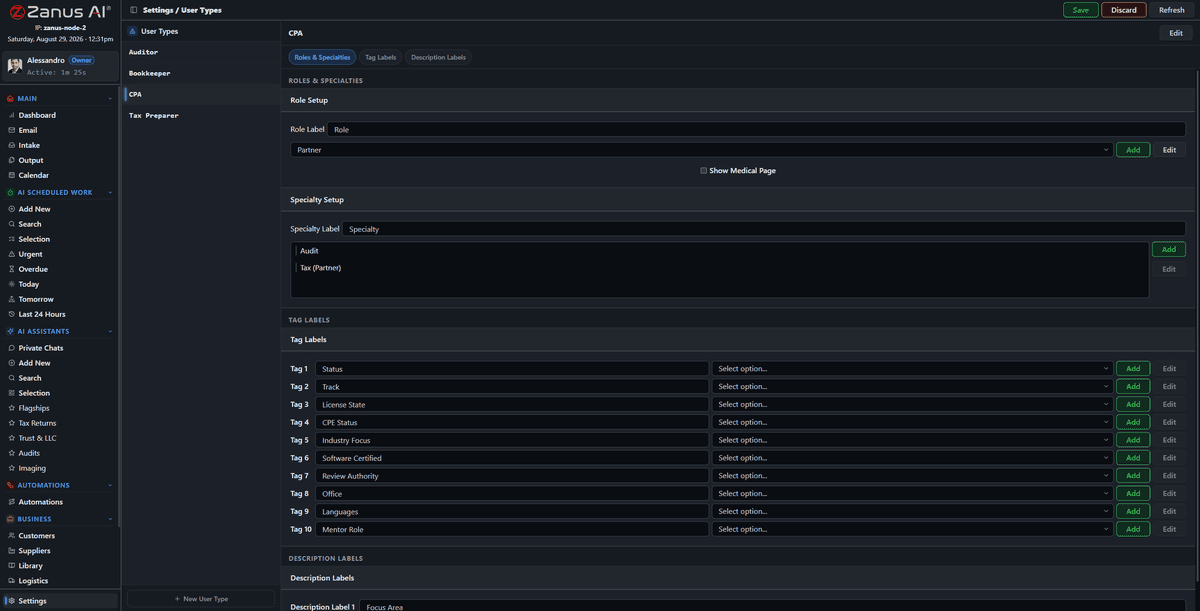
Training runs inside the software, on your own playbooks — the same class in every region, always current.
What it does
The Lisbon hire and the Denver hire learn the same current process — not each office’s local folklore — because both are taught from the same living libraries.
Thousands of “quick questions” flow to the assistant instead of to the five veterans everyone pings — sourced answers, zero interruption tax.
Who has completed what, where the gaps are, which teams lag — training progress is data, not an annual survey surprise.
Reorgs and tool rollouts, absorbed
Every reorg and system migration triggers a retraining wave that normally takes quarters. When the training reads from the same libraries the enterprise runs on, updating the source once retrains every future answer — the wave becomes a ripple.
- Content updates with the library, automatically
- Role-scoped paths per department and level
- Any device with a login — desk, floor, or field
Questions, answered
We run a corporate LMS. Conflict?
The LMS keeps compliance courseware; Zanus covers systems-and-process training where staleness hurts most. Bring the LMS to the demo and we map the split.
See it working on YOUR enterprise — the demo IS the product.
ZANUS AI FOR ENTERPRISE OPERATIONS — AUTOMATIONS
The reporting supply chain, automated.
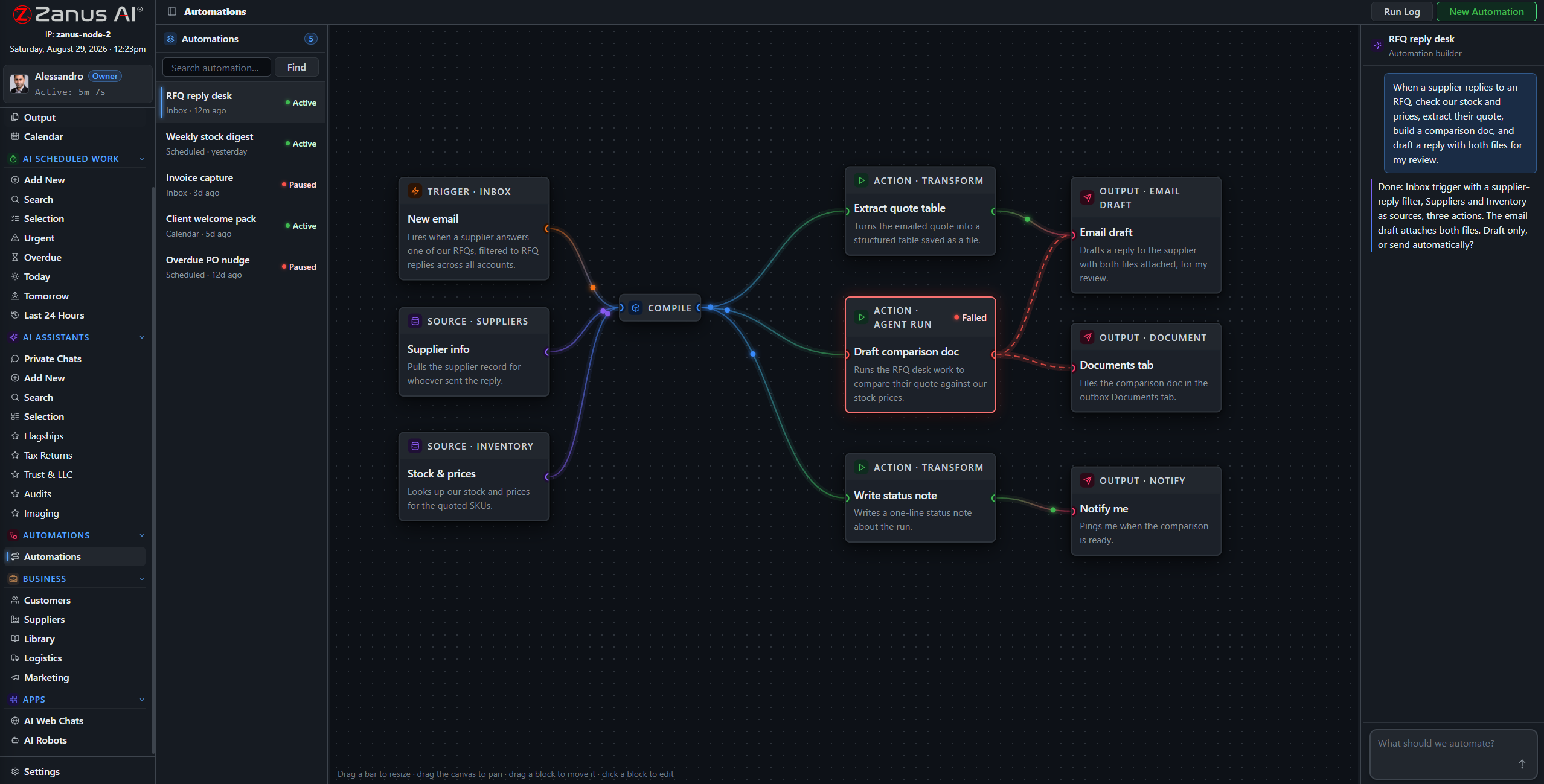
Enterprise reporting is logistics: data arrives, gets transformed, gets distributed — late at every hop. Describe each hop in plain words and it becomes connected blocks on a canvas: trigger, sources, AI step, actions — visible, retryable, audited.
Private tenant or your own servers · your whole team · SOC-2-aligned deployment path
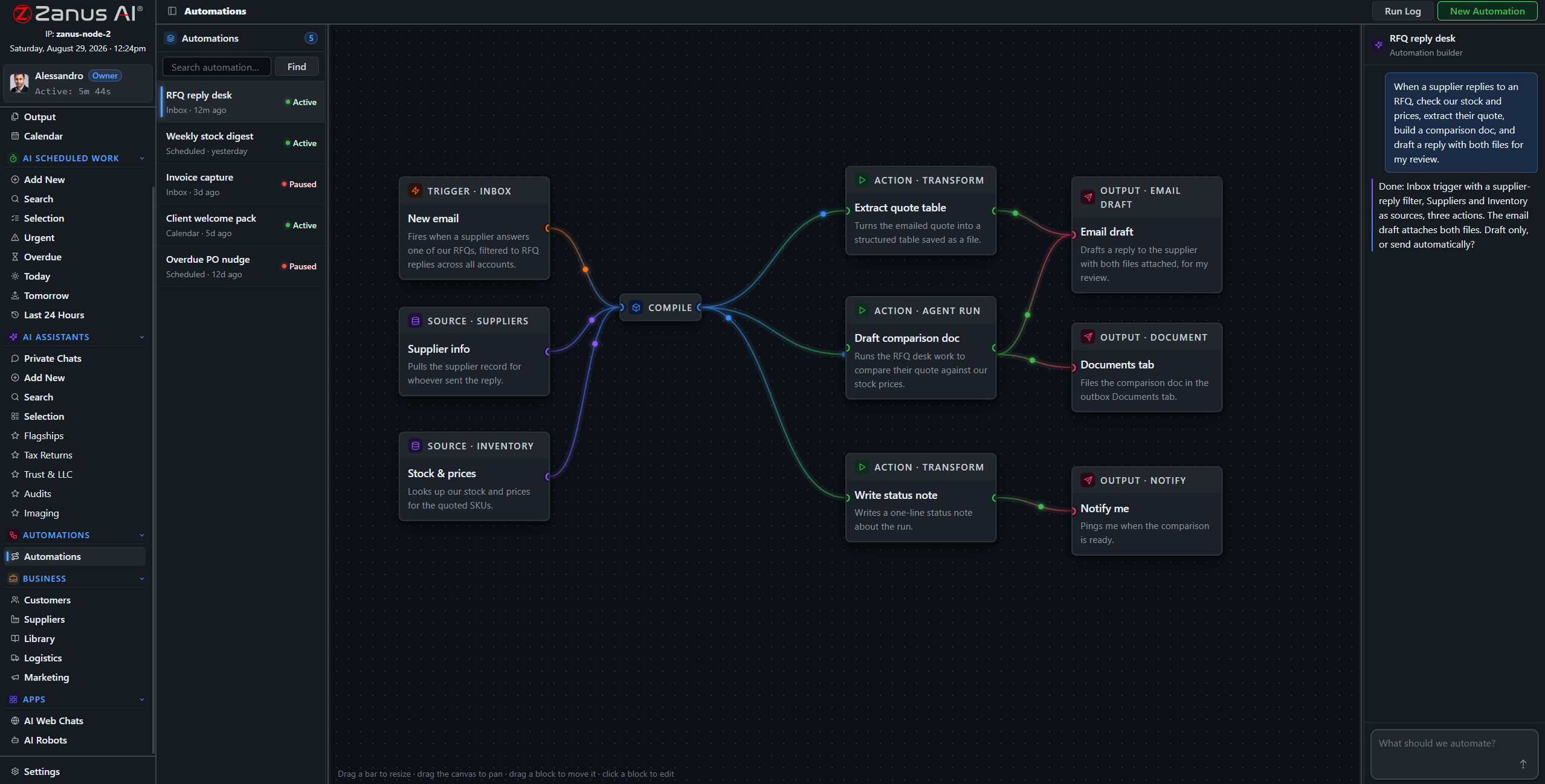
A real flow: data trigger, multi-source pull, AI compile, distribution to workgroups — every run visible.
What it does
The nightly feed completes → rollups compute, commentary drafts, the pack files to Output and the review task lands on the owner’s list — by breakfast.
A breach in the records → the playbook’s escalation path runs: owner paged, account brief drafted, response clock started — the path documented and followed become the same thing.
The weekly forecast, with reasons, distributed to each leader scoped to their org — automatically, from the same live data, no analyst weekend consumed.
Reliability you can show an auditor
Every run paints the canvas green or red on the exact block, with logs, retries and outputs statused in one place. When a control depends on a report being produced and distributed, the evidence that it ran is the system itself.
- Run log per automation, every execution kept
- One-click retry isolated to the failed block
- Runs and outputs on the searchable audit trail
Questions, answered
Who owns automations — central IT or departments?
Both, by scope: departments build flows over their own workgroups; cross-department flows sit where you place them. Every flow is visible, versioned and auditable either way.
See it working on YOUR enterprise — the demo IS the product.
ZANUS AI FOR ENTERPRISE OPERATIONS — ACCOUNT OUTREACH
No key account goes quiet.
Enterprise revenue concentrates in accounts that go quiet before they churn. QBR summaries, renewal sequences, executive updates and win-back campaigns — drafted by the AI from your own account records, in the account’s language, queued for approval.
Private tenant or your own servers · your whole team · SOC-2-aligned deployment path
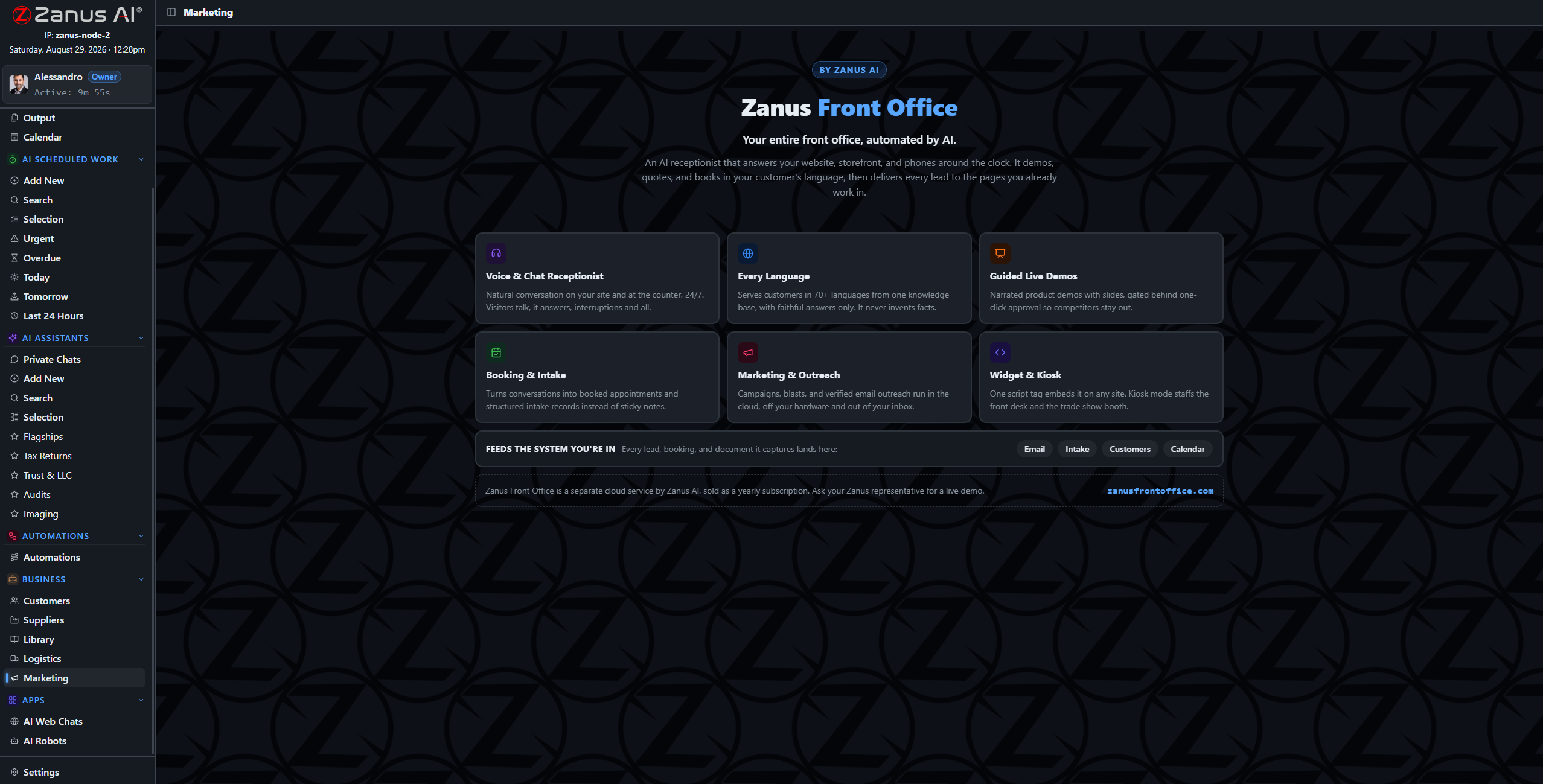
Sequences drafted from account records — renewals, QBR follow-ups, exec updates — awaiting approval.
What it does
“Every account with renewal inside 120 days and declining usage” — built from your own records inside the tenant, precise, never exported to a campaign tool.
The review ends → the summary with commitments and owners drafts itself from the meeting record — sent while the conversation is warm, not two weeks later.
Sequences begin at the interval you set, personalized from each account’s history — opened, answered and escalated visibly, with humans approving every send.
Account intelligence feeds the outreach
The same tenant holds the support history, the invoice record and the conversation transcripts — so the renewal email knows about last month’s escalation and this quarter’s expansion. Outreach written from the whole relationship, not a mail-merge field.
- Drafts grounded in the full account record
- Account data stays in the tenant — private by architecture
- Replies join the same permanent account history

Approval-first at enterprise stakes
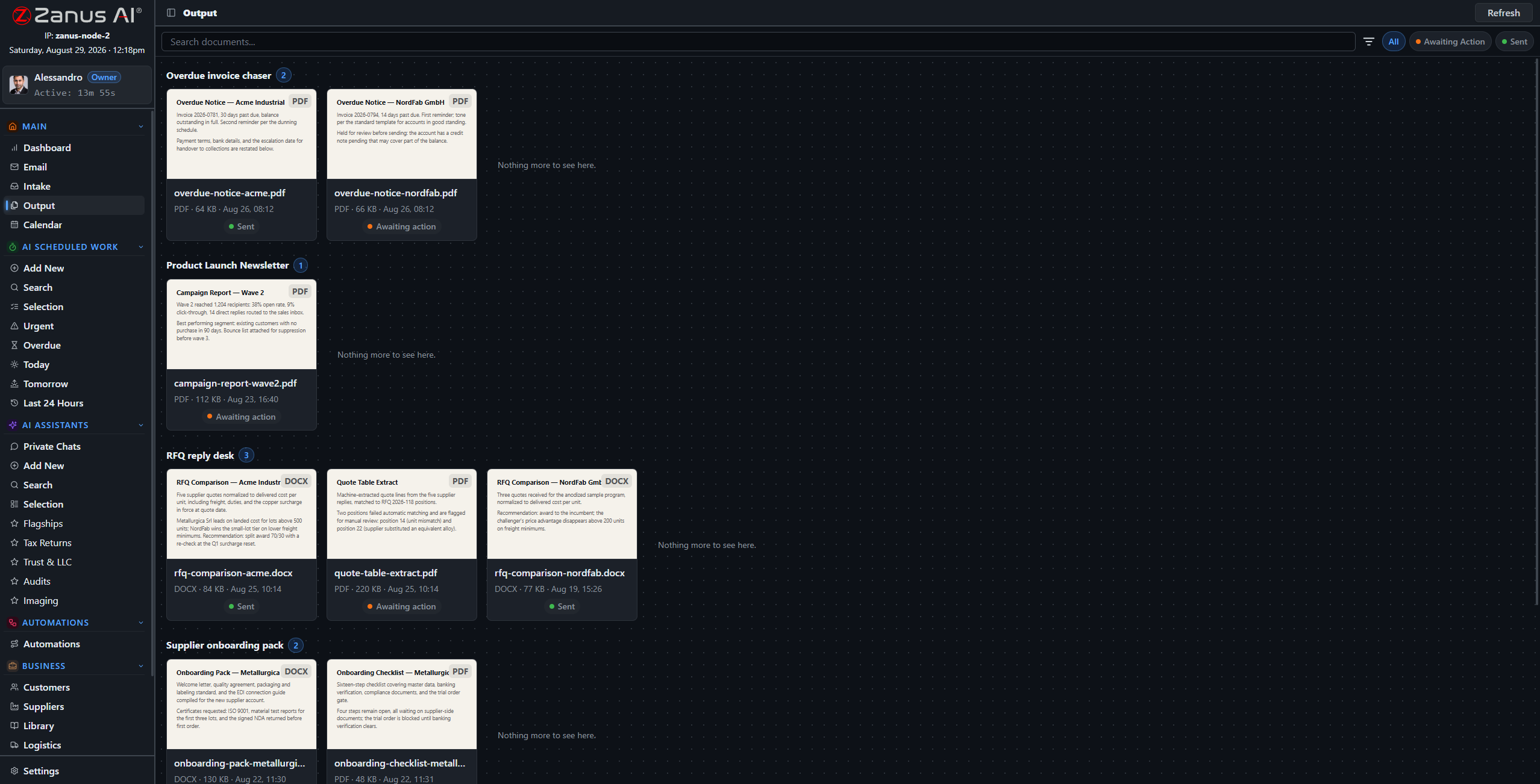
Nothing reaches a named account without the owner’s approval — sequences pause when a human needs to decide, and every send lands on the audit record with its who, what and when.
- Approval workflow per sequence and account tier
- Consent and opt-outs enforced by the system
- Results tracked: replies, meetings, renewals
Questions, answered
How does this relate to our CRM sequences?
Your CRM stays the pipeline of record — connectors sync both ways. The difference is the drafting: grounded in the full operational relationship, not just the CRM fields.
Can account owners keep control?
Structurally: sequences run under each owner’s approval, and the workgroup scoping means owners see and steer only their own book.
See it working on YOUR enterprise — the demo IS the product.
ZANUS AI FOR ENTERPRISE OPERATIONS — BI & INTEGRATIONS
Keep the warehouse. Add the narrator.
The enterprise already owns its data stack; what it lacks is the layer that reads across it and explains. Your warehouse, ERP and CRM stay the systems of record; Zanus becomes the system of work — field-mapped connectors, dry-run previews, REST API and webhooks.
Private tenant or your own servers · your whole team · SOC-2-aligned deployment path

No rip and replace: warehouse, ERP and CRM stay — the AI layer connects to all of them.
What it does
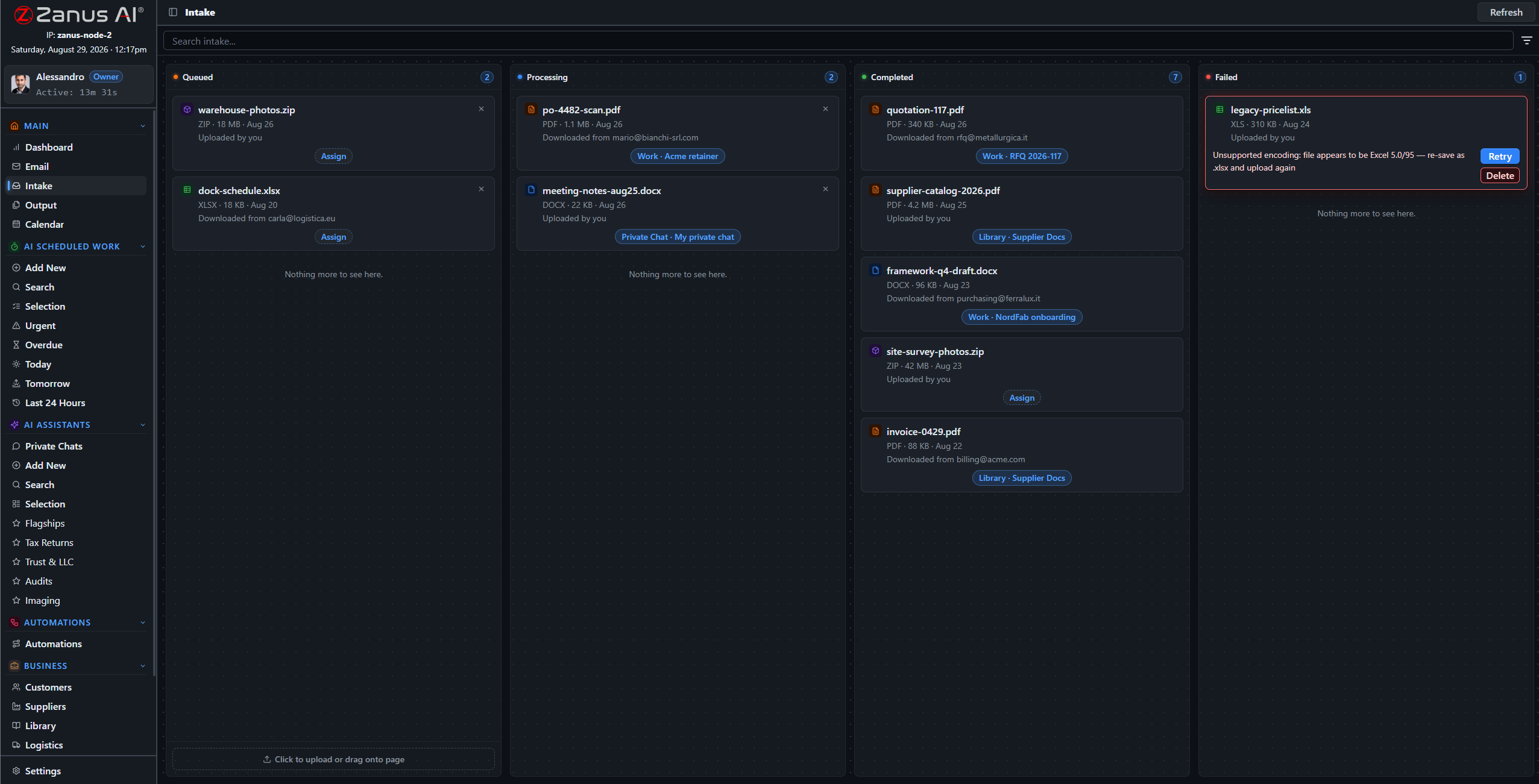
Field-by-field mapping, push, pull or two-way, and a dry-run preview showing exactly what would change — before a single production record moves.
CRM connectors sync accounts, pipelines and activity both ways — the commercial record joined to the operational one inside your tenant.
The homegrown scheduler, the regional ERP instance, the vendor portal — reachable under scoped keys, with webhooks pushing events back in real time.
The question that spans the stack
“What is the full exposure on account Northwind?” touches the CRM, the warehouse, the ticket system and the contract archive. With every source connected to one tenant, it is one question with one cited answer — and one audit entry.
- Each system stays master of its own records
- External systems appear as blocks on the automation canvas
- Every sync event on the searchable audit trail
- Bring your stack to the demo and we map it
Questions, answered
Will this fight our data governance program?
It enforces it: reads are scoped by role, writes are approval-gated with dry-run previews, and everything lands on the audit trail. Bring your governance lead to the demo.
See it working on YOUR enterprise — the demo IS the product.
ZANUS AI FOR ENTERPRISE OPERATIONS — GOVERNANCE
Enterprise controls, by construction.
At enterprise scale, governance bolted on after the fact always leaks. Zanus builds it into the architecture: five-level workgroups, field-level permissions, server-side redaction, pre-update snapshots with rollback, and an audit trail that answers auditors in searches, not weeks.
Private tenant or your own servers · your whole team · SOC-2-aligned deployment path
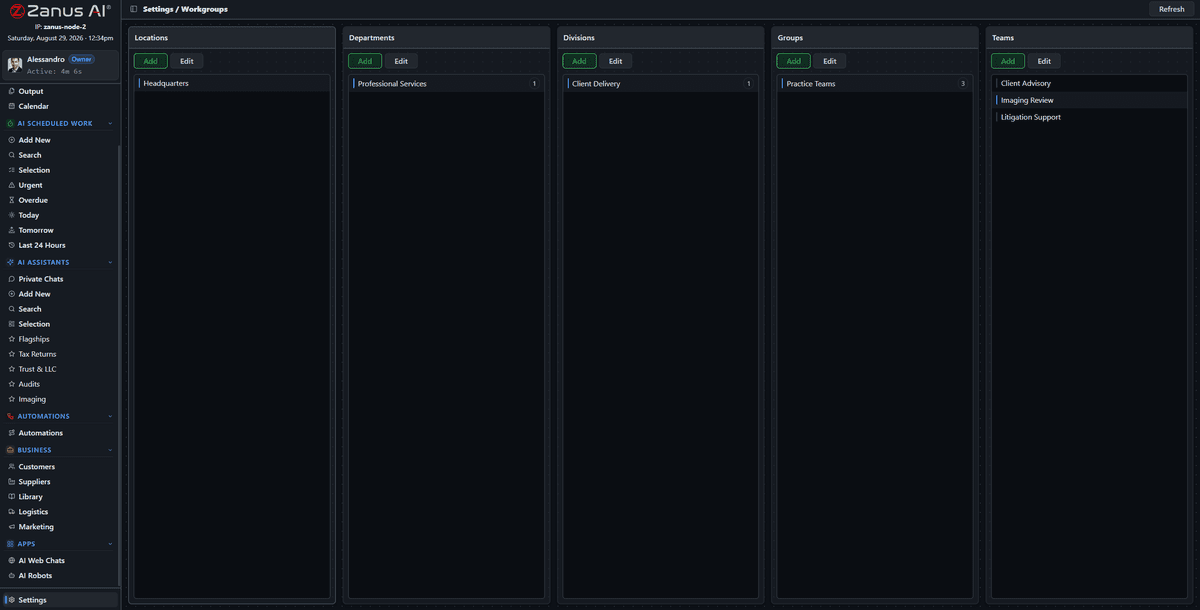
Workgroups map divisions, regions and teams five levels deep — access follows the org chart.
What it does
Divisions, regions, departments, teams: workgroups mirror your structure, and every record, report and conversation is scoped to its place in it.
A user without rights to a field never receives it — not hidden by the interface, never sent. The same question returns different answers per role, by design.
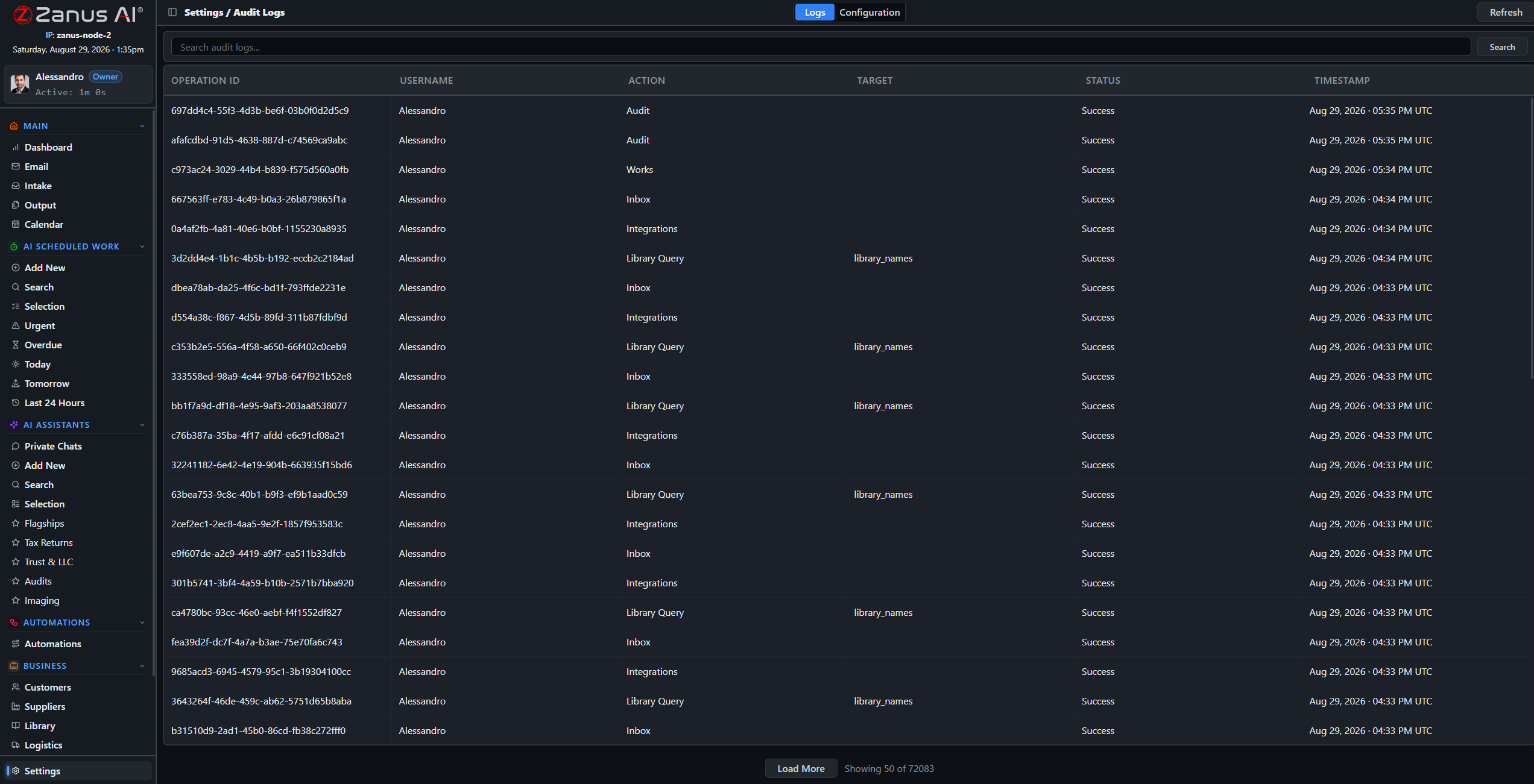
Pre-update snapshots roll back bad changes in one click, and the audit trail attributes every change to a person, a time and a before-state.
The audit that fits in an afternoon
Access reviews, change histories, evidence that controls executed: what normally takes an evidence-gathering month is a set of searches over the audit trail. And where policy requires it, the identical system runs on your own servers, air-gap capable, on a SOC-2-aligned deployment path.
- Searchable audit trail, configurable categories
- Evidence of automated controls in the run logs
- On-premises deployment for data-residency mandates
Questions, answered
Are you SOC 2 certified?
We provide a SOC-2-aligned deployment path with the architectural controls your auditors will ask about — specifics are worked through with your security team during onboarding. Bring the questionnaire to the demo.
Can one tenant serve legally separate entities?
Workgroups isolate entities inside one tenant, or entities run separate tenants on shared infrastructure — counsel usually decides which; both are supported.
See it working on YOUR enterprise — the demo IS the product.
ZANUS AI FOR ENTERPRISE OPERATIONS — LIVE DEMO
Do not watch a video.
Talk to your AI.
Enterprise software demos arrive after three discovery calls and an NDA. Ours is the product itself, configured for enterprise operations: open the chat below-right and try it — ask for a KPI digest, a variance explanation, a cross-department answer.
The conversation you have with us IS the demo
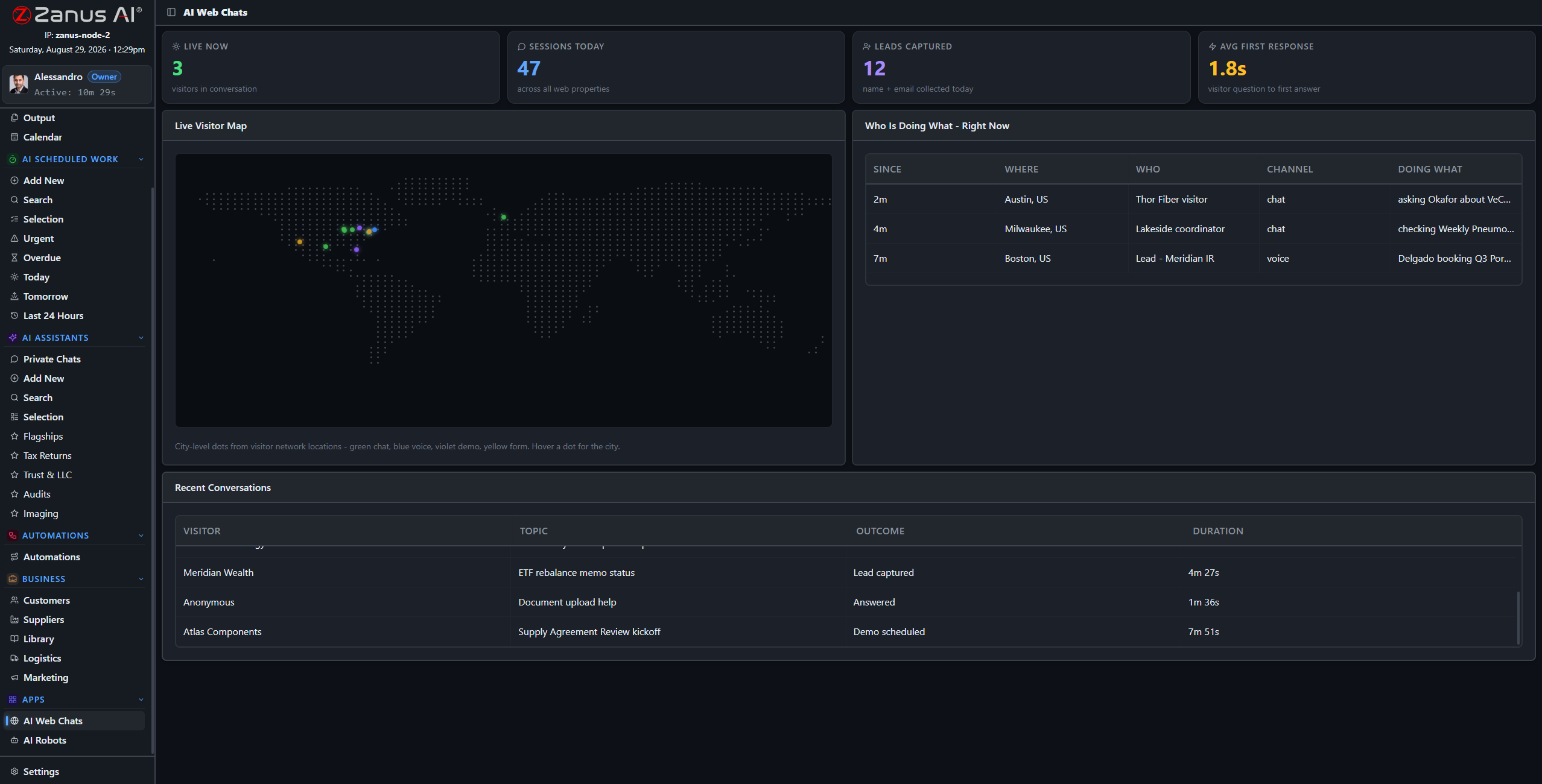
This screen watches demos like yours happen: live conversations, outcomes, first response in seconds.
What it does
Ask the chat: “how would you handle 3,000 inbound calls a day in four languages?” — it answers from the platform’s real capabilities, grounded, no vapor.
Ask: “draft me a Monday KPI digest” — it walks the exact work it would run in your tenant: sources read, figures cited, commentary drafted, sign-off last.
The full demo loads an enterprise tenant with sample divisions: cross-department rollups, forecasts with reasons, governance views — your operation at scale, working.
Or pick your exact business
Every link below is a full live-demo page for that specific business — its vocabulary, its calls, its booking rules.
Two minutes to your inbox
Request the demo and the interactive enterprise demo arrives in about two minutes — no RFP, no procurement dance to see the product. Watch it, interrupt it with questions, and bring your architecture team when YOU are ready.
- Interactive demo, enterprise-configured
- Ask questions mid-demo — it answers and resumes
- In your inbox in ~2 minutes, free

Questions, answered
Is the demo really the product?
Yes — the same AI, configured with a sample enterprise tenant. What you see is what your divisions get, with your data sources instead of the samples.
See it working on YOUR enterprise — the demo IS the product.
Sharing with a colleague? 📄 Get the PDF · ✉️ Email this page ·