ZANUS AI FOR MARKETING AGENCIES — OVERVIEW
Ten clients. Ten voices. One system.
Prospect inquiries answered and qualified while you pitch. Creative briefs, content drafts and client reports produced in each client’s brand voice, from their real materials — cleanly separated by access control, in YOUR private tenant or on your own server.
Private tenant or your own server · unlimited agency users · client separation by architecture
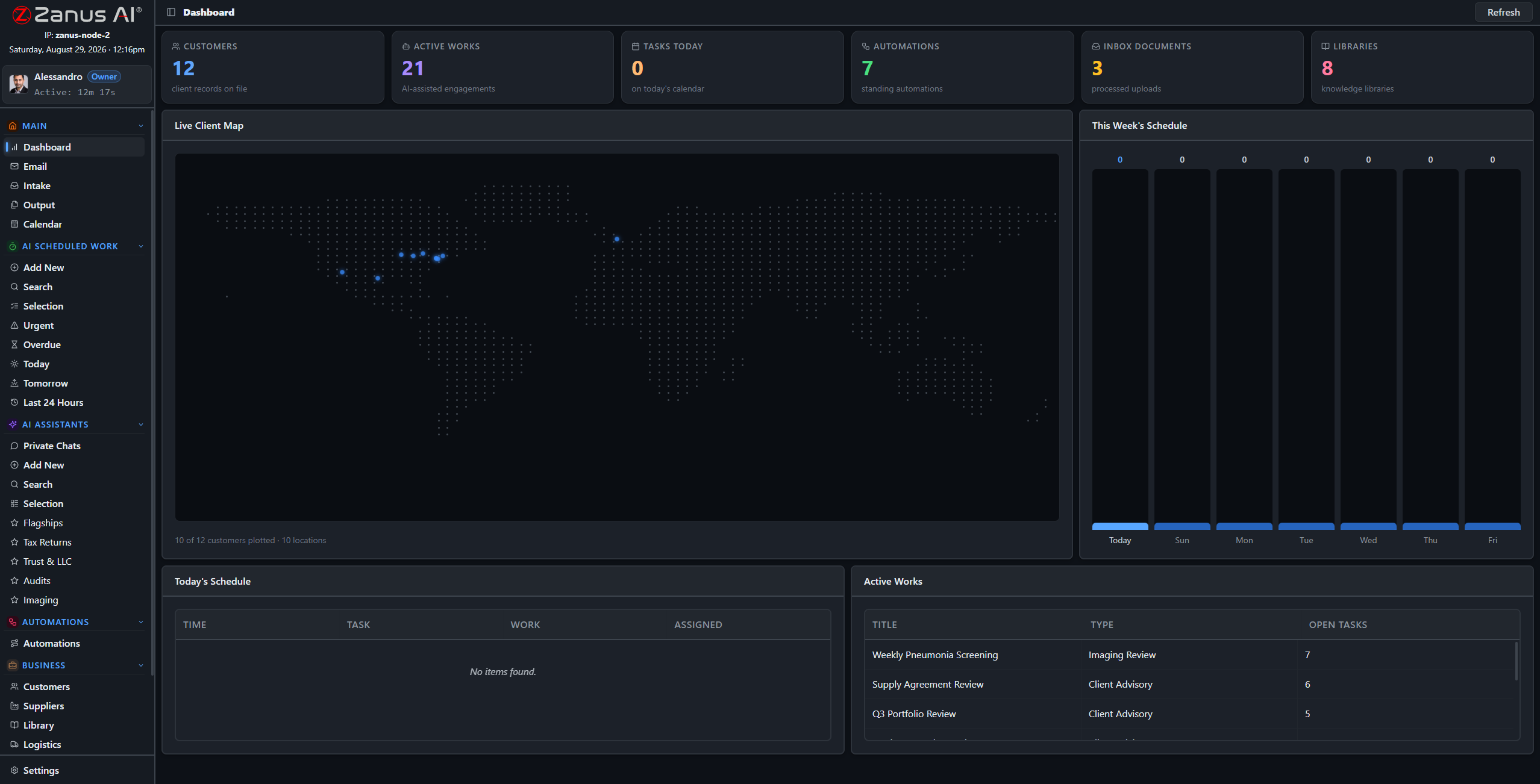
A real deployment view: client workspaces, campaign calendars, scheduled AI works and the week’s deliverables.
What it does
The AI writes from each client’s brand guidelines, past campaigns and approved copy — not from a generic model’s idea of the brand. No materials, no claims.
Client reports assembled on schedule from your data — drafted overnight, cited, waiting for the account manager’s polish instead of eating the morning.
Unlimited agency users on a flat price: every account manager, copywriter, designer and freelancer in the system — no per-seat math before you staff a pitch.
Front office: new business, never missed
A prospect fills the contact form on Friday night; by Monday they’ve chosen the agency that answered. The Zanus front office replies instantly, qualifies the lead, sends an interactive demo in about two minutes and books the discovery call into a real calendar.
- Website chat grounded in your services and cases
- Discovery calls booked into partners’ real calendars
- Interactive AI demos delivered in ~2 minutes
- See the Front Office for agencies →

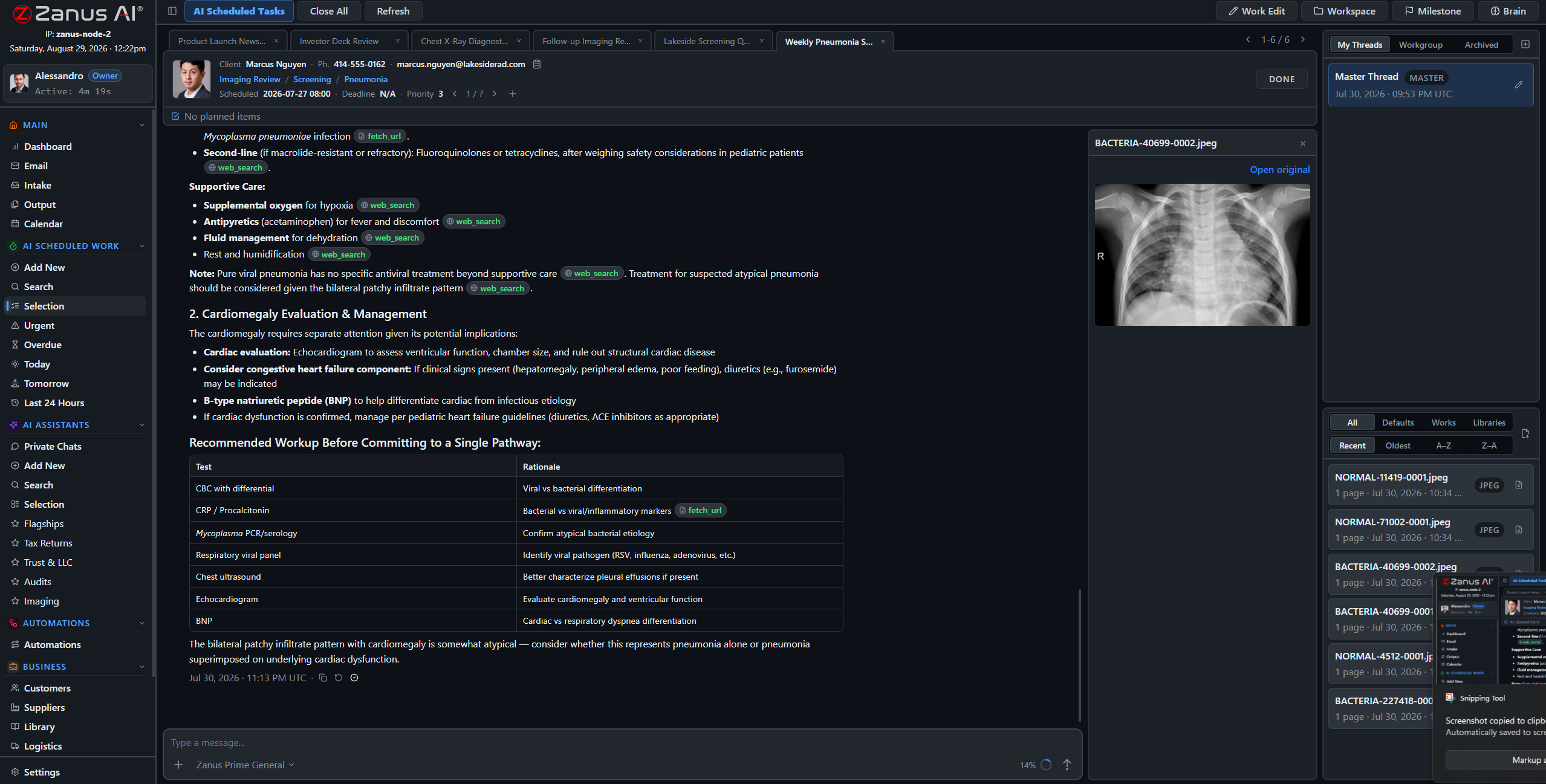
Back office: client work, drafted in their voice
Below is the machinery: per-client libraries holding brand guidelines, briefs and past campaigns — and AI work sessions drafting content, briefs and reports grounded in exactly those materials, awaiting the creative director’s sign-off.
- Per-client libraries with clean separation
- Content drafted from the client’s real materials
- Reports assembled on schedule, cited
- See the Back Office for agencies →
When a client’s NDA demands custody
Enterprise clients increasingly ask where their data sits and whose models see it. The answer: an isolated tenant that trains nobody else’s model — or the identical OS on Zanus hardware inside your own office, air-gap capable, owned outright.
- Private On-Premises AI: owned, no recurring fees
- A data-custody answer that wins pitches
- Explore the AI Servers →

Questions, answered
How does multi-client separation work?
Workgroups and permissions: each client’s materials, contacts and work live in their own space, and access is role-based down to the field level. The team on the account sees the account — nobody else does.
Will the AI mix up client voices?
Each work session reads from the libraries you attach — one client’s guidelines, one client’s campaigns. Grounding is per-client by construction, and every draft cites what it drew from.
Do freelancers count against a seat limit?
There is no seat limit. Your whole team on a flat price — staff a pitch week with five freelancers and remove them when it ships, without a licensing conversation.
See it working on YOUR agency — the demo IS the product.
ZANUS AI FOR MARKETING AGENCIES — FRONT OFFICE
The agency that answers first wins the pitch.
Prospects shortlist fast and buy from whoever responds. The Zanus front office answers your site, your inbox and your phones the minute a prospect shows up — qualifies the lead, shows what you do, and books the discovery call. 24/7, in up to 40 languages.
Private tenant or your own server · unlimited agency users · client separation by architecture

Inquiries, chats, demos sent and calls booked — one dashboard a managing partner can read.
What it does
A marketing director browses your site at 9 PM and asks about B2B experience. The AI answers from your case studies, qualifies budget and timeline, and books Monday’s call.
Interested prospects get an interactive AI demo in about two minutes — something to click, not a PDF to skim. The follow-up sequence runs itself, approval-first.
Status questions, meeting requests and asset deliveries handled instantly — the account team hears about it in the log, not in an angry Monday email.
From inquiry to discovery call, hands-free
The AI answers the inquiry, asks your qualification questions — budget, timeline, scope — checks the answers against your ideal-client profile and offers real slots on the partners’ calendars. Your team walks into Monday with booked, qualified calls.
- Your qualification questions, asked consistently
- Real calendar sync — no double-booking
- Quotes drawn from your real rate card, with payable links
- Unqualified leads politely parked, not ignored


The web front door, staffed
Website chat grounded in your services, cases and process; contact forms answered in minutes, not Mondays; every conversation logged with a transcript for the account team.
- Grounded chat on your site, 40 languages
- Web forms worked in minutes
- Every conversation logged, transcript included
- See the full Front Office tour →
Questions, answered
Can it talk about our work credibly?
It answers from your approved case studies, service pages and pricing rules — no source, no claim. It will not invent a client name or a result.
Do we keep our phone numbers?
Yes. Your numbers stay; calls route to the AI first, humans first, or any mix per line and per hour.
What happens to unqualified leads?
Your rules: a polite decline, a referral note, or a nurture sequence — drafted for approval, never burned bridges.
See it working on YOUR agency — the demo IS the product.
ZANUS AI FOR MARKETING AGENCIES — BACK OFFICE
Monday, 9 AM: every client report already drafted.
Creative briefs, content calendars, campaign copy, client reports: agency work is deliverable work. The Zanus back office drafts it from each client’s real materials, in each client’s voice — cited, separated, and waiting for human judgment before anything ships.
Private tenant or your own server · unlimited agency users · client separation by architecture
A real session: monthly client report assembled — numbers cited, narrative drafted, account manager decides.
What it does
Each client’s monthly report assembled on schedule from your data — results, narrative, next steps — in that client’s template, before the team logs in.
The kickoff notes, the SOW and the client’s brand guidelines become a structured creative brief — drafted for the strategist to sharpen, not to start.
Every draft — copy, brief, report — lands in Output awaiting review. Nothing reaches a client without the account team’s decision.
Brand voice is a grounding problem, solved
Generic AI writes generic copy. Zanus drafts from the client’s own library — brand guidelines, approved campaigns, tone documents — so the blog post sounds like the client, cites its sources, and survives the creative director’s red pen.
- Drafts grounded in the client’s approved materials
- Tone rules and banned words respected per client
- Every claim cited to the source document

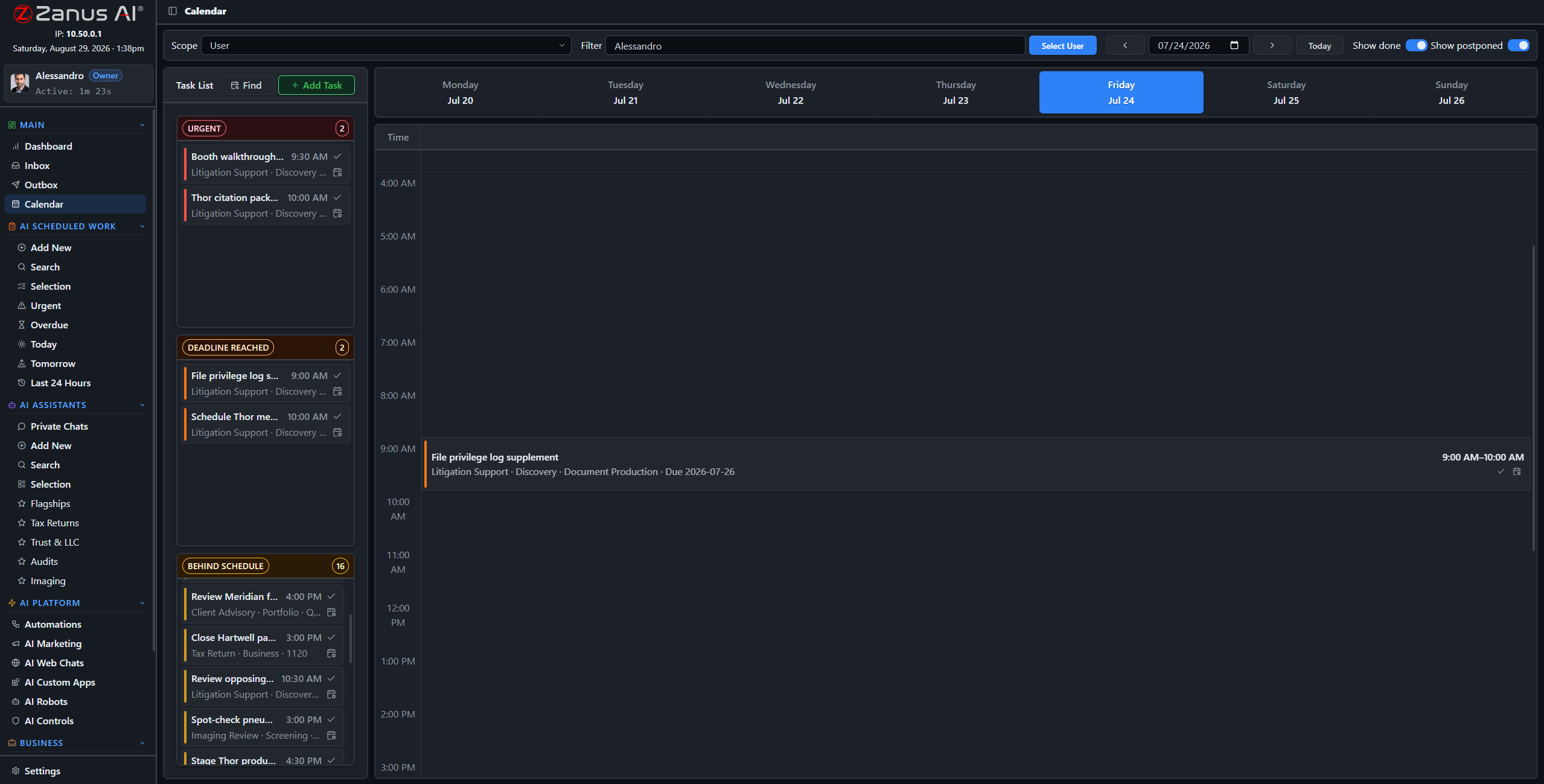
The deliverable calendar, tracked
Every client’s deadlines on shared calendars, work sessions linked to deliverables, status visible — the traffic meeting reads the system instead of reconstructing the week from memory.
- Shared human+AI calendars, tasks and projects
- Work sessions linked to clients and deadlines
- Urgent / overdue / today, one click
Questions, answered
Does AI-drafted content leave our tenant?
No — drafting happens inside your isolated tenant, grounded in the client libraries you attach. Nothing trains outside models; nothing leaks between clients.
Can it match a strict brand book?
It drafts from the brand book you load — voice, terminology, banned phrases — and your creatives review everything. Bring a real brand book to the demo and watch it work.
YOU MIGHT ALSO LIKE
The Back Office executes. Who answers the phone?
Front Office AI picks up every call and chat — books, quotes, follows up, 24/7 in 40 languages. Watch it run a business like yours, live.
See it working on YOUR agency — the demo IS the product.
ZANUS AI FOR MARKETING AGENCIES — BRAND LIBRARIES
Ten clients’ knowledge. Zero bleed.
Brand guidelines, style guides, SOWs, briefs, past campaigns, performance decks — one curated library per client, read by the AI, separated by access control. Ask in plain language; get the answer with the source cited, scoped to the account you’re on.
Private tenant or your own server · unlimited agency users · client separation by architecture
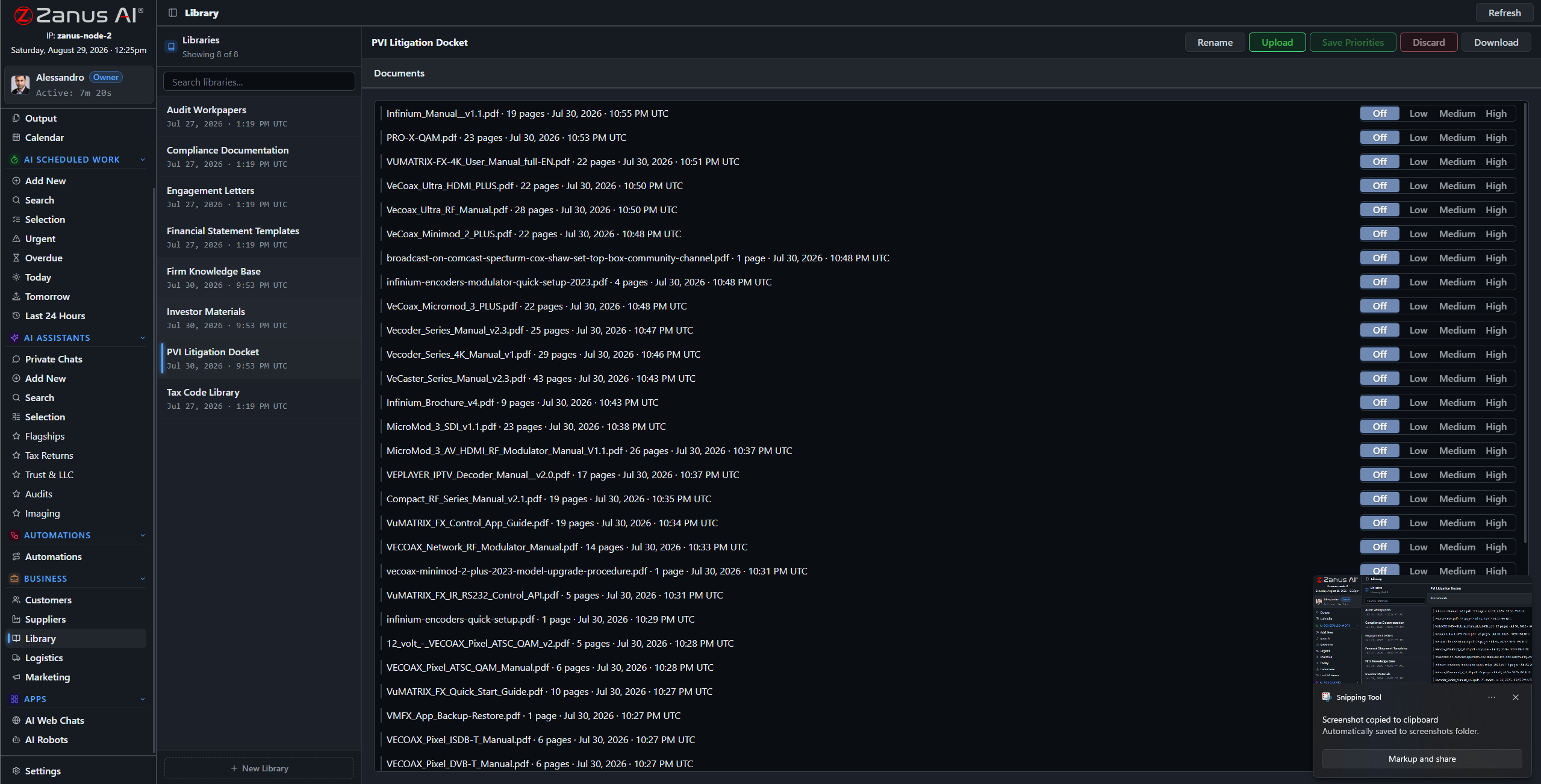
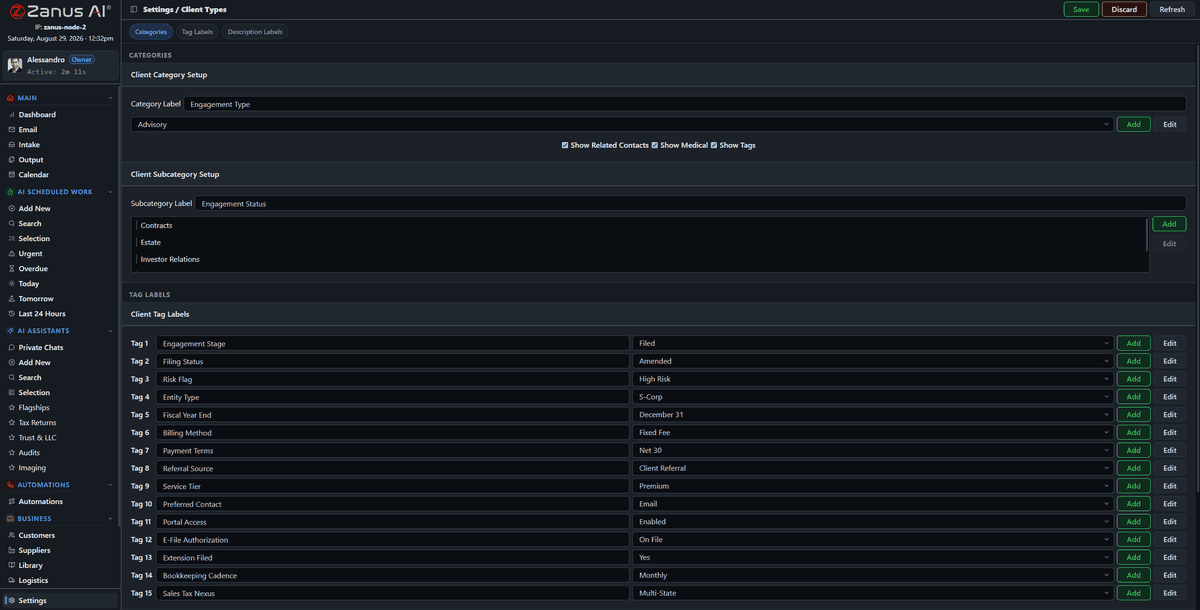
Libraries per client: signed SOWs outrank drafts, the current brand book outranks the 2022 one.
What it does
PDF brand books, decks, spreadsheets, logo sheets, recorded kickoff calls — the ingestion pipeline turns the client’s pile into queryable knowledge.
No source in the client’s library, no claim: the AI cites the brand book, the SOW, the campaign deck — or says it cannot answer. No invented brand rules.
The team on the account queries the account. Permissions are role-based and server-enforced — client A’s strategy never surfaces in client B’s chat.
Institutional memory, on demand
“What did we promise in the SOW about revisions?” “Which subject lines beat control for this client last year?” “What is their rule about competitor mentions?” The archive answers in seconds, documents attached — instead of an afternoon in old decks.
- Plain-language questions across the account history
- Sources attached to every answer
- Priority order: current brand book rules
Questions, answered
What keeps clients separated?
Workgroups, per-library permissions and server-side redaction: separation is enforced by the platform, not by team discipline. The audit trail shows exactly who accessed what.
Do client materials train outside models?
Never. Your tenant is isolated; each client’s knowledge stays in their library — a data answer you can put in an NDA conversation.
See it working on YOUR agency — the demo IS the product.
ZANUS AI FOR MARKETING AGENCIES — AI WORKFORCE
A production team that never misses a deadline.
Assign work to the AI the way you brief a team: type, client library, deadline, recurrence. Monthly reports, weekly content calendars, SOW burn checks — executed on schedule, grounded in each client’s materials, under review.
Private tenant or your own server · unlimited agency users · client separation by architecture
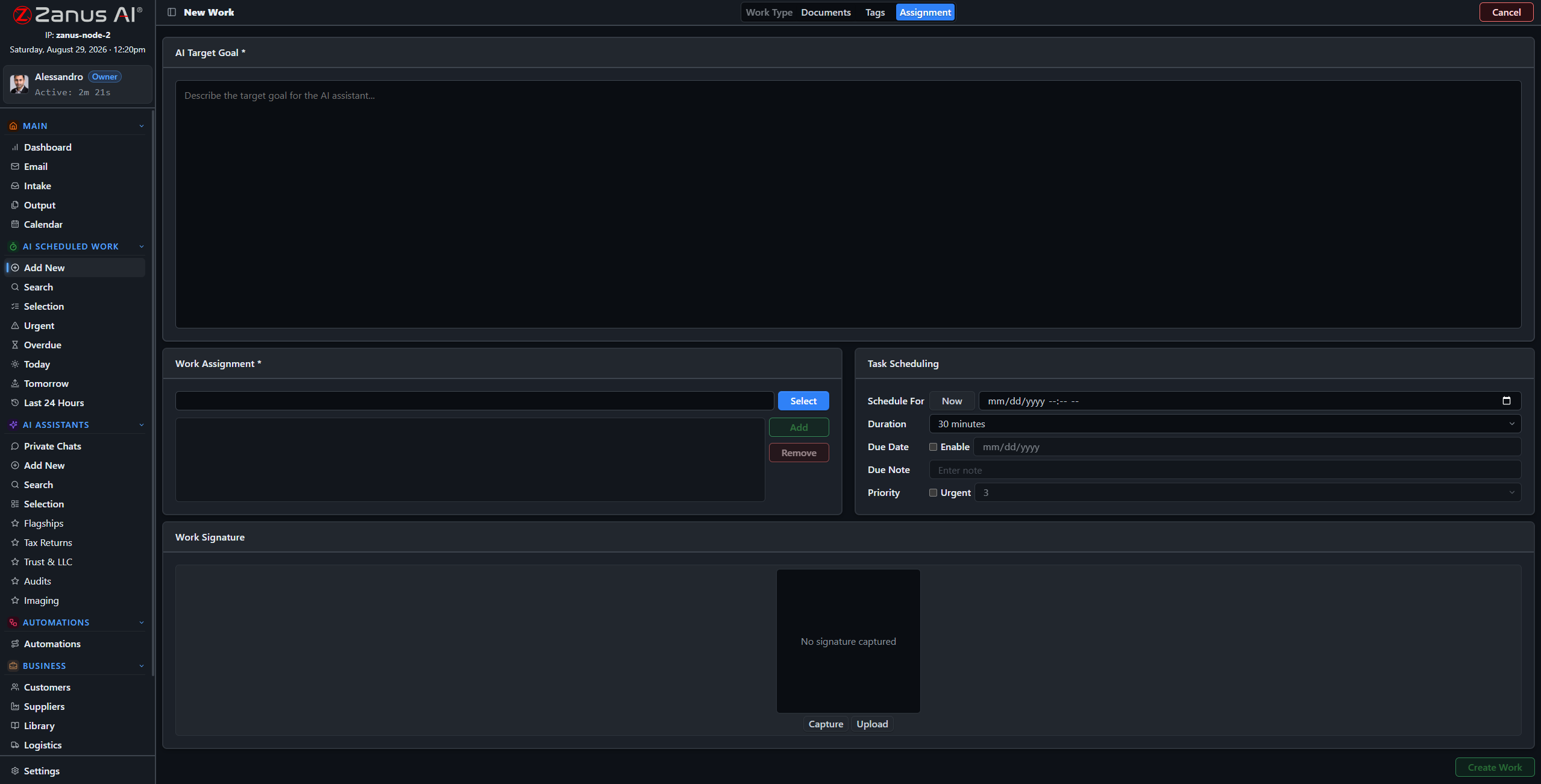
Four steps: work type, client libraries, tags, schedule — the AI takes it from there.
What it does
Client report, content calendar draft, campaign recap, SOW burn review: work types molded to your shop, each with default client libraries and examples.
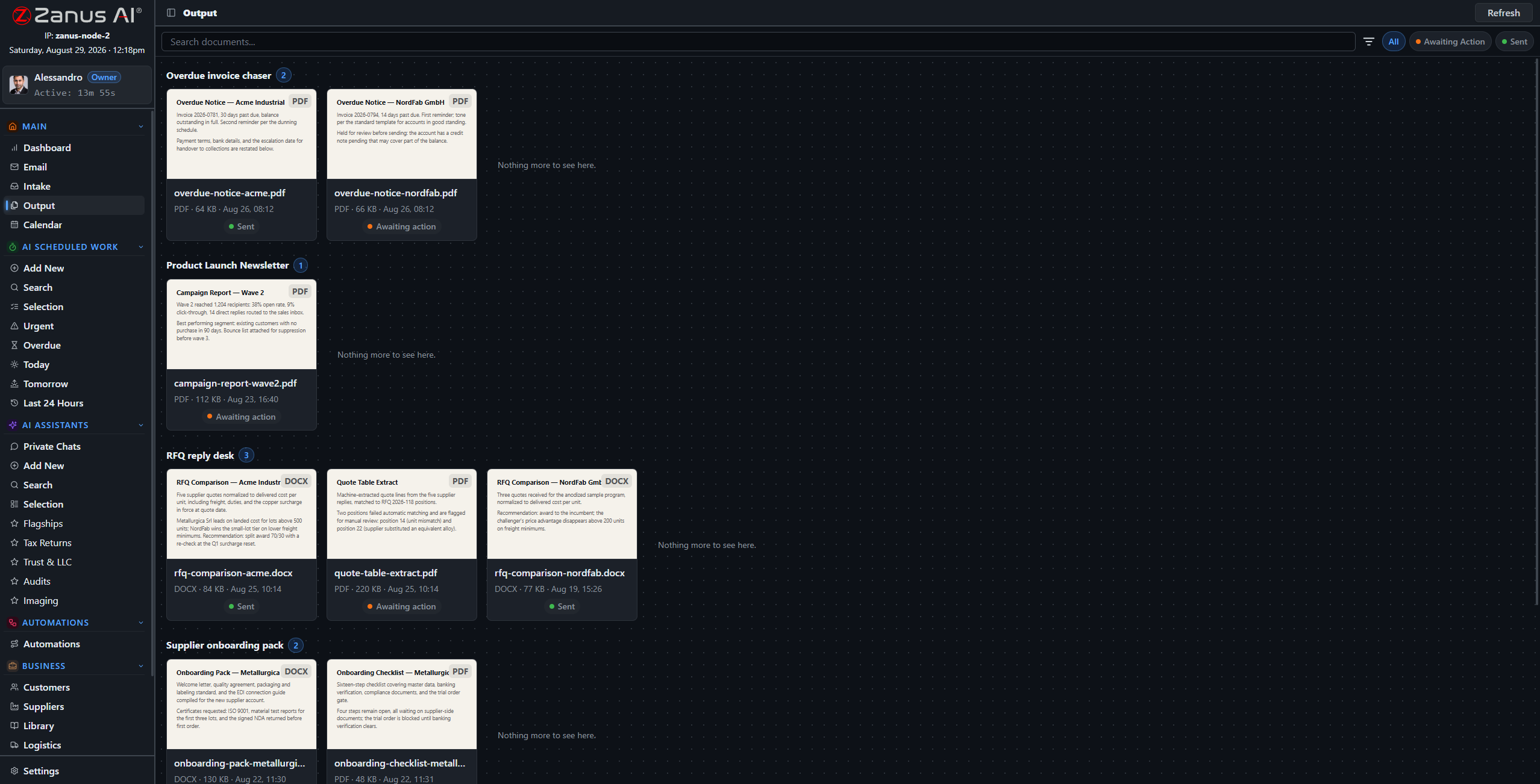
The AI’s workload reads like the traffic board: urgent, late, today, tomorrow — one click, no deliverable ages silently.
Each work is a full session: reasoning streamed, sources cited, milestones tracked, linked to the client and the calendar.
The first Monday of the month, handled
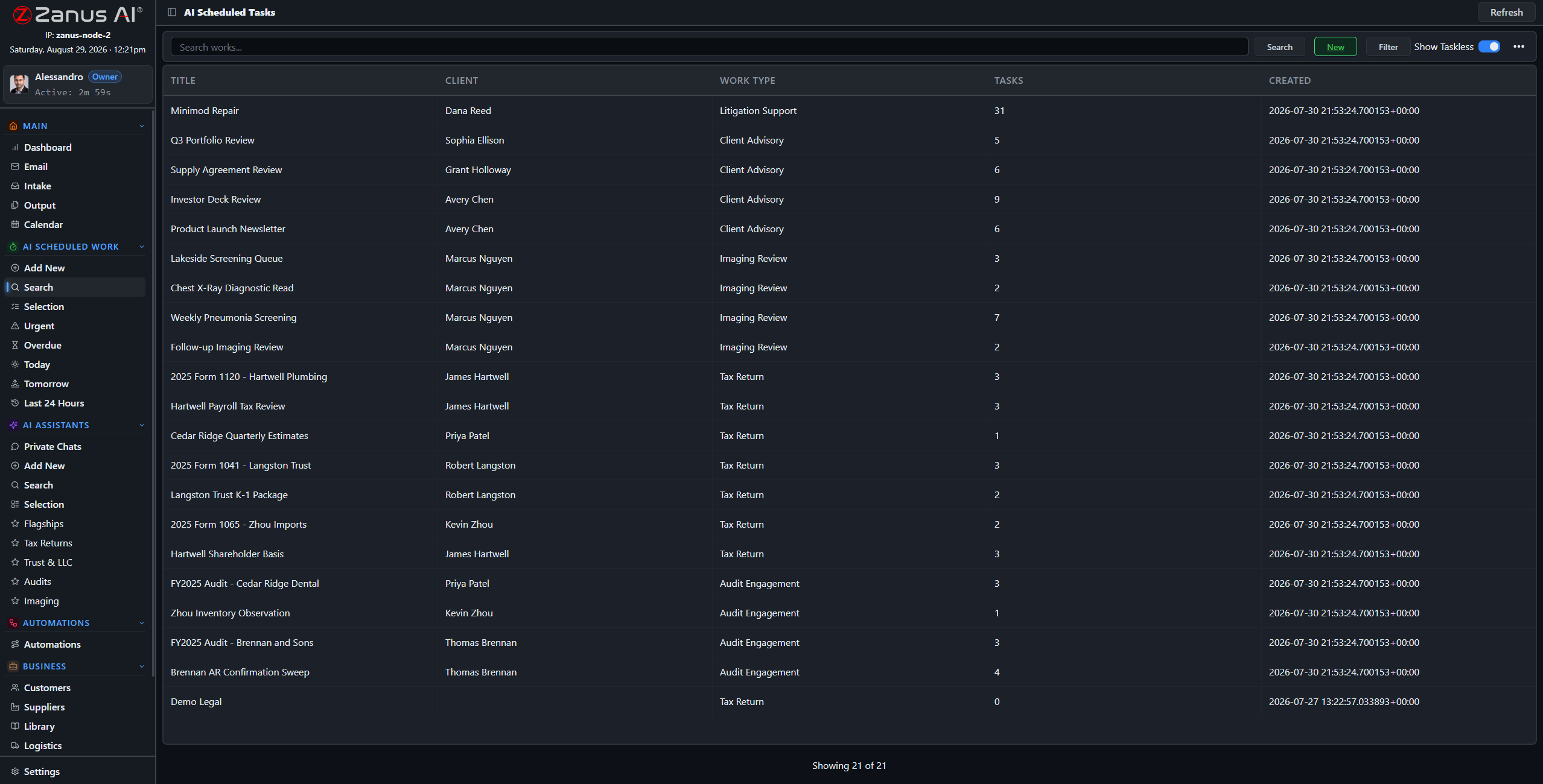
Set “Monthly Client Report” once per account: the AI assembles results from your data, drafts the narrative in the client’s template and files each report to Output over the weekend — the team polishes on Monday instead of producing from zero.
- One recurring work per client, staggered as you like
- Numbers cited to their sources
- Drafts in Output, awaiting the account manager
Wednesday: the SOW burn check
Hours and deliverables measured against scope, per account, flagged before overservicing becomes a write-off. The AI drafts the internal note; the account director decides what to do about it.
- Scope tracked against the signed SOW
- Overservice flagged early, with the math shown
- Internal notes drafted, never auto-sent
Questions, answered
Can we supervise mid-work?
Yes — open any session, read the reasoning, redirect it, or stop it. The AI works like staff: visible, accountable, interruptible.
How many clients can it handle?
It does not get tired — the constraint is your review capacity. Configurations size from a five-person studio to a multi-office network.
See it working on YOUR agency — the demo IS the product.
ZANUS AI FOR MARKETING AGENCIES — PLAYBOOKS
How the agency does things — written down, working.
Launch checklists, QA standards, naming conventions, the brand-review gauntlet: agency process usually lives in a senior’s head and dies with each resignation. In Zanus, playbooks are living documents — answerable in chat, attached to work, priority-ordered so the current version wins.
Private tenant or your own server · unlimited agency users · client separation by architecture
Playbook upkeep on the calendar: quarterly checklist reviews scheduled like client work.
What it does
Campaign launch checklist, reporting QA standard, asset naming convention, approval chain: one library, current versions on top, superseded drafts outranked.
“What is our pre-launch QA checklist for paid social?” — answered in seconds with the document attached, at 5 PM before the launch, to anyone authorized.
Work types carry their default playbooks: the AI drafting a campaign recap reads from the reporting standard — by construction.
Process that new hires can actually find
The QA miss that cost a client is the QA step nobody knew existed. Quarterly playbook reviews run as recurring AI works, update summaries land in the Monday huddle notes, and every review sits on the audit record.
- Recurring playbook reviews with deadlines
- Update summaries drafted for team briefings
- Every review on the audit record
Questions, answered
How do updates roll out?
Upload the new checklist, set it on top: from that moment every answer and every AI work cites the new version. Old versions stay archived for reference.
See it working on YOUR agency — the demo IS the product.
ZANUS AI FOR MARKETING AGENCIES — TEAM TRAINING
The new account manager sounds senior by Friday.
Agency churn is brutal and every departure takes an account’s history with it — unless the history lives in the system. New hires learn your process and their accounts from the AI, and everyone has an assistant that answers “how do we…?” instantly.
Private tenant or your own server · unlimited agency users · client separation by architecture

Training lives inside the software: the AI walks each new hire through the agency’s own playbooks.
What it does
New AMs and creatives learn your process, tools and standards through guided training — and ramp onto their accounts by reading libraries, not by shadowing for a month.
“What’s this client’s revision policy?” — asked to the assistant, answered from the SOW with the clause attached, while the creative director stays in the review.
Your whole team means the pitch-week freelancer gets a login, scoped access to one client’s library, and the same instant answers as staff.

Account knowledge that survives resignations
When the AM who “just knew” the account leaves, the brand book, the SOW, the campaign history and the client’s quirks stay queryable. The successor asks; the library answers; the client never feels the handoff.
- Answers cite the account’s live library
- Personal preset assistants per role
- Training progress visible to managers
Questions, answered
Does training content go stale?
No — the assistant answers from the live libraries. Update the playbook or the brand book once and every future answer updates with it.
See it working on YOUR agency — the demo IS the product.
ZANUS AI FOR MARKETING AGENCIES — AUTOMATIONS
The busywork between deliverables, automated.
Describe the job in plain words — “when a client emails, file it to their workspace, open a task and draft the reply in their voice” — and it becomes connected blocks on a canvas, running on its own, with every run visible.
Private tenant or your own server · unlimited agency users · client separation by architecture
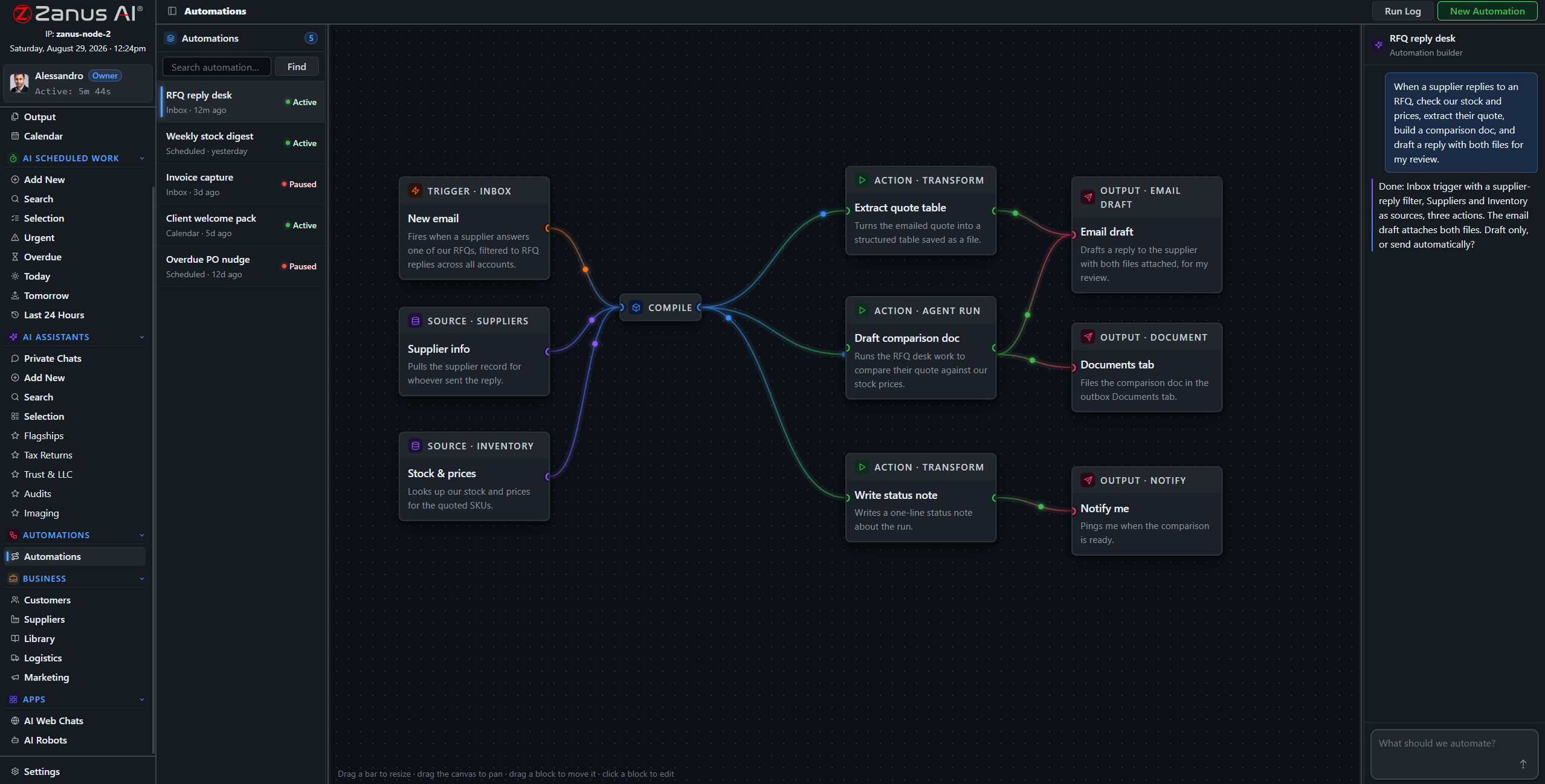
A real flow: inbox trigger, client library sources, AI drafting step, three outputs — drawn from a description.
What it does
Incoming client mail is filed to the right workspace, a task opens for the AM, and a reply drafts in that client’s tone — queued for approval, never auto-sent.
An end date triggers the wrap report: results assembled, narrative drafted in the client’s template, learnings noted for the library — waiting in Output.
A form fill at 11 PM triggers qualification, the interactive demo send and the follow-up sequence — the AM finds a warm, documented lead at 9.
When something fails, you SEE it
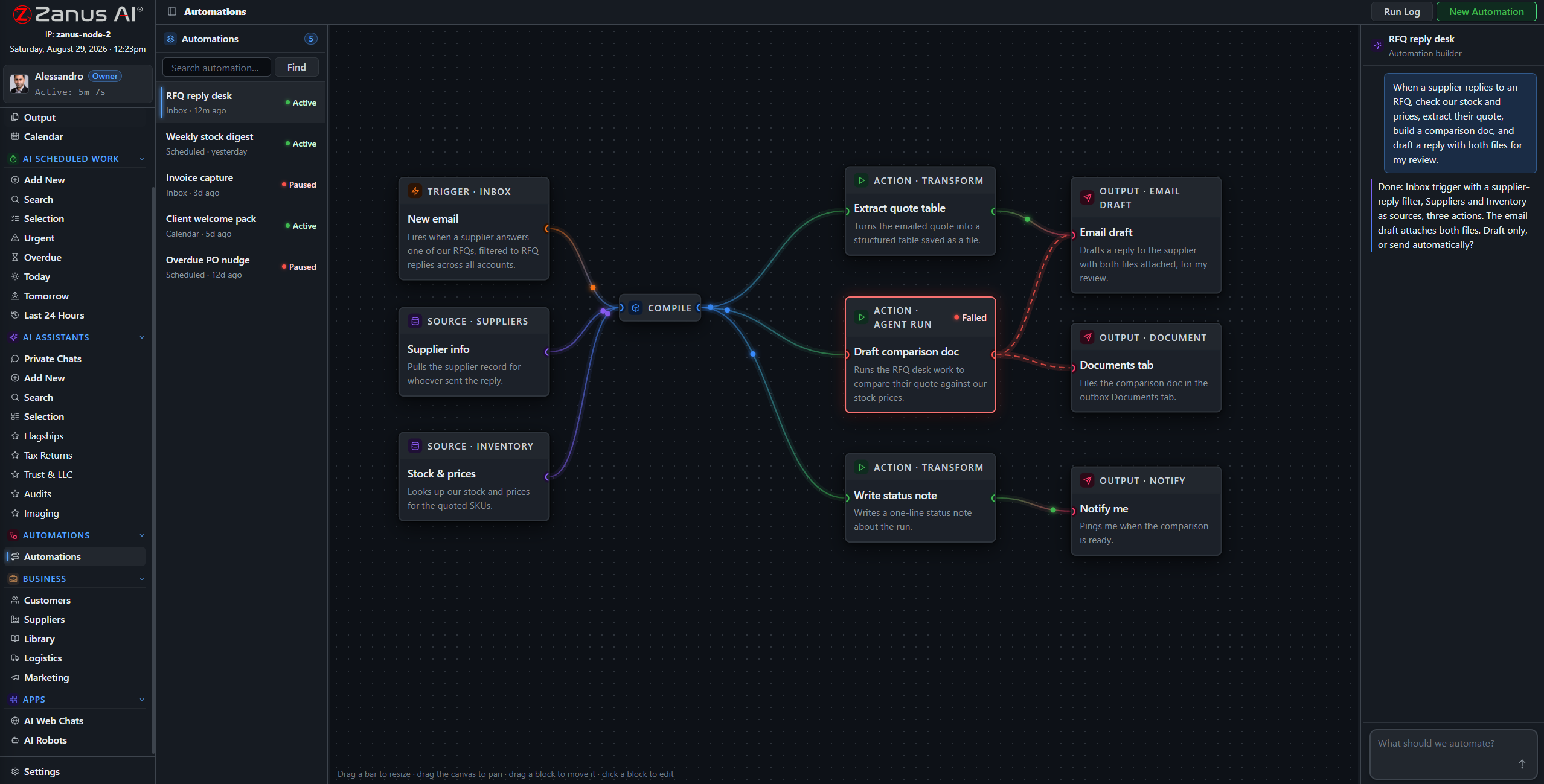
Run states live on the flow: green success, red failure on the exact block. A wrap report that silently never generated is a client call you do not want — here, nothing fails silently.
- Run log per automation
- One-click retry on failures
- Finished documents in Output, statused
Questions, answered
Who approves what reaches clients?
Your rules: queue everything for human approval, or auto-send only what you designate as safe — internal notices, say, but never client deliverables.
See it working on YOUR agency — the demo IS the product.
ZANUS AI FOR MARKETING AGENCIES — CLIENT CAMPAIGNS
Campaigns drafted in their voice. Approved in yours.
Two kinds of outbound live here: campaigns you run for clients — drafted from their audiences and their brand voice — and the agency’s own new-business sequences. Both grounded in real records, both queued for approval, both consent-clean.
Private tenant or your own server · unlimited agency users · client separation by architecture
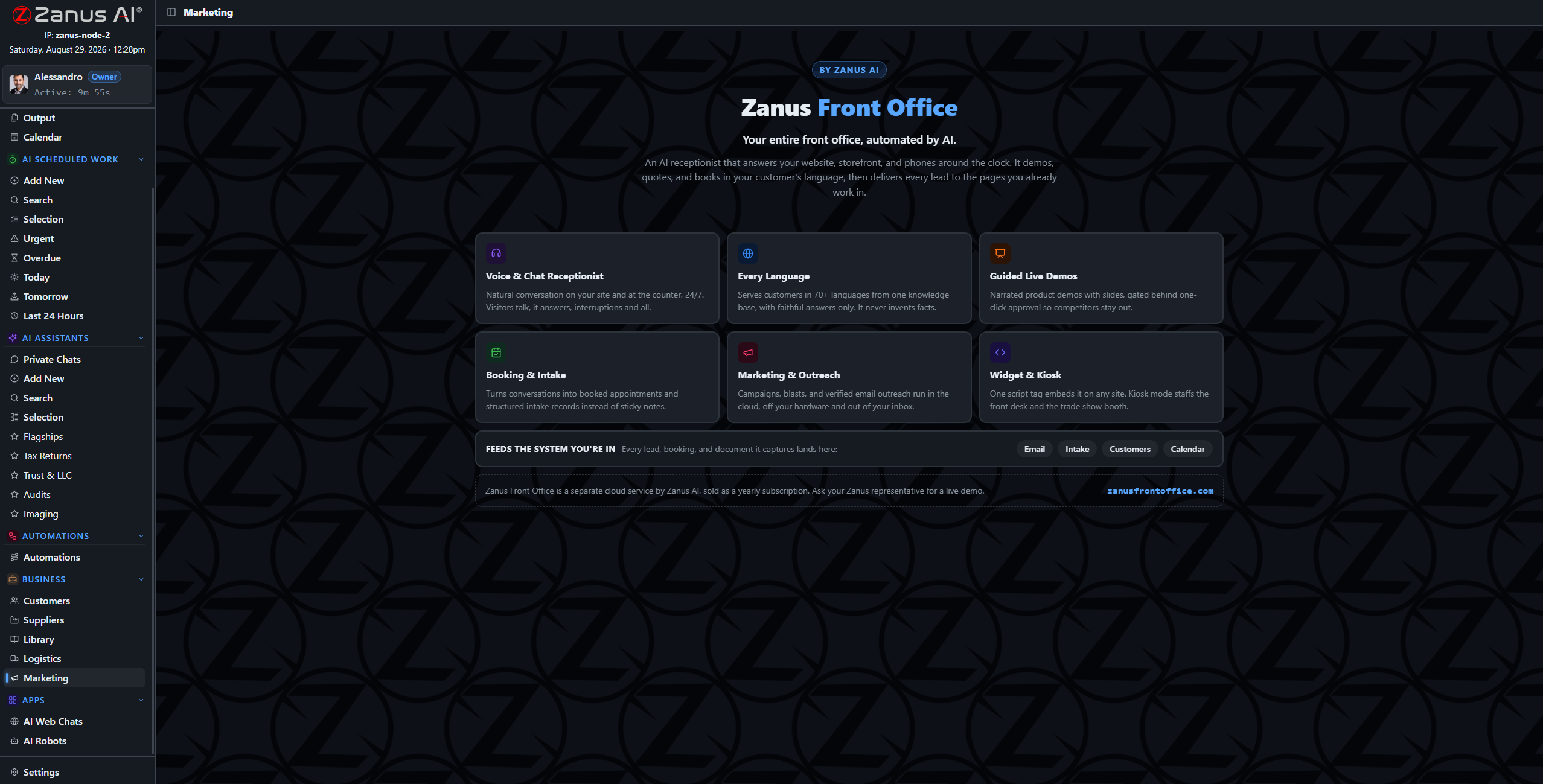
Campaigns and sequences drafted from the records — client sends and agency outbound — awaiting approval.
What it does
Segments built from the client’s own customer categories and dates inside their workspace — no CSV exports bouncing between tools.
Every draft grounds in that client’s brand book and approved campaigns — subject lines, tone, banned words — then waits for the account team’s eyes.
Past-client win-backs, case-study announcements, event invitations for the agency itself — drafted from your CRM, sequenced, approval-first.
One agency, many senders, zero cross-wires
Client A’s newsletter, client B’s reactivation sequence and your own new-business push run side by side — separated by workspace, each grounded in its own library, each with its own approval chain. Nothing sends from the wrong voice.
- Per-client campaigns with per-client grounding
- Approval chains per account
- Opt-outs and consent enforced automatically

Approval first, always
Every outbound message — client campaign or agency outreach — lands in the approval queue unless you designate the category as auto-send. Results flow back: opens, replies, bookings, on the record.
- Approval workflow per campaign and client
- Full history of what was sent for whom
- Results tracked back to the client report
Questions, answered
Can clients approve their own campaigns?
Your call: give a client contact a scoped login to review their queue, or keep approval inside the agency — permissions bend to your process.
Does it respect opt-outs?
Consent and preferences are enforced by the system per audience, and every send is auditable — for your campaigns and your clients’ alike.
See it working on YOUR agency — the demo IS the product.
ZANUS AI FOR MARKETING AGENCIES — CLIENT STACKS & INTEGRATIONS
Ten client stacks. One work layer.
Every account brings its own CRM, analytics suite and ad platforms — and none of them talk to each other. Zanus becomes the system of work across them: connectors pull the data, the AI reads it in context, and reports assemble without the copy-paste relay.
Private tenant or your own server · unlimited agency users · client separation by architecture

No rip and replace: each client’s stack stays — the AI layer connects to all of them.
What it does
The leading CRM suites and beyond: contacts, deals and activity mapped field by field, with dry-run preview — push, pull or two-way, per client.
Performance exports, briefs and assets emailed by clients route through the intake pipeline to the right workspace — filed, not lost in a thread.
A full API for the rest of the stack: analytics, ad platforms, project tools — data in, results out, under scoped keys per integration.
The report data assembles itself
Performance data lives in five tools per client; the report needs all of them. Connectors pull on schedule into the client’s workspace, the AI reads it against goals, and the monthly report drafts with every number traceable to its source.
- Field mapping with dry-run preview
- Each system stays master of its own records
- Every sync event on the audit record
- External tools appear as blocks on the automation canvas

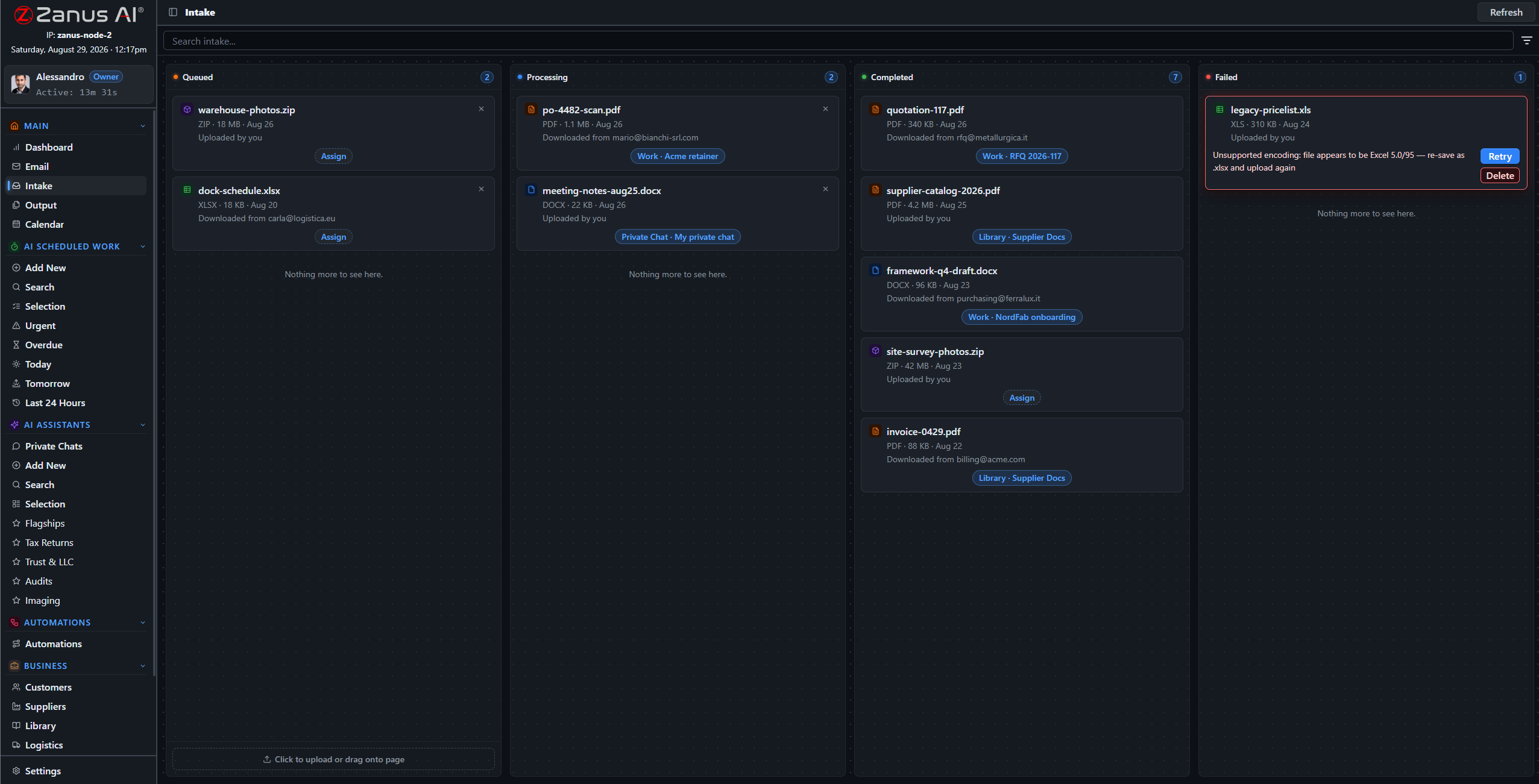
Deliverables flow back out
Approved campaign copy, audience lists, wrap reports: finished work returns to the client’s systems through the same connectors — after the account team approves, never before.
- AI output filed where the client works
- Approval workflow before anything writes back
- Webhooks notify your tools in real time
Questions, answered
Which platforms do you support?
Connectors are mapped per deployment — bring an account’s actual stack to the demo and we walk through the exact integration path.
Does client data pass through third parties?
No. The connectors run inside your tenant — or inside your office on the on-premises option. Data moves directly between systems.
See it working on YOUR agency — the demo IS the product.
ZANUS AI FOR MARKETING AGENCIES — COMPLIANCE
What client A never sees: client B.
Agencies hold competitors’ strategies under one roof — and every NDA assumes you can keep them apart. Zanus enforces it by architecture: workgroups per account, permissions to the field level, server-side redaction, and an audit trail that proves it.
Private tenant or your own server · unlimited agency users · client separation by architecture
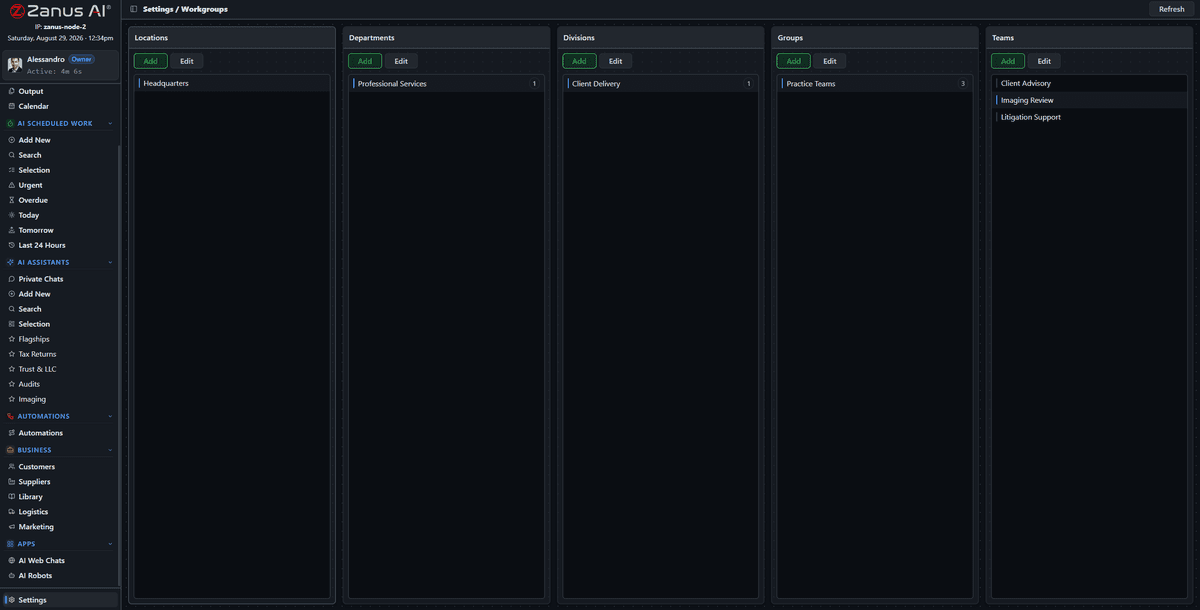
Workgroups map accounts and teams: five levels, scoped access, separation the platform enforces.
What it does
Client materials live in separate workspaces with role-based access — the wrong chat physically cannot read the wrong brand strategy.
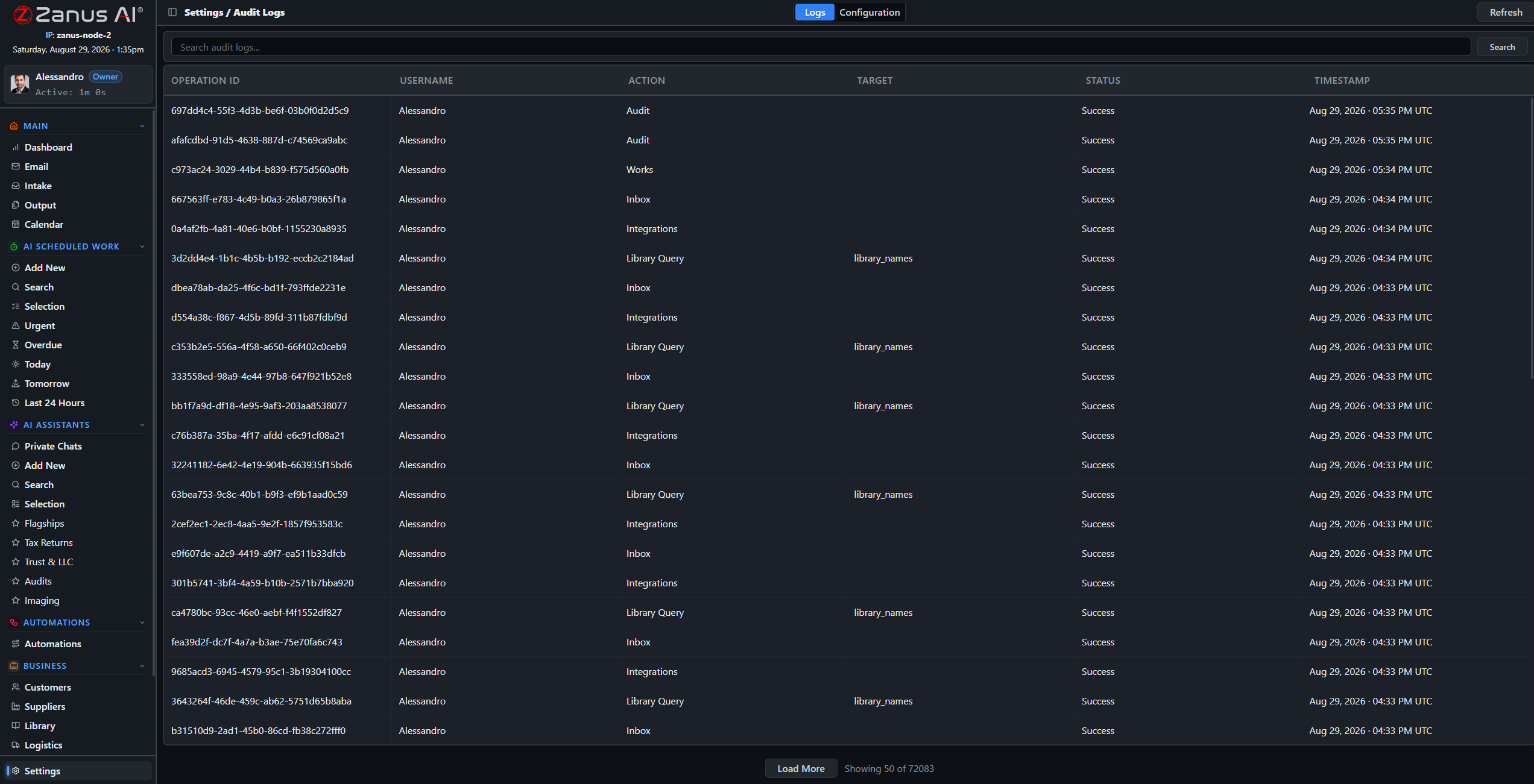
A searchable log of every audited action: who opened which client’s library, who changed which campaign, when — the answer to any client’s security questionnaire.
Nothing trains outside models; each client’s data stays in their library. Need more? The identical OS runs air-gapped on hardware you own.
The security questionnaire, answered in an afternoon
Enterprise clients send 40-page vendor questionnaires. The answers here are architectural: isolated tenant, field-level permissions, server-side redaction, searchable audit trail, pre-update snapshots with rollback — and an on-premises option when procurement insists.
- Searchable audit trail with configurable categories
- Automatic pre-update snapshots with rollback
- USB updates for air-gapped deployments
Questions, answered
Can we prove separation to a client?
Yes — permissions are inspectable, access is logged, and the audit trail shows exactly who touched their materials. Bring their questionnaire to the demo.
Where does client data live?
In your isolated tenant — never training outside models — or fully on-premises on hardware you own, physically incapable of internet exposure.
See it working on YOUR agency — the demo IS the product.
ZANUS AI FOR MARKETING AGENCIES — LIVE DEMO
Pitch decks are easy.
Talk to the product.
Big vendors show agency demos as videos behind a form. Ours is the product itself, configured for agencies: open the chat below-right and try it — qualify a fake lead, ask for copy in a sample brand voice, request a demo of the reporting workflow.
The conversation you have with us IS the demo
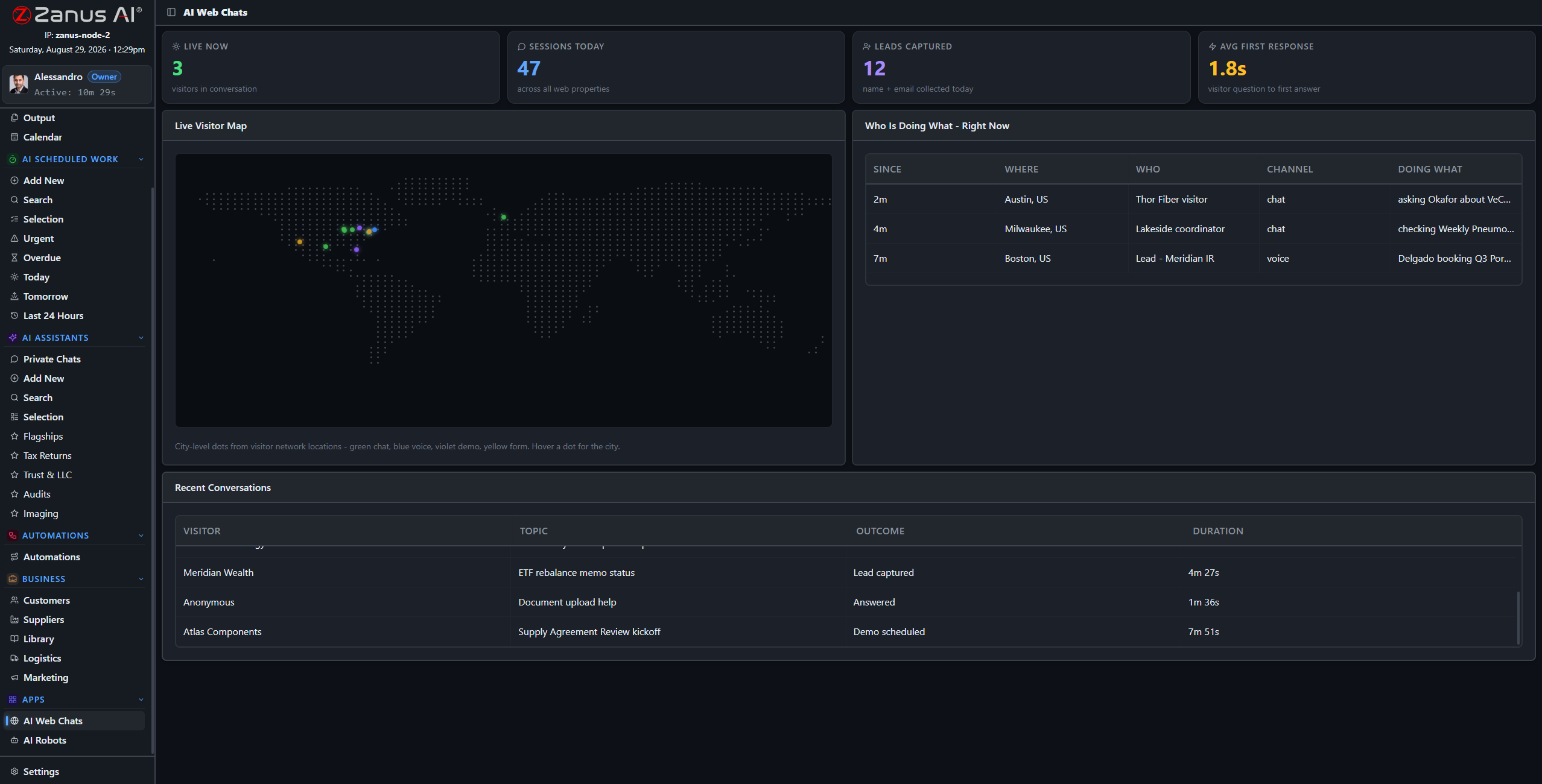
This screen is watching demos like yours happen: live conversations, outcomes, first response in seconds.
What it does
Ask the chat: “we need help with paid social for a DTC brand” — watch it qualify, answer from sample cases and offer the discovery slot.
Ask: “how would you draft a monthly client report?” — it walks the workflow it would run in your tenant, grounded, cited, sign-off included.
The full demo loads an agency tenant with sample clients: brand-voice drafting, report assembly, clean separation — your shop, working.
Or pick your exact business
Every link below is a full live-demo page for that specific business — its vocabulary, its calls, its booking rules.
Two minutes to your inbox
Request the demo and the interactive agency demo arrives in about two minutes — no sales call, no calendar dance. Watch it, interrupt it with questions, and book the human conversation when YOU are ready.
- Interactive demo, agency-configured
- Ask questions mid-demo — it answers and resumes
- In your inbox in ~2 minutes, free

Questions, answered
Is the demo really the product?
Yes — the same AI, configured with a sample agency tenant. What you see is what your team gets, with your clients’ libraries instead of the samples.
See it working on YOUR agency — the demo IS the product.
Sharing with a colleague? 📄 Get the PDF · ✉️ Email this page ·