ZANUS AI FOR BROADCASTING & MEDIA — OVERVIEW
The quote is in there. Now you can find it.
Twenty years of footage, transcribed and searchable to the second — click a result and it plays at the exact moment. Scripts, summaries and metadata drafted from your own content. One AI system for the audience side and the newsroom side — isolated in YOUR private tenant, or on servers the station owns.
Private tenant or your own servers · your whole team · your archive stays yours
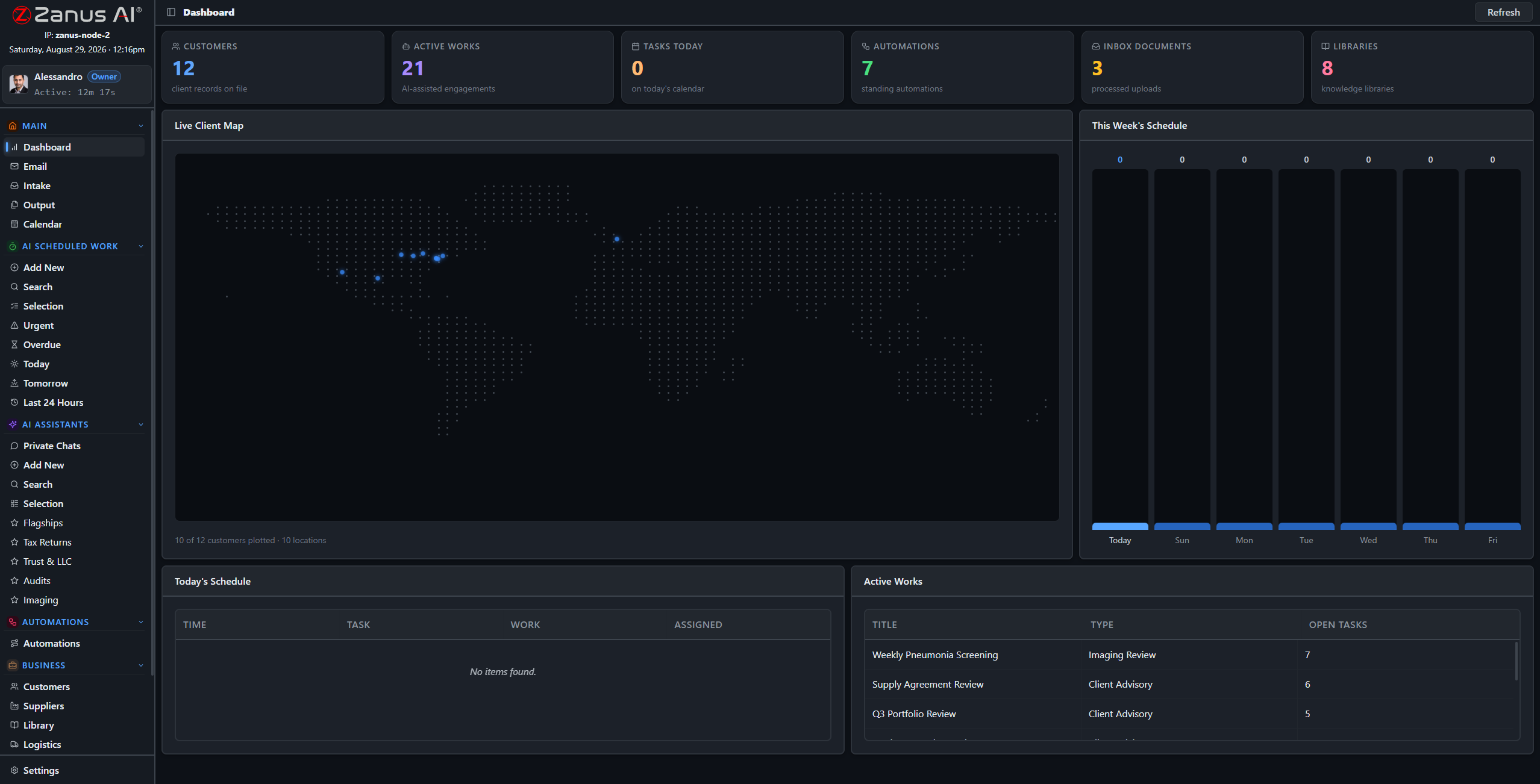
A real deployment view: archive libraries, scheduled AI works, the day’s production drafts in progress.
What it does
Every hour of footage transcribed and indexed — search by what was SAID, not by what someone remembered to tag, and jump straight to the second with click-to-play timestamps.
Summaries, script drafts, metadata and rundown research compiled from your own content — reviewed by producers before anything airs.
Your tenant is isolated; decades of your content train nobody else’s model. Need more? The same OS runs on hardware you own, inside your building.
Front office: the audience and advertiser side, handled
Advertiser inquiries, audience calls, coverage requests and press contacts: the Zanus front office answers every ring on your menu, in the caller’s language, books meetings into real calendars and answers from your approved information — 24/7, in up to 40 languages.
- AI phone on your menu and voices, 24/7
- Ad sales inquiries qualified and followed up
- Meetings booked into real synced calendars
- See the Front Office for media →

Back office: the newsroom side, working
The producer asks “when did the mayor say that about the stadium?” and gets the clip, the transcript and the timestamp — in seconds, not an afternoon of scrubbing. Scripts, digests and archive research become scheduled AI work with citations.
- Search decades of footage to the second
- Scripts and summaries drafted from your own content
- Finished documents await producer sign-off
- See the Back Office for newsrooms →
When the archive cannot leave the building
Stations and studios with rights-sensitive libraries run the identical OS on Zanus hardware inside their own facility: air-gap capable, USB updates, your whole team — the archive physically incapable of leaving.
- Private On-Premises AI: owned, no recurring fees
- On-Prem Tokens Server for high-volume transcription
- Explore the AI Servers →

Questions, answered
How does footage search actually work?
Your media is ingested and transcribed; the transcripts are indexed to the second. Search in plain language, get the matching moments with click-to-play timestamp markers — the result opens at the exact point in the recording.
Does our content train outside models?
Never. Your tenant is isolated; decades of your footage, scripts and rights documents are yours alone — and the on-premises option keeps them physically inside your building.
We run three stations — one system?
Yes: one tenant with workgroups per station, or separate tenants on shared infrastructure. News, sales and engineering each see exactly what their role allows.
See it working on YOUR station — the demo IS the product.
ZANUS AI FOR BROADCASTING & MEDIA — FRONT OFFICE
Every advertiser call answered. Every lead worked.
The sales line rings during the newscast, the audience calls after it, and the press inquiry lands at 9 PM. The Zanus front office answers on your menu, in your voices, qualifies, books and follows up — 24/7, in up to 40 languages.
Private tenant or your own servers · your whole team · your archive stays yours

Calls, chats, bookings and follow-ups — one dashboard the sales manager can read.
What it does
A local business owner calls about airtime after closing their shop. The AI answers in one ring, qualifies the inquiry, books the meeting with the account executive, and sends the media kit.
Program schedules, contest rules, how to submit a story tip, where to find the stream: answered instantly and identically every time, from YOUR approved information.
Event organizers and PR contacts reach a voice that takes the details, logs the transcript and routes the request to the assignment desk — nothing lost on voicemail.
From sales inquiry to booked meeting, hands-free
The AI answers, checks what the advertiser wants to reach, offers real open slots on the account executive’s calendar, books the meeting and sends the follow-up — while your sales team works the pipeline instead of the switchboard.
- Real calendar sync — no double-booking
- Lead qualification and follow-up sequences
- Quotes drafted from your real rate information with payable links
- Every conversation logged, transcript included


The web works too
Website chat that answers like your best front-desk producer, web forms for coverage requests and advertising inquiries worked in minutes, and instant responses to every message — lead-to-meeting in minutes, not voicemail days.
- Grounded chat on your site, 40 languages
- Advertising inquiry forms worked in minutes
- Story tips logged and routed with transcripts
- See the full Front Office tour →
Questions, answered
Can it handle breaking-news call surges?
It answers every line simultaneously — no busy signal — with your approved public information, and routes tips and urgent matters to staff by your rules.
Do we keep our phone numbers?
Yes. Your station and sales numbers stay; calls route to the AI first, staff first, or any mix per line and per hour.
What about editorial calls?
Anything editorial — interview requests, source calls, corrections — is escalated to your newsroom by your rules. The AI takes the details; your journalists make the calls.
See it working on YOUR station — the demo IS the product.
ZANUS AI FOR BROADCASTING & MEDIA — BACK OFFICE
The newsroom runs on deadlines.
The archive now keeps up.
Rundowns, scripts, archive pulls, rights checks, metadata: production is documentation moving at air speed. The Zanus back office turns your content library into a working AI staff — researching, drafting and answering with the source clip cited, under your producers’ sign-off.
Private tenant or your own servers · your whole team · your archive stays yours
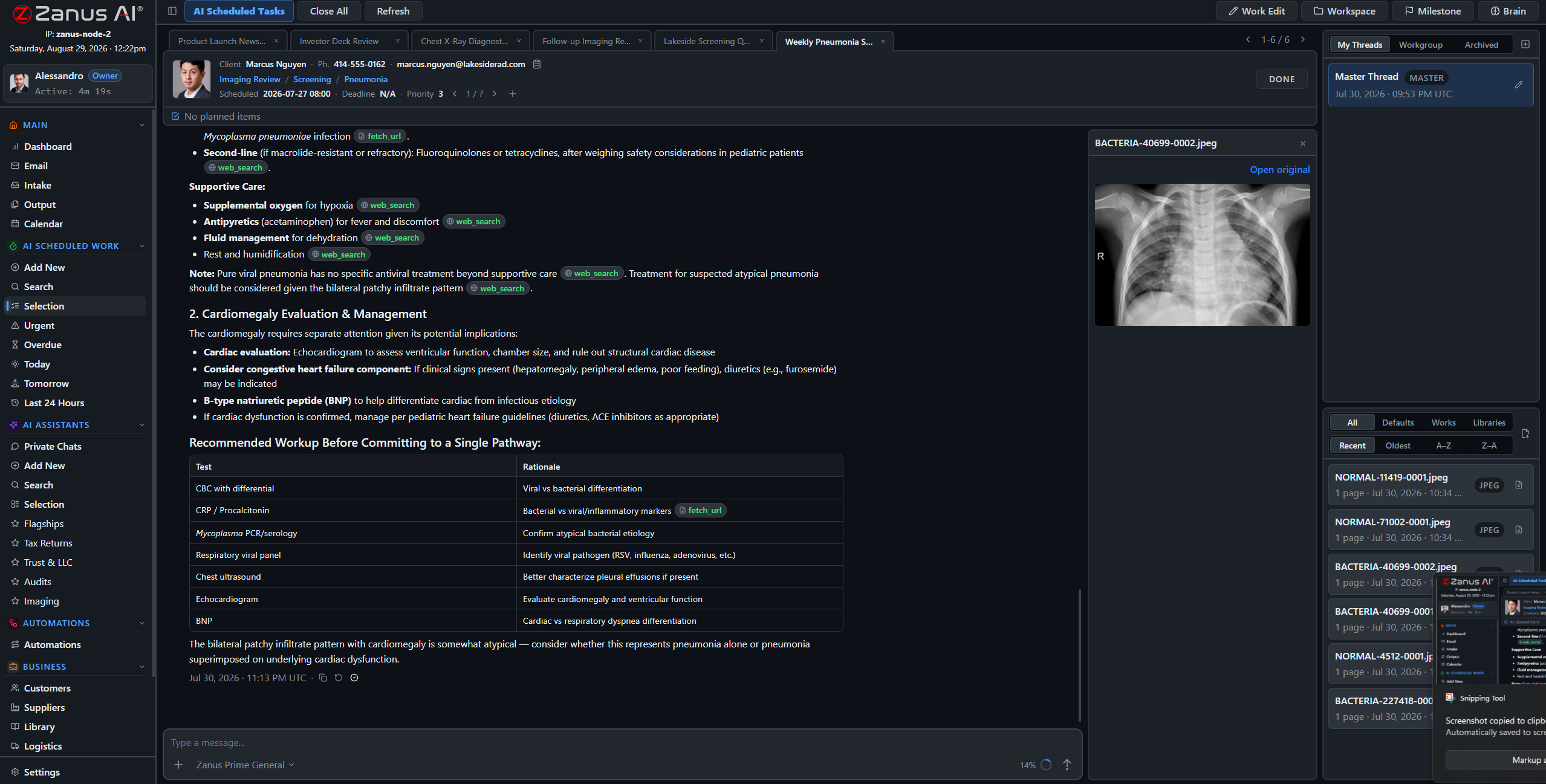
A real session: archive research compiled — clips found, timestamps cited, producer decides.
What it does
“Every time we covered the bridge project since 2015” — compiled with clips, transcripts and timestamps while the producer builds the rundown.
Story summaries, web rewrites of broadcast packages, newsletter digests and promo copy drafted from your own content — in your style, awaiting the editor.
Every AI-drafted script and summary lands in Output awaiting review. Nothing airs, posts or publishes without a human editorial decision.
Finding the exact quote in 20 years of footage
The mayor said something about the stadium financing — in 2011 or 2012, at some press conference. Type the question; the AI returns the matching moments across the archive, each with a click-to-play timestamp. The clip is in the editor by the time the old workflow would have found the right tape.
- Search by what was said, to the second
- Click-to-play timestamp markers from results
- Transcripts attached for quoting and fact-checking


The paperwork of production — drafted
The documents that eat producer evenings: rundown research packets, web versions of broadcast stories, episode metadata, coverage summaries for the news director. Drafted in minutes, from your own content, in your templates.
- Your style and templates
- Source clips cited in every draft
- Approval workflow before anything publishes
Questions, answered
Does the AI write our journalism?
It drafts and researches from YOUR content — summaries, rewrites, metadata, archive pulls. Editorial judgment, verification and the decision to publish stay with your journalists.
Does it connect to our media asset manager?
API connectors integrate with existing systems; media and metadata flow through the intake pipeline under your handling rules. Bring your MAM to the demo and we map it.
YOU MIGHT ALSO LIKE
The Back Office executes. Who answers the phone?
Front Office AI picks up every call and chat — books, quotes, follows up, 24/7 in 40 languages. Watch it run a business like yours, live.
See it working on YOUR station — the demo IS the product.
ZANUS AI FOR BROADCASTING & MEDIA — ARCHIVE & FOOTAGE
Ask the archive. It plays the answer.
Footage archives, transcripts, scripts, rundowns, rights and licensing documents — loaded into curated libraries the AI reads from. Ask in plain language; get the answer with the source cited — and for footage, a timestamp that plays the exact moment.
Private tenant or your own servers · your whole team · your archive stays yours
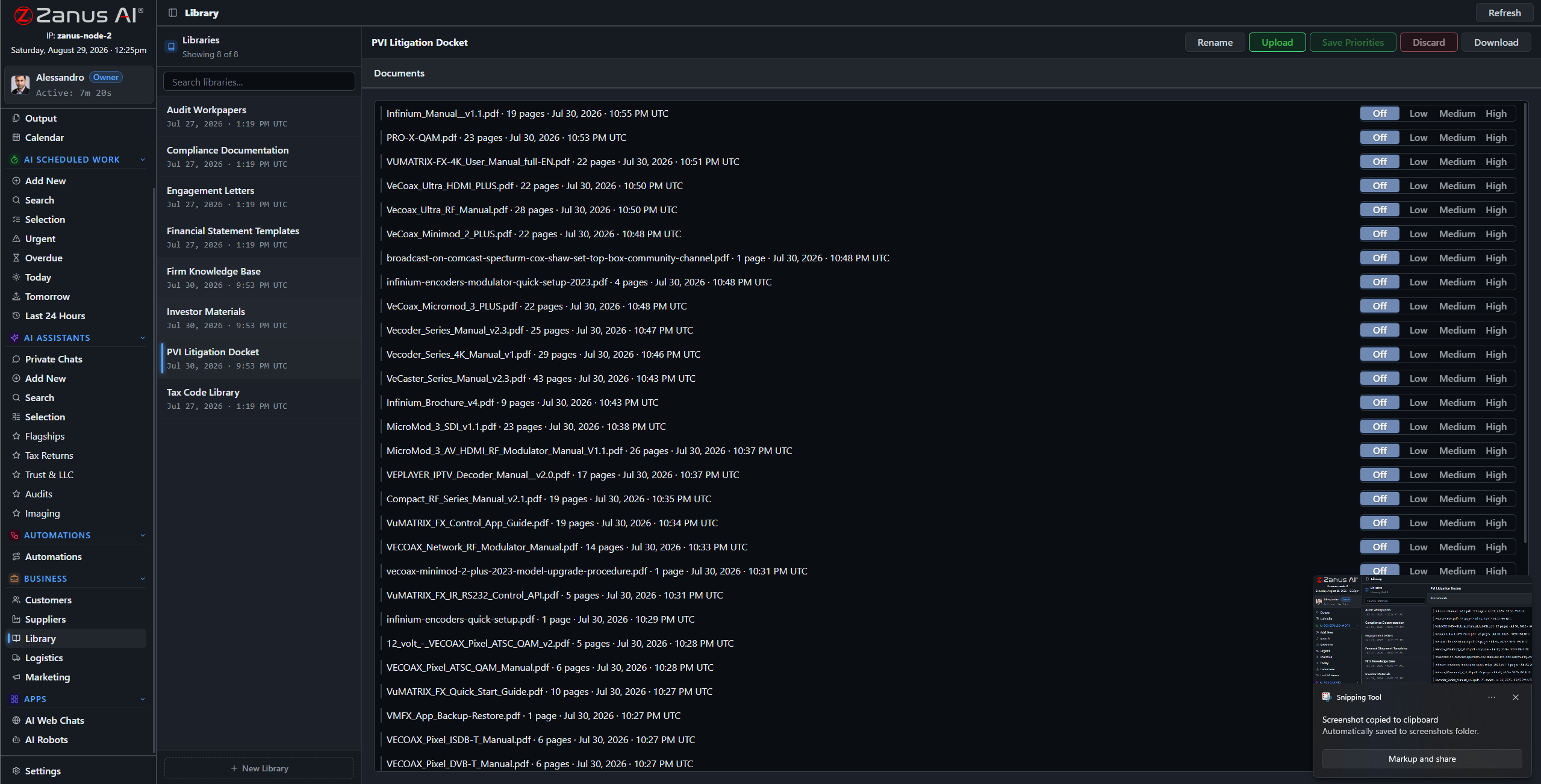
Libraries: aired versions outrank rough cuts, current rights terms outrank expired ones — you set the order.
What it does
Video, audio, scripts, scanned rights contracts and production paperwork — the ingestion pipeline turns what the station actually holds into queryable knowledge.
No source in your library, no claim: the AI cites the clip, the transcript, the contract — or says it cannot answer. Built for work that gets fact-checked.
The intern researching a story and the business manager checking a licensing term each get answers scoped to their role, enforced server-side.
Twenty years of footage, one question away
“What did the coach say after the 2014 championship?” “Which stories mentioned the refinery?” “What are the terms on the stock-footage license?” The archive answers in seconds, with clips at the exact second and documents attached — instead of an afternoon in the tape library.
- Plain-language questions across the archive
- Click-to-play timestamps on every footage result
- Priority order: aired versions and current contracts rule
Questions, answered
How does old footage get in?
Through the ingestion pipeline: digitized media is transcribed and indexed on intake. High-volume backfiles are exactly what the On-Prem Tokens Server is built for — ask about it at the demo.
Does our archive train outside models?
Never. Your tenant is isolated; your footage and scripts are yours alone — and the on-premises option keeps the archive physically inside your building.
See it working on YOUR station — the demo IS the product.
ZANUS AI FOR BROADCASTING & MEDIA — AI WORKFORCE
A researcher that never misses air.
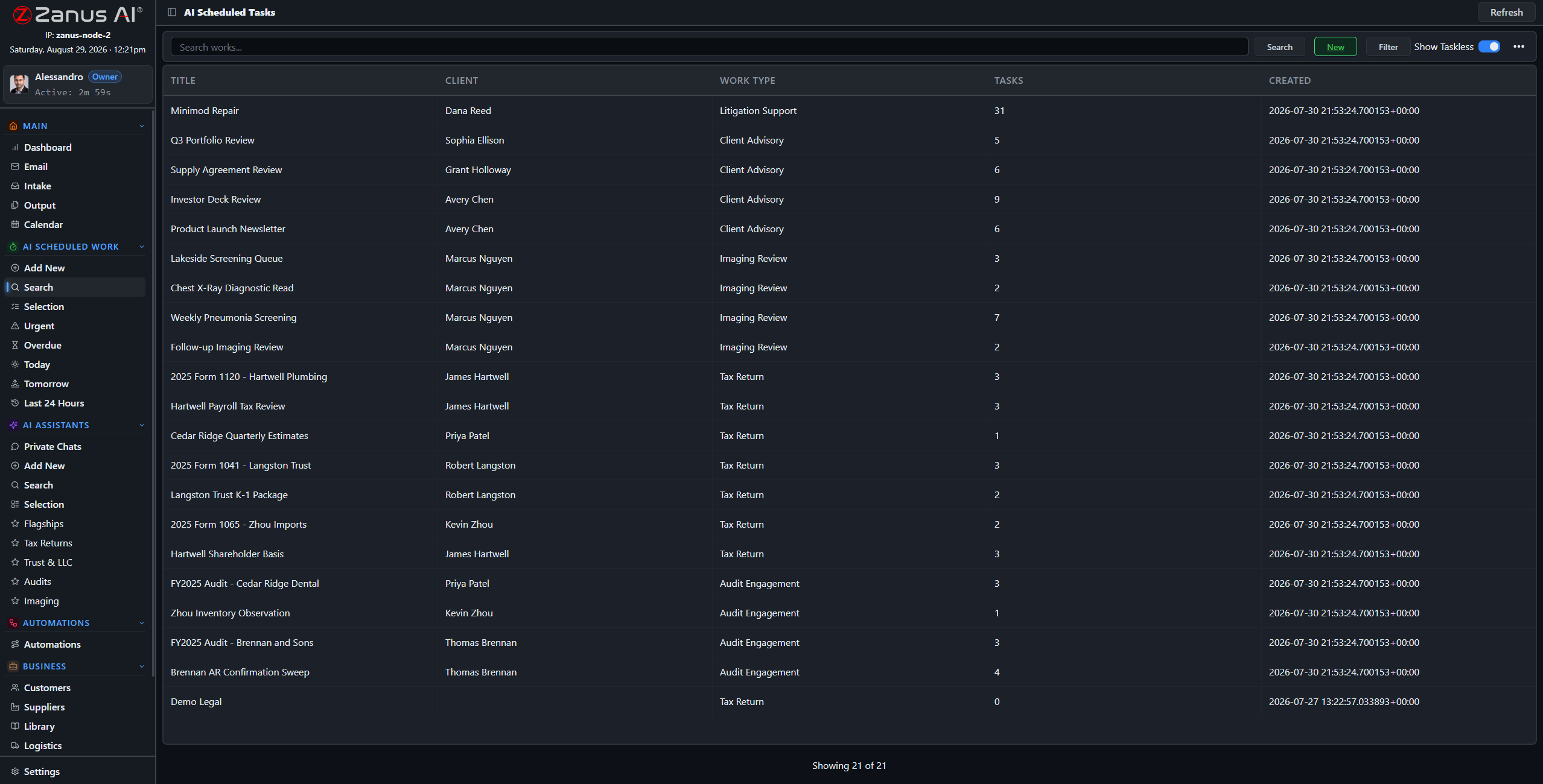
Assign work to the AI the way you assign it to staff: type, sources, deadline, priority. The morning rundown research packet, the weekly archive digest, the monthly rights review — executed on schedule, with citations, under review.
Private tenant or your own servers · your whole team · your archive stays yours
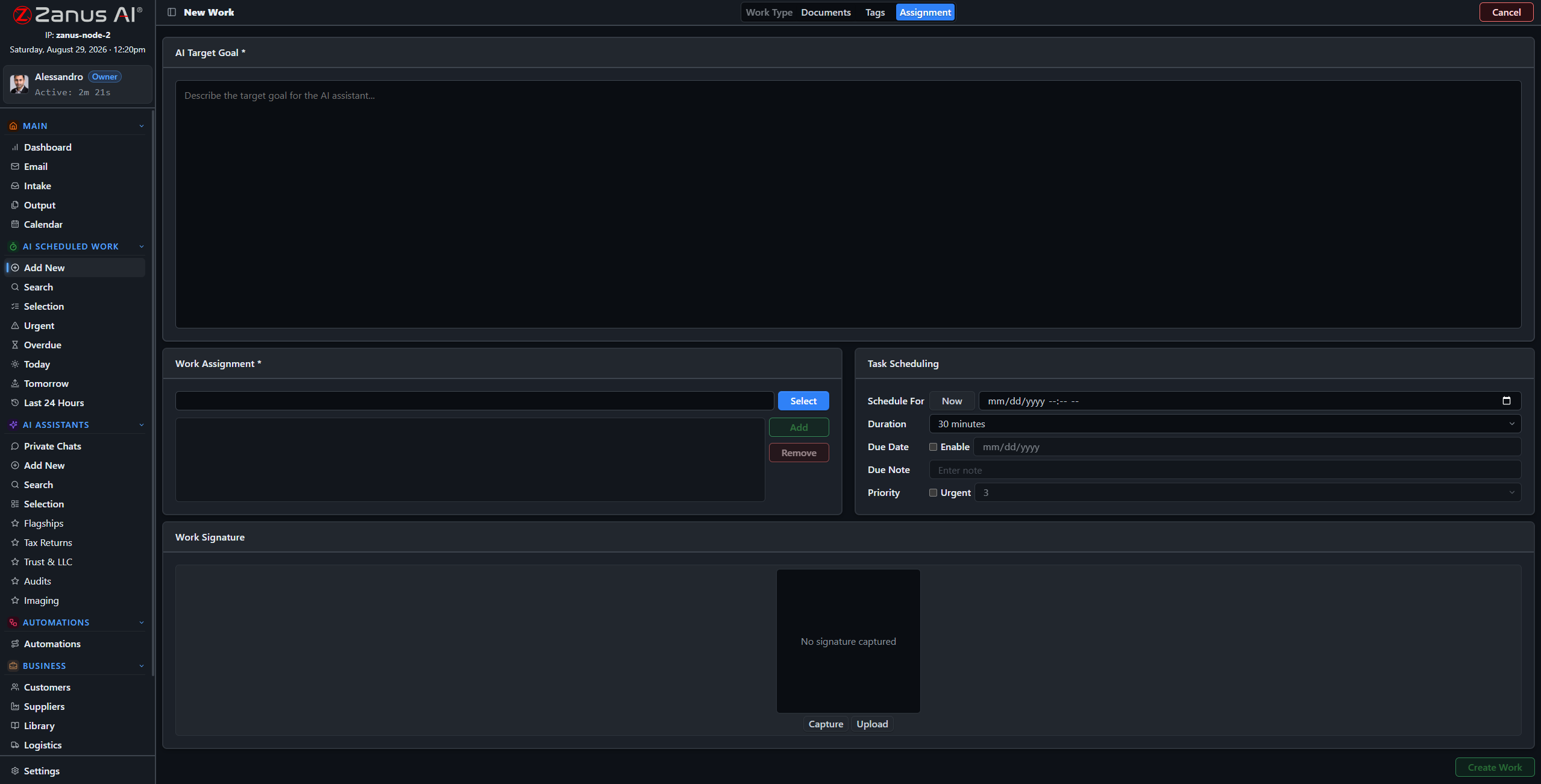
Four steps: work type, media and libraries, tags, schedule — the AI takes it from there.
What it does
Archive pull, script draft, metadata pass, rights review: work types molded to your operation, with default libraries and examples per type.
The AI’s workload is managed like the team’s: one-click views show what is urgent, late, today and tomorrow — nothing slips silently before air.
Every work is a full session: reasoning streamed, sources cited to the clip and second, milestones tracked, linked to the story and the calendar.
Every morning, 5 AM: the research packet is ready
Set “Daily Rundown Research” once: every morning the AI compiles what the archive holds on the day’s planned stories — prior coverage, key quotes with timestamps, background — and files the packet before the morning editorial meeting.
- Recurring schedules for daily production work
- Quotes cited to the clip and the second
- Packet in Output, awaiting the producer
Questions, answered
Can we supervise mid-work?
Yes — open any session, read the reasoning, redirect it, or stop it. The AI works like staff: visible, accountable, interruptible.
What volume can it handle?
It does not get tired: the constraint is your review capacity, not the AI’s. High-volume archives graduate to the On-Prem Tokens Server.
See it working on YOUR station — the demo IS the product.
ZANUS AI FOR BROADCASTING & MEDIA — STANDARDS & PRACTICES
The style guide, alive.
Standards only work when the newsroom can find them — at 11:48 PM, twelve minutes before the late newscast. In Zanus, editorial standards, style guides and operating procedures are living documents: answerable in chat, attached to work, priority-ordered so the current version always wins.
Private tenant or your own servers · your whole team · your archive stays yours
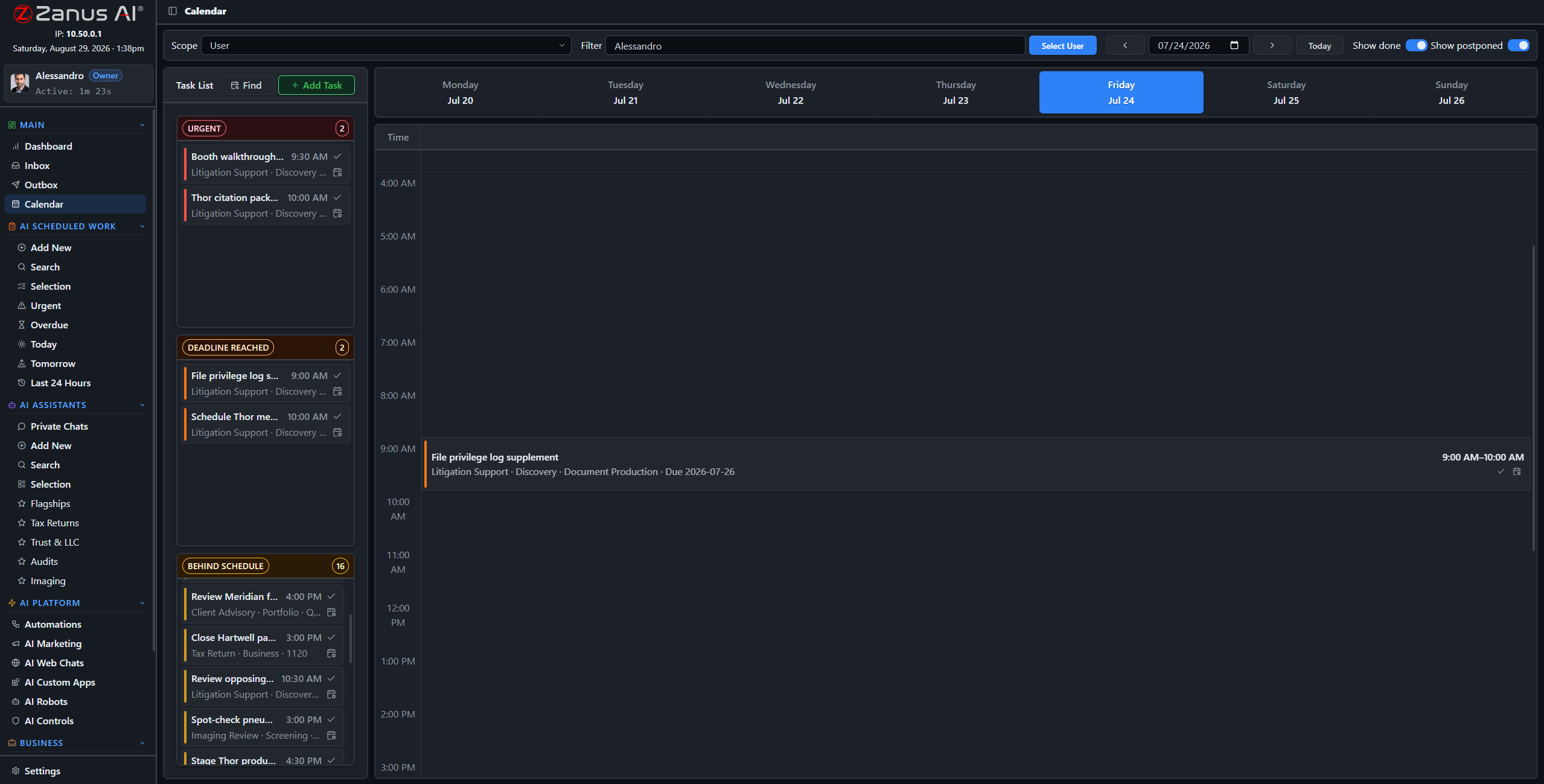
Standards upkeep, scheduled like production work: annual reviews and policy updates on the calendar.
What it does
Editorial standards, on-air style, corrections policy, ingest and naming procedures: one library, current versions on top, superseded drafts outranked.
“What is our policy on airing 911 audio?” — answered in seconds with the document attached, to the overnight producer as reliably as to the news director.
Work types carry their default standards: the AI drafting a web rewrite reads from the style guide — by construction.
Standards work, scheduled like a newscast
Annual standards reviews, expiration checks on licensing agreements, update summaries for the editorial meeting: assign them once as recurring AI work and the binder never goes stale again.
- Recurring review works with deadlines
- Update summaries drafted for editorial briefings
- Every review on the audit record
Questions, answered
How do updates roll out?
Upload the new version, set it on top: from that moment every answer and every AI work cites the new standard. Old versions remain archived for audit.
See it working on YOUR station — the demo IS the product.
ZANUS AI FOR BROADCASTING & MEDIA — TEAM TRAINING
Newsroom turnover without knowledge turnover.
Producers move markets, editors rotate shifts, the new AE starts Monday — and the workflow knowledge usually leaves with the veterans. New hires learn your workflows from the AI, and every shift has an assistant that answers “how do we…?” instantly.
Private tenant or your own servers · your whole team · your archive stays yours

Training lives inside the software: the AI walks each new hire through the station’s own workflows.
What it does
New producers and account executives learn your rundown conventions, naming rules, systems and policies through guided training — productive in days, not a ratings period.
“How do I file a corrections request?” — asked to the assistant at 2 AM, answered from the standards guide, without waking the news director.
Private chats work on any device with a login — the how-to knowledge follows the crew to the control room, the edit bay or the live truck.

The trainer that never tires of the question
The tenth “how do I request archive footage?” gets the same patient, sourced answer as the first. Training material stays current automatically, because the assistant reads from the same living libraries as everything else.
- Answers cite the current procedure
- Personal preset assistants per role
- Training progress visible to managers
Questions, answered
Does training content go stale?
No — the assistant answers from the live libraries. Update the workflow document once and every future answer updates with it.
See it working on YOUR station — the demo IS the product.
ZANUS AI FOR BROADCASTING & MEDIA — AUTOMATIONS
The station’s repetitive work, set once.
Describe the job in plain words — “when new footage lands, transcribe it, draft the metadata and file it to the right library” — and it becomes connected blocks on a canvas, running on its own, with every run visible.
Private tenant or your own servers · your whole team · your archive stays yours
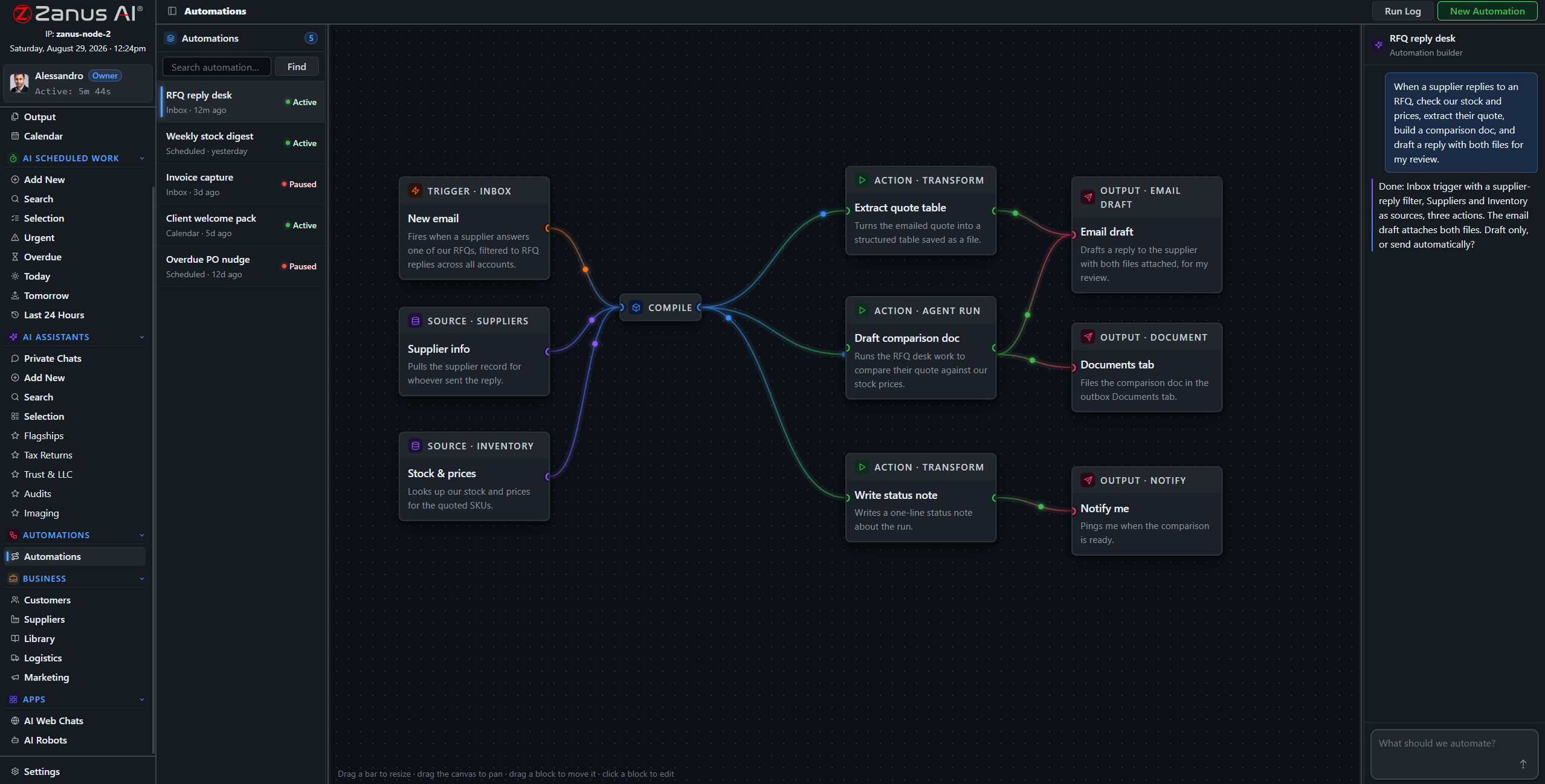
A real flow: ingest trigger, archive sources, AI compile, outputs — drawn from a description.
What it does
New media arrives: transcribed, metadata drafted, filed to the right library with the naming convention applied — searchable to the second by the time the editor sits down.
The morning coverage digest, the weekly web-performance summary for the news director: compiled by the AI, filed to Output, on time every time.
A sales inquiry with no response in three days triggers the follow-up draft — in the advertiser’s language, queued for the AE’s approval.
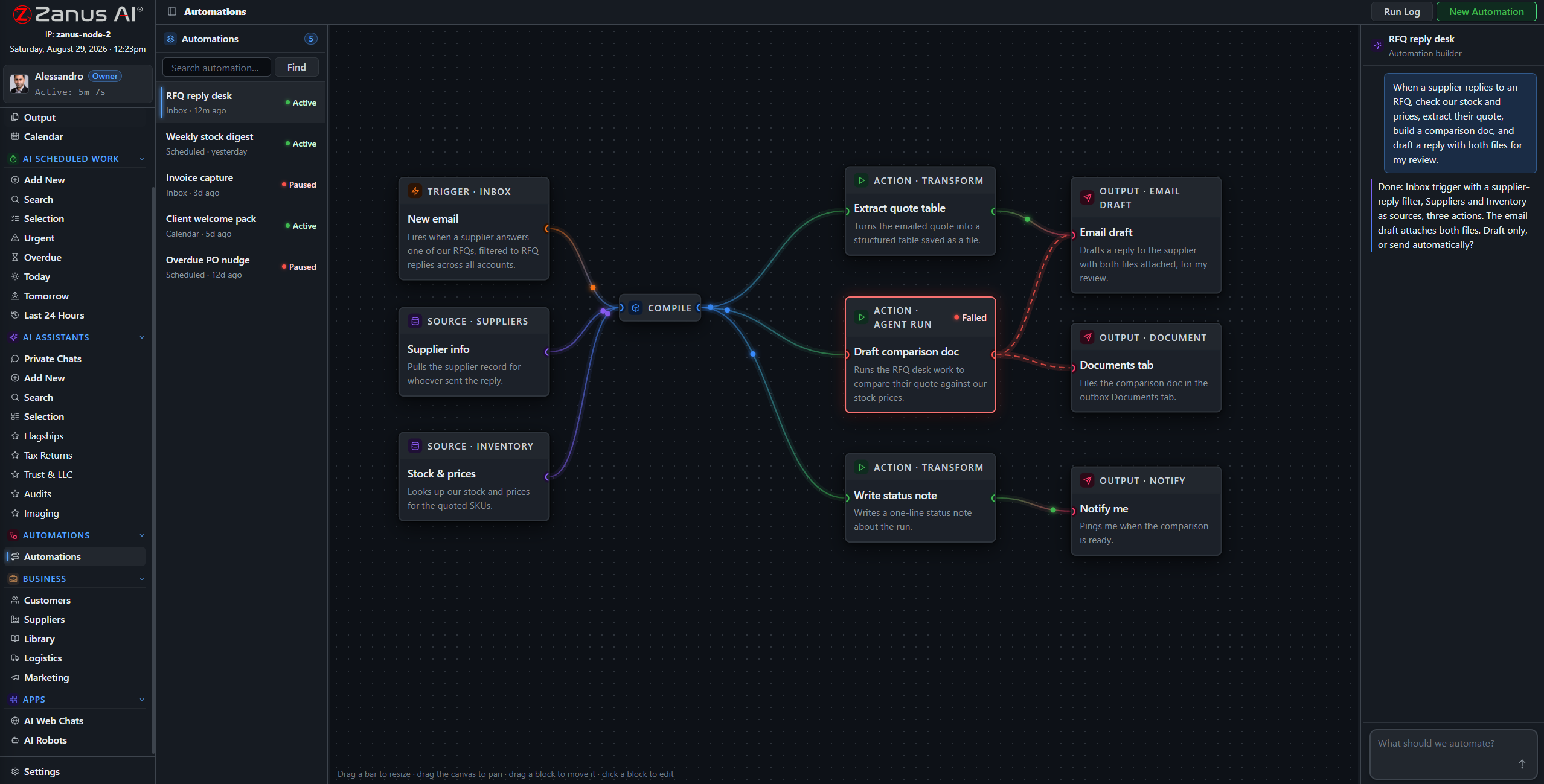
When something fails, you SEE it
Run states live on the flow: green success, red failure on the exact block. When the morning packet feeds the editorial meeting, silent failures are not acceptable — here, nothing fails silently.
- Run log per automation
- One-click retry on failures
- Finished documents in Output, statused
Questions, answered
Who approves what publishes?
Your rules: everything editorial queues for human approval. Auto-run is for internal work — transcription, filing, digests — not for anything that airs or posts.
See it working on YOUR station — the demo IS the product.
ZANUS AI FOR BROADCASTING & MEDIA — AUDIENCE ENGAGEMENT
The audience relationship, worked daily.
Audience newsletters, program promotions, event announcements, advertiser communications — drafted by the AI from your own content and records, queued for your approval. A promotions department’s output, whatever the department’s size.
Private tenant or your own servers · your whole team · your archive stays yours
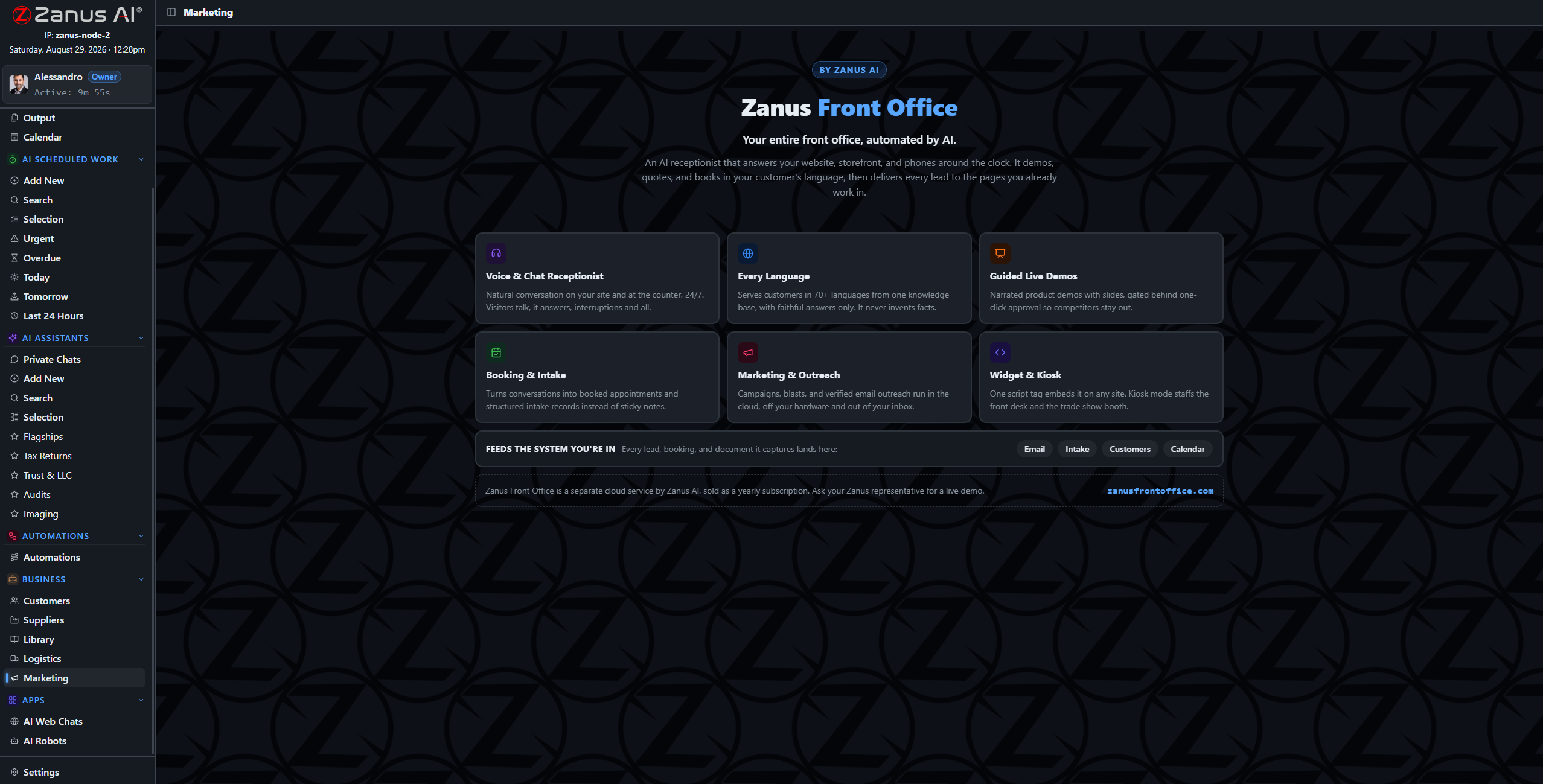
Campaigns and sequences drafted from your content — newsletters, promos, advertiser notes — awaiting approval.
What it does
The daily headlines digest and the weekly program guide drafted from what actually aired — in your voice, with links, awaiting the editor’s approval.
Newsletter subscribers, contest entrants, event attendees, advertiser contacts: audiences built from your own categories — no exporting lists to a third-party tool.
Opt-outs and contact preferences are enforced by the system, not by memory. Every send is on the record.
From the archive to the audience, without export
The audience data, the content and the sending all live in the same system as your archive — nothing leaves your tenant to reach a mailing platform. “Send the anniversary retrospective to the full newsletter list” becomes a drafted, scheduled campaign in minutes.
- Audiences from your own data — private by architecture
- Campaigns and sequences drafted for review
- Advertiser follow-up sequences, approval-first

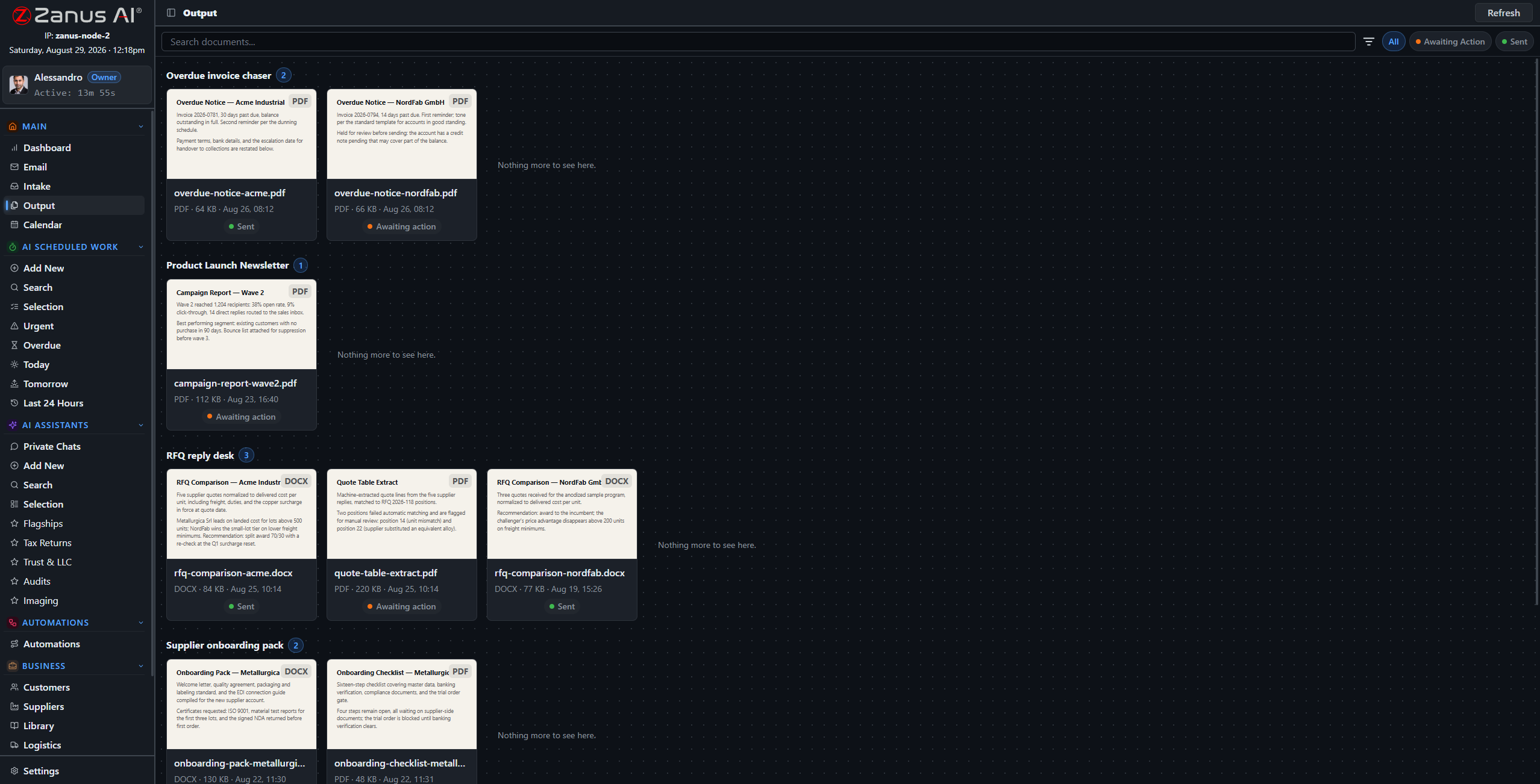
Approval first, always
Every outbound communication lands in the approval queue unless you designate the category as auto-send. The station stays in control of every word that carries its call letters.
- Approval workflow per communication type
- Full history of what was sent to whom
- Results tracked: opens, replies, bookings
Questions, answered
Can it promote tonight’s programming automatically?
It can draft the promotion from your schedule and content the moment the rundown is set — and your rules decide whether it auto-sends or waits for the promotions manager’s click.
Does audience data leave our system?
No. Audiences, content and sending happen inside your tenant — subscriber and advertiser data never travels to an outside marketing platform.
See it working on YOUR station — the demo IS the product.
ZANUS AI FOR BROADCASTING & MEDIA — MAM & INTEGRATIONS
Keep your MAM. Add the intelligence.
Your media asset manager stays the system of record. Zanus becomes the system of work: API connectors sync media, metadata and documents both ways, the intake pipeline transcribes and files what arrives, and AI-drafted metadata flows back where it belongs. No rip and replace.
Private tenant or your own servers · your whole team · your archive stays yours

No rip and replace: the MAM, traffic and newsroom systems stay — the AI layer connects to all of them.
What it does
Assets, metadata and rights fields mapped field by field, with a dry-run preview before anything writes — push, pull or two-way, your choice.
Advertiser records, orders and rate documents route through the intake pipeline — and the AI can draft the follow-ups and the availabilities summary.
A full API for whatever else the station runs: newsroom systems, playout, web CMS — data in, results out, under scoped keys.
One question across all your systems
The asset lives in the MAM, the order in traffic, the rights terms in the contract library — and the AI reads across all of it. “Can we re-air this piece, and is the slot sold?” becomes one question with one grounded answer.
- Field mapping with dry-run preview
- Each system stays master of its own records
- Every sync event on the audit record
- External systems appear as blocks on the automation canvas
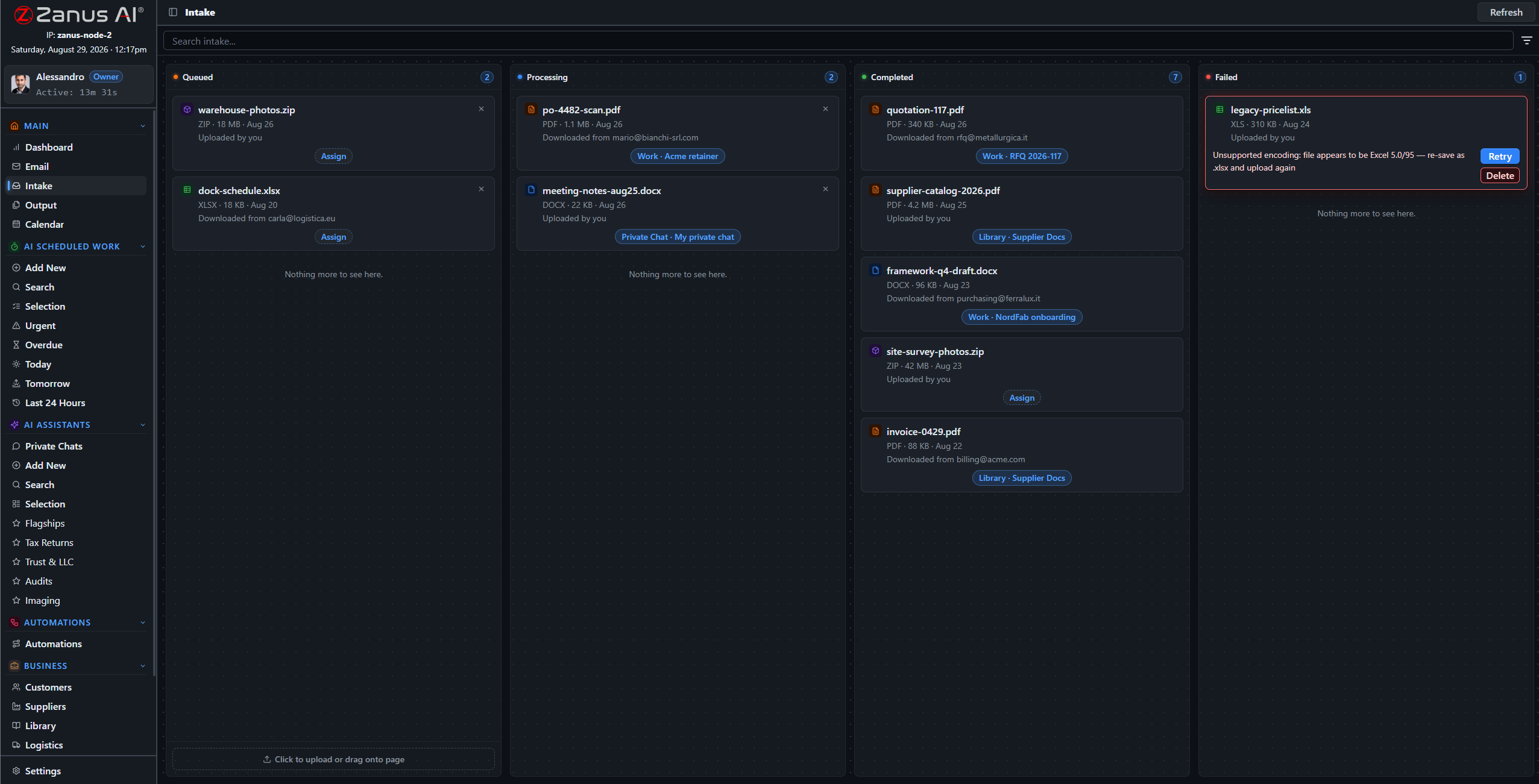
Metadata flows back where it belongs
The transcript the AI produced, the metadata pass, the rights summary: finished work returns to the asset record in your MAM through the same connectors — reviewed by your archivist first.
- AI output filed back to the MAM record
- Approval workflow before anything writes back
- Webhooks notify your systems in real time
Questions, answered
Which MAM platforms do you support?
Connectors are mapped per deployment — bring your MAM to the demo and we walk through the exact integration path for your system.
Does our media pass through third parties?
No. The connectors run inside your tenant — or inside your building on the on-premises option. Media moves directly between your systems.
See it working on YOUR station — the demo IS the product.
ZANUS AI FOR BROADCASTING & MEDIA — RIGHTS & CUSTODY
Built like the archive is the business.
Decades of footage, licensing contracts, talent agreements, unaired material: a media library is an asset and a liability at once. The answer is architecture: permissions to the field level, server-side redaction, a searchable audit trail, and an on-premises option where the archive never touches the internet.
Private tenant or your own servers · your whole team · your archive stays yours
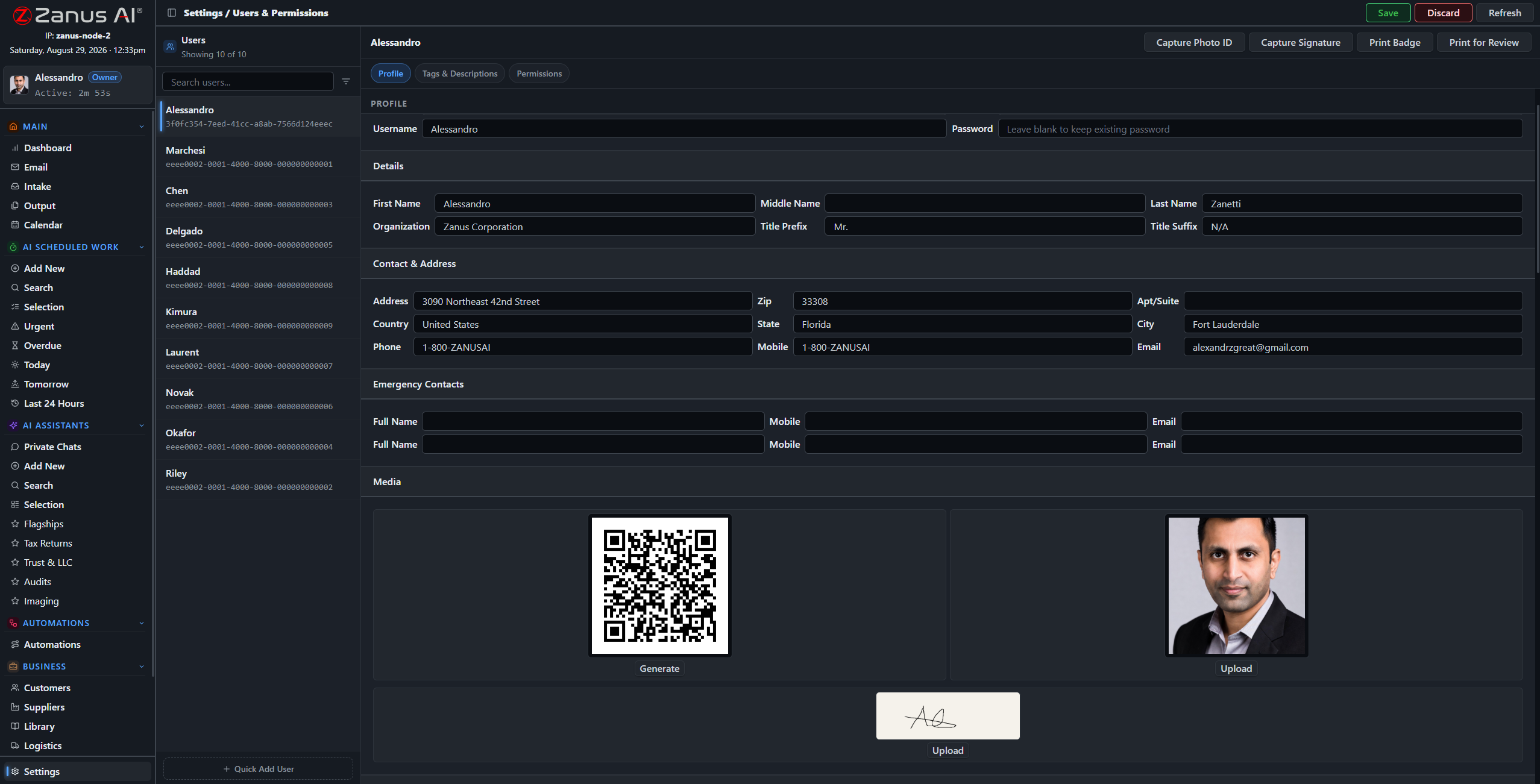
One record per user: role, tags, and granular permissions over every domain of the system.
What it does
The server redacts what a role cannot see — the intern searching the archive sees the aired material their role allows, not the unaired rushes or the talent contracts.
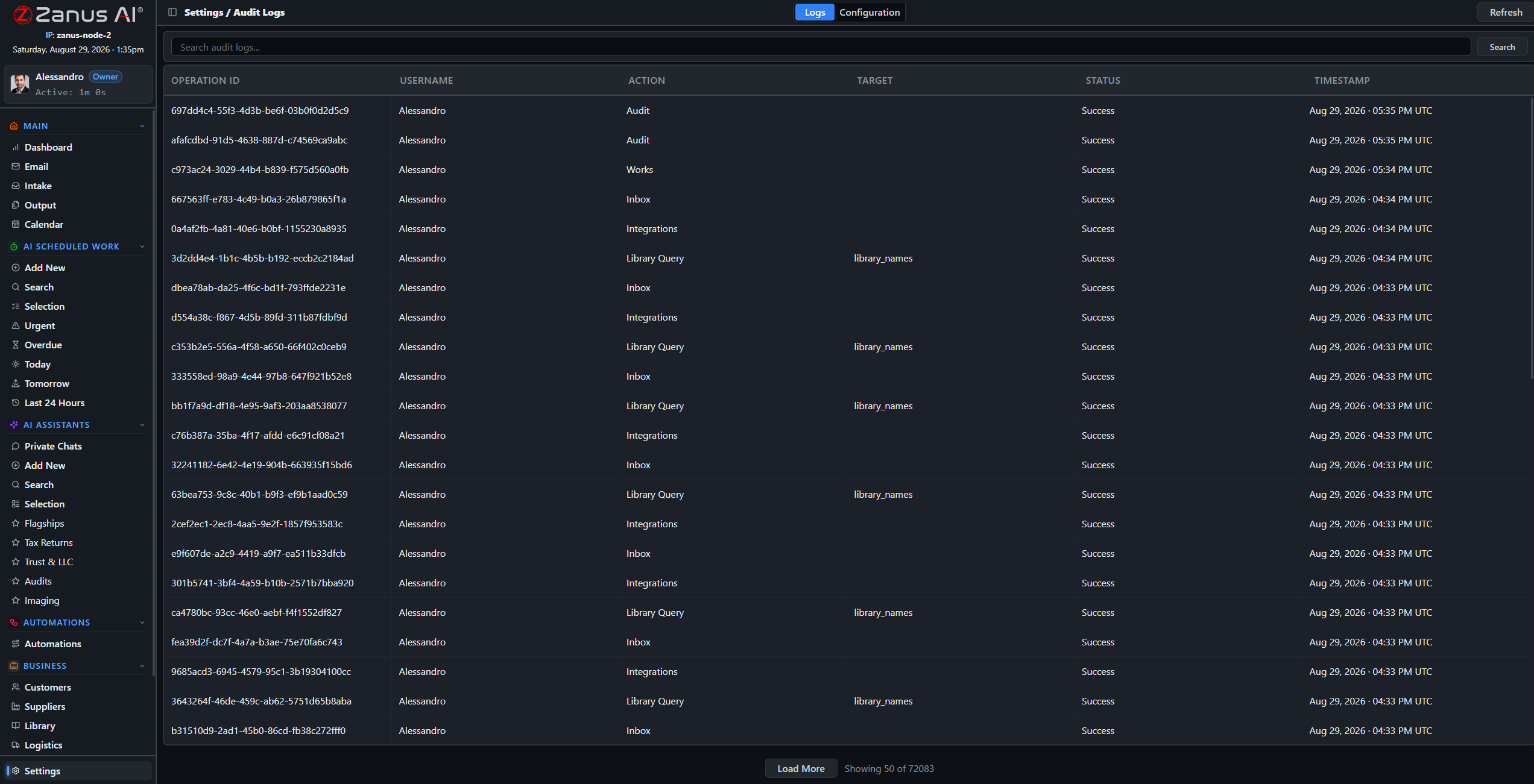
A searchable log of every audited action, with configurable categories: who pulled what clip, who changed what metadata, when.
Five-level workgroups map stations and departments; the on-premises option puts the whole system — archive included — inside your building, air-gap capable.
The rights question that takes minutes, not weeks
When the question comes — from a licensor, a lawyer or your own business office — the answer is a search away: the contract, the usage history, the access records, all in one place. Automatic pre-update snapshots mean even a mistaken change can be rolled back.
- Searchable audit trail
- Automatic pre-update snapshots with rollback
- USB updates for air-gapped deployments
Questions, answered
Where does our archive live?
In your isolated tenant — never training outside models — or fully on-premises on hardware the station owns, physically incapable of internet exposure.
Can it enforce rights restrictions?
Libraries carry handling rules and permissions to the field level, so restricted material only surfaces to authorized roles. Your rights workflow specifics are reviewed during onboarding — bring your business-affairs lead to the demo.
See it working on YOUR station — the demo IS the product.
ZANUS AI FOR BROADCASTING & MEDIA — LIVE DEMO
Do not watch a video.
Talk to your AI.
Big vendors show media demos as videos behind a form. Ours is the product itself, configured for broadcasting: open the chat below-right and try it — ask it to find a quote in the sample archive, draft a digest, or walk the advertiser workflow.
The conversation you have with us IS the demo
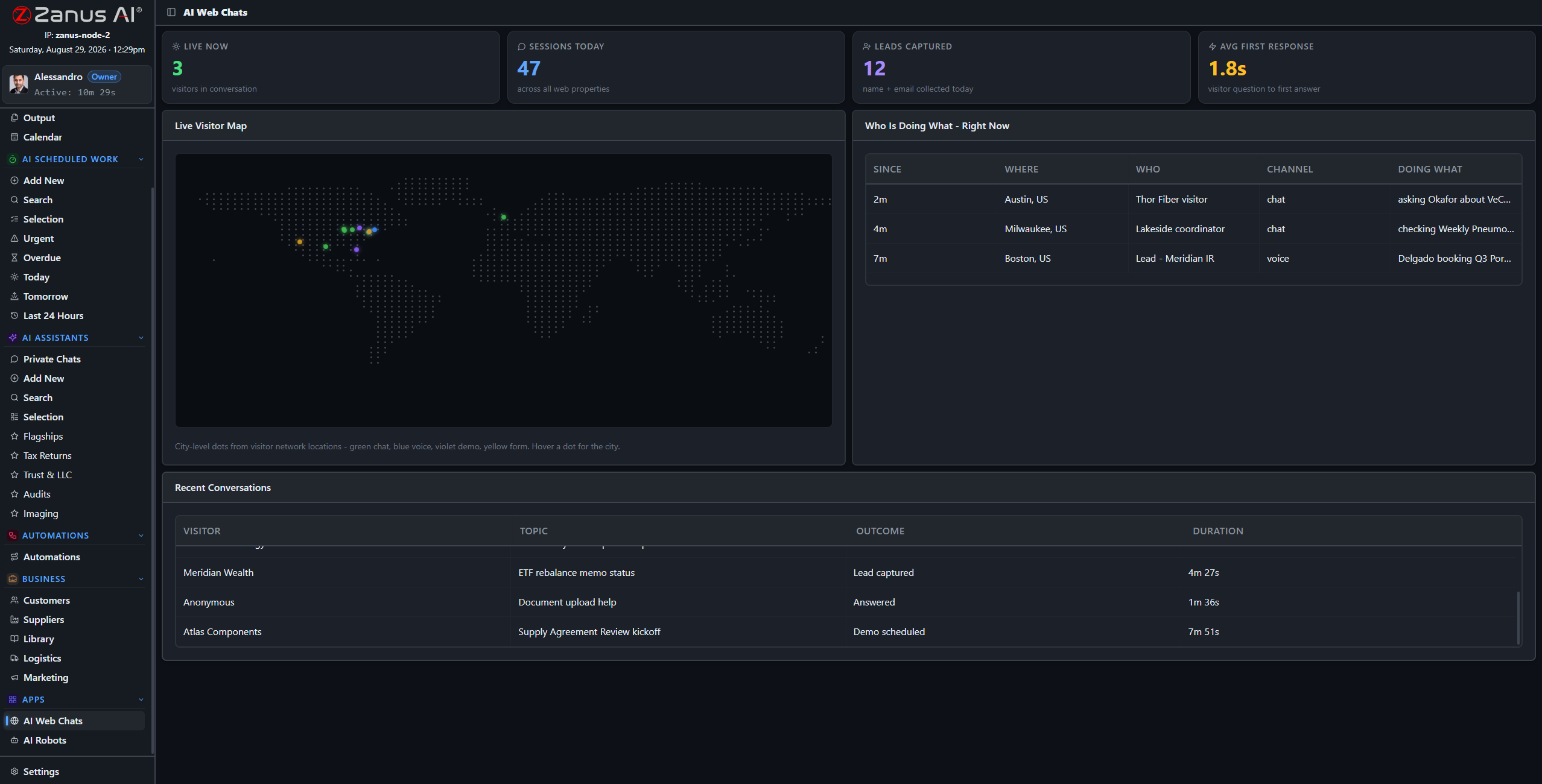
This screen is watching demos like yours happen: live conversations, outcomes, first response in seconds.
What it does
Ask the chat: “I want to advertise on the morning show” — watch it qualify the inquiry and offer the meeting like your best AE’s assistant.
Ask: “how would you find every mention of a topic in our archive?” — it walks the search-to-the-second workflow it would run in your tenant, timestamps included.
The full demo loads a media tenant with sample footage: archive search, digest drafts, metadata passes — your world, working.
Or pick your exact business
Every link below is a full live-demo page for that specific business — its vocabulary, its calls, its booking rules.
Two minutes to your inbox
Request the demo and the interactive media demo arrives in about two minutes — no sales call, no calendar dance. Watch it, interrupt it with questions, and book the human conversation when YOU are ready.
- Interactive demo, media-configured
- Ask questions mid-demo — it answers and resumes
- In your inbox in ~2 minutes, free

Questions, answered
Is the demo really the product?
Yes — the same AI, configured with a sample media tenant. What you see is what your newsroom gets, with your archive instead of the samples.
See it working on YOUR station — the demo IS the product.
Sharing with a colleague? 📄 Get the PDF · ✉️ Email this page ·